Crossing the Line

He is coming soon. I can sense it. He’ll be here before dawn, in a few more hours, just as daylight cracks on the mountaintops. Like warmth fading from a bath, I feel his coldness creeping steadily up the valley.  I’ve given word to the men to let him through unhindered, though he’ll never be out of their sight. 

My name is Michaelson. You’ve  heard of me. I’m the one they call mad. ‘Gone native’ was what they used to say about people like me. They say I’m evil, a sort of human tumor. I’m an object of hate. A mirror reflecting the darkness they fear. 

I no longer believe. 

They want to see me dead.  Five times they’ve sent their assassins up this valley. Always this time of year, as soon as the snows melt and the apricot blossoms cover the trees. Five times they’ve forced me to act. He who lives by the sword shall die by the same, my father used to say.  Evangelista, the one on his way, the latest assassin, will be here soon. Perhaps this time they will succeed. I am tired. My insides are eaten away. Perhaps I do have the madness. It is such a thin line. I’ll let you decide. But first let me tell you my tale. 

I came to Afghanistan after the big quake. Four, maybe five years ago now.  The villages around here were flattened–the landscape was a wasteland.  Houses which had once protected little children and animals had become murdering things, squashing, splitting apart and covering all living beings. Mountains slipped away as new ones rose from the earth. For those minutes of terror, the ground became as unstable as the sea, sucking everything into its swirling mouth. 

By the time I arrived, the first outsider, five days later, the survivors had crawled out from beneath the stones and earth, but they moved and blinked in slow motion.  They spoke in whispers as if afraid to disturb the mountains again.  Women wailed in silence for their dead. I had come with medicines, water pipes, sacks of food and gear of all types. Ready to rehabilitate the survivors, bury the dead and quarantine chaos from order.  The agency had sent me up to establish a beachhead against the forces of disorder and local helplessness.  It was nothing new. That’s what I do. I am an aid worker. A post-modern missionary. 

That was before. Now I am mad. 

My former colleagues, my co-religionists, who once praised and promoted me as a secular saint, now want me dead. Murdered is all right with them. I haven’t left the Wakhan, Afghanistan’s thin extended finger, since the quake. This is my home now, and these people are my family. I am safe with them, and they leave me alone. I ask nothing of them, but they give me all I need.  

My father was a man of the old religion who believed in the salvation of souls and the mandate of Heaven. But I gave my soul to another Faith. I became an apostle of Humanitarianism. A creed universal and acceptable to all. Infallible and intolerant of dissent.  My conviction in the Greater Good was no less strong than my old man’s had been in the Almighty. He had his Great Commission, given by the Spirit to spread the Word to every corner of the globe. We Humanitarians had the Imperative, given by ourselves, to ourselves, to feed the hungry, reconcile the fighting, empower the weak and to spread the new gospel: that the day of salvation was at hand once we arrived with our trucks full of kit, our experts full of knowledge, our bags of food, our tents and latrines. 

I was a true believer. One of the Elect.  If you wanted to make sure your program was a success, if you wanted to get a real mess cleared up, you got Michaelson. I cut my teeth in the Cambodian refugee camps in Thailand and in the dry lands of Ethiopia. Since then, I‘ve been spreading the gospel in dozens of places: Mogadishu, Kurdistan, Sudan and Guatemala.   Freetown in ‘97, Sarajevo in ‘92.   Great Lakes I and Great Lakes II. The biggest human disasters of our time.  I liked that they called me great. 

I accepted the agency’s call because they were paying well and because the Wakhan seemed about the farthest place from where I was: Angola, where I went cross-line. 

*** 

They flew me in from Brussels and didn’t let me leave Luanda airport.  Three pot-bellied big wigs, one each from the American Embassy, the European Union and the UN, briefed me for three hours in a huge room with grimy windows facing the sea.  Russian cargo planes and fat troop transporters skidded and roared down the runway.  The American is the only one I can still remember.  Dick Jaspers was who he said he was as he shook my hand; I can’t remember who he said he represented. 

I introduced myself but the other two didn’t say much.  The UN guy slid his card across the table like he was putting a deposit down on a dirty deal.  The European mumbled his name and took the notes. Jaspers, a former military man–I could read a hairdo–was in charge of the show. 

He knew my CV real well, and ran through it; for the benefit of the other two, he claimed, but I think he really just wanted to let me know how much he knew.  While he did, I stared out at the Atlantic and thought of all that oil beneath the surface and of the Indian diamond dealer who had sat next to me on the plane.  Angola was rich and a rich country in Africa is to be pitied. 

Jaspers stood up and with the aid of the UN man was blu-tacking a badly reproduced map of the country to the wall, making Angola look like a mess of spilled ink. There was a pocket of displaced persons, internal refugees, “right about here,” he said, moving his finger in a circle on the map. “In the Altiplano, the highlands. Rebel country.” There were, he reckoned, about 30,000 in Chitembo, 14 maybe 16, 000 in Cangote and an unknown number in the jungle between Vila Nova and Jamba. “About a hundred thousand, a hundred and a half, tops.” 

Naturally, Jasper and his friends wanted to get food and relief to these people immediately. The jungles of the Altiplano were thick and the roads completely fucked if they existed at all.  Most of the fighting was further to the west, Jaspers said, but mines were a problem and the fact that the DPs, the displaced persons, were spread over a space of several hundred square kilometres would mean this project needed strong leadership. “Which is why we insisted upon you, Michaelson.” 

I’d run similar missions deep in Zaire, before it became Congo. At least these DPs weren’t on the run moving deeper into the jungles like Hutus fleeing Rwanda. Setting up a camp is one thing but running mobile soup kitchens in the middle of a forest that hasn’t been penetrated in centuries is insane.  This operation, what Jaspers and these other two wanted me to do, seemed a cinch. 

The hitch of course was that it wasn’t.  Angola was not Congo. War here was a refined art; they’d been at each other’s throats, burning each other’s villages, stealing each other’s children, and violating one another’s women for thirty years without intermission.  Lines here were never crossed. You chose to work on one side of the line or the other. Either you worked with the government or you worked with United Movement for Angola, UMFANG. The rebels.  No question. Angola was an expensive place to operate out of.  Every agency had to run double programs. Like working in two different countries. People who worked in UMFANG-controlled areas never saw Luanda. And if you worked in Lobito forget visiting your colleagues in Caimbambo, just thirty klicks up the pike.  The country was stained in hate and distrust and we agencies began to act that way too. You distrusted your sisters and brothers working across the line. You despised them. Hate grew inside you like a hungry worm. 

Jaspers was saying that this project was unique and innovative. Cutting edge was the phrase he used. This was the first cross-line operation ever attempted in this country.   

“The front lines in this area,” Jaspers was tracing his finger down a river and then inland and then back towards the river, “are always shifting.”  Because the DPs were stuck behind both lines and because the armies were so close, they were pretty freaked out. Constantly moving a few miles this way and then back the other direction. They were getting pretty weak; some had already died from desperation. They need help, Jaspers said, but no one was willing to set up a program across the lines. Too risky. Who wanted to lose all their vehicles and supplies? No one wanted to put the lives of their staff at risk. The government troops up in the Altiplano were the toughest; they had been given liberties, a different rulebook, than their fellow soldiers in the lowlands.  

“I thought the DPs were in rebel-controlled land,” I said to Jaspers, still looking out at the black ocean. 

“Some of them are. Chitembo is a UMFANG town. Vila Nova isn’t. Cangote goes back and forth, depending.”  

The European kept taking notes. The UN just nodded. 

“Depending on what?” 

“Things.” Jaspers wasn’t a smoking man ,but he looked like he could use a cigarette.  I turned away from the window to look at him. He had sat down next to the UN man and for a moment avoided my eyes.  I waited. 

“Hell, I’ll level with you, Michaelson,” he stood up again but then sat right back down. “This is Angola we’re dealing with. It’s different here.” 

“What are you telling me?” 

Angola, he said, was not just another screwed-up African backwater ala Somalia. There were things at stake here. Lots of things, like wealth and influence, for example. Oil and diamonds. Coastal waters thick with fish and the richest soil in Africa. Angola was prime real estate. South Africa right there, Congo to the east. French, British and American oil companies had been here for decades, but they had never been allowed to truly exploit the black crude because of the fighting. The time had come, Jaspers said. The world wasn’t prepared to stand around any longer waiting for the government and UMFANG to settle this thing. “They’ve had 30 years already, for Chrissakes, and they’re no nearer ending the war then when the Portuguese left in ‘75.” 

Angola needed development. But that just wasn’t going to happen, Dick Jaspers said, as long as the military situation remained as it was. One side had to get the upper hand.  Sure, everybody, the UN, the Europeans, we Americans, hell, even the Russians, were trying their damnedest to keep both parties true to the peace accord, “But to be honest, Michaelson,” Jaspers sighed, “there comes a day when you gotta draw a line.” 

I suspected there was more to come. 

“Since the last government offensive in November,” Jaspers was back at the map pointing at things, “UMFANG hasn’t been able to get back to Vila Nova. It’s immensely important to them, symbolically. Where their movement started back in the early sixties. A holy sort of place. But the government has the town locked up tighter than a you know what.” Jaspers coughed but didn’t smile; I was getting antsy. I could sense where he was leading but I just wanted the bottom line. 

The bottom line was that this was not your straightforward humanitarian mission.  Sure, the DPs, on both sides of the front line, needed assistance, but so did the UMFANG units in the area. If they could recapture Vila Nova, the government would suffer a psychological blow that just might bring the whole corrupt facade down like the walls of Jericho. 

What did they need me for, I wondered.  

“To make sure that the two programs go ahead with equal urgency but that the, ah…um, assistance to UMFANG segment doesn’t get out of the bag. There’ll be lots of publicity, media interest and what not, in the relief program ‘cause it’s the first time anyone’s attempted it across the lines. So that’ll be a natural diversion, so to speak, from the other operation.” 

The other operation, the guns for the rebels part. I raised my eyebrow and turned around and asked who was running that? 

Jaspers said not to worry. What he needed me to do was to keep the focus on the relief side of things. He and his sour companions wanted a perfectly run operation, something the media and the UN could feel proud about. Something so clean, so big, even Woodward and Bernstein wouldn’t suspect the shadow operation. “Can you handle it?” Jaspers asked. 

I know what you’re thinking: running guns and grain in parallel convoys, you got to be kidding, right? But what Jaspers had to say didn’t phase me. I’d seen the same thing done in Afghanistan in the early ‘80s and you’re looking at one of the Contras biggest fans.   You can’t swim in the river without getting wet.    

I could handle it, I said, as long as we kept a couple of things absolutely crystal clear. One, UMFANG kept Jaspers’ guns pointed at government soldiers and, two, they stayed out of the DP camps. As long as the Greater Good was being served, Jaspers’d have no problems from me. In this world things aren’t always as clear-cut as we’d like them to be. Making sure the rebels got a steady stream of weaponry may be a humanitarian act. Who knows? Depends which side of the line you look at it from.  

*** 

I set up base in Chitembo because it was the furthest settlement from the fighting and because the airstrip there seemed like it could be re-rolled quickly if we needed to. The few buildings that hadn’t been destroyed had no windows and were pock marked from bearing the brunt of thousands of artillery shells. Kids in tattered shorts and barefeet played on the rusting Russian tanks that lay half buried in grass and clay on the edge of town. The DPs were huddled close to the town to avoid the constant shelling in the jungles. Every building overflowed. Excess humanity  shivered under tin, or plastic, or shanties with leafy roofs. The highland colours are the only pleasant memory of the place I have. Wide blue skies, the burnt red clay roads, green green jungle, black faces. Red mangoes, yellow plantains, avocados by the ton. 

The little market started to grow again as soon as we arrived. The three camps around town and the market drew people out of the jungles like a magnet. Creaky lorries, with old tires bolted on the wheels, splashed through the puddles. Twisted, rusted metal-framed beds, scraps of blue plastic, roots, cassava, scrawny chickens and porcelain toilet bowls looted from the houses, were put on sale on the side of the road. That thin, skittish Congolese music flowed out of battered tape machines from morning till night. Chitembo was a carnival at the gates of hell. 

Jaspers found some Australian engineers and a slew of Irish nurses. We set up camps near Vila Nova and in Cangote as well.   Jungle was cleared, roads were bulldozed, latrine pits three meters deep were gouged into the earth, huge tin water tanks erected. Overnight six new villages complete with clinics, food stores, administrative offices, whorehouses and video halls sprung up on the outskirts of the three camps. We worked our asses off but when the camps were finally up and the displaced families issued with their ration cards you couldn’t help but feel good. The Europeans made sure we had all the money we needed, and those camps were the best I’d ever seen. Each time I drove through the camps with the kids jumping and hanging from the jeep, seeing the queues by the water collection points and nurses weighing the new babies, I tell you it was a feeling like a king. Almost divine. We had done it again. Drawn a thin line between madness and order.  

After an endless series of meetings and negotiations with government and UMFANG, both sides agreed to let our vehicles move freely across the lines. As long as we gave each side notice each morning and as long as we kept to the one radio channel they allowed us. There were teething problems, to be sure.  Government commanders tried to negotiate a cut of the food rations. Some of our nurses were detained for 6 hours by drunken UMFANG soldiers at a checkpoint, but they were just young boys having a hoot. Both UMFANG and the government were glad to have us in the area because our camps meant they could officially wash their hands of any responsibility for the displaced and concentrate on the real objective: continuing the war. 

I didn’t see Jaspers much once the camps were set up. On one of his trips up from Luanda he introduced me to the UMFANG regional supremo, Joao Batista Mulagu, a tall man with a wrestler’s chest who never removed his sunglasses and who wore a rubber shower cap under his blood-coloured beret. Once a week I’d travel out to his bush headquarters to be briefed on the ‘other’ operation. Whenever his people harassed us at the checkpoints, I reported it to Joao Batista, and he took care of it. He was always interested to know how the camps were running, and expressed his appreciation for the international community’s kindness to his people.   I wasn’t looking for a friend and only visited him to make sure his men stayed away from my camps. 

Commander Joao loved to smoke, and had a collection of smoking paraphernalia. One afternoon before the rains started in earnest, with the sky bruised all black and blue with heavy, threatening clouds, he pulled out his leather case and proudly showed me his collection of pipes, cigarette cases, lighters, worn leather tobacco pouches and Portuguese wooden match boxes, decorated with pictures of old Popes and the dictator Salazar.   

“In three days we go for Vila Nova,” he said, setting the case on the camp bed. We sat inside his large canvas tent drinking rum and warm banana beer.  Outside you could hear the low rumble of heavy lorries rolling through the camp; Jaspers’s convoy of arms, mines and ammunition.   

“Will you take it?” I asked. I hoped so. That would mean easier access to the camps around Vila Nova. I didn’t think, like Jaspers and Joao Batista, that the government was going to collapse if they lost the town but if the rebels managed to move the front line back towards the lowlands, that would give the DPs more protection. 

“We have the weapons this time,” Joao was tamping the tobacco into a large-bowled pipe.  “And the men are eager and brave. But in warfare you always need some luck.” He smiled at me from behind the veil of smoke that rose from the pipe with each deep pull. 

The rum was sweet but the banana beer rancid. I avoided the dirty glass of it that he had placed in front of me. I returned his smile but wanted to leave. 

“You have been good to us Mr. Michaelson, to my people. Without your camps we would not have been able to concentrate on our main goal.” 

“That’s what it’s all about, Commander Joao,” I said. I had no idea what it took to win a battle, whether luck played a part in victory or not. All I knew was that on this continent there were millions of people who needed help and that it was up to people like me and the nurses and our logisticians and engineers to save them.  Nothing would happen if we left it to the government of Angola or UMFANG. Without me and my people, his people were snowballs in hell.  

I finished my rum and lit a cigarette of my own. I stood up to leave. Commander Joao rose as well and put his hand on my shoulder. I bent my head and moved out of the tent into the humid, greying evening. Commander Joao’s pipe needed lighting too, so I held out my old Zippo lighter with the faded “HHH in 68” logo on it. His tobacco was nearly gone; he was having trouble getting the smoke going. But I was edgy and wanted to leave. “Add it for your collection, Commander,” I said.  “Good luck at Vila Nova.” 

A weak ray of sun flickered against his reflector shades as he waved to me. I drove out of the bush towards Chitembo. 

The assault on Vila Nova never took place.  The rains began to fall the night I left UMFANG headquarters and didn’t stop for a week. Floods were reported on several rivers and half of Cangote II camp was under water. One of my people radioed me to come as soon as possible but I couldn’t do anything till the rains stopped. On the ninth day after my meeting with Commander Joao, I took a driver and a jeep and headed down toward Cangote town. 

The road was rutted deep making progress slow. We kept the jeep in low gear, moving steadily forward lest we got bogged in the red gluey mud. It was a beautiful morning. The black clouds were far to the east hovering over the hills but on three sides we had blue sky and revealing sunshine making the water on the avocado trees sparkle. You had the feeling, as so often in Africa, of looking out onto Eden. 

At midday we had to turn off the main road because a bridge was out and a lorry had broken its rear axle and would block the way for days.  The higher we climbed into the hills the rockier the narrow path became but the less muddy. We made good progress. With my arm out the window I was enjoying the sun for the first time in days.   

Very few people were on the track. Most of the villages in this area had been forcibly evacuated years before. Both warring parties were desperate to ensure that no civilians remained to give succor or support to the enemy. The only people who lived outside the camps were the families of UMFANG fighters and the nuns who kept a watch over the churches and convents that lay in the shallow valleys like they were trying to avoid detection.  

The wet sunshine stung my arm and neck. The driver said that his sister was a nun at the convent of Donna Maria de Corrao, just a few klicks up the road. Could we stop and have some coffee? The difficult driving conditions had exhausted him. I said yes, but that we had to make Cangote before dusk.  I’d never been to the convent of Donna Maria de Corrao but some of my nurses visited the place every fortnight to deliver high protein cereal for the orphans. 

We could see the square steeple of the convent’s chapel with its huge white cross from across the small valley.  The driver moved faster, eager to see his sister and stretch his limbs.   

When we pulled into the gate a half hour later we realised that the chapel was the only building not destroyed.  Three long residential halls to one side, the school rooms behind the chapel and the shacks which housed the animals the nuns kept for food and milk were burned to the ground. All that remained were charred smouldering limbs of timber. All around the courtyard, strewn like cans of beer at a festival, were the heads and limbs of infants, small stuffed toys and grey and white pieces of the nuns’ habits. The sisters, their bodies contorted and twisted, some with the horror still on their dead faces, lay to one side.  Blood, like pink spray paint, covered the chapel walls and next to a mound of burned animal and human carcasses lay a Bible and a calendar photo of an old church in Lisbon.  

The driver walked through the carnage muttering to himself. He didn’t stop moving, just walking around and around in circles, whispering to himself as if he’d gone mad.  The government had been active in this part of the country. The front line was on the other side of the bridge that had washed out, but the convent was definitely on the government side. Dirty fucking bastards. 

The smell of death made my neck cold; my rage made me queasy. I was desperate to get to Cangote to protest to the government’s man. This sort of thing threatened our continued humanitarian presence in the area. I called to the driver who was still muttering and rubbing his fingers against his dry lips.  I would drive.  I started the jeep and was about to turn the wheel when near the pile of charred bodies I’d just come away from I saw something glint in the sun. I don’t know why but I got out of the car and walked toward it.  It was only a few paces away. I stooped to pick it up. A battered Zippo lighter.  

*** 

Jaspers couldn’t understand why I was leaving. I’d done, he said, such an outstanding job. Both operations were a success. Things were working out just like we planned. For once. 

I said I couldn’t explain. I had to go.  I caught the Sabena flight back to Brussels and then the quake happened. Sent eighteen villages and four thousand people under the ground. An agency I‘d done work for from time to time was surprised I was in town. Would I go? It was a humanitarian disaster. The worst thing to hit this part of the world since the last worst thing. Already they had raised a million and a half dollars without even trying. The victims needed food, medicine, shelter, the whole shooting match. 

You’re our man, they said. We pay well. 

I accepted. 

It wasn’t Angola that I was afraid of, or running from. It was the blackness.  Something had worked its way inside me at that convent, and it had begun to devour me from inside.   It’s still eating me alive.  The world ended for me at Donna Maria Corrao and I saw it for what it was. A conjurer’s trick.  The lid popped off, revealing nothing but an empty box. The curtain of the temple had been rent from top to bottom. Dunant was dead. 

That day when they said go to Afghanistan the people need you, they are suffering, I wanted only to cover the blackness. I flew to Islamabad and two days later, with a lorry loaded with pipe, chlorine, plastic sheeting, sacks of wheat and tins of oil, I jumped out on to a narrow mountaintop and surveyed the scene.  The agency had sent a Dutch administrator and a water engineer from Bangladesh as my team.  More would be recruited they told me, just get there now. It’s an emergency. 

It was too late that day to do anything. And that night I saw the dream. The same one I had had since my visit to Donna Maria de Corrao.  A vast landscape of devastation. Trees have been turned to stumps, rivers have run dry. Fields no longer produce paddy or wheat. People have shrunken into grotesque children.  The sky is red and purple and the giants on the earth are ghostly and silent. They reach down with pale hands full of food but as the ‘children-people’ reach up the food disappears and the hands throttle the supplicant’s throats.  Some ‘children-people’ do not come forward, preferring to cower in the shadows, afraid of and yet desperate for the attention of the giants of the land.  In the earth are scraps of tattered clothes, broken pottery, shards of glass and twisted striplets of iron.  It is ugliness.  I am observing the scene, unsure of where I am but with a warm sense of familiarity. I’ve been here. This is where I live.  

Slowly, a ‘child-person’ crawling on all fours approaches me. Its face is that of an old woman, wrinkled and ashen, but her body is of a nine month infant.  Her eyes are black and impenetrable but as she moves with such fragility I am not afraid. I look at her. She moves closer and reaches out her small, fleshy hand. In it is a shard of green glass and I am afraid lest she harm herself. I come close and try to remove the glass from her hand but now she is growing larger, more adolescent.  I reach for the glass but she moves her hand away and brings it to my neck. I know what she is to do. I don’t move. I feel the glass press against my skin and feel the vein pop as she cuts me open. She has now lost her child’s body and her face has become young. Her body is strong and adult and beautiful. She moves away and I see that the other ‘children-people’ have grown as well and the giants have disappeared.  I am alone and dying. The people have turned away and left me. 

*** 

The agency wanted to know what had become of the Bangladeshi and Dutch. Why did I not allow the helicopter to land?  How could I explain the lack of communications from my side? Why didn’t I answer their messages? Had I forgotten that there were people to be saved? The world had responded to helplessness and chaos once again. What the fuck are you doing? 

*** 

He’s here. I know he has arrived. Feel my him in limbs and neck. Here. They are cold. He’s brought the coldness. Even though it’s summer, I am shivering.   

It will consume the little of me that is left. 

They say I’ve gone mad. I’m the devil, is what they say. Michaelson is the devil. I’ve heard the reports. I know what goes on. Don’t think I don’t.  This one, Evangelista, the sixth emissary to come and collect me. Why should I allow him to get away? I can’t resist any more. I’ve tried. I’ve tried to forget. To cover the blackness. I’ve prayed to it and cursed it and pleaded and let my mind be ravished by it, but it is never satisfied.  There is no salvation. 

My father was a man of faith. I told you that, didn’t I. He used to warn me, but what son listens to his father? I remember his warning. I can hear it now: the devil comes as an angel of light. 

This is a story I wrote many, maybe 30 years ago. None of the people I shared it with liked it. They found it silly. I think its derivative and a bit too earnest. And pointless. But it was fun to write.

Were the Dark Ages really that bad? W(h)ither Aidland?

I’ve been scanning a few articles and posts on LinkedIn about the crash&burn approach to USAID of the new Trusk administration.  There are two broad schools of thought being advocated. 

The Insider School: this is the worst possible and most unfair action taken against an agency that strives to do only good. The hardship faced by many tens of thousands employee, contractors and implementing partners down the food chain is the main objection, with many expressing solidarity with this newly and unexpectedly large cohort of jobless humanitarians.  Suddenly everyone has the green halo around their profile picture; I’m Open to Work.  

Indeed, this is a shitful way to begin a new year.  I am not directly impacted by Trusk’s actions but suddenly my already slim chances of finding employment within the sector I’ve worked in my entire career are as close to nil as they can possibly be.   

Imagine a series of ponds connected by a stream.  The one at the top is full with just a few fish in it. The middle pond has lots of water but also a huge number of fish.  The stream has been silting up for time and some fish have been struggling to breathe for years. Yet, for the most part the pond has just enough water and oxygen to maintain the status quo.  In the third pond, the water levels are really low but the fish are smaller and seem to be able to do ok though they are constantly aware that the stream from the middle pond is getting dammed and blocked.  

Overnight the top pond is drained of all its water. In a panic, the fish there move into the middle pond. But this is not a solution because the largest feeder stream is dry and the pond’s water supply has dropped by nearly 50%. But there are a huge number of new fish to accommodate. 

In the third pond, fish are dying fast.  Not to mention the many animals surrounding the ponds that depend on the water to survive.  

It’s easy to understand the solution demanded by this group school of thought. Reinstate USAID and all its funding immediately. Turn the tap back on and let the water flow once more.  

The Opportunity School of Thought: This is advocated mainly by (many) fish in the middle and lower ponds. And fisheries experts who work at think tanks and write blogs. The basic argument is: the structure of the ponds and streams was inherently unfair and broken.  The top fish have always determined the quantity and quality of the water flowing to the lower ponds and for the fish in the lower ponds and the animals who depend on the water in the pond, the emptying of the top pond is probably an opportunity to rebuild the system so that it is more equitable. 

No one has yet articulated what a new system might look. The prescriptions are finely articulated statements of principle that have been echoing around Aid-Land forever. They all appear to ignore the cruel reality that we fish, and the animals we support, need water. And if we are going to support a lot of animals and really attack the problems that the animals face, we need lots of water for a long, long time.   

Ok, enough already of this silly analogy. 

The point is that large scale development and humanitarian responses require large volumes of money. And on a steady basis. Governments are generally the only source of such largesse.  Sure, there are billionaires and rich corporations but their interests are extremely narrow and self-serving.  The private sector will never be a reliable source of base funding for humanitarian or development work. 

So, I’m sceptical of the Opportunity school. Of course, if USAID is gone for good NGOs will adjust. Many will cease to exist altogether (not bad in itself); almost all will downsize, shrink their ambition and keep their heads down even lower.  But I’m not holding my breath for a new government led aid infrastructure and financing system to emerge that will be better than the one we love to hate currently. 

And there is a lot to hate. Bureaucracy. Hypocrisy. Conditionality. Compliance over assistance. Risk transfer. Salaries. Bad CEOs with no accountability. Lack of diversity at the top. Recycled thinking. Opaque transparency. Salaries. Sexual harassment and abuse. Baked-in white middle-class privilege.  Over-weening earnestness. Commerical firms who market themselves as humanitarian but are profit making machines for shareholders. 

But the one thing, above all other things, that sucks about the aid business is the donor-implementing partner (be they big hairy international behemoths or a local disabled persons NGO in the south Pacific) relationship. Governments are not just the only viable source of sustainable financing for aid but they call the shots. Their Congresses and Parliaments put so many ridiculous conditions on the receipt of and spending of their funds that many NGOs spend as much time, if not more, filling out reports for donors to ensure they are not violating an ever-growing number of conditions, as they do actually helping actual people.  

For all our claims to be innovative and independent, we have always been beholden to what the State Department or Foreign Office wants.  

This doesn’t put me in the Insider’s camp. I sympathize with those who lost their jobs. Doing away overnight with such a major pillar of the Aidland superstructure will be nothing but disastrous.  And given how most countries take signals from the White House the impact on Aidland is going to be widespread and indefinite.  

I don’t have a solution but frankly I cannot think of any group that can replace government funded aid agencies. 100 Soros’ can’t compete.  I don’t see new scalable financing models emerging. Innovation will happen but at the local level only.  Like democracy, government funded aid is the best of many flawed systems.

The Golden Age of International NGOs and AID is well and truly over. Maybe the Dark Ages weren’t really so bad. 

The circle is Complete

We’ve completed the circle. We Americans have gone out into the world, seen what we’ve seen, come rushing back home slammed the door shut and fitted out the house with surveillance cameras, automatic machine guns, potbellied camo boys with tattoos that scream like John Prine’s* waitress, “Make America Great Again”, a moat slithering with crocodiles and snakes and a steel wall.  

We are ugly Americans again. Led by Mr. Uggers himself, DJT.  His Pestilence is assisted by a black shirted, Seig Heiling immigrant who fled Apartheid not because he opposed it but apparently because he sensed the USA’s soil was more fertile for such diabolic Dogebags** as he.  

They say JFK read the novel The Ugly American and felt shame. Soon afterwards he announced the Peace Corps. And created USAID.  Not so every child in Asia could have cotton candy every morning but because he and his bros believed the USA could win friends by being decent.   

Now his nephew sparks outbreaks of measles in small Pacific Island states.  

We’ve completed the circle. We Americans are ugly again.   

* His 1972 song, Rocky Mountain Time, goes:

I walked in the restaurant
For something to do
The waitress yelled at me
So did the food

**A brilliant turn of phrase from Jon Favreau, former speech writer for Obama, who coined it to describe the youngsters tearing down the Republic.

One Kalashnikov + two Kalashnikovs.

In 1996 I visited Afghanistan and Pakistan for an Australian NGO. The Taliban had just captured Kabul a fortnight earlier and thrust, very momentarily, the plight of everyday Afghans back into the international media’s spotlight. Given the current state of Truskland I think these voices are worth revisiting.

He was as new to town as I.

“I came here from Kabul the day before last. My name is Hashim.” He wore a hesitant smile and a blue waistcoat. He had been watching me walk up through the gardens and toward the street. “Will you make my photo?” he asked.

He posed with his arms across his chest and gazed away from the camera with a cinematic expression. I took his picture and asked what had brought him to Mazar-e-Sharif.

“My father told me to get of of Kabul as the Taliban are capturing all young me to fight. I’ll go back when my father tells me. I am staying in a hotel as I have no relatives in Mazar. Its very expensive. All day I sat here watch people in the garden. I sit and think but I try not to think of my family. We had a shoe factory in Kabul. But when the mujahideen came to power they stole everything. Now I am jobless. In Kabul I study English and also kung-fu. But now everything is closed. I don’t go out because it is too dangerous. I am Turkoman. The Taliban are against us. And the Tajiks and Hazaras.

“I saw Najibullah hanging in the street. It made me sad. None of these groups are Muslims. They only kill anyone who doesn’t agree with them. ‘Grow a beard!’ ‘Wear a hat!’ ‘Don’t go outside!” And if you disagree to grow a beard it is the end. For the last 5 years I have seen these people. They are not Muslim.

“See that man there, singing. He’s gone mad. I’ll go mad, too. I sit here everyday. I want to get out of here, to Germany or to an English speaking country but its too expensive.”

*****

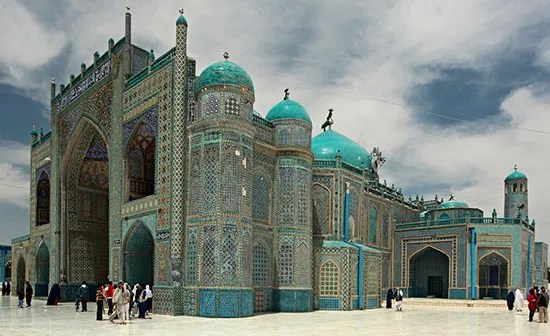
Blue Mosque/Tomb of Ali, Mazar-e-Sharif

“How is my English? I have been studying for two years but most foreigners do not like to speak with me. Why is that? One time I asked a foreign man what time it was. He told me, ‘Sharp 4 o’clock!’ That was that. He said no more to me.” Khaililullah spoke excellent English. He was a northern-Pashtun–dark, almost Indian in appearance. But he had born north of Mazar and had recently returned from over 10 years as a refugee in Pakistan.

“I teach English. In Monkey Lane. Will you come and visit our class?” I told him I would come but not today. Today I was interested in visiting the shrine of Ali, the grand blue-tiled mosque around which this desert town spills. I told Khalilullah how much I admired the mosque and its color. “You’re lucky to live so close to such a beautiful building.”

“By the grace of God we have a good leader. General Dostum. He used to be a communist but now he prays five times a day–he’s very good. And powerful. The Taliban are the trouble. They want to keep girls from school And this forcing men to pray in the mosque five times a day. Even our Prophet Mohammad himself only prayed 4 times a day sometimes So who are they to force us?

“Of course. There were excesses in Najib’s time. He gave too much freedom and too quickly. Especially to women. This corrupted us. Women went about barefoot–without shoes and wore nothing at all on their heads. According to Islam, a woman’s head should be covered. But not completely hidden. Both the Taliban and Najib are wrong. God save us from that much freedom. On the other hand under Najib, women and girls were educated and worked. That was good. So he was not entirely bad.”

Najibullah felt that the public hanging of Najibullah was inevitable. In his mind it was a justice of sorts for having allowed women to go barefoot and to be judges. But what he told me next I heard many times during my visit.

“Before they killed him they ordered him to sign his own release papers. He refused. He had denounced communism and discovered patriotism. He did not feel he had to confess to any crimes. But I know from an accurate source that he had memorised the entire Quran. But he refused to sign the papers confessing to anything. So they killed him. But in that, he was right. All Afghans respect Najibullah now. He wasn’t afraid to die. He was a true Afghan.”

When I visit Khalilullah’s school a few days later he refused to discuss anything except English and non-political subjects. “What do you call this?” he asked me, pointing to a shelf. He made not of my response, “A mantel.”

He and his fellow students discussed music and literature as if nothing was wrong with their country. The school had 600 students, women and men, learning English every day. “We want to prepare ourselves for the future. Today you must have knowledge of two things, English and computers, if you want to succeed.”

Jamil was adamant. “What do you believe will happen to Afghanistan?” Before I could respond he went on. “We are fanatics. This is no way to bring universal peace anywhere. And there is no way our people will talk. No way they can win in fighting either. I don’t know what will happen. This fighting will continue. All I know is that I will go to English class and then I’ll go home. Tomorrow? God only knows. Who sees beyond today? We are ready for anything though. My father is not a commander. We are civilians. We want peace and normality. Things like sports and music. My name is Jamil. It means beautiful. We want to help ourselves by learning English but our pronunciation is all bad. What do you think?”

*****

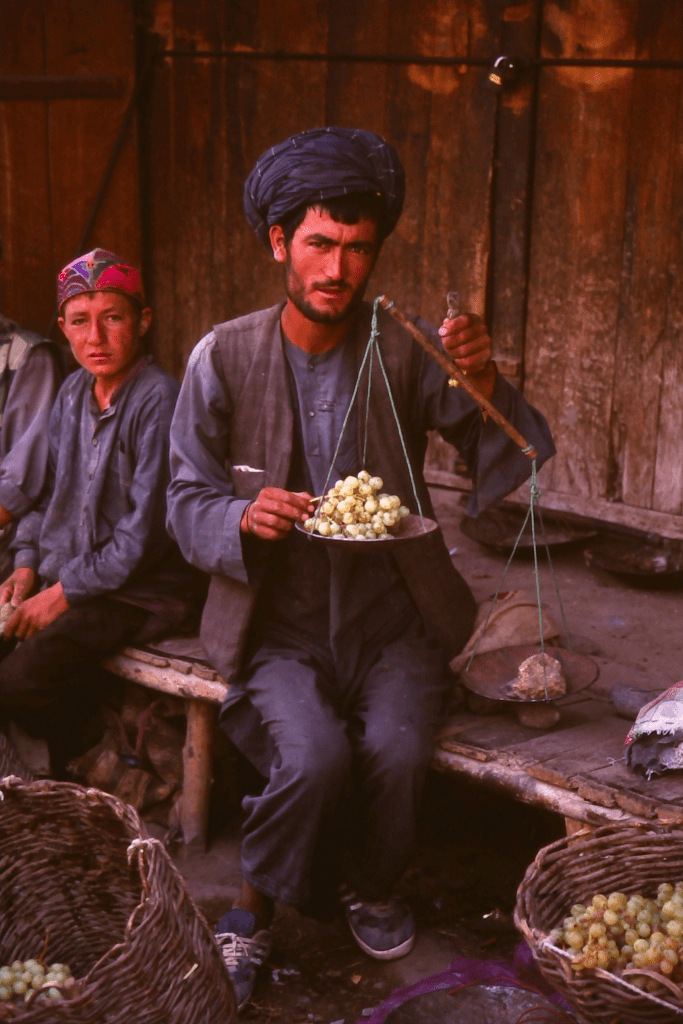
A Tajik grape seller, Faizabad, Afghanistan 1999

*****

“Welcome! Just have a look, no need to buy.”

The huge bearded Afghan stood beckoning to me from the doorway of his carpet shop in Peshawar’s Khyber bazar. It was a typical sales pitch but it soon changed when I enquired about the man who owned the shop next door. He was the son of a friend from Melbourne.

“You want to see Hamid?” he glared at me.

I nodded.

“Communisti!” The word hissed out of mouth like air leaving a tyre. His companions in the shop immediately turneds toward me and smiled sheepishly.

“Hamid is no good man. He is a foreigner. And communist. He supported Russians and speaks their language.” The man stumbled about for words to express his dissatisfaction with his neighbor. He spoke broken English and felt limited in what he could say.

“Communists. Uzbeks. Hazaras. Very bad.” He made a gesture with his finger slicing across his neck. “They are not Afghans. They are Angrez!”

I asked what he meant by calling Uzbeks and Hazaras, the most Mongol-featured of Afghans, Englishmen.

“He means they are foreigners. They have come to Afghanistan only recently. They are not true Afghans. We Pashtuns are real Afghans. The others are not. They are so small in number, not like us. Pashtuns are 60% of Afghan people. The others are only few. Miniorities, you know.” This man who spoke better English wouldn’t tell me his name but he did identify himself as working as a ‘spokesman’ for the Taliban office in Peshawar. “I know very well the Taliban. They are very good. They are against Communism and foreign domination.

“You see, we are refugees in Pakistan. It is not good for us to say that we want to control Pakistani politics of government. This is not our right. We should only sit quietly and do our business. It is not right for us to force our desires on the Pakistani public. And so it is with Uzbeks and Tajiks–though Tajiks are not so bad. But Uzbeks and Hazaras. They are refugees, not true Afghans. They came only in the last 40 years and now they want to dominate the whole country. But it is for us Pashtuns to control Afghanistan. This is our country. Uzbeks should return to Uzbekistan and Tajiks to Tajikistan. Why should they stay in Afghanistan?”

The bearded carpet seller broke in again. It is very dangerous here these days. Every day the Shi’a are attacking Sunnis. We must kill the Shi’a.”

Most Hazara Afghans, the poorest and historically most discriminated against of all Afghan minority groups, are Shi’a.

The TV in the shop began broadcasting an old Pakistani film romance. The men ignore me and lay down on the carpets in front of the TV. A woman danced through a rose and fountain garden to a lively folks tune. The men smiled as they watch the star dance.

I didn’t bother to ask them about the Taliban’s attitude toward women.

*****

The next day I had tea with an Afghan refugee family. They had come to Pakistan after the fall of the Najibullah government in 1992. They were secular, non-Pashtun Afghans. Educated abroad and middle class. For four and a half years they had lived in Peshawar.

The matriarch of the family, Hafeeza (not her real name) has lost a husband, two sons and two daughters. Her husband, a senior figure in the PDPA (People’s Democratic Party of Afghanistan), the Soviet-backed party that ruled Afghanistan from 1978-1992, was assassinated in 1989. Her eldest son and daughter were kidnapped in 1992 by triumphant and vengeful mujahidin in Kabul. “I have no idea why they were taken from me. These people hate everyone…especially people who they consider communists or Russians.

“My eldest daughter was a doctor. Since the day of her marriage I have not seen her. She may be dead. Or she may be living secretly someplace. But I’m sure she is dead because even if she was in Mazar or overseas she would contact me.”

Hafeeza had been the principal of a large school in Kabul. In Peshawar she had tried to get a job as a teacher but had been turned from every door, called a communist and foreigner. “I have even tried to have young children come here to our house for tutorials but parents forbid their children from attending because they believe I will teach them wrong things.”

She smiled ironically. Another member of the family took over. “In the schools here in Peshawar, which are controlled and run by the mujahidin and Taliban, Afghan children are taught to kill people like us.”

She puled out a text book which looked like any normal grade-school primer. Poorly drawn figures and large simple sentences filled each page. Instead of apples and kitten the lessons used AK-47s as object lessons. 1 Kalashnikov plus 2 Kalashnikovs equals how many Kalashnikovs? On the following page, a similar arithmetic problem used grenades.

“What will happen to our children? What is the future of our country if they are taught such things? They are taught to hate and kill. Their masters in school teach them that if they kill 3 Communists or kafirs they will become ghazi. No wonder they hate us. Our lives are in danger. We cannot get work and we are afraid to move about in the streets.” Hafeeza broke down.

The other family member told me, “Just six weeks ago, her only remaining son was kidnapped here in Shaheen town. He was going to an English class be he never returned. He had been threatened and warned by some bearded people a few times, ‘we know who your rather was. You are a communist and Russian.’ Hafeeza asked him not to go out but he was young and wanted to learn something. But now he’s gone and I’m sure he’s dead.”

Hafeeza stared blankly at the floor. Her only remaining child, a 19 year old daughter, comforted her mother, though she herself was in tears. “They do not go out at all these days. They are afraid after what happened. Who will protect us? We are not communists and we are not Russians. Our fault is we are not Pashtun and we oppose the Taliban. For this they want to kill us.”

The family has siblings and parents in Melbourne. But their repeated attempts to get visas to come to Australia have failed.

The final nail? Trusk do away with USAID

The decision by Trump/Musk to do away with USAID should be a development we are not surprised by. But I am.  It does not bode well for millions of people and communities around the world whose American tax-payer-funded assistance will cease. But its certainly, a huge nail in the nearly completed coffin of the aid sector as we know it. 

The move to disappear stand-alone aid agencies is not new.  Canada did it. Boris Johnson did it. And it happened here in Australia in 2013 when a pugnacious let’s-move-back- to-the-past Prime Minister mandated the death of AusAID.  

Everywhere it has happened it has had a similar effect.  The quantum and impact of the ‘aid’ decreases dramatically. Experts with decades of experience and knowledge are turfed out and replaced by graduates and bland bureaucrats with no interest in the subject matter. When Australia did its downsizing over a decade ago, the budget for international aid had been growing steadily and significantly every few years. Both parties, pledged to make Australia a good global citizen and set a target of .7 GNI (gross national income) to be the annual goal.  This would have taken Australia from a medium sized supporter of community development and humanitarian response to the major leagues.   

When Tony Blair became Prime Minister of Britain in 1997, he removed the ’Aid’ office from the Foreign Office and created a separate and well-funded agency which dominated the sector for the next 15 years. DFID, as it was known (Department for International Development) was very well funded, filled with recognised technical experts and championed new ideas. It was the thought leader of the global sector, respected by all for its commitment to addressing some of the inherent problems that exist in such an agency. 

USAID was the Daddy Warbucks of the industry. The agency with the deepest pockets, largest infrastructure and a pioneer in the financing of major infrastructure projects like dams and roads that were critical for countries to building their sense of nationhood and post-colonial economies.  It had its political constraints imposed by Republicans (no support to abortion or reproductive services, for example) but it was so big these things got lost in the shuffle.

As a kid in India, one of the regular features on the landscape were American men sporting crewcuts and white shirts running around in the most remote places laying the groundwork for or directing the building of such projects.  I attended school with several kids whose parents were in India or Bangladesh or Burma or Ceylon for a few years, working for USAID or the Canadian aid agency on these massive projects. 

It seems those days are now gone forever.  I lament not the white men and crewcuts or even the massive projects, but that governments no longer consider soft power and aid to be something of value. And the implicit if unspoken belief that poverty can be defeated. And that the ‘West’ has a degree of responsibility for taking steps to reduce that poverty and vulnerability. 

DFID is no more. BJ smooshed it back into the Foreign Office and its budget was stripped to support other brilliant schemes like sending asylum seekers to imaginary camps in Rwanda. And to support other underfunded Tory projects. Where if once was a beacon, Britain’s aid program, like so much else in the UK, is flickering candle in a rainstorm.  Canada means well but has lost its importance as an aid donor.   

Australia, flying high with billions of dollars and ambitious plans to support climate change around the world, is now a sick, in-house joke.  Rather than .7% of GNI, the aid budget represents .19% GNI! The lowest level since the 1950s! It’s important presence in South Asia, Africa, and SE Asia has disappeared. It’s only significant programs are in Papua New Guinea (former colony) and a few other Pacific Island nations.  Its priority is pro-business and infrastructure. Issues like public health, agricultural support, education support or humanitarian response is as thin as the storyline the politicos spin in front of the cameras. 

For well over a decade now, Interntional non-governmental organisations (INGOS) have been struggling to find a reason to stay alive.  This is a long and inglorious story of strategic blindness, consolidation and refusal to face the reality of a changing world.   In this way, perhaps Trump’s bull-in-a-China shop approach will finally bring on the crisis that will at last bring reality crashing through the cubicle partitions. That could be good. But the damage will be massive and the chances of it leading to anything but chaos and corruption, extremely low.

More likely what we will see is the aid budget going to support Trusk designed projects (Trump hotels in Myanmar, rocket ships for Kazakstan, oil drilling in South Sudan, shopping malls and data farms in Greenland). And huge disruption to the financial viability of INGOs around the world that have built themselves into large often-bloated institutions whose main source of revenue is USAID. Which is now shuttered. 

I just tapped in “USAID.gov”  

Stay tuned for further developments on this front. 

Letter from Dushanbe

Rudaki Square, Dushanbe

LETTER FROM DUSHANBE 
 
There are two things that could kill you in Tajikistan these days. The first is a massive earthquake. Tajikistan, the poorest of the former Soviet Central Asian republics with a population of six million, is the place where four major mountain ranges meet as the Indian subcontinent inexorably crushes and grinds northwards into Europe. You feel the earth tremor here almost every week: sometimes just a low quiver; at others a quick chiropractic snap that rattles your windows and creaks the walls. 

The second way you can be deprived of your life is to be slammed by a vehicle with tinted windows (could be a Jeep Cherokee, could be a tiny Lada 1500) whizzing dangerously through the shaded intersections of Rudaki Avenue, equally scornful of traffic signals and pedestrians as of the sour-faced militia that hang thick as bats along the main drags of the capital, Dushanbe. Not too long ago the odds on being kidnapped and then murdered, or shot in the crossfire of street fights were definitely better than the first two scenarios. 
 
So, on the face of it, things have improved in Tajikistan. Gangsters may be bad drivers but at least snipers aren’t drawing a bead on you when you go shopping. Tajikistan’s society fell apart the same moment the Soviet Union declared itself null and void. Seventy years of communist wall papering had done nothing but thinly cover the rifts that had been cracking across the landscape for centuries. Northern Tajiks, long the “blessed ones” of the political system began to squabble with uppity, uncouth Southerners. Democrats from Dushanbe and Islamicists from the isolated, honey producing Karategin valley joined forces against Communist party hacks. Ethnic Uzbeks, Russians and Germans were attacked, harassed and forced to quit the country. Fighting broke out in the streets of Dushanbe and carried on for five years. Tens of thousands of Tajiks fled into Afghanistan (could there be a worse place on earth to seek refuge?) as hundreds of thousands more became displaced within the country. 

Tajikistan, like many other recently independent states, is one of the lost nations of our world. Though not yet a failed state, Tajikistan is falling with increasing velocity towards the bottom of the misery stakes. It has always been a poor country and except for a couple of centuries a millennium ago, when Tajiks were the undisputed rulers of this part of the world, holding the northern borders of the first Islamic Persian empire, the Tajik people have always been lesser partners in the power arrangements of Central Asia. The fabled cities of Bukhara (ascetic and spare), and Samarkand (opulent and gregarious), are their proudest contribution to world civilization. But with the gradual loss of the northern realms to Turkic tribes the Tajiks were unequivocally usurped and subjugated to a life of cultural domination and political irrelevance. Until, that is, 1924, when the new Soviet state carved out a Tajik Autonomous Region. For the first time the Tajiks began to imagine themselves as a distinct national group. The Tajiks’ feelings toward the Soviet Union were, not unnaturally, largely positive. They were grateful for bringing them into the world. And being part of a sprawling powerful Union gave the tiny land-locked country much greater security and prosperity than it would have been able to acquire on its own. If there was any doubt about what their fate could have been without the Soviet Union, one only has to glance south of the border to the basket case called Afghanistan. Ten years ago, when Tajikistan followed the general trend and declared its independence the occasion was a cheerless event. Those once fond feelings have given way to bitterness and regret. The civil war that broke out almost immediately achieved little of positive consequence. The industry, farms and orchards of the most dependent economy of the former Soviet Union (40% of the budget had come in direct subsidy from Moscow) fell into utter neglect and disrepair. Nothing was produced and very little grown. Factories stood as empty as the revolutionary slogans that had suddenly fallen out of vogue. Bazaars were deserted. Restaurants were beyond imagination. Since an UN-brokered peace settlement four years ago Tajikistan has struggled to find its way in the big bad frightening world marketplace. It will be years before the people of this country enjoy the standard of living they had as Soviets when time extended securely into the future and holidays in Georgia were assured. 
 
Ten years after independence there remains little warm feeling for the capitalist, free market and democratic jargon their leaders mouth each day in the smudgy, thin, state-controlled newspapers. Hunger and poverty are growing in Tajikistan. The World Bank estimates that 96% of the people live on less than $28 a month. More than a third live on less than $5. Forty one percent of children under five years of age are seriously malnourished and weigh less than children their age in all except the poorest countries. Basic buying power is the issue in this country. Most Tajiks don’t have any. There is no work and what is available pays a paltry sum. Many agriculture workers working the old state and collective cotton farms have not seen a wage for three years. In most households outside of the capital (and increasingly here as well) the day’s meal is a loaf of round naan bread and tea. Russians, once the prime beneficiaries of the system, but now among the poorest, have taken to stewing dogs in some urban centers. Poverty can be measured in any number of ways. But if you calculate the degree to which a people’s standard of living has fallen (evaporated nearly overnight) then the collapse of most of the Soviet-dependent societies has produced one of the cruelest forms of privation. Recently I visited the home of a deaf pensioner who receives a small donation of American wheat flour and vegetable oil. The effects of a stroke twist his face. His flat, on the first floor of a concrete tower on the outskirts of Dushanbe, is shabby and dark. His trousers are pinned together and his shirt collar is worn; old spectacles off kilter. “I used to be a highly skilled type setter at a publishing house. Now all I can do is cry.” As I left the building I recalled what one man said to me when I asked him what he thought of the new world order. “The Russians used to say ‘We’ll screw you but then we’ll feed you.’ Now we are being fucked but there’s no food.” 

This piece appeared first on the blog Hackwriters in 2003

I lived and worked in Dushanbe, Tajikistan between 1999-2001. Dushanbe is the Tajik word for the second day of the week, (Tuesday) and was named for a historical weekly Tuesday market that had been held in the area for centuries. During the Soviet era the city was known as Stalinabad (1929-1961). With the ‘thaw’ that followed the death of Josef Stalin, the ancient historical name was reinstated.

Sometimes I Lie Awake at Night and Wonder

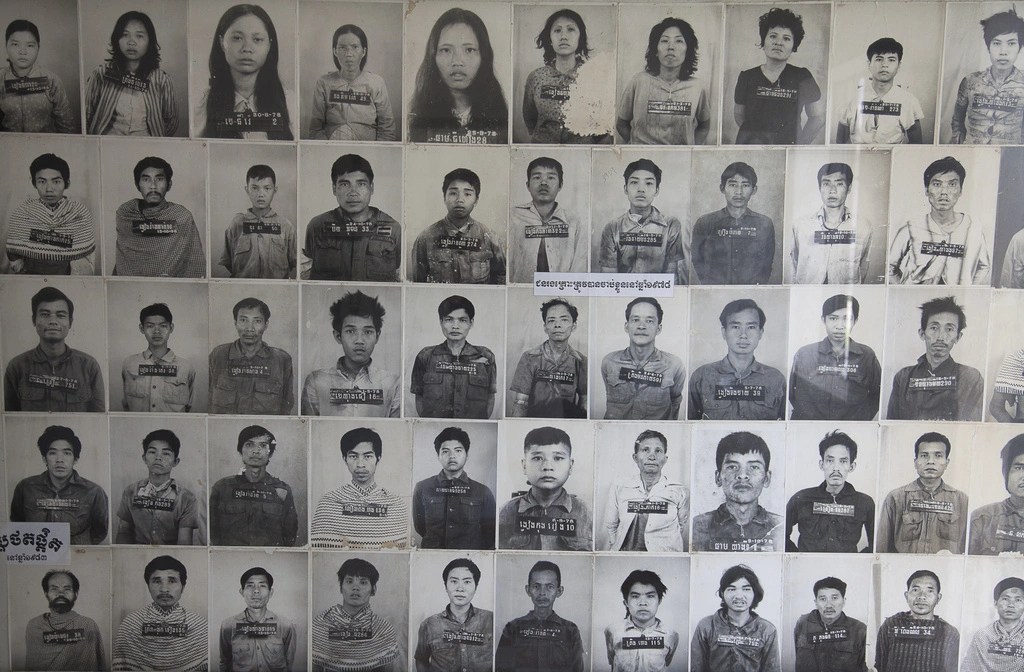
Some of Pol Pot’s victims, S-21 Prison. Phnom Penh

Tonight I’m in Phnom Penh and can’t sleep. I seem to always wake up at this time, when the day is still dark and the only sound is that of lazy thoughts shuffling inside my head. On the other side of the hotel window a boat bangs softly against the jetty.

It is windy and the monsoon is nearly at an end. I was told Cambodia is a land of dusty sunsets but I find the county resplendent with green paddy and the gurgle of the pale brown Mekong in flood. I expected, too, to meet a morose and sullen people. But the Cambodians are warm and can’t repress their smiles.

Throughout the town small but smart restaurants cater to the foreigners that work for the NGOs and UN agencies that finance and prop up the social welfare system of struggling countries like Cambodia. Banners pronouncing tourism as a ‘tool to build cooperation’ droop in the thick air. The tourists are back. Backpackers from Australia, packs of Japanese and most ominously, ugly aging men on the prowl for sex with young Khmer girls and boys. Cambodia is challenging Thailand as the premier destination for sex tourism. Such are the hairline cracks of a poor country’s development.

There is another macabre little industry in Phnom Penh centred around the horrific torture chamber known as Tuel Sleng or S-21. Tucked deep inside a residential neighbourhood the former high school transformed by the Khmer Rouge into a laboratory of evil, S-21 is a ‘must see’ for any visitor to Cambodia.  Along with the temples of Angkor, part of the grand tour.  Moto drivers call out to you, ‘Tuel Sleng. Look at Khmer Rouge jail’. You can buy T-shirts with disgusting recreations of faces behind bars on the backs.  They also sell bags and skirts made of bright Khmer silk right next to building B where Pol Pot’s most important enemies were kept in tiny wooden cages before being cut open like animals and fed to the demon, Angkar, ‘the Organization’. 

I certainly remember the name Pol Pot but his crimes were still unknown outside of Democratic Kampuchea in those years, 1975-1979. It’s an old story now, how this country was transformed, almost overnight, into a giant slave camp. Cities were evacuated and left empty and the population forcibly moved from province to province to reshape the face of the land. Canals were gouged out of the earth. Dams glued together. Millions of paddy fields planted. All done without the help of machinery, with only bare hands and fingernails. Machines were deemed impure and imperialist. Money was abolished as was religion, privacy and even talking. Democratic Kampuchea was a massive experiment in applied paranoia. The people were starved and then themselves became fodder: sustenance for Angkar. Hundreds of thousands, even more than one million, perished. There is not a family here that doesn’t harbour the loss of a sibling, parent, child or spouse.

Why didn’t we hear of this when it was happening, I wonder?

I recall an exhibit at S-21. Instructions painted on a signboard to those under torture. Among the many protocols is the command not to ‘yell out or make any sound when you are beaten with electric wire’.

The single most important factor in the success of Pol Pot’s revolution, according to most scholars, was the carpet-bombing by American B-52s between 1970-1975.  By the time Phnom Penh fell the people of Cambodia were massively traumatized from years of dodging falling explosives that wiped out their villages, families and animals.

I used to work in Iraq. One night the Kurds went wild and fired their machine guns into the air. We lived in tents against the side of a hill. We ate under a thatch and open sided cabana. For several minutes I felt the terror of having no control over my well being. Shells from the celebrating Kurds’ guns rained down from the sky thwacking into the earth and cracking into rocks. I ran for cover but why, I don’t know. There was nowhere to hide. How was a canvas tent to protect me from a hot piece of iron falling from the sky?

And how was a Cambodian peasant to protect himself from a massive cluster bomb falling from an unseen American warplane? And not just once but night after night, week after week? When the Khmer Rouge came to town they didn’t have to ‘recruit’. The people swarmed to anyone who claimed they could stop the bombing.

Daylight is breaking over the city.  I can hear street children laughing now and the sky is white. It’s going to rain some more today.

I wonder.

In the 1970s an American President doggedly pursued the ‘national interest’ and filled the air with airplanes and bombs and mighty words about the need to stop communism from sweeping across the world.  More quickly than Presidents Johnson, Nixon or Ford could have imagined and certainly more inelegantly than the American people were led to believe, communism and the horror that the planes and bombs were to supposed to eliminate, ran the Americans out of town. And tore apart the people and society they were supposed to save.

A year ago another American President began massive bombing against another weak and troubled Asian country. “We’re going to get him dead or alive” the world was told. And something else too. “This time we’re not going to let the Afghan people down. We’ll change the leadership, establish the rule of law and stick around to rebuild the country.”   One year on the Taliban are gone but still active on the periphery. Osama is neither confirmed dead nor alive, apparently relegated to the ‘too hard basket’.  The rule of law remains a fantasy in Afghanistan and donor fatigue has already set in. Of the billions pledged to rebuild Afghanistan to ensure that terrorism has no room to hide, much has not been delivered. The Afghans, it appears have once again been sold a line by their ‘saviours’.

President Bush is once more in dogged pursuit of American interests. Come hell or high water, right or wrong, support or not, we are told he must “change the leadership in Iraq, establish the rule of law and get the UN to pay the billions needed to rebuild the country”.

Sometimes I lay awake at night and wonder.

What sort of new horror is going to arise from the ashes of Afghanistan and Iraq, similar to that arose here in Cambodia? Will Americans wake up and see the links between their crusades against communism and their wars against terrorism and the misery and hatred that follow in their wake?

Phnom Penh, Cambodia 2003