WHO NEEDS A BULLET TRAIN WHEN YOU HAVE SO MUCH TIME TO KILL?

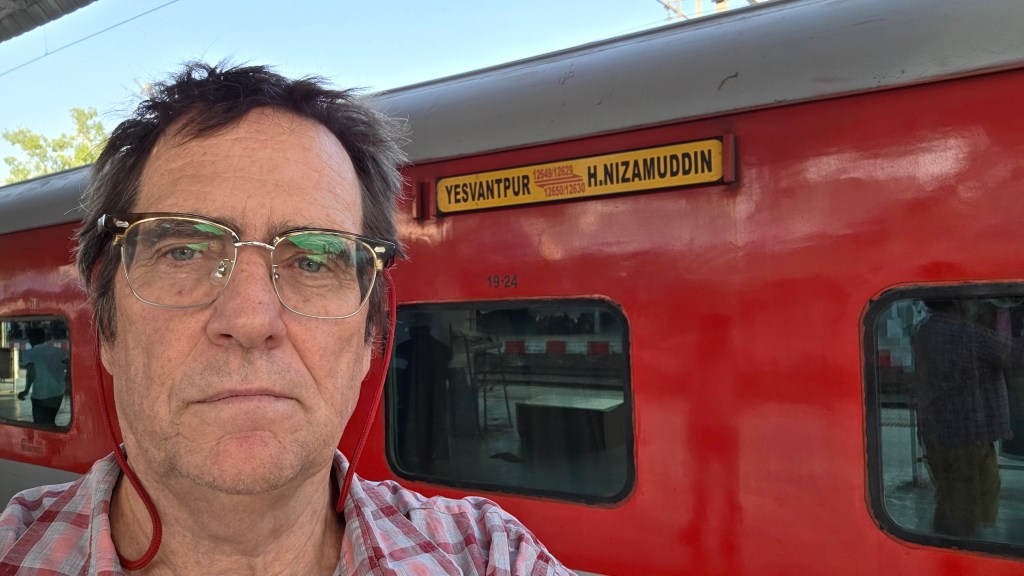
I just took a thirty-seven-hour train trip straight down the center of India.  Like a surgeonโ€™s scalpel, the train sliced open the skin of the land to reveal worlds usually unseen and taken for granted, but hiding in plain sight.  

It was a long-distance train with an equally long-winded name–12630 Hazrat Nizamuddin โ€“ Yesvantpur Karnataka Sampark Kranti Super Fast Express.  As she sped along, we travelled through time traversing ground whose extrusion 66 million years ago helped bring the age of the dinosaurs to its end. We were carried through the myths of Lord Krishna playing on the banks of the Yamuna in Mathura; the Taj Mahal watched us from a distance.  The number of dynasties that ruled these thorny, dry hills boggles the mind. I lost count at ten but love saying their names to harmonize the clickety clack of the trainโ€™s wheels.  Shunga, Kanva, Naga and Shilahara. Bundela, Maratha, Scindia and Patwardhan.   

The trip touched not only the mythical origins of Hinduism but the peaks of Indian Buddhism and glories of medieval Islam.  We swayed our way by supreme icons of Indian art such as the seven storied stone palace at Datia, built as a guesthouse by Bundela king Maharaj Bir Singh Deo for the World Conquering Jahangir who never set foot inside. And the seven-meter-tall pillar of quartz sandstone gifted to Shunga king,  Bhagabhadra,  by Heliodorus the Greek ambassador of Taxila, to commemorate his conversion to Vishnu worship. The sublime Great Stupa of Sanchi commissioned by Ashoka for his wife, the first Buddhist power couple of South Asia, just a short distance from the tracks near Vidisha.  

On and on I could go. 

We crossed two of Indiaโ€™s sacred rivers, the Yamuna within the first few minutes of the trip and the Krishna just before entering northern Karnataka 30 hours later. We climbed up and down several mountain ranges:  the Satpuras, the Sahyadris and the Dharwad Crags. And of course, the range that divides the north from the south–the Vindhyas–about which Iโ€™ll tell you an old story. 

Once upon a time Vindhya, the king of mountains, felt slighted that Suryadev (the sun) circumambulated Mt. Meru, the original mountain of creation, but ignored him. He demanded that Suryadev include him in his orbit. But Suryadev explained that his route was not his call but the command of Lord Shiva.  Sorry, dude. 

Vindhya flew into a rage. To show his power he and his fellow mountains began growing higher and higher, and promised to block out the sun . The gods panicked. They begged the sage Agastya, who Vindhya respected as a guru, to have a talk with Vindhya. “Convince him to stop growing, dear Sage. You are our only hope.โ€ 

 Agastya felt compassion for the gods and began his journey southward.  As he approached, Vindhya called out a welcome to his guru and asked where he was going.  Agastya replied that he was on his way to the southern part of Bharatvarsha (India) and requested  his friend to let him pass.  โ€œAnd while I am away, I would like you to bow your heads until I return this way, at which time you can again stand straight and tall.โ€ 

Vindhya and his followers unquestioningly bowed their lofty heads and swore to remain thus until such time as the Sage returned North.  In the South the sage did many wonderful things and was so feted he never returned North. And so, until today, Vindhya and his clan of mountains remain bent low, as they promised, allowing the Himalayas to reign supreme as the Land of the Gods.  

All this lore and history in 37 hours; in a single train journey covering 2100  kilometers.  Hundreds of books could be written about the stories that echoed against the glass and steel of the train as it tracked that single course through central and western India.  

Sage Kakbhusundi

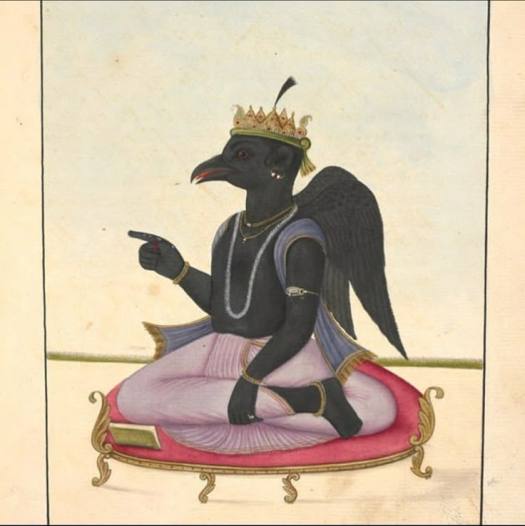
There is another story, a favorite, about the sage Kakbhusundi, the immortal crow-man who is playfully swallowed by the infant Rama.  Inside the godโ€™s young belly Kakbhusundi is entertained by a phantasmagoric, psychedelic, wild and crazy show of multiple worlds, multiple timelines, multiple universes all unfolding simultaneously in the past, present and future.  When the crow sage is burped back out of the childโ€™s belly, he discovers that in fact, no time has passed whatsoever. On this particular journey, in the late spring of 2026, that strange and wonderful creature took the form of an elderly Bihari man travelling to his sonโ€™s home in Pune and became my travelling companion.

I normally am a โ€˜stick to myselfโ€™ traveler. Iโ€™ll be polite and converse, but rarely will I introduce myself or initiate a conversation. But as soon as I entered the cubicle, I found myself saying, โ€˜Namaste. My name is Rabe. I am travelling to Hubli.โ€™ 

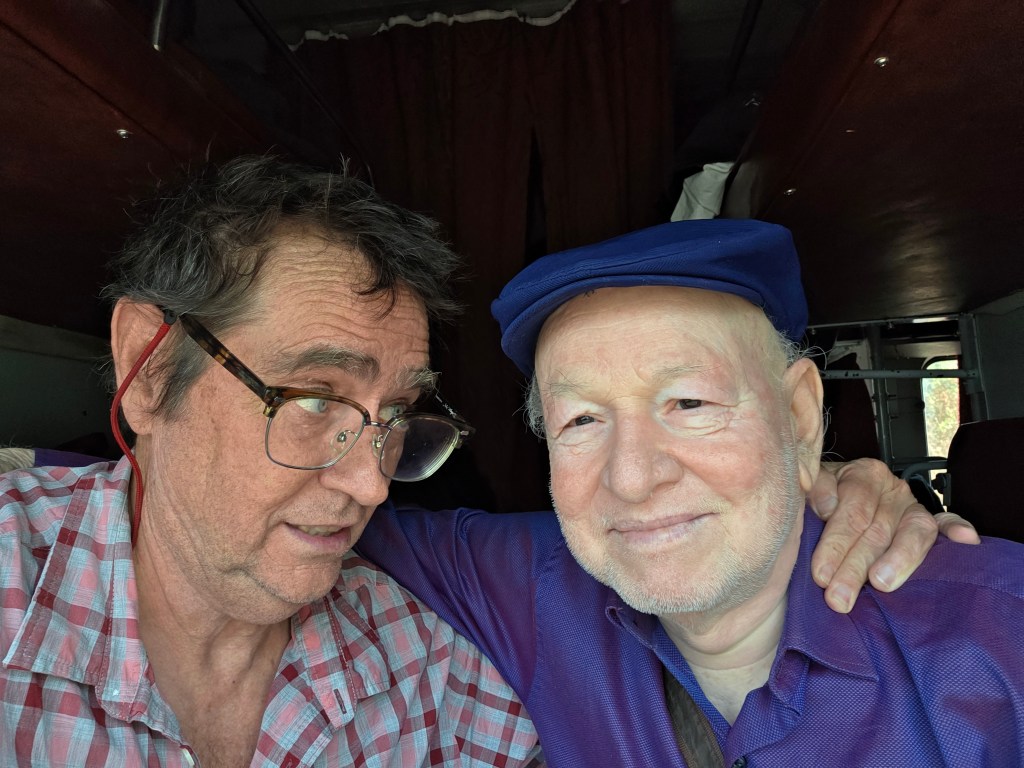
I am Pradeep Kumar Yadav. 

The speaker wore a dark blue flat cap, a new, still-creased purplish-blue shirt that changed color depending on the light and, track pants. He reminded me instantly of my momโ€™s oldest brother, Uncle Omer, a kindly, gentle-countenanced school cook from Minneapolis. Shri Yadav had my uncleโ€™s cherubic face, his quick warm smile and balding pate (which I noticed a bit later, was peeling from being outdoors too long without his cap). He was quiet. His black corvid eyes sized me up while I exchanged the usual traveler’s chitchat with his daughter and grandson who had come to see him off.  Before too long they asked his blessings, wished him safe journey and took their leave.   

Yadavji opened the proceedings. 

What job do you do in Australia?  

I told him, but not fully trusting my Hindi asked if he was familiar with what I had described.  

Oh, of course, I know NGOs. They do good things for people. Bahut accha. Retired? I see. Ok. Ok. I understand.  

When he spoke I could see he loved his paan(betel nut). He was missing several of his upper teeth; the rest were stained a dark reddish brown especially in the fault lines where they met. I marveled at his coloring. He was not an albino but every part of his skin including his toes and feet were closer in hue to mine than those of any other passengers.  I asked him what he had done for work. 

I was a junior engineer in the railways. Actually, a little above junior engineer. Mostly worked in the big Jamalpur workshop, on the loop line between Patna and Calcutta. No no no. I was not a driver. I was mechanical. Working inside the shop itself.  My original place is Munger. Next to Bhagalpur. In the 1960s some Baba set up a big yoga school and now people come from all over, mostly Ingland and America, to study yoga.  You know when I was young, between 1962-65, we used to see lots of American young people in India.  We used to call them hippies! โ€˜Look at that hippie. This hippie is doing that.โ€™ That is what we called them. Hippies.  

He broke into little chuckles as he spoke. His eyes twinkled at certain points for emphasis. As is commonplace in India his hands and fingers moved as well, unconsciously adding visual punctuation. 

Bihar is very ancient, isnโ€™t it? 

Very ancient. Yes. Very much . All the great philosophers, Buddha (well, he came from Nepal actually but he became enlightened in Bihar), Mahavira the saint of Jainism.  Adi Shankaracharya, you know his name? Yes? Good. He travelled all over India, going from one corner to the other. But he found the greatest fame in Bihar.  He was the one who emphasized Jnana. Knowledge. But you know, today, even though  the teaching of these philosophers has spread across India and the world, in Bihar itself everyone has turned it all upside down. No one considers the teachersโ€™ main message which was ahimsa. Non-violence. Instead, today people practice only himsa. Life is all about violence, power, corruption only.   

He was clearly a man well-read for this station in life. He talked about Israel and Iran, Max Mueller, and theorised about the benefits of โ€˜evilโ€™ being a step toward human development.  He asked me what my favorite place in the world was, seeing as โ€˜youโ€™ve been everywhere.โ€™ Before I could finish my usual too-long answer, he was talking again.   

Our Vedas and purans you know are full of amazing things. They have written that the gods would use bows with arrows that shot fire! And even that they could shoot the other arrows out of the sky. And if the arrows   collided in the air they would join together and shoot straight up into the heavens. Zhoom! Rockets!  Even, some scientist discovered, that in Mohenjo-Daro the people could write something on one tablet here, and on the same sort of tablet hundreds of kilometers away, the same exact thing would be written. 

I push back at this. โ€˜How does anyone know that? No one has deciphered the script and how can you say any two slabs of stone were written at the same time.โ€  I suspect he might be what they call these days a bhakt. A Hindu chauvinist who believes that nearly everything we experience in the contemporary world from plastic surgery and the internet to air travel existed in Vedic times (1500 BCE).  But I see that Iโ€™ve missed the point he is making. 

Of course, you are correct. But you see scientists discovered that in some of those stones in that area there was some sort of magnetism that allows this process to happen. Here, one thing. There, the same! 

He quickly shot his arms in different directions to help me understand what he was saying. Here. There.  

I want to mention quantum entanglement theory; the one Einstein called โ€˜spooky action at a distanceโ€™ but knew I would never figure out how to do so in Hindi, so let him continue.  But heโ€™s in no hurry. He falls into silence. I look out the window. He tells me we are coming up to Mathura, the land of Krishna.  I watch the station of the modern city whiz by. Our train doesnโ€™t stop. Neither does it at Agra, a further half hour down the track.   This is the agricultural heartland of UP he says, before nodding off. When the train lurches he wakes up and continues the thought. 

One time during the British days, Germans came to India to study our philosophy. They studied it deeply and took back 500 Sanskrit scholars to Germany and set up a Sanskrit University! Yes! In Germany itself. People from every country, even from India, go there to study. Can you imagine!   

That Indian scholars would travel to Europe to gain knowledge of their own culture seemed to simultaneously tickle and disappoint him.  

These Germans began to look for the science in our scriptures. The Vedas are actually about science, they concluded. But our Indian pandits say the Vedas  are only religious books. They are content with that much only. They are happy to say, โ€œyou see, we are the worldโ€™s best religion because we invented all these modern technologies before anyone else.โ€  But the Germans wanted to understand and discover how they could use the Vedas and purans to benefit mankind.  So, they did deep research to discover and explain the Vedas in scientific terms. As a result  they invented so many things like rockets and missiles.  And today we have the modern world. You see Europeans, especially the French and the Germans, not so much the English, were clever. They didnโ€™t just say, โ€˜we thought of these things first.โ€™ They wanted to test to see if Vedic science could be made to work. That is why Europe and the West are so much more productive than India. We Indians are content to simply know. And make statements about things. But take action.  Look at those fields. The soil here is so rich but the productivity is so low.  Go into any village and youโ€™ll come across a group of men here, and one over there, and more over there someplace else, playing cards. Thatโ€™s what they do. Play cards and gamble all day. When others could make the land so much more productive for the benefit of everyone.  That is why Europe and Japan are so far ahead of us. They work and use their minds to help others, not just to chant slogans. Which is all these pandits and holy babas our government likes to promote, do. This is our predicament.  

While heโ€™s talking a part of me sees glimpses of other people I love in his face. Mike, my oldest brother. Yadavji shares his birth year (1947), and he has the same inquisitiveness about the world as my brother did. I hear Phil, a school mate, in the way Yadavji speaks Hindi; especially the way he becomes more confident towards the end of a story or a thought. His cadence quickens and his mannerisms, slightly challenging, like a fired-up cock, match the way Phil spoke Hindi back in the day. 

Stanley, a dear friend for many years, also seems to be winking at me from within Yadavji. They shared a love for Bihar and told the same kind of jokes. Simple ones. Not especially clever ones but ones you could not help laughing out loud to because the punchlines pointed to the foibles of being human in a crazy world.   Like this one:  

Modi wanted to get a bullet train for India so went to Japan. He had a ride and was very impressed. On return home he invited the Japanese PM to come and visit India. Having been so impressed by the bullet train and Japan in general, Modi wanted to show his counterpart the best of India. So he took him to Varanasi.  They spent  hours floating around the river, up and down, in front of the bathing ghats and temples. 100s of priests and pandas chanted mantras and did aarti with incense and small diyas.  There was loud religious chanting and resounding drums.  After four hours, the officials got off their boats and climbed to the top of one ghat for the official ceremony.   The Japanese PM leaned over to Modi and said, โ€œI don’t know why you’re so interested in a bullet train when you’ve got so much time to kill!โ€ 

We both burst out laughing at this absurdity. And then we laughed a bit longer because we were both laughing and enjoying the moment.  This was exactly how Stanley would get me to tears of joy and draw me in. As Yadavji and I looked into each other’s eyes, I felt the uncanny presence of my deceased friend, chortling and smiling back at me.  

As to his halting Hindi this is what he had to say.   

In Munger we speak Angki. The area is old and in those days that area was known as the kingdom of Ang. No, no. It is Hindi. My language is Hindi but my boli, my tongue, is Angki.  

I knew about Maithili and Magadhi. I even could understand a bit of Bhojpuri, all dialects and boli from Bihar and Eastern UP. But I’d never heard of Angki. 

Yadavji was from the Hindi belt but messed up his genders, cases and tenses. Like me and Phil. This was another little bond that connected us for the time we were together. We didnโ€™t care about the delivery but the content of what we were saying.  And yet when his family called, his words flowed smoothly without any hesitation. I could understand a word here and there, but not many. It was a completely different language than what I knew as Hindi.  

I later discovered thatย Angkiย is one of the oldest living languages in India, stretching back to the 5th and 6th centuries before Christ. Indeed, as Aramaic was to Jesus of Galilee,ย  Angkiย was to Gautam Budh.ย Kakbhusundiย it seemed,ย hadย avtaredย asย Yadavji,ย from a lost worldย speaking a language thatย Buddha wouldย haveย preached in.ย And morphing from oneย familiar faceย to another in some sort of play.ย ย ย ย 

Yes, indeed, Bihar is an ancient land.  

We rolled into Pune about an hour late. There was a lot of slow going as maintenance crews bolstered the tracks against the dynamic earth that shifted frequently and radically just a few meters below the surface.   He plugged in his earphones and returned to watching something on his phone. He laughed to himself. I watched the big city grow around us.  But I couldnโ€™t stop thinking of the crow-man in the belly of Rama. And how within a single soul, the soul of one man, a myriad of worlds, histories, and incarnations exist, not in conflict but in some weird harmony. 

By the time I helped him on to the platform atย Puneย weย hadย sailed together throughย several worlds.ย ย Fromย geologic epochsย upย to the present day. Dozens of kingdoms andย rajas had risen and fallen over the hours.ย Timelessย ragas andย sermons had beenย  composedย  andย  preachedย and yet thisย all had unfolded in a single trainย compartment.ย 

Yadavji, likeย Kakbushundi,ย the man who became a crowย whoย worshippedย Vishnu whoย in turnย became Rama andย laterย Krishna,ย and Hanuman who could leap across time and space with ease, was a man who contained avatars of my family, my friends and myself. Displaced outsiders living in just one of theย many possibleย multitudes ofย universes laughingย  andย  discussing andย sitting as two friendly ghosts, translucent to all whoย observedย us.ย 

Hello again. I’m seeking help.

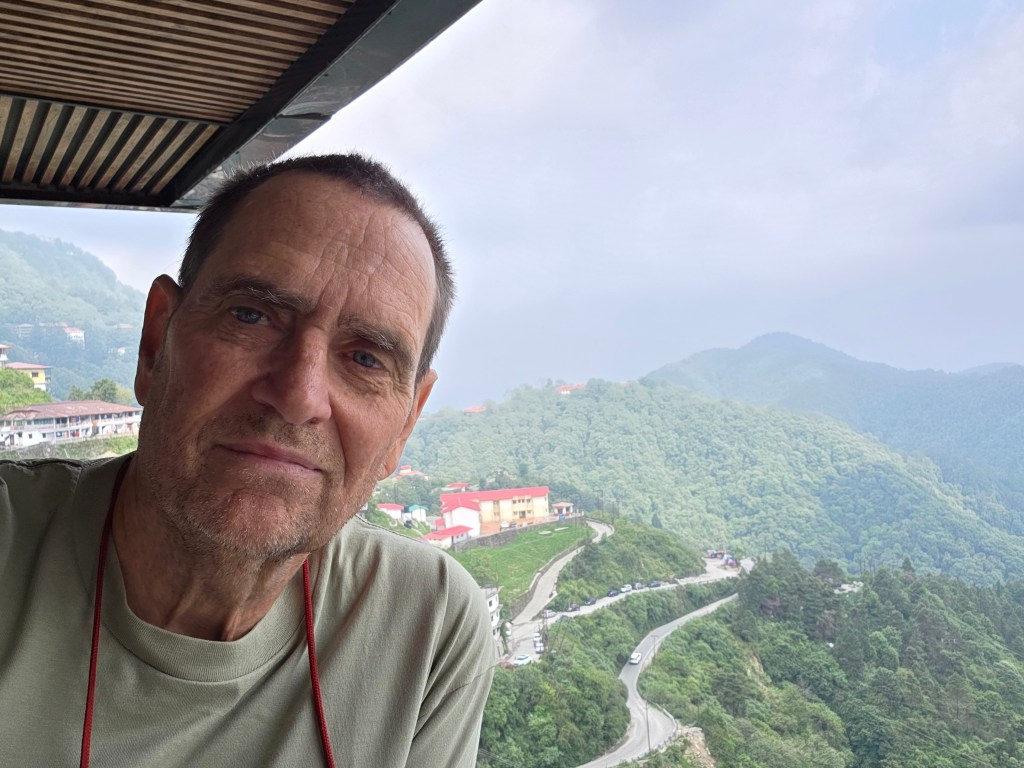
This is yours truly dropping in from Landour, a pretty hill station 7000 feet up in the Western Himalayas in north India. This is where I attended boarding school between 1964 and 1975 and where I have been for the last ten days or so.

I thought I’d let you know of a pretty significant change in direction for me personally and sneak in a request at the the same time.

After years of huffing and puffing about being a writer I have taken the leap. I came to India for 6 weeks to revisit some of the places I spent my youth and now that those six weeks are coming to a end, I have decided to stay on. Indefinitely. I can make my meagre income go much further here than in Melbourne and as I’ve always known, this is the country that is most tangled up in my mind, heart and soul. Over the past 18 months I’ve seen my ‘settled life’ as an aid worker, father, husband and ‘known entity’ change dramatically. The speed and extent of that change has only quickened and probed into depths I had not expected over the last month. Writing has been my preferred way of making sense of this world and so it makes sense to launch my new life here, while I’m here.

I will keep this site open but due to my reduced financial circumstances will be unable to maintain most of the music links associated with this and other blogs like C90 Lounge much longer. So if you are interested in downloading any of them I think you may have about 48 hours max. Good luck.

I am writing a lot but not really posting much anywhere as I’m not sure how to proceed. There is Substack, Medium, and lots of specialised writing communities out there. I know a few writers do drop by here from time to time. I’d love to hear from you (ajnabi1957@gmail.com) if you have any preference for any particular platform or site or how you approach sharing your work.

I think what feels right for me at this point is finding/creating a small community (as small as one other person even) who would be interested in sharing, reading and critiquing each other’s work. A sort of minor league of mutual criticism. It would require a commitment of some time and thought and effort on both (or all three or four) of our parts but may be quite rewarding as we support each other in getting better at connecting thoughts with words. If you’re keen or you know someone who might be or of a small group looking for another participant, I would really be grateful if you reach out. [ajnabi1957@gmail.com]

I am more a non-fiction/memoir/narrative fiction/historical fiction sort of guy but have written a couple of novels so am open to either genre.

As always thank you for your support and encouragement across the blogs and years. As a small gift here is a piece I’ve written recently, post arrival in India. No critique necessary to enjoy it!

Whatโ€™sย the Point ofย a Bullet Train When You Have So Much Time to Kill?ย 

Closing and Opening

Twelve months ago I separated myself from my family. In that time I have had my 35 year career as an international aid worker come to an emphatic close. I have been and continue bed-surfing and residence hopping as one does when you leaves a marriage suddenly. My 18 year old daughter does not talk to me. Thankfully, my 22 year old son, does (though he did keep to himself for several months). I have found that the age pension with a bit of taxi hacking meets my daily needs quite adequately. I have returned to driving cab for a second time, after spending a year between MA and potential PhD, driving the icy roads of Minneapolis for Blue & White taxis. I have had my license suspended for running too many red-lights and am on enforced leave until July 8. That is fine by me, because in early March, while still tending a broken heart over so much loss and change, I nearly killed myself, two lovely young women passengers and the driver of the car that smashed into my taxi as I did a careless U-turn.

The most significant change I have made over this time, is to embrace the fateful decision to no longer be (just) a weekend blogger, novelist and retro-fitted writer. Rather I am placing that long-echoing call at the centre of my retired life. Beginning a new adventure is what some people call this. I’ve heard it called Fool’s Errand, too.

And in a little less than three weeks I will be heading back to India, the land of my birth and first 18 years on a sort of ritual pilgrimage. I am going so I can feel the wind blow through the ‘cobwebs of my mind’, feel the heat burn the detritus of the professional salary man, and let the sounds, smells and sights of that fabled land wash over me wave upon wave.

Why do I tell you these things?

Though I’ve not met you in the analog sense, some of you have been fellow travelers and kindred spirits. And you have always wished me well. I have not been entirely dedicated to my blogging in the period under review and it is always good to explain oneself. Given where I’ve paused to catch my breath at this point in time and space I am inclined to direct my creative energies towards a memoir. As a way to make sense of some of old, chipped and stained pillars that have held up my world for as long as I can recall: India & my missionary-kid childhood.

I am daunted, excited, confused, compelled and called by, about and to this. I’ve not been to India since 2012 and not been to the places on my itinerary for between 62 and 19 years. So I’m looking forward to whatever awaits.

I may post a bit along the way but look forward to having your good wishes as I depart. As a small gift here is a mixtape of World Fusion which just so happens to be heavily colonised by South Asian sounds.

WF2

This War in Iran has me thinking

of a quote I had posted to my wall when I was a working man.

The code of tribal wisdom says that when you discover you are riding a dead horse, the best strategy is to dismount. But NGOs often try strategies with dead horses including the following:

o Buying a stronger whip

o Changing riders

o Charging a lower price for the ride

o Saying things like, โ€œThis is the way weโ€™ve always ridden this horse.โ€

o Appointing a committee to study the horse

o Declaring the horse is faster, better, cheaper dead

o Harnessing several dead horses together for better speed.

Across North India by Train and Some People I Met

Calcutta bus by Nate Rabe

18 January 1990

What a rush at the airport. A huge group of Raiwindi[1]s was heading to Lahore from Karachi. It was a jumbo.

Wally met me in the drizzle at the airport and took me straight to the border. Heโ€™s pretty bummed out with the developments in the States. Berkeley has fucked him over the BULPIP directorship; hiring someone else and informing him that he was not even in the running for this yearโ€™s directorship.ย  Wally takes these things very hard but I know I would too.

Got across to Amritsar in an Ambassador[2] which stopped every half kilometer or so due to โ€˜blockageโ€™ in the fuel pump. An ansty Aussie shared the front seat with me. He was wiredโ€”shouting at the drunks, pissed off with having to pay Rs. 20 for the taxi and going on and on about missing concerts and plays back in London.  Not the kind of travelling companion I want. We parted at the Railway Station.

I was greeted by 2 friends–rickshaw walasโ€”from my last trip to Amritsar. Made a new oneโ€”a hustler who first told me there was no way Iโ€™d get a berth on the Amritsar-Howrah Mail tonight.  He left and then came back after a brief interval. He suggested if I paid a little โ€˜chai paniโ€™[3] Iโ€™d definitely get one.  So, I paid Rs. 20 for the ticket clerk and Rs. 40 to my new friend for the luxury of a sleeper berth. A good deal. Rs. 220 for a 1879km journey.

I asked my rickshaw friends if he was a โ€˜gentโ€™. Not the English term but a shortening of the word โ€˜agentโ€™, used in these parts to refer to touts and fixers. โ€œYesโ€, they replied, โ€œbut an honest one. Heโ€™ll do what he says he will.โ€ And he did.

I had asked if there were any bombings on the rails[4] these days.

They looked at me disappointingly. โ€œThis is written at the time of our birth. There is no changing it. Bombs or no bombs, when your number is up, itโ€™s up.โ€

One of the rickshaw walas then broke into a parable.

โ€œThere once was a man. A mad camel got to chasing him and to escape the man jumped into a well. The camel sat outside the well and said to himself, โ€˜Heโ€™s got to come out one day and when he does Iโ€™ll bite himโ€™. He settled down to wait.   After a couple of days a poisonous snake slithered by and bit the camel. In an instant the camel was dead.

โ€œThe man in the well finally crawled up to have a look. He saw the camel lying bloated in the sun, rotting away. He triumphantly strode forward and gave the camel a mighty kick. His leg sunk deep into the rotting belly of the camel. The manโ€™s leg got infected and he died.

โ€œSo, you see,โ€ said the rickshaw wala, โ€œeven when we take precautions, Fate tricks us.โ€

With such encouragement I set off for Calcutta.

19 January 1990

A long journey across northern India. Lucknow, Pratapgarh, Benaras, Patna. People flow in and out of the aisles as if choreographed. Itโ€™s stuffy on the top tier but I sleep a lot. Iโ€™m surprised at the spareness of the big stations. Itโ€™s hard to find even a packet of Marie biscuits. The thought crosses my mind that maybe the great lurch into the 21st century that India Today so proudly heralds has been at the expense of the further impoverishment of most Indians.

I share a smoke with a masala magnate from Calcutta. Heโ€™s actually Punjabi but his family moved to Calcutta from Lahore over a century ago. He never goes back to Punjab.

โ€œI like Calcutta because itโ€™s the cheapest and safest place in India. You have no riots, no ghadbad.[5] The loadshedding is tolerable-nothing like in Benaras. The prices of everything is cheapโ€”living, food, transport.โ€

Heโ€™s a real Calcutta booster. At one point to tells me, โ€œYes, the police are corrupt but at least a Bengali will do what heโ€™s bribed to do. You give him some money and your work is done.  Itโ€™s the honesty I like.โ€

He speaks in a soft voice. He begins to tell me about how he used to drink like a โ€˜mad manโ€™.ย  Always drunk. Always looking for a drink.ย  He was, as he puts it, โ€œat the last stageโ€.ย  He then sought the help of a guru, whose name is drowned out by the clacking of the rails as we whoosh by a dark Bihari village. He pulls out an amulet with a hand tinted image of his guru. โ€œWhatever he says, has to happen,โ€ he quietly says. He places the image back under his shirt and against his chest. He begins relating more miraculous acts of his guru to a couple sitting next to him.

I climb up again to the 3rd tier and fall asleep.

20 January 1990

Calcutta is the city of superlatives.  There is no end to the seeming premier-ness of the place. Most dirty city, most crowded. Most posters per pillar, most taxis per person. Most specialised bazaars. I saw one this morning which catered entirely to shoppers interested in balloons and rubber bands. Most cruel means of public transportation (hand-pulled rickshaws).  Most diverse inhabitants, most rundown colonial buildings. Most cultured city: International Film Festivals, Classical music programs, Beatlemania stage show. Most touts. Itโ€™s hard to find anything new to say or any new superlative to add to Calcuttaโ€™s already superlative list of stellar โ€˜mosts and bestsโ€™.

I have found a room in the Paragon Hotel, one of these new tourist hostels which are the same no matter where you go nowadays. The Ringo Guest House just off Connaught Place is no different than the Paragon Hotel just off Chowringhee.

Touristsโ€”Germans, Dutch, Japanese, Australians and a few frightened Americansโ€”writing in small script in their journals, talking to each other about their similar discoveries and eating out at the same restaurants.

I walk up Sudder Street. I remember coming here, to the Red Shield Guest House[6],with my family every other year enroute to a deserted beach in southern Orissa/Odishaโ€”Gopalpur-on-Sea.

Iโ€™m afraid to go Gopalpur these days. Afraid to find sparsely dressed Germans scowling at me as they strut around like they discovered the place.

In those days (late 60s) we seemed to be the only white faces in Calcutta.  Sudder Street was quiet; New Market cool and refreshing; the Globe Theatre ran movies like The Bible. Now it shows Young Doctors in Love and New Market is crawling with sad Muslim touts begging you to buy or sell something. Hotels proliferate. Tourists swarm.

These tourists are backpackers. Young folks from the 1st world bumming around the 3rd.  In Benaras they learn sitar, in Dharmsala they take a course in Buddhist meditation. In Jaisalmer they ride camels into the desert and here in Calcutta they volunteer for a week or so at Mother Teresaโ€™s. They then catch a train to Puri or Gaya.

I admire (in a way) their altruism for washing and feeding the dying. I wish I could do the same. But something rubs me the wrong way. There is a feeling of inevitability to their righteousness. Mother Teresa is another stop along the wayโ€”like the journey of the cross in Jerusalemโ€”full of good material to write home about. Mother Teresa is now another tourist franchise, another neat thing to do.

Calcutta is a pleasure to visit again despite the restless 1st Worlders who hang on like frightened knights of the tourist round table. The locals donโ€™t seem to give a damn about your origins here.


Calcutta by Nate Rabe

22 January 1990

Spent a thrilling few hours wandering among colonial tombstones in the Park Street Cemetery (opened 1760). The image that comes to mind is a ghost ship shipwrecked on an isolated reef, forgotten and dark. Like all cemeteries it has an immediate calming effect. Jumbled and disorderly tombstones and mausoleums crumble in silent gloom among trees and hundreds of potted plants. Some of the paths are under repair but other outlying areas are as untouched as they were a hundred years ago.

Iโ€™m instantly aware this place is an entire city. Stately and expansive.ย  Towering citadels with Corinthian columns, baths and porticos keep watch over a host of long-dead nabobs and Company servants far from home.ย  Each tomb is grander than the next. Spires rise 6, 8, 10 feet above the soil in honor of a young civil surgeon downed by โ€˜feverโ€™ or an indigo planter consumed by the pox.ย  The most ordinary of Indiaโ€™s first British colonizers have erected over their bones and spirits structures few Presidents can boast.

The Raj was young when Park Street opened. The Battle of Plassey was only three years won. Young men with no social standing back home, here had a chance to be rajahs off the plentitude of Bengal. These young men had never dreamed of the fortunes to be made in Bengal; Bengal had no way to stop them. Park Street memorialises the sense of destiny and ostentation of the early Raj. The world was waiting to be plucked from the mohur trees. Fortunes were huge and readily won for those who showed their ruthless ambition. For them this was a larger-than-life world. I suppose a bereaved father felt it perfectly natural to raise a small Roman temple in honour of his nine-month old infant son, dead by flux.  The cemetery, like the period, like the characters buried here is an overstatement. The epitaphs are sentimental and overegged. There was never a disliked, cruel or greedy person buried here.

Of course, not everyone buried here is insignificant. William Jones, the great Orientalist icon who was the first to propose the idea of a shared kinship between Sanskrit, Greek and Latin, lies under a 15-foot obelisk. Charles Dickensโ€™ second son has been lovingly moved here by students from Jadavpur University. Richmond Thackeray, father of William Makepeace Thackeray, a senior servant of the Company, lies here, as does the wife of William Hickey, Indiaโ€™s first prominent English journalist.

Teachers of Hindoostanee at Fort William College, traders and fair maidens, Park Street Cemetery is, more than any other place in India, a memorial to the Raj.ย  Here one can taste the self-aggrandisement, the self-importance and most of all, the self-pity which characterises British India. You only need to close your eyes to hear them speak again. Little do they realise that their ostentatious moments of death are long forgotten and ignored.

23 January 1990

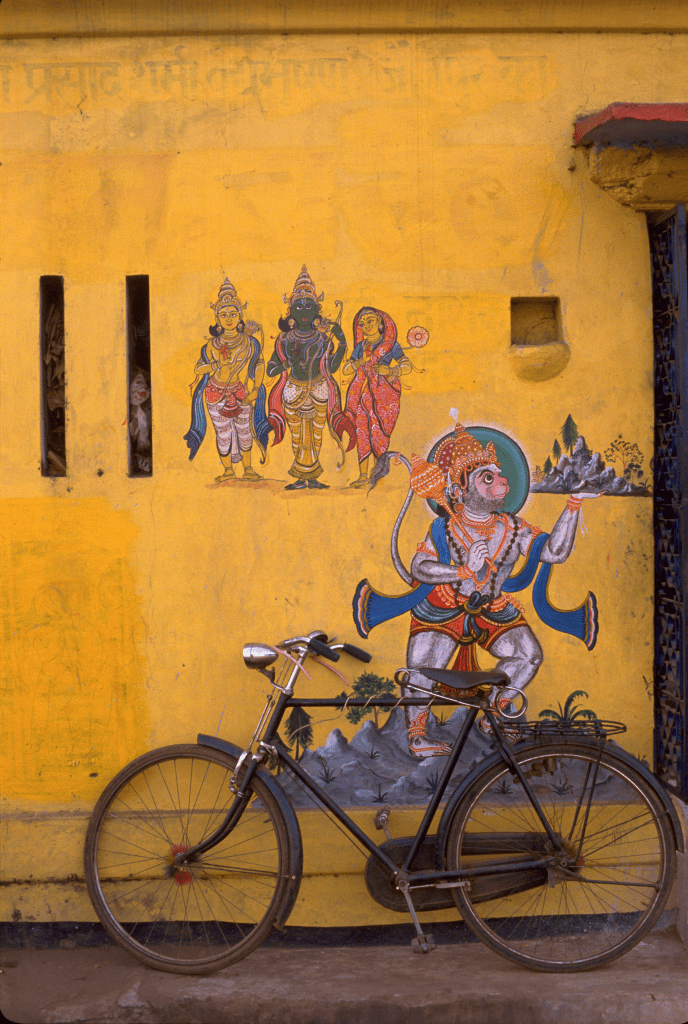
Residential mural in Bhubaneshwar by Nate Rabe

Today I arrived in a cemetery of a different sort. The great ancient temple city of Bhubaneshwar. Anย  initial quickie around the city has left me awed with the grandeur of Indiaโ€”truly the Wonder That Was. Iโ€™m none too impressed however by the greedy mahantas and pundits who follow me with visitor books filled with the names of foreigners who have come before me and donated Rs. 100 or 150. They are like blood suckers who will not detach themselves from you until you fork over some cash.ย  Muttered curses follow me when I hand over a fist of Rs. 2 notes or a tenner. โ€œYou should give at least Rs. 50,โ€ one calls out as I walk away.

24 January 1990

Had a sleepless night. The bed in the Janpath Hotel was infested with bedbugs and the room abuzz with mosquitos. I was so tired and on the verge of the final descent into sleep only to be woken by a damn katmal gnawing at some remote part of my body. The room was distinctly shitty. A weak but persistent stench wafted across the room. No windows, only some cement grating at the top of the wall which allowed easy access for the mosquitos.

I flung my few large pieces of cloth on the floor and turned on the fan. I caught a cold and my neck ached but I must have fallen asleep between 2 and 3.

I blearily wandered off toward the Lingaraja complex which was still as impressive as it was yesterday evening.ย  The priest left me alone to take some photos. I met two young pandas[7] who were only interested in chatting, not in extracting money from me.ย  One was Kuna and the other Bichchi. Kuna kept classifying women into a personal scale of โ€˜sexualโ€™.ย  โ€œWestern lady very sexualโ€, or โ€œJapanese lady most sexualโ€.ย  He was full of obscure English aphorisms.ย  โ€œEvery book has a cover every woman a loverโ€, was his favorite but others addressed less sexual subjects as well.

Bichchi was interested in telling me about politics. One of the Patnaik[8]s was in power. Another Patnaik was trying to squeeze him out now that he (the second Patnaik) had the leverage of the National Front government in Delhi.  Bichchi was confident that his Patnaik (the second one) would be victorious in the end. The main complaint against the ruling Patnaik was thatโ€”as best as I could understand from Bichchiโ€™s broken Hindiโ€”he liked to consort with little boys.  If not that he drank or smoked something that wasnโ€™t good.

Kuna immediately spoke up. โ€œIs there only one tiger in the jungle? They all do these things. Have you ever seen only one tiger in the jungle?โ€

They tried to encourage me to drink some bhang[9]. Being already light-headed from a sleepless night I declined.ย  They extolled the virtues of bhang but cursed heroin, charas [10]and alcohol.ย  All these vices Bichchi attributed to the Pakistanis.ย  He saw a nefarious attempt to destroy his country. Apparently, there are in Bhubaneshwar a growing number of drug addicts.

Kuna again offered his own interpretation. โ€œIt is good. We have 90 crore[11] people here in India. If a few kill themselves with heroin good. It will keep our population down.โ€

I took my leave after an hour under the shade of the Lingaraja, one of 125,000 temples said to be scattered around the city.  This statistic came from Bichchi.  I was tired and wanted to nap but didnโ€™t want to do it in the Janpath Hotel.  Over a beer at the Kenilworth Hotel, I resolved to head immediately to Puri in search of cleaner mattresses and an airy room.

25 January 1990

ย Puri strikes me as an overgrown seaside fishing village. Except for the fact that it is one of Hinduismโ€™s four major dhams[12], there didnโ€™t seem much to commend the place.ย  The beach is here too, of course, but it has none of the isolated charm of Gopalpur or the lushness of Kovalum. The alleys are dark and damp and only Hindus are permitted to enter the ancient Jagganath[13] temple. For a photographer it is also frustrating. The temple is set at an awkward angle which makes it almost impossible to capture well. The square in front of the temple is in glaring light most the day so people huddle in the shadows under the tarped awnings.ย  After walking around searching for some good light, I put my cameras away. From now on Iโ€™ll stick to the alleys where little icons and shrines add color to the landscape.

I talk with Mohammad Yusuf who is selling reptile scales for the cure of piles and general unwanted blood flow. He makes rings of these and advises his customers to wear them on their left hand so as when they perform their toilet, the ringsโ€™ magical effects will โ€œmake you 100% clean. You can spend Rs. 10,000 on a doctor but these rings will cure you completely.โ€

He is an Oriya[14] but like most Muslims in the north speaks quite good Urdu.  When I told him I was living in Pakistan he quietly asked, โ€œWhatโ€™s the news? Is it good?โ€  I find the Muslims Iโ€™ve run into โ€“a lotโ€”to be sad people, though Iโ€™m probably projecting.  In Calcutta all the booksellers and tape hawkers on Free School Street are Muslims from Howrah. One told me with a bit of over enthusiasm that โ€œHindus are the best. I have more Hindu friends than Muslims. We have no problems here!โ€

Another, Salim, is a waiter at the Janpath Hotel in Bhubaneshwar.ย  He was soft spoken and left me with a feeling tender. He claimed to make Rs 200 a month in the hotel of which $150 he remits to his family.ย  He used to work in Calcutta in a factory that makes cooking utensils but for some reason came, as he put it, โ€œinto the hotel line.โ€ He doesnโ€™t like the work but is stuck.ย  He saw two postcards I had bought from a sidewalk dealer on Sudder Street. One was of the Kaaba[15] the other was of Imam Hussain on his horse. Salim kissed them and pressed them against his forehead when I offered them to him.

The Muslims seem to be accepted and other than a slight hesitation before telling me their names, they seem content. They confess to cheering for Pakistanโ€™s cricket team but have been quite uninterested in asking me about life in Pakistan. Only one, a cloth merchant in Bhubaneshwar, asked me if I preferred India or Pakistan.

Tomorrow, I take a day trip to Konarak. Itโ€™s Republic Day and will be overrun with tourists undoubtedly.

26 January 1990

I was accompanied to Konarak by a Gujarati, Dr. Parwar. A pleasant and gentle man who had pulled himself up to a position of considerable rank and authority in a government hospital.  His father was a manual labourer in Pune, โ€œso I have seen life from close up.โ€ Through hard work he got his MBBS and MD from one of the best medical schools in India and has since added a triad of MAโ€™s in subjects like Public Health, Venereal Diseases and Administration.   He has been attending a conference in Calcutta on Public Health Administration and has come to Puri to kill some time.

He is deeply committed to serving the people of India as a doctor back in Ahmedabad.  He has no desire for an overseas job or money. He proclaims more than once how proud he is of being Indian.  This is not something I hear in Pakistan very often.

Konarak is impressive. The stone sculpture is beautiful and majestic. The monument is set out as a sun chariot with 24 giant wheels pulled by 7 rearing horses. Most of the original temple has been destroyed but the remaining bits inspire awe for their size and beauty.  The original temple rose more than twice as high at the remaining remnant which rises 80 feet into the air.

Dr. Parwar and I climb to the top of the temple and gaze into a deep opening. A pedestal is at one edge where we overhear a guide explain, โ€œThis is the place where the image of the Surya (the Sun God) stoodโ€.  Inside his stone head and feet, apparently, was magnet which when a certain interaction of physics and metaphysics transpired โ€œcaused the Godโ€™s head and feet to move.โ€

The Indian government is preserving the temple. Dozens of lungi[16] clad workers scratch the eroded stone with water-soaked bamboo brushes. Here and there new plinths and slabs of granite have been fitted into the chariot spokes and walls.  Up near the top they have placed two huge Buddha-like images, upon which, during the Eastern Ganga dynasty[17] which built the temple, the sun was said to have shone continuously. One at dawn, one at noon and one at dusk. The third image is yet to be restored.

Dr Parwar and I silently take in this magnificent piece of human-divine cooperation before boarding a bus back to Puri.


[1] Raiwind, a town near Lahore, famous as the headquarters of a major Islamic missionary organisation, Tablighi Jamaโ€™at

[2] Hindustan Ambassador. Iconic Indian manufactured sedan which for decades was about the only car available in most parts of India.

[3] Literally, ‘tea water’. Colloquially used to indicate a small gift/bribe.ย 

[4] A Sikh movement for Khalistan as a separate country was raging in the 80s and early 90s. Often trains passing through Punjab were bombed as part of the terroristic tactics of militant Sikh groups. By 1990 things had calmed down quite a bit but my question was not entirely unjustified.

[5] Hindi/Urdu word meaning โ€˜chaosโ€™; โ€˜confusionโ€™; โ€˜disorganisationโ€™. Colloquially, โ€˜hassleโ€™.

[6] Part of the Salvation Armyโ€™s global charity empire. Cheaper rates for Christian missionaries right in the heart of Calcutta!

[7] Hindi word for priest or guide to a temple. Not the Chinese animal.

[8] A prominent political dynasty in the state of Orissa/Odisha.

[9] Traditional Indian cannabis drink.

[10] Hashish

[11] Hindi/Urdu for the numerical value of 10,000,000

[12] The four dham are the major Hindu pilgrimage destinations located at each cardinal point of the compass. Dwaraka (West), Puri (East), Badrinath (North) and Rameshwaram (South)

[13] From which we get the English word, juggernaut.

[14] A native of Orissa/Odisha

[15] The stone building at the center of Islam’s most important mosque and holiest site, the Masjid al-Haram in Mecca, Saudi Arabia

[16] sarong

[17] 11-15th century CE

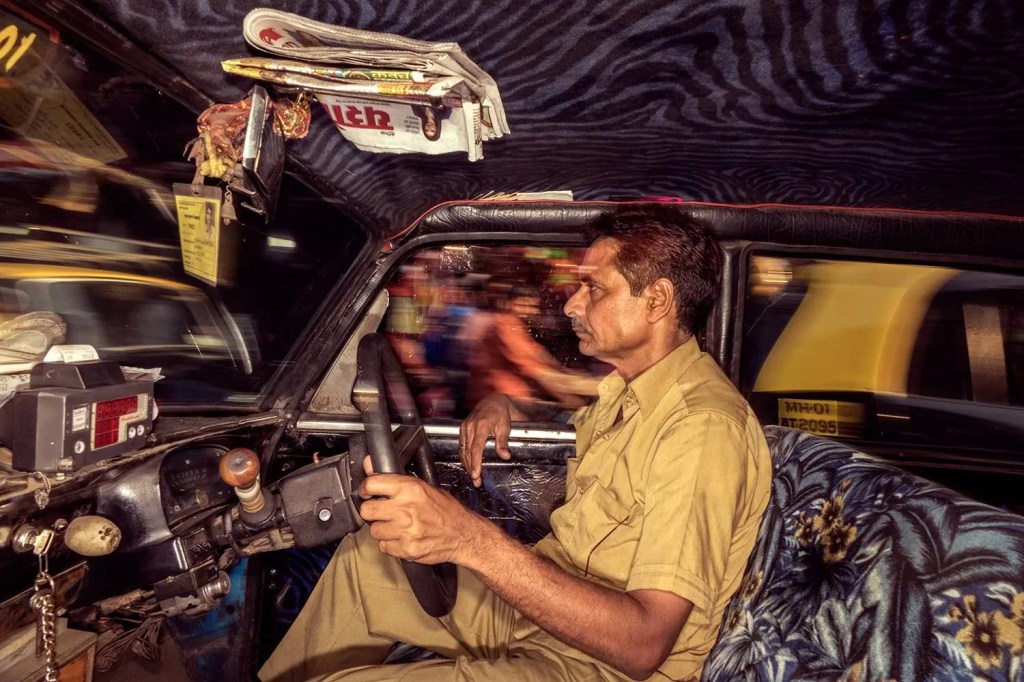
Recalled Conversations: Taxi driver, Delhi.

Photo by Dougie Wallace

For the first several minutes he said nothing, just guiding his yellow and black Suzuki taxi through the clamorous traffic of midday Delhi.   My daughter wanted me to ask him what his name was.  โ€œJai Bhagwan,โ€ he said. โ€œAn old-fashioned name.โ€ His smile is half apologetic.

โ€œYouโ€™ll be going to Jaipur? Thatโ€™s a beautiful city. They call it the Pink City. Its a five hour drive from Delhi and Pushkar is another 2 or 2 and half hours further.  Youโ€™ll stay in Pushkar for a few days? No? I see, just for a day. Ajmer is just half hour more away. What a place that is. Moinuddin Chisti…the Emperor of India!  Will you be taking the train from Ajmer to Varanasi?  No, from Agra. Ok. I see, your agent arranged it that way. Watch out for these agents. Theyโ€™re in it for themselves, a lot of them.

This traffic is like this but not for too long. Thereโ€™s a fly over up  ahead and the road narrows so everything slows down to a crawl. But soon weโ€™ll be moving again.  Yes, that metro line was made for the Commonwealth Games in 2010. What a rip off!  The organizers stole 80% of the investments. Only 20% was spent on the infrastructure. The main crook, Kapladi is in jail but what does it matter. It wonโ€™t change anything. The rich and our netas donโ€™t give a shit. All the rules are for the poor, not one of them is for the rich.  It never changes.

My people used to own the land around the airport.  A long time ago the government came and forced us off the land and gave us Rs1.40 per square meter! A very low price. But they got what they wanted. You know Gandhi? They say he is the father of the nation. We say heโ€™s the number one Thief. Donโ€™t believe me? What did he ever do for us? Did he do anything to improve our lot? He and Nehru did everything for themselves and to make their own money and name.  Gandhi, the old bastard, used to feed his goat grapes while the rest of the country starved. 

The real hero of India was Subhas Chandra Bose. What a guy. You know what his slogan was? Give me your blood and Iโ€™ll give you freedom!  He was a man of action. Thatโ€™s why they killed him. You know Gandhi could have freed Bhagat Singh but he didnโ€™t. He let him hang. All for his own glory.

Ambedkar? Yeah, he was a good man too.  He wrote the Constitution. No one else could have done that. He was a great man actually. I have nothing bad to say about Ambedkar.

Right, weโ€™re almost at your destination. Just 5-10 minutes more.โ€

How Do You Like It?

Nagma and Salman Khan

The Flying Coach had just pulled out of Gujrat. Passengers were settling in for a couple hours of sleep before our arrival in Pindi. Quietly whispering to each other, fussing with their reclining seats. Yawning. I had a window seat. My head rested against the glass. Outside, pitch black.

The driver inserted a tape into the deck and a mix of recent Indian film songs competed with the post-dinner clamour. Indian film songs in Pakistan are hugely popular. Slowly the coach fell silent and the music was the only thing to be heard.ย  One of the songs immediately caught my ear. It had a smooth, soft-rock sound with a steady disco pulse at the bottom. Definitely catchy. Much closer to Western pop than โ€˜classicโ€™ Hindi film fare. The singers teased each other by asking, โ€˜Kaisa lagata haiโ€™ (How do you like it?) and responding, โ€˜Achha lagata haiโ€™ (I love it).ย 

Pure earworm stuff.

Hearing the song again the other day, memories flooded back, not just of that road trip but of that general era. The very end of the โ€˜80s and the beginning of the โ€˜90s were hugely turbulent years in India. ย One ุฏูˆุฑ (daur/epoch) was quickening to an end. The new age, still undefined, was just beginning to emerge.

Though many of the giants of the โ€˜60s and โ€˜70s were still in the game, all across the film world fresh young faces, alluring voices and disruptive attitudes were pushing their way into public consciousness. Kishore Kumar whose peak came in the 70s, was still recording as were the nightingale sisters Lata (Mangeshkar) and Asha (Bhosle). But Kishoreโ€™s son Amit, who won Best Playback Singer of 1990 for Kaisa Lagata Hai, was in big demand. Lata and Asha were still beloved but new arrivals Anduradha Paudwal, Alka Yagnik and Kavita Krishnamurthy were popular among the younger set.  

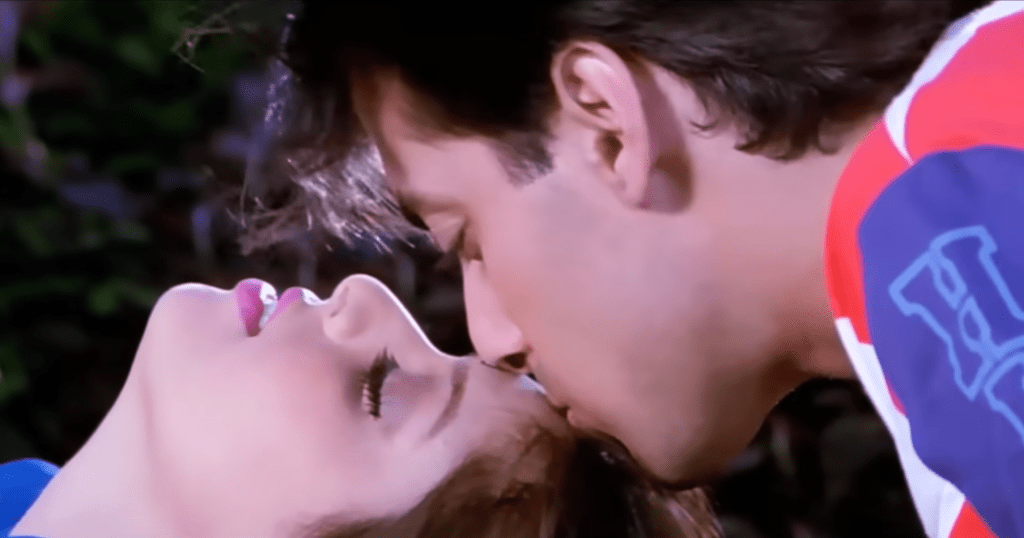
The scene from the movie in which the song was inserted depicted a country starting to creak toward a major makeover. The stars Salman Khan and Nagma were fresh and young. Salmanโ€™s red white and blue striped jumper clearly represented kids who looked to America rather than the Soviet Union as did many of their parents. They are shown shopping at Foodland one of Bombayโ€™s early western-style supermarkets and buying large blocks of Toblerone chocolateโ€ฆhitherto a rarity other than in Duty Free stores. Despite their new cool clothes and products their behaviour very much was still line with the flirty, cutesy comportment of previous eras; devoid of any adult sensuality.

**+**

India felt like it was going to explode in those years. Something had to give. There was so much potential being held back by an inefficient bureaucracy and the sclerotic โ€œnetas/เคจเฅ‡เคคเคพโ€ (leaders) of Independence-era politics. The subterranean rumble of a vibrant business, media, creative and learned sector was impossible to ignore. The political system was fizzling with sparks and thick smoke while shooting colourful lower caste personalities who leveraged significant political influence, into the public realm. Something unstoppable was going on. India was changing. Perhaps too fast. Perhaps long overdue. But with no clear vision (yet) of the destination.

I lived in Pakistan at the time which was trying to cope with its own massively shifting tectonics. (Another story for another time.) Many of my holidays were spent in India, where I had been born and lived until the age of 17.  As soon as you crossed the border the energy of a changing culture was everywhere to be seen, heard and felt.

Whatever you thought of Rajiv he was not your usual Indian politico. The Great Leaderโ€™s grandson, who flew commercial jets. Undoubtedly young and handsome ย but also henpecked by his fierce Italian wife. Rajiv was the first national leader with some actual experience of the world beyond Congress and JP politics. He was admired pretty much universally. For a few years anyway. ย With his blood connection to Nehru and Indira, Rajiv led the country to the base camp of the political Everest that would eventually be summited and claimed by Narendra Modi.

Mud vessels were replaced overnight by cheap bright colored plastic buckets. Tea was now always served in a porcelain cup or glass tumbler. Youโ€™d get it in a clay mutka only in certain out-of-the-way places.

Doordarshan, the stuffy national television station was being bruised up by Star TV and Zee TV.  Networks that provided youth-centric game shows, music videos and reruns of international television hits. Bandits were in the news. Phoolan Devi and Veerapan. Multiple states were sites of โ€˜rebellionsโ€™: Punjab, Assam, Kashmir. Khalistan and Gurkhaland were put forward as new ideas.  Naxalites seemed to be resurging in Andhra. Hand painted movie hoardings were quickly fading away.  Digitally produced adverts choked off one of the great pleasures of being a film buff.    

Everything was in flux. It was an edgy time. Assassinations of Prime Ministers. Caste politics. Phoolan Devi was sent to jail for her crimes against the upper castes but then was elected to Parliament. Elections, held once every five years, had been up to this point, a yawning affair in which Congress or Indira seemed always to win. But between 1996 and 1999 the country voted 3 times. Seven PMs took the oath of office in the 90s. Most of them lasted a year, tops. Some a few months. A fatigued shopkeeper in Mysore sighed deeply as he gave me my change, โ€œToo many elections.โ€

India as a real center of global power and influence was still largely rhetorical but everyone knew it was only a matter of time before the โ€˜old waysโ€™ of running India were shredded for good. ย Looking back, it was a generational change. A transition from a solid base built by a single political organisation and its most prominent family, to skyscrapers, flyovers, Pepsi and the birth of India’s billionaire class, Ambanis jaise. Hard to believe today the Nehru/Gandhis could ever have been relevant and admired.ย  Narendra Modi was a state based political apparatchik at the time but the wave he would ride to successive victories was starting to swell.ย  A group of young men talked loudly to me as we rode a train through central India. The Muslims had it coming. They were tricky and dirty and evil minded. This is a Hindu country.ย  ย 

**+**

Pop music, which in India equates to filmi[1] music, was sounding different too. ย A decade earlier the first lightning bolt to electrify the airwaves struck in the form of a 15yr old Pakistani girl singing the catchy, Aap Jaise Koi (Somebody Like You) in Qurbani (Sacrifice), the biggest movie of 1980.ย  With a sound that mirrored perfectly the soft rock heard on American AM radio in the mid-70s (groovy bass, scratchy rhythm guitar, synth, soaring melody lines) the singer (Nazia Hassan) and producer/composer (Biddu) went on to become international stars throughout the 80s. Disco-lite had arrived in India.

A transition from the founding fathers and sons of Hindi film music, to a new crew of shamelessly self-promoting producers/writers/composers like Bappi Lahiri began chipping away at the thick walls that had protected film moguls from even considering changing their decades-old formula. Four voices[2], two female and two male, had completely dominated filmi music since the 60s. The soundscapes in which they were asked to sing were equally dominated by Indian instruments and compositions based upon classical ragas or Punjabi/Bengali folk songs. If Western sounds and instruments were heard it was to signal the arrival of the vamp or the Vat 69-drinking villain.

Bappi Lahiri was a different kind of music director. He reveled in excess. As big as Barry White, he draped himself in bling, wore flamboyant shades 24/7 and embraced the wildest ideas. ย A true disrupter. He could compose in the comforting, long-standing sound of the 50s-70s with real conviction and skill. ย But a trip to a nightclub in Chicago in 1979 changed his career from a respected composer/arranger into the badass of Bombay. โ€œAfter a Chicago show,โ€ Bappi told an interviewer. โ€œWe went to a club.ย  A DJ was playing the most amazing music. Something completely new and fresh. John Travolta and the Bee Gees. I asked him what this was and he said, โ€˜Disco.โ€™โ€ ย 

Disco hit Bappi hard and upon return to India he introduced its thumping beats into nearly every one of his projects. If Biddu had snuck sweet Western pop melodies into Qurbani, Bappi turned the volume up to 11 and exploded woofers from one end of India to the next. Bappi was shameless. For the rest of his career his name was synonymous with upbeat, percussive dance music. Though the โ€œDisco Kingโ€™sโ€ formula rarely strayed from a steady, 4 on the floor beat, and vapid, repetitious lyrics, there is no question that without Bappi Lahiri there would be no AR Rahman.

Huge as Bappi was (he died in 2022) it was technology that really laid the walls of filmi music to waste. Cassette tapes came to India later than the rest of the world. They started to appear in the late 70s but import restrictions and decades-old laws that promoted local manufacturing meant they were priced as a luxury item. Or at least the machines that played them were. But as demand increased some restrictions on manufacturing both tapes and tape recorders were lifted and Indian entrepreneurs jumped into the deep end with gusto.

In the winter of 1984 on a visit to Allahabad I was blown away by the carts of cassette tapes being hawked in every bazar in the city. Literally hundreds of titles by artists I had never heard of. Everyone was browsing and buying, even rickshaw walas, school kids and policemen, who until that moment had probably never owned anything but a radio. Especially popular was a genre called ghazal. Especially as sung by a husband and wife pair, Jagjit and Chitra Singh. Their tapes sold fast and new ones released just as fast. What was even more remarkable was that this was not filmi music.

Ghazals and Jagjit and Chitra may have been the most successful genre in cassettes but they were not the only style and type being bought up. All sorts of regional folk styles hitherto untouched by the major recording companies (EMI and Polydor), in every language and dialect under the Indian sun were suddenly available dirt cheap. Tapes with sexy lyrics, comedy tapes, religious chants and pop music by wannabe stars from small cities in the hinterland were available everywhere.

Not just a giant tech leap forward, the cassette boom must surely rank as one of the great economic stimulants of that period. Piracy helped the revolution along. What just a couple years before had been seen as a โ€˜foreignโ€™ object for the well-to-do, was now available for a few rupees. This was a very exciting period to be a music lover in India. I could not get over the fact that here were the faces of Kishore and Rafi or Amitabh on a cassette cover, equally at home as Michael Jackson and the Rolling Stones .

In the words of Peter Manuel, whose 1993 book Cassette Culture: popular music and technology in north India documents this period of transition, โ€œโ€ฆcassette technology effectively restructured the music industry in India. In effect, the cassette revolution had definitively ended the hegemony of GCI,[3] of the corporate music industry in general, of film music, of the Lata- Kishore duocracy, and of the uniform aesthetic which the Bombay film-music producers had superimposed on a few hundred million listeners over the preceding forty years.โ€

Filmi musicโ€™s share of the market shrank immediately and dramatically to less than 50%. Indipop, as this new wave of non-film music was labeled, stormed into public consciousness. New stars singing in new languages, including loads of English phrases, new factories set up in places like Bhopal, Coimbatore and Dehra Dun opened thousands of new markets. ย It seemed filmi music was going to die a quick death. ย Indipop flourished, thanks to the plastic cassette and the arrival of what Indians call โ€˜liberalisationโ€™.

By the late 80s, Indiaโ€™s protected and insular economy was no longer fit for purpose. All political parties understood this and in 1990 a process of doing away with the restrictive import duties, tariffs and allergic attitude to foreign investment especially in products valued by the booming middle class began.  Satellite and cable TV showed foreign movies and TV shows. People with money could travel more freely and experience the same things people outside of India took for granted.

The film industry was given government financing for the first time in its 60 year history. More movies were being shot overseas. Sound quality of the music improved dramatically. Audiences thrilled to see their idols dance through the streets of Paris, Cairo and Sydney all in the same song! But filmi music held on. It learned from the changing times and by the early 2000s had once again grabbed back its near monopoly of the popular music market. Indipop stars, once the great โ€˜altโ€™ pop singers, were invited to sing in the films. ย The half dozen geriatric (though immensely beloved) singers who had โ€˜ownedโ€™ filmi music were steadily pushed aside, along with those folk and classical talas and sensibilities.

Songs like Kaisa Lagta Hai were among the first to move in a new direction. Kishore Kumarโ€™s son, Amit, sang the male lead. Anuradha Paudwal the female lead. Amit eventually retired, blown away by the likes of Anu Malik, Kumar Sanu, Udit Narayan, Lucky Ali and in the late 90s and early 2000s exciting singers from Pakistan: Atif Aslam, Zafar Ali and Adnan Sami. ย Sophisticated, widely influenced and wildly talented composers, exemplified by AR Rahman were now firmly in control of the filmi ship.ย  American and European audiences grooved to Jai Hoย and Mundian Bach Ke. Bappi Lahiriโ€™s compositions found new life in American/European songs like Addictive (Truth Hurts), Freeze (Madlib) and Come Closer (Guts).

And India today, whether you like Modi or not, is a true global power center and influence peddler. It all began when the floor of old India and the old Hindi filmi world fell away with the tentative arrival of songs like Kaisa Lagta Hai.


[1] Music and songs from Indian, mainly Hindi/Urdu language, movies.

[2] Lata Mangeshkar, Asha Bhosle, Mohammad Rafi and Kishore Kumar

[3] Gramophone Company of India, formerly known as His Masterโ€™s Voice, was until the late 60s the only significant producer of recorded music.

Book of Accounts (Instalment # 10)

XII

General Petros Zalil, known to the public as head of Party Intelligence, but to Abdul Rahman as Director General of Jihaz Haneen, was a vile Christian bug. A failed doctor and scholar, Zalil had amused his way through youth by decoding ancient dead languages and practising โ€˜surgical interventionsโ€™ on a variety of household pets. His family of shopkeepers, who had left Lebanon to settle in Tikrit during the Ottoman times, despaired of young Petros ever bringing honour or profit to the name Zalil, but then shopkeepers never care for politics. And no one was surprised more than his father when, after the first failed Baโ€™ath revolution in 1963, young Petros was charged with the task of constructing the Baโ€™ath Partyโ€™s secret apparatus.

Though a Christian (he liked to remind people that a cousin had once served the Patriarch of the Maronite Church as personal secretary), Petros Zalil cared nothing for God and less for man. A feverish, personal sense of injustice had fired him into the steel rod so needed by the Baโ€™ath Party. Zalil hated everyone and everything lukewarm, especially those weak in their commitment to the Baโ€™ath. He resented and eliminated communists wherever he smelled their foul stench. Timeservers in every Ministry, he smoked out like hares from their holes. Officers who had joined the ranks during the time of President Aref were cashiered, then jailed. And it was Zalil who almost single-handedly cleansed Iraq of the Jews. His bitter hateful feelings were distributed universally and democratically; there was no one Zalil did not loathe, except Saddam Hussein, the man who had personally chosen him to build the partyโ€™s secret police: the Instrument of Yearning. Jihaz Haneen. And it was because of Zalil and his secret organs that the first Baโ€™ath President, al Bakr, and Vice President Saddam Hussein, were able to keep the power they grabbed in July 1968.

Of course, Zalil had no military or security training โ€” where was a poor shopkeeperโ€™s son to find such means? โ€” but Saddam knew that Zalil understood the most fundamental law of Baโ€™ath survival: loyalty. Saddam was confident that Zalil, Christian though he was, could, and would, bring order to the secret groups, which by 1963 had been completely infiltrated by the armyโ€™s generals. Perhaps because he was snatched from obscurity (Zalil was a mere sergeant in the Tikrit police when Saddam discovered him) Petros Zalil did not disappoint his master. From that day forth his mind remained vigilant to anything and anyone who threatened his Almighty, his God, his Creator, his Comrade, Brother, Father Saddam. In fact, Zalilโ€™s personal devotion to his Saviour became the only standard by which Jihaz Haneen was to be judged. Truly, Petros Zalil was a giant of the Iraqi nation.

In the early days, General Petros Zalil โ€” he had been promoted in 1965 โ€” could not trust his good fortune; lest he lose the grace of his benefactor, Petros Zalil took upon himself the task of demonstrating his loyalty to Saddam at every opportunity. Even the triumph of the 1968 July Revolution did not allow him to relax. But then in December 1968 a very nasty conspiracy designed to bring down the young Baโ€™athist State was publicly exposed by Zalil and at last, once and for all, his place close to Saddamโ€™s breast was secured.

The entire nation, including Abdul Rahman, had watched the disgusting interview on television or listened on the radio. Three men (one of them a Party big shot) confessed that they had been recruited by a merchant of kitchen utensils in Basra: a Jew named Nadji Zilkha. The Jew used a radio set he had manufactured and hidden inside a church to contact Israel. He had arranged for Iraqi Jews to receive military training in camps in the mountains of Iran and, with the help of the Kurds in the north, succeeded in setting up a channel through which large amounts of dollars from Israel to Iraqi Jews flowed. Such a terrible plan could only have been imagined by a Jew! Of course, Zilkha, the Persians and  the Kurds were not alone. The President of Lebanon, Henry Firoun, arranged for the Director of the American Ford car company in Baghdad, also a Jew, to smuggle the Iraqi Jews into Iran by means of a Pakistani shipping company! When the men completed their pitiful confession, the judge sent them directly to prison. They never were seen by their families after that day. But the others, mostly Jews, thirteen in all, were rounded up by Zalilโ€™s men and executed within three weeks.

On the day of the executions, Abdul Rahman and his friend Aziz went with the crowds to watch the Jew corpses swinging in Nafura Square. What a marvellous sight! Iraqis came from all across the country. Even Bedous, stinking of date oil, emerged out of the desert on their camels and pressed into the square, jumping up and down to get a glimpse of the criminals. President al Bakr shouted encouragement to the crowd, vowing to foil all the plans of the Zionists.

Like the other spectators, Abdul Rahman had no particular feelings about Jews. They had shops which everyone knew about, but they spoke like Arabs and looked like them too. As the corpses dangled in the square, the crowd was excited not by feelings against the Jews but by feelings of pride. Of victory over traitors. Until the Baโ€™ath, Iraqis had resigned themselves to foreign domination: Persians, Turks, the English. Everyone wanted to remove Iraqi oil at low prices. It was only when Petros Zalil took control of the secret organisations that Iraqis dared feel confident. To see the limp bodies of those traitors was a great day in Iraqi life. The people were sure that from now on all foreigners would think very carefully before attempting to undermine the State; especially, but not only, the treacherous Jews.

The response of the public and the President encouraged Zalil; more and more conspiracies were exposed. Every week the papers published the names of those who had been caught in their plottings and executed. Hundreds of Iraqis swung from lampposts in those days; and not just Jews. Christians too, and even Muslims. Zalilโ€™s power grew with each triumph. With every exposed plan, the head of Party Intelligenceโ€™s confidence swelled. Newspapers and officials praised his efforts. His speeches, full of long, impressive words, were printed and sold as pamphlets. On the second anniversary of the Revolution Zalil gave a speech in Tahrir Square which Abdul Rahman never forgot.

โ€˜The Iraq of today,โ€™ Zalil shouted, โ€˜the great Baโ€™athist and Arab homeland, the womb of culture, will henceforth not tolerate traitors, spies, foreign agents or fifth columnists. Not a single one. The bastard-child Israel, Imperialist America and Persian lackeys must hear this message. We will discover their dirty tricks! We will take punitive action against their agents! We will suspend their spies from Iraqi trees, even if they despatch thousands of them! You, each of you, are the protectors of the great Iraqi nation. You must not slacken the pace we have set since the advent of our pan-Arab revolution! We have just taken the initial steps of the revolution! The great immortal squares of Iraq shall be filled up with corpses of traitors and doublecrossers! Just wait!โ€™

The Christian general praised the success and efficiency of his secret police. But, he noted with regret, some, especially those not โ€˜entirely Arab and purely Iraqiโ€™, seemed to be questioning whether it was indeed necessary any more, at this stage of the Revolution, to fill up the squares and alleys of Iraq with traitorous corpses. Some newspapers, he screamed, had begun to sow seeds of doubt within the public. The crowds attending the executions were decreasing in size. The papers were writing shorter and shorter articles on the public humiliations and executions. One rag especially, Al Anwar, was leading the way. Wasnโ€™t the paperโ€™s proprietor a pre-Revolutionary minister in Qasimโ€™s thug government? A new plan was needed, Zalil bellowed, which would meet this new challenge to the victory of the Revolution.

โ€˜Any strategem to achieve victory over the enemy,โ€™ he continued, โ€˜must consider from the outset liquidating those pockets which guarantee that the enemy has information, and that play a role in generating destabilising propaganda, thereby weakening the spirits of the people and their resolve for victory. This leads to a loss of self-confidence in preparation for defeat. When we Arab Iraqis become determined to wage war against the foreign un-Arab espionage networks, we of necessity must be aware, and we must be possessed of the certitude that hitting at these networks must necessarily be accompanied by an assault on the pockets of mongrel Judeo-Persian-American exploitation. In order to purify the nation and its people, I propose to refocus our efforts on these sinister pockets of public treason.โ€™

Three days after the speech, the owner and editor of Al Anwar daily newspaper died when his car exploded into the evening sky of Baghdad. The next day a bus carrying Jewish schoolchildren to their college was bombed as well. Throughout Baghdad, and even in other cities like Mosul and Kirkuk, prominent but suspicious journalists, professors and priests were murdered in a terrible campaign of car bombs. The explosions were so frequent that Baghdadis avoided all vehicles, preferring to walk about the city. The taxi drivers petitioned the government to take action to save their livelihoods.

Zalilโ€™s campaign succeeded beyond his own wild imagination. Not only were dozens of State enemies eliminated but within months President al Bakr announced Zalilโ€™s elevation to the Revolutionary Command Council. Al Bakr, they said, nearly showed tears during his speech. Iraqis had always been known for their loud mouths and boisterous ways but from the time of the rise of Petros Zalil, Iraq was transformed into a country more quiet than midnight. โ€˜My proudest achievement,โ€™ Petros Zalil never tired of repeating.

Indeed, turning a nation of hotheads into a laboratory of mice within five years was a grand accomplishment. And for more then ten years Zalil was satisfied. But it was only a matter of time before the situation began to change. For ten years Zalil feared Saddam. But slowly he developed his plan to devour him.

โ€˜Is it not often the case that the gateman is more powerful than the king?โ€™ Zalil enjoyed speaking to his own image each morning as he shaved. As the most feared man in Iraq he had few friends but even as a boy he had preferred his own company. Other humans were an annoyance. The razor cut a path through the thick white cream, and he said out loud. โ€˜The king, busy within the castle, manages the affairs of his people, but he must trust the gateman to keep the enemy beyond the city walls. But should the gateman not be worthy of the kingโ€™s trust, or decide that the throne is rightfully his, since it is he who determines whether an usurper gains access to the inner court, then the king is transformed into a pawn. Who has more power? Surely, not the one who must trust in the other?โ€™ As he splashed water onto his freshly shaved face he was satisfied that no one stood between him and President Saddam.

The gateman began to plan his own coronation.

*

In 1980 Zalil had applauded Saddamโ€™s audacious invasion of Iran, but for years he had not been happy with the way the President was conducting the war. When Khomeini sent waves of children to face Iraqi tanks, the television and newspapers were filled with photos of fields, covered with little dead boys. Eight or nine years old. Who could comprehend the beastly nature of the Persians? Who could sacrifice their own sons in such a way?

Zalil of course cared nothing about the children. โ€˜Iraq,โ€™ he shouted into the mirror one morning, โ€˜has been brought to its knees by toddlers.โ€™ The refusal of Iraqโ€™s top officers to slaughter the children was a point of humiliation, a sign of weakness that Zalil could not admit. โ€˜What better chance will God give to Iraq than this?โ€™ he demanded. He ran water over the razor to relieve it of his heavy whiskers. โ€˜Never again will the road to Tehran be covered with such a plush carpet. Our tanks should roll over these Persian children as if they were a field of onions.โ€™

It was not just the armyโ€™s reluctance to kill children; there was Saddamโ€™s frequent change of field commanders which tried Zalilโ€™s patience beyond all limits. For more than ten years Zalil had developed Haneen networks in every barracks and every regiment and battalion in the army and airforce. Many of the top brass were either fully Haneen or had sympathies with the head of Party Intelligence. Of course, these men were loyal Baโ€™athists; their allegiance to the Baโ€™ath Revolution was unquestionable. But they had been groomed by Zalil. It was he who had rigged their promotions and plotted their careers with the mind of a chess player; their ultimate loyalty was to him, not the President. โ€˜See again, how the gateman is more powerful than the king.โ€™ He winked at himself in the mirror.

One year the Iraqi army lost over twenty top field commanders. And middle rank officers? Beyond counting. Every time a battle was lost and even once when the broken axle of a supply truck caused a delay in the refuelling of an advance unit the commander in charge was summoned back to HQ. Bang. Dead. Soon the High Command didnโ€™t bother to make the arrangements to bring the officers back to Baghdad; they were shot in their own units, usually by their own soldiers.

โ€˜This is intolerable. How can the President demand vigilance if he is intent on plucking out every eye I have put into place?โ€™ He made another large sweep through the remaining foam of his pudgy face. โ€˜Damn!โ€™ A small trickle of maroon blood moved down his right cheek. Zalil grabbed a towel with exasperation. โ€˜This manโ€™s erratic behaviour threatens my entire life work. I cannot permit this to happen.โ€™

*

The message was dispatched in a sealed envelope from the Ministry of Antiquities to each of their homes by the official ministry courier. In the envelope was an invitation to a celebration organised on the occasion of President Saddam’s birthday on April 28. Each of the recipients โ€” thousands of officials around the country โ€” was invited to make a donation of no less than one hundred dinars, and to select an ancient Sumerian symbol provided in a list by the Ministry of Antiquities. The donation would be used to mint a coin embossed with the name of each official and the special ancient Sumerian hieroglyph and was to be presented to the President on his birthday as a sign of the gratitude of his ministers.

The thousands of envelopes contained identical letters, worded exactly the same, and included the same set of Sumerian hieroglyphs. But in the envelopes delivered to the Ministers of Oil and Transport and Industry, Generals Fikri and Mahmood, and Dr Idris, Chairman of the Regional Command Council of Baghdad, Petros Zalil included his own short list of Sumerian symbols. Each man, a conspirator with the head of Party Intelligence, had been instructed to select one symbol only from Zalilโ€™s list and return it with their invitation, and in this way indicate their participation in the gatemanโ€™s move against the king. Within a week Zalil had received five of the six special invitations properly marked. The Minister of Transport had lost his nerve and decided not to return his invitation. Without a second thought the viperous Zalil struck: two days later the Minister was discovered by the departmental cleaner, dead on his office floor, a bottle of turpentine next to his head. Five litres of fluid were pumped from his stomach when his bloated body was delivered to the Emergency Ward at Medinatul Tib hospital.

Each of the plotters had been in contact with their spider, Zalil, for some time, and each had his own private complaint. The Minister of Oil had been brought to financial ruin by the blackmail of Saddamโ€™s half-brother, Barazan. Dr Idrisโ€™s son had been denied treatment for his cancer in Germany and died at the age of seventeen. The Generals, of course, feared for their lives as long as the Persian war raged on year after year. The Minister of Industry, Haider al Haji Younus, Abdul Rahman’s relative, had been three times denied a seat on the Regional Command Council of Tamim Region.

After the untimely, but little mourned, death of the Minister of Transport, Zalil arranged a large dinner party at his residence to mark a grand Revolutionary occasion. Among his guests were not just his colleagues in the conspiracy, but members of the Presidentโ€™s family, members of the RCC and the Prime Minister, Mr Izzat Qureishi. Zalil had prepared, and delivered very dramatically, a grand speech to mark the occasion and, of course, crates of whiskey, arrack and vodka and the most sumptuous meal had been laid on for the guests. But by the early hours of the morning Zalil was left alone with just his five co-conspirators. In a private study, in which every listening microphone and every hidden eye had been disabled prior to the start of the eveningโ€™s festivities, Zalil called the final meeting of the plotters to order. Each of the men present had been given their assignments: the Generals confirmed the availability of two thousand men and many armoured personnel carriers; the Oil Minister had already begun to scale down production, and the pipeline to Turkey was โ€˜closed for repairsโ€™. Haider, Minister of Industry, had been in contact with Iraqi exiles in Europe for the past two years. Some had already returned; others were on the way. The only thing remaining was to finalise the actual plan. Zalil confirmed that Saddam would be out of the country for two weeks in June, on official visits to the Soviet Union, East Germany and Finland. Upon his return to the country, the group would assassinate the President.

Assassinating Saddam was a game of Russian roulette. The President of Iraq never travelled in his official, announced motorcade. Always, five dummy convoys were sent through the streets of Baghdad, each taking different routes to the destination, and even Saddam himself knew which motorcade he would choose only at the very moment he stepped into a vehicle.

But it was Zalil’s belief that as gateman he could successfully foil the system. The system, after all, had been designed by him. Within Haneen a unit answering to Colonel Nizar, was responsible for monitoring each and every alley and street in the city. Every lamppost, every window, every turn and every manhole was known to them. Colonel Nizarโ€™s information was priceless, and he was with the plotters. Determining the routes of each convoy would not be difficult: Nizarโ€™s unit was responsible for selecting and preparing and securing all routes on every Presidential journey. Only the driver of the lead vehicle, a Haneen employee, knew the route of the convoy, and that only a few moments before the beginning of the journey when he received the instructions, in code, on a secure radio channel.

Zalil and Nizar had arranged that along each route, near a predetermined crossroad, the first vehicle of each convoy, pre-planted with a bomb, would explode. Discovering which vehicle would lead each convoy was also simple. Always a dark-green, almost black, Mercedes provided by Party Intelligence and driven by Haneen drivers. This system had been instituted by Zalil in 1970 and it had never changed. A wire laid across the road would send an electronic signal causing the bomb to explode just as the first vehicle rolled through each prearranged junction. This is where the Generals became useful. Ten armoured vehicles and two hundred men fully equipped with rocket launchers, machine guns and grenades, hiding in pre-arranged vacant rooms and buildings in the side streets, would burst forth, firing openly on the remnant of each convoy. Zalil’s intention was to decimate all five convoys. The explosion was only diversionary. The Presidentโ€™s vehicle is always fourth in the convoy. As the first two or three cars were caught in the mรชlรฉe, the driver of the Presidentโ€™s car, trained for such exigencies, would turn instinctively into the nearest street. Because Zalil and Nizar had selected especially narrow cross streets for each explosion, the driver of vehicle number four in each convoy would have no option other than to turn unthinkingly into the plottersโ€™ side streets. There was no way Saddam would be able to escape.

The plan was faultless. While the convoys were under attack Zalil planned to announce a popular uprising, which the returned exiles were responsible for generating in towns all around the country. โ€˜By noon, Baโ€™ath power will be wiped from the pages of Iraqi history,โ€™ he cooed at his tired but eager guests. The sun was rising over the Tigris. Zalil’s dinner party was over.

*

It is true, Zalilโ€™s plan was daring and bold and he had more support than any other plotter before him. To have even the overseas Iraqis supporting the show was Haider Younusโ€™s great contribution. Zalil could not fail. Everything was under control. But then something unexpected and miserable happened. In May, the Prime Minister, Mr Izzat Qureshi, โ€˜resignedโ€™ and the plotting Minister of Industry, Haider al Haji Younus, was appointed in his place.

As much as anyone, Haider was taken by surprise by this sudden twist of fortune. For years he had struggled for promotion to the Regional Command Council and each of his attempts had been rebuffed. He had resigned himself to dying as Industry Minister, until resentment led him to Zalilโ€™s group. But now, so unexpectedly, Haider was Prime Minister! A seat on the Regional Command Council, dreams of which, until then, had tortured his every waking moment, now, from his lofty new perch, seemed ridiculous. And the resentment he had harboured towards the President for so many years turned, overnight, to bottomless gratitude.

Of course, Haider had been selected as Prime Minister because he was a weak and completely dependent character. Unlike Prime Minister Qureshi who preceded him, he did not enjoy the backing of foreign interests. He was extremely dispensable. The country was in the midst of unexplained bombings and unrest was increasing, not just in Baghdad but throughout the country. If Haider Younus was unable to do what was needed, no one would shout or cry when his time came to be sacrificed.

Naturally, Haider was in a state of confusion as he took his oath of office. He swore allegiance to the Party, the State and the President himself, but at the same time he had made promises to the gateman to destroy all three. It was time to make a quick calculation of risk, but nothing is ever valuable if done quickly. On one side, he knew that Zalil was still depending on him for his support. In fact, on the day of his promotion, Zalil sent a message and a bottle of twenty-one year old Chivas Regal to Haider, congratulating him on his good fortune and predicting an even brighter future โ€” a signal that the plan was to go ahead on schedule. On the other side of the balance, there was the President. Haider was overcome with gratitude by his elevation. Horses, it is said, sometimes bite their masterโ€™s hand, but Haider did not consider himself to be a horse. Not unnaturally, his views on the plot changed dramatically.

But not only was Haider not a horse, he was not a decisive creature either. For three weeks he did nothing to suggest to Zalil and his conspiring colleagues that he was in two minds about the plot. And just like Zalil, and all the others who had been drawn close to the Presidential breast had done before him, Haider wanted to demonstrate his loyalty to Saddam. So on the day the President was to return to Iraq to meet his almost certain death at the hands of Zalil, Haider requested the Presidentโ€™s son, Uday, to pay a visit to the Prime Ministerโ€™s office.

โ€˜I must notify you,โ€™ Haider told Uday, โ€˜as the President is out of the country, that a plot to assassinate your father has been uncovered. The plotters are at this very hour gathering at the airport.โ€™ He then elaborated the plan in detail.

*

At Saddam International Airport, Zalil, with most of the governmentโ€™s senior officials and military top brass, had arrived to welcome the President. At 9.45 a.m. he noted that Haider had not yet arrived; the Presidentโ€™s plane was due to land at 10.10 a.m. Without hesitating, he approached the Minister of the Interior and the Minister of Defence.

โ€˜I fear there may be trouble today. The Prime Minister, that rodent Haider Younus, is not here. Indications are that he is involved with Generals Mahmood and Fikri and Colonel Nizar as well as that old fart, Basil, the Oil Minister. I have just received information that their objective is to assassinate not only the President but most of us here.โ€™ He paused. A vehicle pulled up behind the men. โ€˜Do I need to insist that we should depart immediately and return to the city and do our best to protect the President?โ€™

The three men ducked into Zalilโ€™s vehicle. Inside, Zalil and his two bodyguards removed their pistols and pressed them against the sweating necks of the Ministers. Zalil commanded his driver to head north to Baqโ€™ubah. Before Uday and Haider had been able to notify Military Intelligence, Zalil had disappeared from Baghdad with his two hostages like a cloud in a drought.

When the Presidentโ€™s plane landed, Saddam was advised to remain on board while the plotters, Generals Fikri and Mahmood, Colonel Nizar and the Oil Minister, Basil Hamdoon, were arrested. The army units waiting quietly in their hideouts on the side streets panicked when the time for their action long passed. By evening more than three hundred arrests had been made.

The following day, after the body of the Interior Minister was recovered from an alley in Kirkuk with nails throughout his body, Saddam placed a price on the gatemanโ€™s head. Three days later, the Minister of Defence was discovered by a taxi driver, lying in the middle of the highway at Chamchamal. His throat was slit and not a stitch of clothing was on his flabby body. Zalil, the rumours went, escaped to Iran where the Persians welcomed him like an Olympic champion.

Abdul Rahman had been aware of these incidents. Who hadnโ€™t? Each new development was presented in the papers as another demonstration of the invincibility of the President. And so it seemed. If Zalil, that most intimate confidant, could not succeed in his evil, surely the Spirit of the Arabs rested on Saddam. Abdul Rahman trimmed the newspapers like a rose bush, grafting the small news items into his accounts ledger. The involvement of his relative in the mess had disappointed him but, as Haider had acted properly by exposing the plot, Abdul Rahman rested in the confidence that it was the President who was now indebted to his relative. Abdul Rahman’s own destiny was secure. Of this he was certain.

But Saddam was not fooled. For Haider to know about Zalilโ€™s plot in such detail he must have been in on the conspiracy. Prime Ministers, despite their lofty office, do not enjoy direct access to the secret goings-on of Jihaz Haneen. Saddam had chosen Haider because he was expendable and so he was expended. After a meagre six weeks in office, Haider was arrested by the Emergency Law and Order Administrator and taken to Abu Gharaib prison. Within eight hours he was no more.

*

That damp July morning, after the arrest of his relative, as Abdul Rahman drove through the city to his small flat, scales fell from his eyes. His household was in an uproar. He strode into the dining room with motivation and strength, persuaded that whatever confusion he himself felt he would not show it to his family. At the dining table his wife sat sobbing. Jamila, the servant girl, tried to comfort the woman, but was pushed away each time she reached toward Abidaโ€™s face. Haroun and Hassan jumped up as soon as they saw Abdul Rahman and said in unison, โ€˜Father… โ€™ They wanted to say more but reconsidered. Abdul Rahman sat down next to his weeping wife and told Jamila to bring a cup of coffee. His sons remained standing as if frozen in ice.

โ€˜What is the matter, Abida?โ€™ he asked. โ€˜Why all the commotion?โ€™

Abida continued to sob for several seconds before lifting her face. She tried to speak but only managed to blub more tears.

โ€˜What is it? Has someone broken into the house? Come now. Be calm. What happened?โ€™ Abdul Rahman’s composure was strained; his mind already confused by the nightโ€™s momentous changes. He reached towards his wife and placed a hand on her shoulder. He squeezed her firmly. His mind remained filled with the weirdness he had seen on the streets; he was exhausted. A strong urge to consult his ledger for reassurance that the Prime Minister was, in fact, still on his seat, washed over him. He wanted nothing more than to look at the man’s photos and to re-read the articles of his appointment.

He was growing more impatient with his wife every passing second.

โ€˜Abida!โ€™ he said sternly. โ€˜Stop nittering and tell me what is the problem! I have a headache like a mountain.โ€™

She wiped her wet face deliberately. Her lips quivered. โ€˜Zubeida has disappeared. She hasn’t returned since last night. With the changes today I’m afraid she… โ€™ Abida could say no more.

His hand fell from her shoulder. In the kitchen Jamila, the servant girl, had stopped making coffee, and waited. The house was quiet except for Abida’s soft, unceasing sobs. Haroun and Hassan stood still, daring only to blink. Abdul Rahman leaned back in his chair and closed his eyes.

โ€˜Why did you allow her to leave the house? And where did she go? Why didn’t you send a message to inform me last night?โ€™ His voice shook with fear.

โ€˜She went to the tutor’s house yesterday afternoon, I think.โ€™ Abida said, still looking at her lap. โ€˜You are the one who is always pushing her to keep studying even though the world is crumbling around us.โ€™

โ€˜But why didn’t you inform me yesterday?โ€™

โ€˜How am I to contact you? There is a curfew in the city from six p.m. Of course, that is something you haven’t noticed is it? But I’ve noticed it. So has the rest of the city. If we go outside this house after that hour we can be killed. How am I to inform you? I have no number to call you at your office.โ€™

โ€˜Of course, there must be an explanation. If there was a curfew she must have stayed at Mr Mohsin’s overnight. I’m sure Zubi will return as soon as the buses begin to move.โ€™ He felt relieved as he spoke the words.

โ€˜I have called Mr Mohsin. He had no plans to see Zubi yesterday. Only on Thursdays and Mondays since about the last two weeks.โ€™

โ€˜Don’t speak rubbish, bitch!โ€™ he shouted. The chair fell over as he pushed away from the table. The two boys scampered from the room like startled rabbits.

โ€˜In one night my relative, Prime Minister Haider, has been deposed and jailed. The country I thought I lived in and served has changed before my very eyes. I see devils parading up and down the streets. The radio is chanting strange names and barking strange orders. And now…this.โ€™ He moved closer to his wife and pulled her from her chair. She averted her puffy face, flushed from a night of tears. She shivered in his hands. Abdul Rahman had never beaten his wife or children, but that day he raged within himself. He wanted to lash out and hit her for suggesting that his little canary had disappeared. As he loosened one hand he remembered Jamila, the servant girl in the kitchen. โ€˜Get out! You should never have been in this house. Go! Run! Now!โ€™ he shouted. The front door shut quietly as she slipped away.

Abdul Rahman turned his attention toward his wife. He let her drop to the floor and kicked her; she rolled over and hit her head against the dining table. โ€˜Where is my daughter? What are you hiding from me? Where is Zubi? Zubi, where are you?โ€™ he called out. His voice bounded off the walls and back into his face as if it were slapping him. Absolute desolation crept into his heart. โ€˜Where is she? Where is my angel?โ€™

Abida pulled herself up against the wall. She shook her head in silence.

Unable to control his grief he lunged and fell to the floor next to her. His fist hovered for a moment above her face but instead slammed into the wall. And then again, and again. He shouted and pounded until his knuckles split and blood stained the sleeve of his shirt.

That day he didnโ€™t sleep. His mind was a slab of grey slate. Heavy bags were tied to his feet and dragged behind him everywhere he went. Although he drank lemon water constantly, each time he opened his mouth his tongue felt as dry and unwieldy as an old shoe. His heart danced in his chest like a drop of water on a hot plate. He asked Abida to call a doctor, but which doctor was willing to leave his house and come to Abdul Rahman’s? Throughout the day he tended a grief so deep his limbs and ears stung.

Abida refused to join him in his room, and sat without moving in front of the TV, staring at the announcer who read ever longer and more detailed proclamations from the Emergency Law and Order Administrator. โ€˜In order to ensure maximum peace and stability in the coming week…โ€™ Abida paid no mind. The images coming from the screen passed before her as if they were paying last respects to an acquaintance. Her head was cut slightly where she had rolled into the table; there was no blood but she sucked on her bitter thoughts. โ€˜I no longer care about your daughter,โ€™ she said in the evening. โ€˜Zubeida has always been yours, not mine. Your grief leaves no room for me to partake.โ€™

*

Thirty-three days later the Emergency Law and Order Administrator himself was deposed. The new Emergency Law and Order Administrator, Colonel Abdallah, proclaimed that Iraq was now under temporary martial law. In his first address to the people he condemned by name the man he had just overthrown, calling him a jackal. Abdallah emphasised his sincere desire to set the country back on its historic and stable path of development. He said, promised, stressed and underlined many other things but one in particular shocked Abdul Rahman beyond belief.

โ€˜The motivation of President Saddam Hussein and the RCC in embarking on this unprecedented act of armed intervention is to ensure the secure and stable and prosperous future of our country and its citizens. In the recent past some leaders of the State have been isolated from the people. The aspirations and ideals of the common man, the demand for justice and honesty, have been ignored. Even more, they have been deliberately trampled upon. A vast network of repression has been operating in this country with the primary purpose of crushing the spirit and voice and will of the people. It is a sad and bitter reality that in our country there have been many abuses of human rights. The police and special branches have arrested thousands without reason. Hundreds of these have disappeared or been returned to their families after having endured horrific torture and bodily abuse. Some intelligence organisations have been the leaders of this atrocity against the country’s dignity and honour. While there is a legitimate need for the State to defend itself against internal enemies the activities and intentions of some intelligence networks can only be termed criminal. Is it any wonder that you the people of Iraq have demanded the overthrow of this band of murderers? It is only because the President of the Republic knows that you endorse this intervention that I am able to proceed.

โ€˜With immediate effect and until notified by the Emergency Law and Order Administrator, the activities of all intelligence, counter-intelligence, investigative and interrogative bureaux and departments are disbanded and dissolved. All personnel employed by these departments and bureaux are ordered to remain at their place of residence until further notice. They are forbidden to travel beyond the borders of the country until such time as the ELOA determines their appropriate recompense.โ€™

Book of Accounts [Instalment #9]

Abdul Rahman locked the drawers of his steel desk and put on his leather jacket. An unusually cold rain had been falling all night, spreading chilliness and mud throughout Baghdad. Clouds obscured the normally intense summer sun. Leaving his office he walked outside where Aziz, his oldest friend, was leaning against his motorcycle listening intently to the first news bulletin of the day. He motioned Abdul Rahman to be quiet and to join him on the motorcycle.

โ€˜The state of emergency will remain in effect until further notice. All citizens are notified that the curfew currently in place will be extended from four p.m. to six a.m. and will be enforced with shoot-to-kill orders. Only personnel involved in official capacities and selected medical personnel will be allowed to move during these hours. The Emergency Law and Order Administrator, answering directly to the RCC, is charged with the enforcement of the curfew and all further proclamations. As of midnight all Governorate and city governments are dismissed and are replaced with ad hoc Security Committees. The office of Prime Minister will remain vacant until further notice.โ€™

Aziz fidgeted with the small radio, moving the antenna about as if trying to make contact with flies. Abdul Rahman stopped his arm. His voice was filled with panic. โ€˜A new Prime Minister? What has happened to Haider Younus? Who is this new Administrator? What has happened?โ€™

Aziz raised a finger to his lips and made a shushing sound.

โ€˜All universities, colleges and other institutions of education will remain closed until further notice. The Emergency Law and Order Administrator appeals to all students and teachers to desist from non-educational activities or risk severe repercussions. All citizens are forbidden to leave the country. All citizens providing aid and assistance to the following renegade groups are ordered to cease such assistance, otherwise be liable for severe repercussions: the National Relief Committee, the Flag of Justice, the Party of God, the National Democratic Party, the Peopleโ€™s League, the Committee for the Cessation of Human Rights Abuses, the traitor Petros Zalil…โ€™

The bulletin continued buzzing like an irritating mosquito.

Abdul Rahman could no longer sit quietly listening to the radio announce the destruction of the world. โ€˜Aziz, tell me, what is all this? Is this some joke? What is all this nonsense about Law and Order Administration? What happened to Haider Younus, the Prime Minister?โ€™

โ€˜He’s been arrested.โ€™

โ€˜Who has been arrested? You mean Haider Younus? The Prime Minister has been arrested? But he’s my relative…this is impossible. Who has arrested him? How can they arrest the Prime Minister? They can sack him, or he can die, or resign, but on whose authority has he been arrested? It is not logical, Aziz.โ€™ Abdul Rahman was desperate to hear from his friend that what he dreaded was not true.

โ€˜The Emergency Law and Order Administrator has arrested him,โ€™ said Aziz who was now scanning the dial for more news. โ€˜I suppose you can say that we have arrested the Prime Minister. For after all, it is our General Petros Zalil who is the cause of his troubles.โ€™ Aziz fished in his leather jacket for a pack of cigarettes. Abdul Rahman watched smoke hug the contour of Aziz’s face. โ€˜We should be pleased. Our ship has come in. It is our team that has won, Abdul Rahman. The secret organisations are now in charge of this country. No more worrying about the generals in the army, or that fool of a Prime Minister. You should see the way people will cringe before us after today. We are in charge now, my friend.โ€™

โ€˜How can you say we are in charge? I feel as if I have nothing. What do you mean? What is this about Petros Zalil? It is not normal. It is against the regulations and rules governing the structure of the state. The Prime Minister is appointed by the President. What does General Zalil have to do with such matters?โ€™ Abdul Rahman found it hard to slow his mind; his temples wanted to explode with questions.

โ€˜My friend,โ€™ Aziz chuckled, โ€˜where have you been living for the past twelve months? What rules and regulations are you talking of? The only rules you know are the ones you live by in your head. The rest of the people in this country have been trying to make new rules every day for the past year. The Prime Minister is in jail. He may even be here.โ€™ Aziz flicked the ash from his cigarette towards the ugly oblong concrete buildings behind them. โ€˜The head of Party Intelligence, Petros Zalil, has shat on the structure of state, or whatever you call it. I’m sure Saddam will twist some tails now.โ€™ Aziz smiled at the thought.

Abdul Rahman became numb. His body was like wax. He walked away from Aziz without a word. His friend’s excitement was beyond Abdul Rahman’s ability to comprehend. A sickness took hold of his insides and nearly flipped him to the ground. He leaned against his small Suzuki car and breathed deeply for a few minutes, desperate to inhale some understanding. After a few moments he slumped into the seat and drove. At the gate a guard handed him a piece of paper with the word Official scrawled in large blue letters. โ€˜Put this somewhere where it can be seen. We’ve made the letters as big as possible so it can be read from a distance. You don’t want to dodge bullets on every street.โ€™ He smiled weakly. Abdul Rahman dropped the sign on to the dashboard.

Outside the compound the streets were deserted. Only a few army jeeps scuttled about, like tiny crabs on the beach, ducking into narrow lanes and around corners. Each time he was pulled over and questioned his irritation grew, even though as soon as he showed his identity badge he was saluted and waved through; he felt as if he had been asked to drop his trousers for their pleasure.

Before that day Abdul Rahman had accepted the checkpoints and requests for identification as part of the harmony of daily existence, but now he viewed the soldiers, many of them his acquaintances, as rude, unwanted strangers. They grated against his nerves. The smoke from smouldering tires washed him with a sense of doom. He rubbed his eyes and wished for Baghdad to be as it was yesterday, before the Prime Minister had been arrested. Out of an alleyway a coffin draped in green and gold cloth, bobbed up and down on the shoulders of men; a group of women followed close behind, but their grieving was silent. His own city had become more alien than a remote, horrible country.

XI

How many hours or days had he lain in the oil shed with his hands and legs chained together? Was it still night, or was he asleep? There was a weak empty feeling in his gut; the desire for food made him struggle to a stiff sitting position. It was day. I have been sleeping. Just to be sure he looked around, half-expecting to see Aziz sitting on the boxes with his transistor in one hand and a smoke in the other. A hard piece of bread by his knee held his eye for what seemed minutes. Like a monkey lifting a grub from the earth, he picked it up and put it to his dry tongue. The bread wouldn’t go down the first time; he sucked it slowly, gently coaxing dampness to the surface of his tongue until it became soft and the bread seemed to melt.

Four turbans with rifles scowled at him from the door that creaked open while he was eating. Two grabbed his shoulders, pulled him to his feet, and watched as Abdul Rahman’s legs buckled slightly then gave way. The steel bar running from his ankle to his waist poked deep into his groin as he collapsed, and made him groan. The turbans lifted him again and pushed him forward as if they were his parents and he was an infant taking his first steps. He weaved and nearly fell again but the turbans caught him. With a rifle behind and one in front Abdul Rahman was dragged across the sand to the fat man’s bungalow. Purple and orange bougainvillaea against the stone house reminded Abdul Rahman of Zubi and the ribbons in her hair.

โ€˜Come in, Mr Iraqi Refugee,โ€™ called the fat man from the dark, chilled house. An unseen air conditioner hummed somewhere inside; the turbans were anxious to feel the crisp cool air and dragged their prisoner in immediately. The sudden change from the dark shed, to blinding desert sun and again into a darkened room, was too much for Abdul Rahman’s weak eyes. The fat man was breathing in front of him but Abdul Rahman saw nothing. โ€˜Kif al haal, ustad?โ€™ the fat man asked in Arabic. โ€˜Feeling well and healthy?โ€™

Abdul Rahman said nothing. Are they still holding me? Why am I feeling dizzy? His mind prepared itself stupidly, slowly, deliberately for the fall to the floor; he imagined each movement โ€” buckling knees, hands moving up, body twisting round โ€” as if he were connecting the dots of a picture in one of his sonsโ€™ art books. But he didn’t fall and slowly the thought came to him, I don’t want to fall again. The floor will be hard. But cool. His mind was a boulder he couldnโ€™t move.

โ€˜How is this, Mr Iraqi Abdul Rahman? Huh?โ€™ The fat man snorted.

I know that smell. The floor is cool. I want to lie on it. The smell reminds me of…kebab. Aziz is this true? Really, Haider is dismissed? I want to eat a kebab.

โ€˜Would you like a taste, huh?โ€™ The fat man was speaking, but Abdul Rahman saw only a dim shadow. โ€˜Come sit. Join me at the table.โ€™ The fat man snapped something in the local language to a turban who jumped to it, dragged Abdul Rahman to a chair and settled him in. Abdul Rahman tilted sideways like a pile of boxes stacked too high and was heading for the floor when the fat man barked again and a guardโ€™s arm steadied him. The fat man carried on talking. Maybe it was his state of mind or maybe it was the fat man’s poor command of Arabic but Abdul Rahman only heard broken pieces of phrases.

He paid no mind to the fat man and hung his head in a determined effort to gain a sense of balance. When after a few minutes he felt strong enough to lift his face he saw on the table before him dish after dish of food laid out on a white tablecloth, like the range of mountains outside the window of the shed. Bowls of soupy curries. Plates covered with shimmering red tomatoes and the thinnest slices of pink onions. Stacks of long brown bread. More stacks of white round breads. Meat on skewers and a greasy roast chicken. A huge thigh of goat right in the middle. Porcelain platters piled high with rice flecked with peas. Melon cut in squares and whole yellow mangoes next to what appeared to be a thick white pond of yoghurt. Cucumbers and radishes sliced and spread fan-like on a brass lipped plate. And in the back, glistening like light against a mirror, three bottles of ice-cold water, each standing in its own damp circle.

Without thinking, Abdul Rahman reached towards the nearest bowl; the chains holding his wrists together clanked against the table. As if he were swatting an annoying fly the fat man brushed Abdul Rahman’s hands back on to his lap. โ€˜La! La! Mamnuah! Forbidden, my Iraqi Refugee troublemaker. Forbidden.โ€™

Without blinking, Abdul Rahman continued to take in the plain of food stretching before him. Aromas penetrated him and enveloped him and gladdened him for the first time in days. He was sure he was biting that thick piece of tomato there. He tried again to lift his hands but the chains were too heavy, so he just stared.

A spoon dipped deep into a bowl of curry. Potatoes and peas. Fat fingers broke off a huge piece of brown bread and other fingers from another hand delicately lifted some tomatoes to the plate. Lemon juice squirted down like rain. Square pieces of meat rolled from a skewer. Thick bumpy yoghurt splattered over everything. The fat man could be heard chewing. He masticated his food deliberately, as Abdul Rahman watched his plump childlike lips suck in the food; his jowls quivered excitedly as the food passed from the lips to the cheeks.

The fat man was enjoying his noon time meal and apparently was having difficulty making up his mind whether to eat some rice or just stick to bread. There was a delicate mound of rice on his plate but he only nibbled on it; he made a face as if he were reminding himself to make a point to the cook. Each movement of the fat manโ€™s hand and lips was watched by Abdul Rahman in the same way a dog waits for its master to toss it a piece of gristle.

โ€˜Alhumdulillah. Thanks be to God.โ€™ The fat man belched with resonance from the depths of his full belly. โ€˜Now, Mr Abdul Refugee from Iraq.โ€™ He squeezed Abdul Rahman’s thin cheeks like he was testing a melon for its freshness. โ€˜I have news.โ€™

The fat man extricated himself from the tableside, forced his swollen pinkish feet into a pair of undersized plastic bath sandals and shuffled into another room. Abdul Rahman was too tired to turn to see where he had gone. And besides, the half-eaten feast still held his attention.

โ€˜The UN came yesterday. All your friends, the Iranians, have gone to Quetta. Only one is left here in Nushki. Only one. You.โ€™ The fat man clicked his teeth.

โ€˜What will you do with me?โ€™ Abdul Rahman whispered, but he himself wasnโ€™t sure if he had spoken or just thought the question to himself. The fat man was beside him again slicing open the fiery yellow skin of a mango.

โ€˜Huh? Speak up, Mr Iraqi refugee Abdul Rahman sahib.โ€™

โ€˜What will you do now? With me?โ€™

โ€˜Depends. On your attitude. Good attitude may produce happiness. Bad attitude something else.โ€™ The fruitโ€™s stringy pulp dangled from the fat manโ€™s unshaven face.

โ€˜Why did UN leave me here? Was I sleeping?โ€™ Abdul Rahmanโ€™s thoughts on the UN had changed. Why did they leave me here with this man? I want to eat that chicken. Untouched. This man is a devil. If UN talk with me I will tell them of my bad treatment. My ledger?

โ€˜They had no Arabic speaker to interview you. Only Mr Gilani came. He speaks only Persian.โ€™ The fat man shrugged as if he didnโ€™t care.

โ€˜I am a refugee. I need a refugee card. Money too. To go from this place.โ€™ Abdul Rahman mumbled.

โ€˜I told Mr Gilani, the UN officer, that they must send someone to interview you by Sunday. Pakistan government can not bear your expense forever, huh?โ€™ The mango lay on his plate like a carcass picked clean by a vulture.

โ€˜The day today?โ€™ Abdul Rahman asked.

โ€˜Wednesday.โ€™

โ€˜If no UN officer comes?โ€™

The fat man squeezed the Arabโ€™s cheeks again. โ€˜Back to your stinking bloody country. Back to hell. What do I care, huh? But we will not give you hospitality beyond Sunday. Pray to Allah, dear Mr Refugee sahib. Pray that UN will find someone who understands your language.โ€™

The fat man said something to a red turban who saluted him and marched out of the room. Abdul Rahman was shivering in the air-conditioned room, but the fat man was daubing away the sweat from his forehead. The servant returned with Abdul Rahman’s ledger, which he handed to the fat man. The District Commissioner opened the cover and flipped through the carefully constructed book; on several of the pages, as a reminder of his interest, he left behind oily smudges.

โ€˜What is the meaning of this book, huh? These photos are of whom, Mr Iraqi refugee man?โ€™

Abdul Rahman said nothing.

โ€˜When I was a lad I collected butterflies and beetles and other bugs. Pinned each one to paper and labelled them with my best handwriting and a special pen. I maintained a record of each of them as well. Like this book, only smaller, huh?โ€™ The fat man smiled at Abdul Rahman. โ€˜This is an excellent collection, huh? Who are they?โ€™

Again Abdul Rahman refused to answer. He wanted food. For the first time in his life his ledger held no interest.

โ€˜Big shots, huh,โ€™ the fat man seemed to be talking to himself as he lifted a few more pages. โ€˜Officials. This one with a military uniform. And here, former Prime Minister Haider Younus. Isnโ€™t this him? Or am I mistaken?โ€™ The fat man tipped the ledger towards Abdul Rahman who did not look. โ€˜Hey, Mr Abdul Rahman sahib. Refugee from Iraq. Do you always make a habit of ignoring your host? Huh? Eh? Who is this man? The one with the big smile posing by Saddam?โ€™ There was menace in the fat manโ€™s voice.

โ€˜You are right. It is the former Prime Minister. Haider.โ€™ Abdul Rahman croaked.

โ€˜And this? A General?โ€™

โ€˜Brigadier Saad Hamadi. Commander of Republican Guard Southern Region.โ€™

The fat man shut the ledger and grabbed Abdul Rahman’s face as if it were another tasty dish. โ€˜What is the meaning of this book? Why have you collected these important people? What are they to you?โ€™

โ€˜They are my relatives.โ€™

The reply knocked the wind out of the fat man. For a few minutes he breathed laboriously and then he let loose a mirthless laugh. โ€˜Prime Minister Haider is your brother, is that it? And Brigadier Saad sahib. Who is he? Your brother-in-law? Donโ€™t lie to me. You are a liar. Tell me the truth, refugee man. Huh!โ€™

โ€˜I have no brother. Haider al Haji Younus was my distant cousin. Brigadier Saad is a relation of my wifeโ€™s. This is the truth.โ€™ His voice was barely audible in the whirring of the air conditioning. He lifted his heavy head towards the fat man. โ€˜I am hungry.โ€™ He returned to his examination of the food.

โ€˜First you tell me who you are. Huh. Huh. And second you tell me why you have collected these famous people in this book. Relatives? And I am the Prophet, peace be upon him. If these people are your relatives why are you so lowly and hiding like a dog in this desert? Why are you afraid of your relatives? Why do you seek protection here and not from them? Do you know what I think you are, Abdul Rahman Baghdadi? Huh!โ€™

โ€˜Please, I am hungry. Will you give me food?โ€™ The fat man pulled his chair closer. With him came a plate of bread and some kebabs.

โ€˜Eat these. Then tell me, huh? Who are you? Tell me then why you are calling yourself a refugee.โ€™ The fat man picked up a piece of meat and lifted it to Abdul Rahmanโ€™s mouth. โ€˜Eat. Then we will talk.โ€™

Abdul Rahman snapped the meat as if he were a wolf. The fat man picked up another and another and pushed them into Abdul Rahman’s mouth. As he gulped down the meat, the fat man continued to talk.

โ€˜You listen. You eat. No problem. I will talk and you listen. You call yourself a refugee, huh? Is that right? Al mohajir?โ€™ The fat man was excited; spit had gathered in the corners of his soft wide mouth. โ€˜These are not your relatives, huh, Mr Iraqi Abdul Refugee. You are not a refugee. What refugee carries such a book as this?โ€™ He banged his palm flat on the ledger; Abdul Rahman jumped. โ€˜I have seen hundreds of refugees come through here. They carry photo albums of their families. One or two snaps in their pockets, not an entire library with notes and photos. This is not a refugeeโ€™s book. It is a book of someone else. A someone else who has other plans.โ€™

Abdul Rahman stared at his hands. How thin Iโ€™ve become. In just one week. If I had moved my knee on the bus as he asked me I would be in Peshawar. Away from this hell.

โ€˜What are your plans, huh? Are you on your way to Europe as well?โ€™ The fat man scratched his ear and sucked in the spittle on his lips.

Abdul Rahman shook his head.

โ€˜Then where are you going? Refugees do not come to Pakistan to stay here. We are what is known as a transit country. Refugees pass through on their way to better places: America, Norway, Germany. France, maybe. But you say no, you do not want to go to these places, Isnโ€™t it? You told me yourself the night of our first interview. Speak, you Arab devil. Answer me. Why have you come to Pakistan? Who are you? You are not a refugee.โ€™

โ€˜I am hungry. I do not know what you are speaking of.โ€™

โ€˜Eat then. Who is stopping you? Eat. Here it is. Meat. Chicken. Rice. All of it. You like rice? Have rice. With peas. This is our special dish. And yoghurt. Eat, eat, refugee man. Eat. Then you will tell me. Everything about why you came here.โ€™ The fat man lifted a spoon to Abdul Rahman’s lips. The food went down in big gulps; the meat unchewed, the tomato slices whole; they were being sucked down a drain. Grains of rice fell into his lap. Everything tasted wonderful. Tears were in Abdul Rahman’s eyes as he leant forward to grab each spoonful of food that the fat manโ€™s chubby hand held before him. More spoons of rice. More spoons of curry. More spoons of yoghurt went down.

โ€˜Should I tell you? Do you think you can fool me, huh? You have come with a secret intention. You did not expect to be caught when you tried to murder one of my men and escape, huh. Escape is easy from Iraq maybe. Not here. Not Pakistan. This is not Iraq, huh.โ€™ He opened the book once more and slapped the pages. โ€˜These people here, they are not your relatives. Am I donkey to believe such shit?โ€™ The fat man watched Abdul Rahman grimace. His eyes twitched almost imperceptibly. He was uncomfortable and the fat man pressed his argument. โ€˜You are a spy. Al jasoos in Arabic. You have collected this information here in this book because you intend to do these people harm. Correct? Huh? You do not want to go to the places other refugees want to go, perhaps because you seek allies in Afghanistan. Or even in this country. Isnโ€™t it? You are here to make contact with others and this is the information they are waiting for. You are a spy, Mr Abdul Rahman, huh. Now I understand fully who you are. Not refugee. That is a disguise. You are jasoos. A spy.โ€™

Abdul Rahman struggled to concentrate on the fat manโ€™s words but then the pain kicked in. As if it had received a sudden knife wound Abdul Rahman’s stomach tightened and knotted. What is this? What is happening? He has poisoned me. The Devil. Oh Zubi, I am to die.

Abdul Rahman grimaced and pushed his chained wrists into his stomach. The fat man watched in amazement; a bowl of yoghurt spilled on to the tablecloth as Abdul Rahman fell forward in agony. He cried out and then, in a mighty demonic surge, all that had entered his stomach came out on to his lap and floor. He retched and writhed as if he were possessed by the Devil. โ€˜Aaaahhhh! What is this pain? Why have you poisoned me?โ€™

*

The pain of having swallowed too much food stayed with Abdul Rahman all evening. Though there was nothing left in his gut, his body convulsed regularly until the sun set and the buses stopped moving and the desert became as quiet as death. Abdul Rahman went into a sleep with the sensation of falling off a mountain ledge. As he fell he saw his friend Aziz and reached out with a hug. All that Aziz said was, โ€˜Our side has won. People will cringe before us, Abdul Rahman. As they should. Thanks to Petros Zalil.โ€™