

Country music is all about beer (crying in it; drinking too much of it), Mama cryin’ and Daddy prayin’, adultery, trains and murdering your girlfriend. And lately, pick-up trucks.
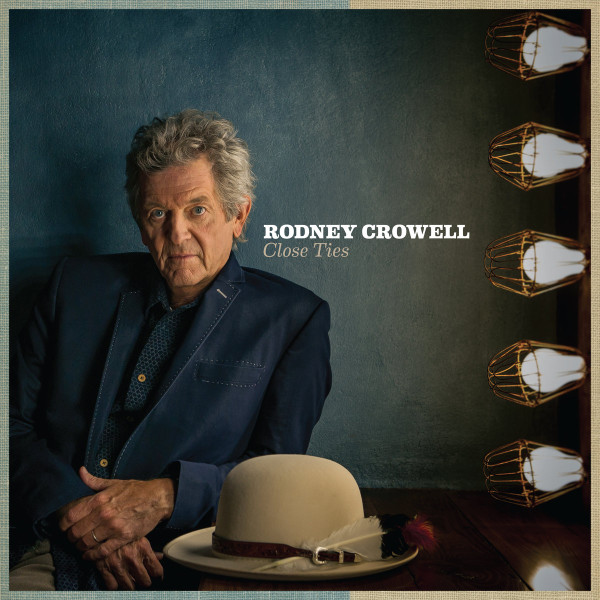
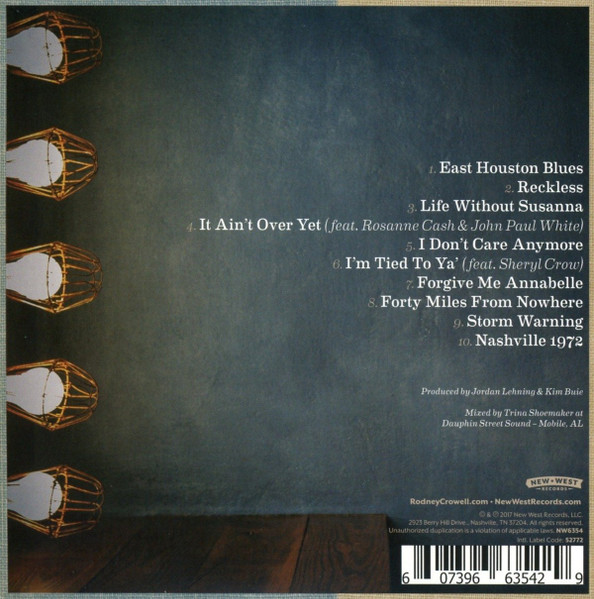
Rodney Crowell’s album Close Ties (2017) is a country record that is about none of that. Or if it is, it is taking those things and skinning them alive. It is the testament of a fully matured man. A man who has pulled off the road to a lookout to behold a not always scenic landscape.
Crowell grew up poor in East Houston, moved to Nashville in the early 70s where he wrote a slew of hits for others, released a few albums, produced several more for his then wife Rosanne Cash and by the end of the ‘80s was one of the faces of the so-called ‘neo-traditionalist’ country set. Guy Clark, Emmylou Harris, Townes van Zandt and Steve Earle were peers and friends.
In 2017, Crowell was sixty-seven years old. In those years he’d
been lied on, spied on, cried on, tried on, taken for a ride you bet
Fracked, cracked, smacked jack, what you see is what you get
I’ve been spit at, hit at, quit at, shit at, shouldn’t hurt a bit at, what I’m trying to get at
and had somehow transformed all that into a record that reveals adults inhabiting adult relationships more confusing, messy and meaningful than anything their younger selves thought possible.
He sings about taking too much and giving not much. Taking love for granted. And about the sort of love that disappears but never really dies.
With faith beyond religion, we search the great unknown
Free fall into darkness, someplace we’ve never gone
I’m tied to ya
I’m tied to ya
I know a guy, someone I’m just getting to know a bit better, who finds himself kneeling on the bloodied battlefield of Love. To one side stands the woman he married but pushed away. To the other is the woman he loved beyond imagination who has pushed him away. He tells me he can’t imagine being squeezed for another drop but can’t stop wishing for their hands to massage, pummel and prod him. Especially those corners of him that haven’t seen the light of day for years. Maybe ever.
The first time I saw her she threw me that smile
Pure angel of mercy east Texas style
A poet in gingham, an assassin in jeans
The most near perfect woman I’d ever seen
She was hardly routine
He’s trying to find signs of who he is in the things he’s done.
Life without [her]
Troubles me in ways hard to express
As she withdrew I grew distant and judgmental
A self-sure bastard and a stubborn bitch
Locked in a deadly game of chess
The upside of my status a cut above the rest
His marriage was a constant battle. His love affair an unexpected oasis.
The last time I saw her was close to the end
I cried like a baby for the shape I was in
No lipstick or powder to soften the tone
The most worthy opponent I’ve ever known
Was already gone
That second to last line describes both women, he says.
And then Crowell cruelly, or perhaps mercifully, reminds us
It ain’t over yet
You can mark my word
I don’t care what you think you heard
We’re still learning how to fly
It ain’t over yet
And what isn’t over yet? Our love? Our prideful ways? Our cluelessness? Our life? All of the above. And more.
These are songs that only a man who has marched his demons up the hill and back down again could write. And sing. Crowell, the singer is every equal to the songwriter. He has an uncanny talent of delivering cutting self-criticism as well as the bitter tears of the jilted without self-pity or indulgence or pleading. This comes, you’d think, from that place every pilgrim hopes to reach, where the storms of life neither seduce nor reduce you. That place where parental approval, manly accomplishment and perfect love are finally stripped naked.
But I don’t care anymore about the fortune and the fame
I was better off before I tried to make myself a name
Close Ties is really a break-up album. A man breaking-up with the masks he has worn, the roles he’s played, the sins he’s denied committing. A man whose world is so shaken and crumbly he sees ghosts everywhere.
I don’t care anymore who does what and why
I was better off before when I was just another guy
I see why my friend keeps listening to it. Because Crowell is expert at bringing to life the oldest of all break-ups—love.
When you walked out on me, it tore my heart in half
And I hid behind a laugh
As I became a slave to shame I cursed your name
God Damn you, rot in Hell
Can you forgive me Annabelle
He is full of regret and clarity. But there is precious little calm here and not much confidence he won’t keep offending. This record is a tale of how many ways a brokenheart feels horrible.
Right about now it gets quiet around here, what with nightfall in the wings
The floorboards creak and faucets leak, but it’s the emptiness that sings
The wind grows chill and then lies still
Forty miles from nowhere
At the bottom of the world
Yet, in the end, full of hope.
I won’t deny that I believe these things you say are true
I’ve seen the way you gauge each distant star
As long as I can be myself and still be there with you
I’ll go anywhere you ask me, near or far
I’m tied to ya
I’m tied to ya

For the first several minutes he said nothing, just guiding his yellow and black Suzuki taxi through the clamorous traffic of midday Delhi. My daughter wanted me to ask him what his name was. “Jai Bhagwan,” he said. “An old-fashioned name.” His smile is half apologetic.
“You’ll be going to Jaipur? That’s a beautiful city. They call it the Pink City. Its a five hour drive from Delhi and Pushkar is another 2 or 2 and half hours further. You’ll stay in Pushkar for a few days? No? I see, just for a day. Ajmer is just half hour more away. What a place that is. Moinuddin Chisti…the Emperor of India! Will you be taking the train from Ajmer to Varanasi? No, from Agra. Ok. I see, your agent arranged it that way. Watch out for these agents. They’re in it for themselves, a lot of them.
This traffic is like this but not for too long. There’s a fly over up ahead and the road narrows so everything slows down to a crawl. But soon we’ll be moving again. Yes, that metro line was made for the Commonwealth Games in 2010. What a rip off! The organizers stole 80% of the investments. Only 20% was spent on the infrastructure. The main crook, Kapladi is in jail but what does it matter. It won’t change anything. The rich and our netas don’t give a shit. All the rules are for the poor, not one of them is for the rich. It never changes.
My people used to own the land around the airport. A long time ago the government came and forced us off the land and gave us Rs1.40 per square meter! A very low price. But they got what they wanted. You know Gandhi? They say he is the father of the nation. We say he’s the number one Thief. Don’t believe me? What did he ever do for us? Did he do anything to improve our lot? He and Nehru did everything for themselves and to make their own money and name. Gandhi, the old bastard, used to feed his goat grapes while the rest of the country starved.
The real hero of India was Subhas Chandra Bose. What a guy. You know what his slogan was? Give me your blood and I’ll give you freedom! He was a man of action. That’s why they killed him. You know Gandhi could have freed Bhagat Singh but he didn’t. He let him hang. All for his own glory.
Ambedkar? Yeah, he was a good man too. He wrote the Constitution. No one else could have done that. He was a great man actually. I have nothing bad to say about Ambedkar.
Right, we’re almost at your destination. Just 5-10 minutes more.”
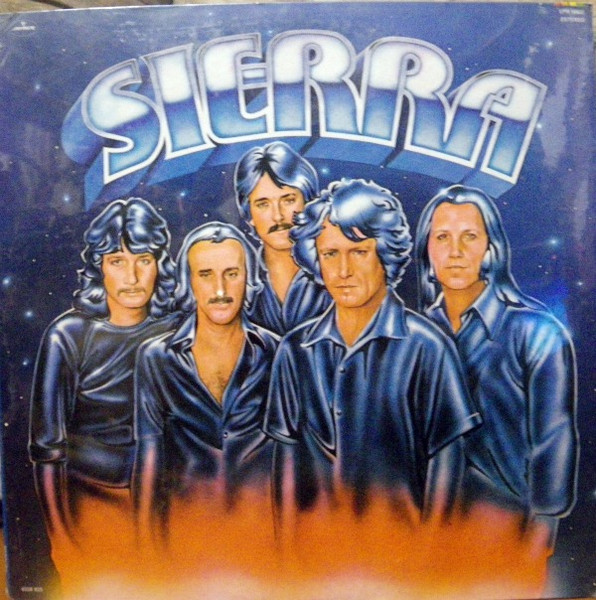
One of those albums that sunk like a stone. Released and then gone. Mores the pity, because this collection of 11 songs by Sierra is more than just alright.


Sierra was a single-album band of refugees from a bunch of country-rock and rock bands of the late 60s. By 1977, when their only and self-titled record was unleashed upon the buying public by Mercury, the individual players were in the sort of professional limbo that comes about regularly but is usually swept under the carpet in the biography. Which is too bad and a bit unfair, because Sierra was made up of some formidable names with very respectable curricula vitae.
Gib Guilbeau, on rhythm guitar, had played in a whole series of country-rock and proto-Americana bands like The Flying Burrito Brothers, Swampwater and the legendary Nashville West. On drums, Mickey McGee had credits as the drummer for Jackson Browne (Take it Easy), JD Souther, Linda Ronstadt, Chris Darrow, and Lee Clayton (Ladies Love Outlaws), not to mention an early country-rock outfit Goosecreek Symphony. Oh, and late Flying Burrito Brothers! Eddie’s nephew Bobby Cochran contributes blistering lead guitar and lead vocals. ‘Sneaky’ Pete Kleinow’s steel has graced hundreds of rock and country rock albums and was first brought to wide attention as a founding member of The Burrito Bros and New Riders of the Purple Sage. On bass, Thad Maxwell, another vet of the 68-75 scene, and band fellow of Gib in Swampwater. Felix Pappalardo Jr. produced and contributed piano parts. A storied figure, throughout out his life Pappalardi supported or produced everyone from Tom Paxton to Cream, not to mention his own weighty Mountain.
So, no slouches these guys. They were not suburban lads looking for a break. Their combined talent and credits were formidable. In the parlance of job advertisements they had a “proven track record” of making excellent music.
But alas, here the sum of the parts didn’t add up. Which is not to say this a shit album. Far from it. Sierra is a very good record of late 70s American pop and deserves to be hauled up from the bottom of the deep lake of forgotten country-rockers.
The art work is a put-off and no doubt played a big part in the record’s stillbirth. A perfect example of a cover designed by some free lance artist with no idea about the sort of band Sierra was. Many styles did they play, but spacey country-disco was not one of them. You could be forgiven however for thinking this was in fact, their speciality, if you had access only to the dumb, lifeless cover art.
On the black wax we are treated to high quality examples of soft rock (Gina; If I Could Only Get to You), So Cal country-rock (Farmer’s Daughter; She’s the Tall One), British blues (I Found Love), top 40 slick pop (Honey Dew), boogie, rock ‘n’ roll (Strange Here in the Night; I’d Rather be With You) all sauted in the spicey warmth of the Tower of Power horns. (In this era if you were good enough to entice the ToP to record with you, you were ensured at least one extra star from the reviewer.)
But it didn’t work. The album suffered not from a dearth of talent or poor production. It sank because it had no focus. Spaghetti was all over the wall, perfectly al -dente no doubt, but spread across too wide a plane. For country-rockers in search of Gilded Palace of Sin or even One of These Nights, this was bland stuff. Waaay too poppy, man!
But for this old guy living 50 years in the future, and slightly anxious about the coming extinction of human made music, Sierra deserves 7 stars out of ten, for capturing several trends of America popular music current in 1977. Especially the eternal wrestle between Country and Rawk.
There are some blatant and pointless rip-offs like You Give Me Lovin, which is essentially a copy of the Eagles, Already Gone, but what did more than the front cover to kill this album, is its refusal to rise above the very good level. The album should really have been titled, Bob Cochran and Sierra, as he is the real star. It is Bob (the only non ex-Burrito), who shows the most excitement here. His guitar is sharp and always stands out. His high-tenor voice fits perfectly in both soft rock and pop—audiences the record label was clearly trying to attract. Sadly, the band of sages behind him seem content to play perfectly, expertly, confidently but, alas, with very little real energy or pizzaz.
Ratings:
Musicianship-8/10
Listenability-8/10
Energy: 6/10
Songwriting: 5/10
Cover: 3/10
Historic Value*: 7.5/10
*a subjective ranking of combined significance & interest to the history of North American (mainly) popular music of the 1970s. Judged by myself on a particular day. Significance could include the musicians, the cover art, the producer, production quality, songwriting, influence, innovation, listen ability etc.
My first novel was published in London in 2000. It was nominated for a couple of awards including the Guardian First Novel Award. I will be serialising it here as it is out of print.

AUTHOR’S FOREWORD
The Book of Accounts is a work of fiction and imagination. The inspiration comes from the many Iraqi friends and refugees with whom I have worked, who have endured the hell of torture.
Although this novel is fictional many of the events described — including the gassing of Halabja, the hostage-taking incident and the Muhyi-Ayash conspiracy — are historical facts. The organisations mentioned: al Amn al Khas, Mukhabarat, Estikhbarat and Jihaz Haneen are real. In the case of Jihaz Haneen very little is known of the organisation even within Iraq, and therefore any description of its structure in the Book of Accounts is based largely (but not entirely) on speculation. These organisations are integral to maintaining Saddam Hussein’s and the Ba’ath Party’s grip on the Iraqi people.
Other than Saddam Hussein, Muhyi Rashid, Mohammad Ayash and ‘Chemical’ Ali, and one or two very minor personalities, all characters in the book are fictional, though some have been based on historical personalities. All revolutionary parties, including the People’s League, are also fictional.
The historical context of the novel is the recent past of Iraqi history from the late 1950s to the late 1980s. Unlike the characters almost all locations in the book are actual villages, towns and neighborhoods. I have provided a historical timeline of the major events referred to in the novel as well as a glossary at the end of the novel.
For the reader who knows Iraq and who may find some of the liberties have taken for the sake of the story irksome, I beg your indulgence.
_________
PROLOGUE
He lay shivering on the stone floor in a cell in Baghdad that had become colder as the storm outside built in intensity. He hugged himself tightly and let out a sharp sneeze.
‘Oh! Lucky boy. Someone is thinking of you!’ laughed the guard.
For two nights no one had bothered him. But on night number three as he lay sleeping, pushed up against the stone wall, they called his name. ‘Please,’ he said, ‘it is very cold,’ but the words were lost somewhere between his mouth and the wall. Two men in grimy uniforms pulled him from the cell; one of them held him tightly while the other tied a band around his eyes then reached down to secure the young man’s hands behind his back. When he was pushed forward into the corridor, a lady guard stepped towards him and whispered, ‘This way. Your time has come.’
The small party made its way through the building. He tried to imagine the surroundings. When they didn’t leave the building he thought, Executions must be carried out inside. I only wish I could see. Why stop me from seeing if I am to be killed? I am glad they didn’t give me any warning. I wonder if this is how everyone feels. He felt calm. He did not feel self-pity. Thoughts of his family, and of picnics and parties, of books unread and questions unasked, seemed tiny and hard to pick up. He remembered the soft fullness of his lover’s breasts, and for a moment he even thought he caught her scent.
The lady guard pressed the prisoner’s shoulder as a signal to stop. A door opened and the prisoner was nudged forward. He thought he
saw a room with no back wall. A line of men with rifles stared straight ahead with dull eyes. White billowy clouds and a blue sky. He felt the wind on his neck as he took up his position against the openness. Each man raised his rifle but he saw only one; an eye squinting, a finger resting against the trigger. An arm wavered slightly as the marksman took aim. The bound man stared directly into the one open eye and for a second the executioner hesitated, then a bullet shot forward. The prisoner watched as it spun through the air. The woman guard wore a crooked smile. Suddenly the prisoner felt warm.
‘Sit down here and wait. Do not try to see anything.’ It was the voice of the lady guard, who pushed him firmly into a chair and removed his blindfold; a cloth hood fell over his head as a substitute. She squeezed the prisoner’s shoulder then left him alone in the room.
The hood over his head was damp and stank of fear. He stared at his feet on the floor until the opening of the door diverted his attention. Footsteps on one side of the room. A chair scraped against the concrete. Must be the man with the gun.
As the newcomer came in, did he even notice the shivering figure tied like a rabbit to the chair? Or did he see him and feel only scorn? What was he thinking? This is him. Disgusting dog. His mind was already familiar with the territory ahead. The map was drawn.
The newcomer, the invisible one, was eager to proceed. He lifted his head and stared at the hooded prisoner in front of him. He sized him up like a chicken in the market. They shared the silence and the relief an actor feels when the curtain goes up on the last night.
The chair scraped across the floor again and the hooded prisoner’s muscles tensed involuntarily. His saliva tasted sweet and cool. He sensed the other behind him and waited. But for what?
A blow?
A shot?
He was lost without a compass. Is he still behind me or has he moved to my right? The hood was hot and suffocating. He was being stalked by a lion and prepared his body for the pounce. But nothing happened. The beast was examining its catch. Admiring another fish in the net. The big one at last? But after what seemed an hour, the hunter still had not slapped or even clawed his captive. Slowly — he was back behind the boy again — the invisible man lifted the bloodstained woollen hood from the prisoner’s head and let it drop to the floor.
He had decided that his prey deserved to see his tormentor from the beginning. And he was determined to enjoy the young man’s fright


If you don’t know by now, let me lay it out there once and for all: I am in love with the music of the 1970s. It’s when my musical ears started to grow up. I am emotionally tied to the ‘70s, the years that took me from a 13-year old dork to a married man in 1980. University, travel, losing the Big V, jobs, drinking too much, etc. Formative years.
This doesn’t mean I spend my days listening only to peak Elton and Born to Run. I spend a lot of time in the weeds in music from around the world, especially the Indian barsageer, and contribute to the profits of Bandcamp quite faithfully. But with age comes many things. One of which is a dropping away of the need to be considered hip. Another is going deep into things. The music of the 70s may be comforting and familiar but in the same way I knew nothing of India until I came to America, it is only in the 3rd decade of the 21st century that I’ve begun to try to really listen to what was going on in the popular music of those years.
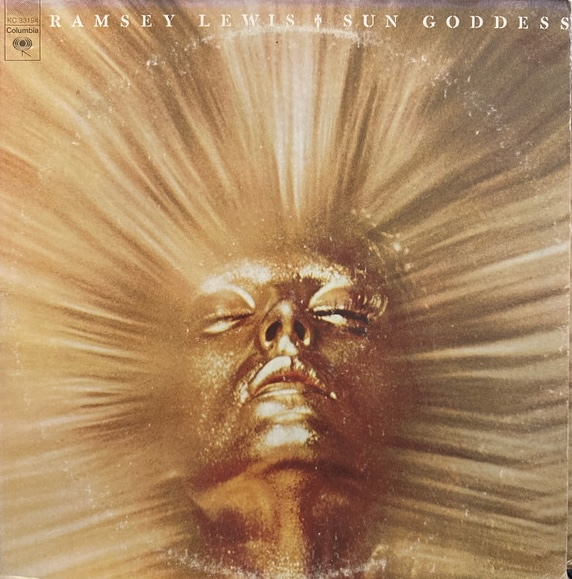
I knew of Ramsey Lewis from regular visits to the local record store. His albums of that time, especially Sun Goddess (1974) and Salongo (1976) were very attractive. Covers that stood out from the mass that called out to be picked up handled. Being poverty struck I was never going to put $4.98 down to actually buy one, but man, I really did love the look of those albums.
Ramsey had got his start in Chicago in the mid-50s. He played what I call club jazz. A sort of diet-Jazz that was accessible, occasionally funky and generally soothing. You’d hear it in small clubs in big cities across America. Les McCann and Lou Rawls, would be there the week before you, maybe Willis Jackson or Brother Jack McDuff, the week after.
Ramsey was a very accomplished pianist/keyboard player and a warm person. But the overseers of ‘Jazz’ showered him with putdowns like lightweight, mainstream, ‘happy clappy’ and bland. He didn’t care. Some of the giants of jazz, including the Duke himself, were fans and mentors. And besides, he was actually making money and had a mixed audience of black and white fans who liked his cross-pollination of styles.
When jazz synced up with R&B and became soul-jazz in the late 60s and allowed George Benson, Grover Washington Jr., and the like to become pop stars in the 70s, Ramsey fit right in. He’d been laying the foundations of soul-jazz for years.
Sun Goddess was released at the end of 1974. The cover pictured the gilded face of a beautiful woman set against what looks like a background of liquid silk shooting out like rays of the sun. Bold & beautiful. Confident. Daring & intriguing.
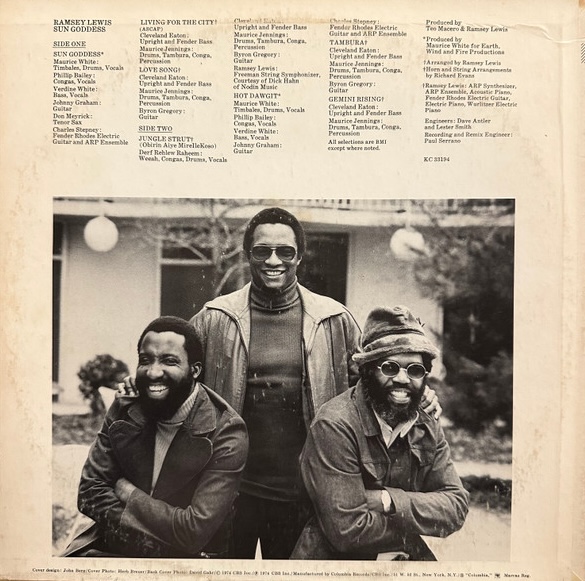
When the stylus hit the wax that lush, warm sound of the times filled the room. Maurice White and several mates from Earth, Wind & Fire were in the studio as players and producers which gives several of the tracks, especially the title and opener, a funky EW&F feel. Maurice and Ramsey went way back. Maurice had been picked up as a session drummer by Ramsey after the departure of Redd Holt in 1966. They had stayed together for several years until Maurice laid out his idea for a large, dance, funk and pop group to Ramsey around 1970. Ramsey smiled and wished him every piece of luck as Maurice moved to LA.
By 1974 White’s group was about to release their breakthrough That’s the Way of the World which included the Billboard Number 1, Shining Star. That EW&F were in essence Ramsey’s backing band on Sun Goddess no doubt gave him and the album a huge boost of street cred.
The music exemplifies that strain of African-Americana which is confident, unapologetic and intensely positive. On the charts in those years were songs like Love Train (The O’Jays), Wake Up Everybody (Harold Melvin & The Bluenotes) and Black Wonders of the World (Billy Paul). Sun Goddess is the sonic realisation of the popular slogan, “Proud and Black”.
Scratch guitars look forward to disco, about the happiest music ever created, but which was still an underground phenom. Ramsey’s keyboards, on piano or Fender Rhodes, always stand out even though he is surrounded by some of the best musicians working at that time. Critics consider Sun Goddess to be a deliberate attempt by Lewis to cross over to R&B. Could be. But there is no sense that he is out of his depth or uncomfortable with the increase in funk that defines the sound. He’s perfectly at ease and as accomplished and classy as ever.
If you’re interested in understanding the music of the 1970s, then you’ve got to get this record.
I wish ‘they’ still made music like this.