I’m getting tired of this attitude from Democrats:
Democratic Brain Trust moaning about no-power to push back against Herr Trumpf and Elon Speer.
Given where we are at, the floor of a corrupted Congress is not the place to look for resistance to Doge-bags and the Fuerher.
Remember when Yeltsin jumped on a tank? Remember when that guy stood in front of the tank in Tiananmen Square? Remember when Gandhi marched to the ocean to make salt?
Will someone in the United States please get out there in the streets, forget about passing a goddamn “bill” which is going to be ultimately rejected by the corrupted Supreme Court and inspire Americans who don’t want this shit?
Met a mate at the John Curtin Hotel in the city last week. Free tickets from one of Melbourne’s wonderful radio stations, Triple R, for a visiting UK DJ.
Like free beer, free music is not to be sniffed at. My friend and I wandered upstairs with our pints of American Pale Ale to a large empty space with two decks of electronic noise making machines and related cables, pedals and mixers. Total audience, including us, 6.
Were they starting late? Warming up? Testing their machines? No, it was The Show. We sipped and waited as the room fell into silence. A Couple audience members wandered back downstairs. Now we were 4.
Then this.
Loud. For minutes on end.
We went downstairs again where a DJ played an electic two hours of non drone music.
33 years 2 months and 2 days ago Mikhail Gorbachev announced his resignation as leader of the Soviet Union. The next day, 26 January 1991, the world learned that the Soviet Union itself, had ceased to exist as a political entity.
I watched Gorbachev on American TV. The enormity of his resignation and the dissolution of USSR silenced the room. The consequences of it were unclear but generally I think everyone felt lighter; things were bound to get better.
Today, I watched President Trump and VP Vance go on TV and announce their desire to join a new USSR, led by their buddy Vlad Putin. The enormity of this decision was lost in a squabble of hectoring and scolding more akin to a WWE extravangza than a diplomatic photo opp.
Just as Gorbachev’s announcement stunned the world, so too the Dynamic Duo’s performance on live TV today, has left the world immobile with shock. Only instead of hope we watch in horror, knowing for sure that only worse lies ahead.
A few months earlier I had watched Boris Yeltsin jump onto a tank in the middle of Moscow and rally his fellow Russians to resist the coup that had been launched by hardline Communists against Gorbachev’s glasnost and perestroika. I remember thinking, ‘Wow, that’s ballsy!’ And the people rallied, the coup was put down and Big Boris led them into a new era.
I don’t watch TV or read much news anymore. But I find it interesting that Yeltsin’s demonstration of leadership and purpose is apparently so uninspiring to the politicians of the Greatest Country in the History of Humanity. Our leaders, our so-called Yeltsins’, our hardcore anti-Putin hawks, now flap their wings and coo quietly in harmony with the two assholes at the top.
All religions are rife with factions. And in that way, they are a manifestation of the most primitive and base of human instincts. Group think. Tribalism. Belief regardless of a lack of evidence. Even evidence to the contrary.
I was born and nurtured within the ‘Bible is the inerrant Word of God’ tribe. The people who insist that every word, every story, every miracle found within the Christian/Jewish Bible is cent per cent pure and untainted by any contradiction or human failing. The Universe was created in six 24-hour days. Elijah ascended to ‘heaven’ in a burning chariot. The Supreme Lord of Everything addressed Abraham through a burning bush. Wine to water. 2 pieces of bread and 5 sardines fed 5000 people. You get the picture.
I should clarify. My father, our clan leader, actually felt most comfortable in a sub-faction of this larger tribe. I would call it ‘the Bible is the actual reflection of God’s mind but not 100% historically or scientifically accurate’. He argued that science and learning were needed to understand the mysteries of such a revered set of writings as the old and new testaments. He would acknowledge (later in life) that humans did not have the capacity to understand ‘God’ and so, ultimately, whether or not Jesus did turn a cistern of water into Merlot at the wedding party, it was not worth starting a war over. He liked to believe it, but he and others in the sub-faction allowed space for individual interpretation.
I have no personal faith or belief in Jesus, Yahweh, God or any other such divine creature. But I had a good childhood and my 25 years of practicing Christianity has made an indelible imprint on my mind. I cannot and do not want to excise that part of me. I find great comfort in many passages of the Bible (OT and NT). I still love and sing along to the hymns and choruses I learned from countless Bible Clubs, camps and revival services. And throughout my adult years I have enjoyed reading academic and true-believer debates about all manner of Biblical studies and archaeology.
I recently read a book titled Jesus Interrupted. I didn’t finish it because it was a bit too elementary for me. The author, is an ex-believer like myself, but a scholar of the Bible. His audience seems to be those of the ‘Bible is the inerrant Word of God’ tribe who are looking for encouragement to use their minds rather than practice blind faith. I can hear him whispering to them ‘It’s ok. Jump. You won’t be crushed by what you find.’
He spends a lot of time talking about ‘contradictions’ and ‘inconsistencies’ within the 4 Gospels and other books of the New Testament. Of which there are many. And which should be sufficient for any unbiased reader to understand that what they are reading is not History. For those who have come to believe that the God of the Bible is a distinct and discrete being, separate from the Universe, and who’s wont is to stick his hand into the petri dish called Earth and mess things up or direct action in a particular way, the notion that the story of the 3 wise men or the resurrection is not the accurate tale of an actual event, is a hard concept to embrace.
I have published two novels, the first of which is what bookstores label, ‘historical fiction’. It is set in mid-20th century Iraq and as such the narrative refers to and is framed by actual events. And people who are historical figures, the most prominent of which is Saddam Hussain. But there are many others who pop up, mostly in very minor and insignificant roles. The main characters are entirely fictional and most of the happenings that the book describes are real only to the characters. They have no basis in history.
If you used my book to prepare for a trip to Iraq you might get a EXTREMELY HIGH LEVEL glimpse of the turbulent political history of modern Iraq up to about 1985. But I hope no one would ascribe the words I put in the mouth of real historical figures as ‘accurate’ or historical. The point of my book, what got me going, was to explore and try to understand the idea of politically-motivated violence against people who think differently. Torture. What goes on in the mind of the man who willingly and knowingly inflicts physical pain upon those who have been captured and have no way to fight back?
I was not writing and didn’t set out to write a description of the Ba’ath party or Iraqi politics. It was my way of unpacking an issue I was confronted with on a daily basis when I worked with the UN refugee agency.
As I read Jesus, Interrupted it dawned on me that the best way to describe the Gospels and other Biblical stories is as “historical fiction”. They are historic in the sense that they describe a society and historical figures that really did exist. But they are like tent poles or stakes that hold the story up but which are really supportive rather than central to the action. Yes, there was a tough guy named Pontius Pilate. And there were a group of Jews known as Pharisees. Nazareth and Bethlehem can be found on a map. But anything beyond this sort of thing is historically iffy. Even the historic reality of the central hero, Jesus.
The gospels, written decades after Jesus was allegedly crucified, by unknown writers, were composed to tell a specific story to a specific audience. The story was one of spiritual and moral guidance not a biography of the Nazarene.
None of this is fresh insight. It’s as old as the hills. But it does help me understand these essential texts of my life. They are not history. But they are not fiction, either. They are historical fiction.
One is Civil War. Here is a piece I thought I had shared one of my other blogs (C90 Lounge) but may have not. Apologies if you’ve read this before.
I saw Civil War yesterday. My companion, an emotionally hard-boiled Aussie of the 80s, was sceptical. He expected a ‘made for TV’ type production and groaned at the poster’s depiction of a gunner’s nest in the flame of the Statue of Liberty.
I’m invested in this, I said.
Years ago, in the era of ‘W’, my brother and I half-seriously agreed that should ever there be a revolution in America, we would return (he was living in Canada, me in Australia) and fight for the good guys. So, I’ve been seeing armed rebellion in the heartland for decades. In the intervening years I’ve worked in Iraq and the former Yugoslavia and Tajikistan. Each of those countries, in their own space and time, were places where citizens believed, ‘it will never happen here’.
Of course, it did happen there. Half a century of state building and brutal imposition of power by an ultimate stable, seemingly intractable family or party structure crumbled faster than anyone could have imagined leaving once proud capital cities and rural hamlets alike pockmarked with the imprints of thousands of shells, collapsed roofs, burned out vehicles and bands of uniformed heavily armed men with trembling trigger fingers in attack or perhaps in retreat.
The picturisation of the road trip from NYC to DC depicted in Civil War gets full marks from me. The mayhem and the menace were completely believable. The Americanisation of the scene, for an initial moment seemed unreal, but quickly the recollection of similar road trips I’ve made through Bosnia and Kosovo, Central Asia and Angola, made me appreciate the truism, local context is everything. This is exactly what civil war and the collapse of a national superstructure looks like. It just so happens that McDonalds dot the landscape instead of mosques.
The film is not edifying. I left scratching my head what it said about the media. Villian or simply the least-worst group in a land full of horrible people? The scene with the red-headed militia man with his red sunglasses was completely real and believable. Appropos to the storyline I left the theatre wondering, ‘who were the good guys?’. Maybe my brother and I would have fighting each other, not side by side. It was depressing.
Much better than I expected, said my hardboiled friend. Neither of us had much to say for a long time.
**
The second film is Shatranj ke khiladi (The Chess Players). It came out in 1977 and is a brilliant picturisation of Indian writer, Munshi Prem Chand’s, beloved short story of the same name.
Set in 1856 it recounts the final days of nawabi 1Lucknow, the most important ‘successor’ kingdom to emerge in the years following the severe collapse of Mughal political authority in north and central India, beginning in the early 18th century.
Satyajit Ray directed the all star cast which includes Sanjeev Kumar, Saeed Jaffrey, Sir Richard Attenborough, Amitabh Bachchan, Shabana Azmi, Amjad Khan, Victor Bannerji and Tom Alter, with whom I share a personal connection and whom I knew as an ‘upperclassman’ at boarding school. Each actor gives a generous and pitch perfect performance.
I love the sound of this film which is told in Urdu. Lucknow was accepted as the center of the Urdu speaking world and Urdu, with a Sanskrit grammar base but Persianised vocabulary, is among the most beautiful languages ever devised by us humans. The atmosphere (mise-en-scène?) of the film is authentic to my imagined 19th century nawabi Hindustan, 2 and captures the dust-layered pale clay and brushy landscape of that part of India perfectly.
The story is both hilarious and deeply sad. It is a tale of self delusion in a time of political chaos and confusion. A story about the passing of one era and the forceful, violent birth of a new order. A story perfect for this notorious American moment. The copy that is on You Tube is high quality with English sub titles, though significant parts of the story are told in English. Highly recommended!
Nawabi is an Urdu term meaning ‘royal’ but which over time has become shorthand for a particular culture and lifestyle of Muslim (mainly) elites, centered in Lucknow but prevalent across much of the Gangetic plains of north India. Nawabi is a way to signal decadence, hedonism and a self indulgent ruling class of land owners and pleasure seekers.↩︎
Hindustan is often used to refer to India as a whole, but historically and culturally it refers to the area of northern India the is watered by the Yamuna and Ganga (Ganges) rivers, also known as the doab (two waters.) More broadly it refers to the heartland of Muslim India that stretches from Lahore in Pakistan to Dhaka in Bangladesh.↩︎
I’ve been scanning a few articles and posts on LinkedIn about the crash&burn approach to USAID of the new Trusk administration. There are two broad schools of thought being advocated.
The Insider School: this is the worst possible and most unfair action taken against an agency that strives to do only good. The hardship faced by many tens of thousands employee, contractors and implementing partners down the food chain is the main objection, with many expressing solidarity with this newly and unexpectedly large cohort of jobless humanitarians. Suddenly everyone has the green halo around their profile picture; I’m Open to Work.
Indeed, this is a shitful way to begin a new year. I am not directly impacted by Trusk’s actions but suddenly my already slim chances of finding employment within the sector I’ve worked in my entire career are as close to nil as they can possibly be.
Imagine a series of ponds connected by a stream. The one at the top is full with just a few fish in it. The middle pond has lots of water but also a huge number of fish. The stream has been silting up for time and some fish have been struggling to breathe for years. Yet, for the most part the pond has just enough water and oxygen to maintain the status quo. In the third pond, the water levels are really low but the fish are smaller and seem to be able to do ok though they are constantly aware that the stream from the middle pond is getting dammed and blocked.
Overnight the top pond is drained of all its water. In a panic, the fish there move into the middle pond. But this is not a solution because the largest feeder stream is dry and the pond’s water supply has dropped by nearly 50%. But there are a huge number of new fish to accommodate.
In the third pond, fish are dying fast. Not to mention the many animals surrounding the ponds that depend on the water to survive.
It’s easy to understand the solution demanded by this group school of thought. Reinstate USAID and all its funding immediately. Turn the tap back on and let the water flow once more.
The Opportunity School of Thought: This is advocated mainly by (many) fish in the middle and lower ponds. And fisheries experts who work at think tanks and write blogs. The basic argument is: the structure of the ponds and streams was inherently unfair and broken. The top fish have always determined the quantity and quality of the water flowing to the lower ponds and for the fish in the lower ponds and the animals who depend on the water in the pond, the emptying of the top pond is probably an opportunity to rebuild the system so that it is more equitable.
No one has yet articulated what a new system might look. The prescriptions are finely articulated statements of principle that have been echoing around Aid-Land forever. They all appear to ignore the cruel reality that we fish, and the animals we support, need water. And if we are going to support a lot of animals and really attack the problems that the animals face, we need lots of water for a long, long time.
Ok, enough already of this silly analogy.
The point is that large scale development and humanitarian responses require large volumes of money. And on a steady basis. Governments are generally the only source of such largesse. Sure, there are billionaires and rich corporations but their interests are extremely narrow and self-serving. The private sector will never be a reliable source of base funding for humanitarian or development work.
So, I’m sceptical of the Opportunity school. Of course, if USAID is gone for good NGOs will adjust. Many will cease to exist altogether (not bad in itself); almost all will downsize, shrink their ambition and keep their heads down even lower. But I’m not holding my breath for a new government led aid infrastructure and financing system to emerge that will be better than the one we love to hate currently.
And there is a lot to hate. Bureaucracy. Hypocrisy. Conditionality. Compliance over assistance. Risk transfer. Salaries. Bad CEOs with no accountability. Lack of diversity at the top. Recycled thinking. Opaque transparency. Salaries. Sexual harassment and abuse. Baked-in white middle-class privilege. Over-weening earnestness. Commerical firms who market themselves as humanitarian but are profit making machines for shareholders.
But the one thing, above all other things, that sucks about the aid business is the donor-implementing partner (be they big hairy international behemoths or a local disabled persons NGO in the south Pacific) relationship. Governments are not just the only viable source of sustainable financing for aid but they call the shots. Their Congresses and Parliaments put so many ridiculous conditions on the receipt of and spending of their funds that many NGOs spend as much time, if not more, filling out reports for donors to ensure they are not violating an ever-growing number of conditions, as they do actually helping actual people.
For all our claims to be innovative and independent, we have always been beholden to what the State Department or Foreign Office wants.
This doesn’t put me in the Insider’s camp. I sympathize with those who lost their jobs. Doing away overnight with such a major pillar of the Aidland superstructure will be nothing but disastrous. And given how most countries take signals from the White House the impact on Aidland is going to be widespread and indefinite.
I don’t have a solution but frankly I cannot think of any group that can replace government funded aid agencies. 100 Soros’ can’t compete. I don’t see new scalable financing models emerging. Innovation will happen but at the local level only. Like democracy, government funded aid is the best of many flawed systems.
The Golden Age of International NGOs and AID is well and truly over. Maybe the Dark Ages weren’t really so bad.
We’ve completed the circle. We Americans have gone out into the world, seen what we’ve seen, come rushing back home slammed the door shut and fitted out the house with surveillance cameras, automatic machine guns, potbellied camo boys with tattoos that scream like John Prine’s* waitress, “Make America Great Again”, a moat slithering with crocodiles and snakes and a steel wall.
We are ugly Americans again. Led by Mr. Uggers himself, DJT. His Pestilence is assisted by a black shirted, Seig Heiling immigrant who fled Apartheid not because he opposed it but apparently because he sensed the USA’s soil was more fertile for such diabolic Dogebags** as he.
They say JFK read the novel The Ugly American and felt shame. Soon afterwards he announced the Peace Corps. And created USAID. Not so every child in Asia could have cotton candy every morning but because he and his bros believed the USA could win friends by being decent.
Now his nephew sparks outbreaks of measles in small Pacific Island states.
We’ve completed the circle. We Americans are ugly again.
In 1996 I visited Afghanistan and Pakistan for an Australian NGO. The Taliban had just captured Kabul a fortnight earlier and thrust, very momentarily, the plight of everyday Afghans back into the international media’s spotlight. Given the current state of Truskland I think these voices are worth revisiting.
He was as new to town as I.
“I came here from Kabul the day before last. My name is Hashim.” He wore a hesitant smile and a blue waistcoat. He had been watching me walk up through the gardens and toward the street. “Will you make my photo?” he asked.
He posed with his arms across his chest and gazed away from the camera with a cinematic expression. I took his picture and asked what had brought him to Mazar-e-Sharif.
“My father told me to get of of Kabul as the Taliban are capturing all young me to fight. I’ll go back when my father tells me. I am staying in a hotel as I have no relatives in Mazar. Its very expensive. All day I sat here watch people in the garden. I sit and think but I try not to think of my family. We had a shoe factory in Kabul. But when the mujahideen came to power they stole everything. Now I am jobless. In Kabul I study English and also kung-fu. But now everything is closed. I don’t go out because it is too dangerous. I am Turkoman. The Taliban are against us. And the Tajiks and Hazaras.
“I saw Najibullah hanging in the street. It made me sad. None of these groups are Muslims. They only kill anyone who doesn’t agree with them. ‘Grow a beard!’ ‘Wear a hat!’ ‘Don’t go outside!” And if you disagree to grow a beard it is the end. For the last 5 years I have seen these people. They are not Muslim.
“See that man there, singing. He’s gone mad. I’ll go mad, too. I sit here everyday. I want to get out of here, to Germany or to an English speaking country but its too expensive.”
*****
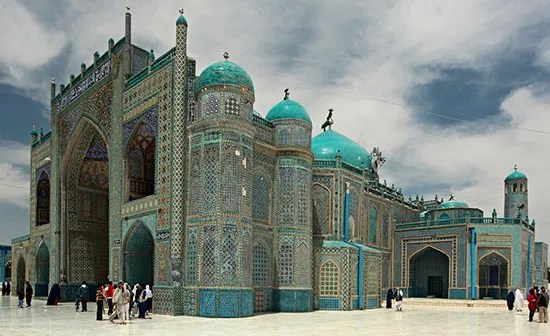
Blue Mosque/Tomb of Ali, Mazar-e-Sharif
“How is my English? I have been studying for two years but most foreigners do not like to speak with me. Why is that? One time I asked a foreign man what time it was. He told me, ‘Sharp 4 o’clock!’ That was that. He said no more to me.” Khaililullah spoke excellent English. He was a northern-Pashtun–dark, almost Indian in appearance. But he had born north of Mazar and had recently returned from over 10 years as a refugee in Pakistan.
“I teach English. In Monkey Lane. Will you come and visit our class?” I told him I would come but not today. Today I was interested in visiting the shrine of Ali, the grand blue-tiled mosque around which this desert town spills. I told Khalilullah how much I admired the mosque and its color. “You’re lucky to live so close to such a beautiful building.”
“By the grace of God we have a good leader. General Dostum. He used to be a communist but now he prays five times a day–he’s very good. And powerful. The Taliban are the trouble. They want to keep girls from school And this forcing men to pray in the mosque five times a day. Even our Prophet Mohammad himself only prayed 4 times a day sometimes So who are they to force us?
“Of course. There were excesses in Najib’s time. He gave too much freedom and too quickly. Especially to women. This corrupted us. Women went about barefoot–without shoes and wore nothing at all on their heads. According to Islam, a woman’s head should be covered. But not completely hidden. Both the Taliban and Najib are wrong. God save us from that much freedom. On the other hand under Najib, women and girls were educated and worked. That was good. So he was not entirely bad.”
Najibullah felt that the public hanging of Najibullah was inevitable. In his mind it was a justice of sorts for having allowed women to go barefoot and to be judges. But what he told me next I heard many times during my visit.
“Before they killed him they ordered him to sign his own release papers. He refused. He had denounced communism and discovered patriotism. He did not feel he had to confess to any crimes. But I know from an accurate source that he had memorised the entire Quran. But he refused to sign the papers confessing to anything. So they killed him. But in that, he was right. All Afghans respect Najibullah now. He wasn’t afraid to die. He was a true Afghan.”
When I visit Khalilullah’s school a few days later he refused to discuss anything except English and non-political subjects. “What do you call this?” he asked me, pointing to a shelf. He made not of my response, “A mantel.”
He and his fellow students discussed music and literature as if nothing was wrong with their country. The school had 600 students, women and men, learning English every day. “We want to prepare ourselves for the future. Today you must have knowledge of two things, English and computers, if you want to succeed.”
Jamil was adamant. “What do you believe will happen to Afghanistan?” Before I could respond he went on. “We are fanatics. This is no way to bring universal peace anywhere. And there is no way our people will talk. No way they can win in fighting either. I don’t know what will happen. This fighting will continue. All I know is that I will go to English class and then I’ll go home. Tomorrow? God only knows. Who sees beyond today? We are ready for anything though. My father is not a commander. We are civilians. We want peace and normality. Things like sports and music. My name is Jamil. It means beautiful. We want to help ourselves by learning English but our pronunciation is all bad. What do you think?”
*****
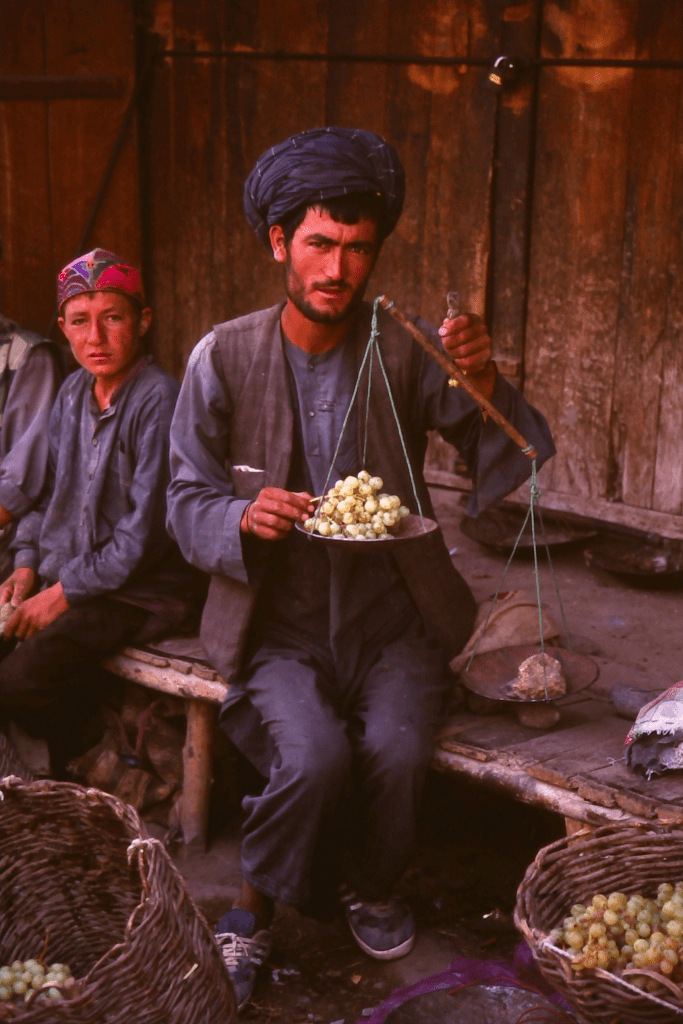
A Tajik grape seller, Faizabad, Afghanistan 1999
*****
“Welcome! Just have a look, no need to buy.”
The huge bearded Afghan stood beckoning to me from the doorway of his carpet shop in Peshawar’s Khyber bazar. It was a typical sales pitch but it soon changed when I enquired about the man who owned the shop next door. He was the son of a friend from Melbourne.
“You want to see Hamid?” he glared at me.
I nodded.
“Communisti!” The word hissed out of mouth like air leaving a tyre. His companions in the shop immediately turneds toward me and smiled sheepishly.
“Hamid is no good man. He is a foreigner. And communist. He supported Russians and speaks their language.” The man stumbled about for words to express his dissatisfaction with his neighbor. He spoke broken English and felt limited in what he could say.
“Communists. Uzbeks. Hazaras. Very bad.” He made a gesture with his finger slicing across his neck. “They are not Afghans. They are Angrez!”
I asked what he meant by calling Uzbeks and Hazaras, the most Mongol-featured of Afghans, Englishmen.
“He means they are foreigners. They have come to Afghanistan only recently. They are not true Afghans. We Pashtuns are real Afghans. The others are not. They are so small in number, not like us. Pashtuns are 60% of Afghan people. The others are only few. Miniorities, you know.” This man who spoke better English wouldn’t tell me his name but he did identify himself as working as a ‘spokesman’ for the Taliban office in Peshawar. “I know very well the Taliban. They are very good. They are against Communism and foreign domination.
“You see, we are refugees in Pakistan. It is not good for us to say that we want to control Pakistani politics of government. This is not our right. We should only sit quietly and do our business. It is not right for us to force our desires on the Pakistani public. And so it is with Uzbeks and Tajiks–though Tajiks are not so bad. But Uzbeks and Hazaras. They are refugees, not true Afghans. They came only in the last 40 years and now they want to dominate the whole country. But it is for us Pashtuns to control Afghanistan. This is our country. Uzbeks should return to Uzbekistan and Tajiks to Tajikistan. Why should they stay in Afghanistan?”
The bearded carpet seller broke in again. It is very dangerous here these days. Every day the Shi’a are attacking Sunnis. We must kill the Shi’a.”
Most Hazara Afghans, the poorest and historically most discriminated against of all Afghan minority groups, are Shi’a.
The TV in the shop began broadcasting an old Pakistani film romance. The men ignore me and lay down on the carpets in front of the TV. A woman danced through a rose and fountain garden to a lively folks tune. The men smiled as they watch the star dance.
I didn’t bother to ask them about the Taliban’s attitude toward women.
*****
The next day I had tea with an Afghan refugee family. They had come to Pakistan after the fall of the Najibullah government in 1992. They were secular, non-Pashtun Afghans. Educated abroad and middle class. For four and a half years they had lived in Peshawar.
The matriarch of the family, Hafeeza (not her real name) has lost a husband, two sons and two daughters. Her husband, a senior figure in the PDPA (People’s Democratic Party of Afghanistan), the Soviet-backed party that ruled Afghanistan from 1978-1992, was assassinated in 1989. Her eldest son and daughter were kidnapped in 1992 by triumphant and vengeful mujahidin in Kabul. “I have no idea why they were taken from me. These people hate everyone…especially people who they consider communists or Russians.
“My eldest daughter was a doctor. Since the day of her marriage I have not seen her. She may be dead. Or she may be living secretly someplace. But I’m sure she is dead because even if she was in Mazar or overseas she would contact me.”
Hafeeza had been the principal of a large school in Kabul. In Peshawar she had tried to get a job as a teacher but had been turned from every door, called a communist and foreigner. “I have even tried to have young children come here to our house for tutorials but parents forbid their children from attending because they believe I will teach them wrong things.”
She smiled ironically. Another member of the family took over. “In the schools here in Peshawar, which are controlled and run by the mujahidin and Taliban, Afghan children are taught to kill people like us.”
She puled out a text book which looked like any normal grade-school primer. Poorly drawn figures and large simple sentences filled each page. Instead of apples and kitten the lessons used AK-47s as object lessons. 1 Kalashnikov plus 2 Kalashnikovs equals how many Kalashnikovs? On the following page, a similar arithmetic problem used grenades.
“What will happen to our children? What is the future of our country if they are taught such things? They are taught to hate and kill. Their masters in school teach them that if they kill 3 Communists or kafirs they will become ghazi. No wonder they hate us. Our lives are in danger. We cannot get work and we are afraid to move about in the streets.” Hafeeza broke down.
The other family member told me, “Just six weeks ago, her only remaining son was kidnapped here in Shaheen town. He was going to an English class be he never returned. He had been threatened and warned by some bearded people a few times, ‘we know who your rather was. You are a communist and Russian.’ Hafeeza asked him not to go out but he was young and wanted to learn something. But now he’s gone and I’m sure he’s dead.”
Hafeeza stared blankly at the floor. Her only remaining child, a 19 year old daughter, comforted her mother, though she herself was in tears. “They do not go out at all these days. They are afraid after what happened. Who will protect us? We are not communists and we are not Russians. Our fault is we are not Pashtun and we oppose the Taliban. For this they want to kill us.”
The family has siblings and parents in Melbourne. But their repeated attempts to get visas to come to Australia have failed.
I was born in India in 1957. The youngest of four siblings in an American missionary family from small town North Dakota and Minnesota. We were evangelicals. Conservative in a Protestant theology heavily influenced by the Holiness movement of the 19th century. Small sect Methodism that believed all sinners could be completely ‘sanctified’ or perfect, in their lifetimes. Among other things of course.
I was born in the southern Tamil temple city of Madurai but we lived 850 kilometers northwest in a Kanarese speaking area of what is now the Indian state of Karnataka. Dad’s employer, the Oriental Missionary Society or OMS, had established a bible training college in the town of Gadag, famous for producing one of classical Indian music’s noblest performers, Pandit Bhimsen Joshi, and a lively printing industry.
Dad taught theology and related subjects to young Christian men and women from the surrounding areas. He regularly preached at outdoor revival meetings with his colleagues and students. Mom helped out wherever she was needed, sometimes as the bookkeeper for the college, sometimes she would join the pastors’ wives in their rural evangelizing campaigns but mostly she raised us kids.
They had landed in Bombay after a long voyage across several oceans from New York in February 1952. They were appointed to join another American family, The Davises, who had two boys round about the same age as my two brothers, and a jolly, tubby spinster from Baltimore, Mary Ella Taylor.
Mike my oldest brother was 5. Gregg, next up was 3. My sister Rebecca would arrive 3 years later, in 1955 and I brought up the rear in ‘57. There is a good case to be made that another sister was stillborn before I came along.
We lived on the campus of the Karnataka Bible Seminary, whose red brick buildings dated back several decades. It was well shaded at least in the front part and served as a safe, walled but sprawling little world for me to explore as a kid.
We were generally happy and normal. Among our subcultured circle of missionaries anyway. In fact, compared with the Davises, mom and dad were liberal youngsters, which did cause ongoing friction between them over the years. As is the wont of every child what they see in their homes they project onto the entire Universe. There was nothing different about us. We all believed broadly the same things about the Bible and God and Jesus. We shared a barebone existence with few physical comforts. It was simple, filled with good food, devotions, trips to exotic places like the temples of Hampi, Shravanabelagola and the beaches of Karwar. Of course, “we” in these instances refers to other OMS missionaries or white folk in India more broadly.
It was impossible not to notice that most everyone else around us and among us did not believe these things. But then, that was the whole point of our landing up in rural southern India. To try to get as many of them as possible to come over to our team. A spiritual kabaddi match.
Only recently have I begun to distance myself from the lived experience of my childhood. To look at it not from within but from a distance of 60 year; and from the outside. How did this rural, poor family from Minnesota end up in the villages of central India, speaking strange tongues and eating strange food? Why? What was going on in India at the time? And how did being surrounded by religion and spirituality, in the home or everywhere you went in India, and speaking Kanarese simultaneously as fluidly as English and having Indian friends to whom I was closer than to my brothers who were away in boarding school?
What does /did this niche childhood-–Minnesota, Holiness Methodists, missionaries, newly Independent India, bilingual communication–influence who I am today?
This is about that.
India has been an indivisible aspect of my life since 10 July 1957. At times some have found it irritating and maddening. Others have seen it as fascinating and exotic. Most just shrug, especially now in this tiny world we live in, in the 2020s.
My connection to India is something I’ve always loved but haven’t known how to incorporate into my story. Or stories. It depended on the audience of course, as all stories do. My wives have felt threatened by India which is so easy to love in comparison with a real complex woman. So, there is shame and protection mixed in with my love of India. I’m sure many, including myself, thought I would outgrow my romantic childhood when I became an adult and that its influence would settle into a manageable and quaint curry now and then and perhaps one grand tour with the family when the kids are old enough to enjoy an adventure.
But it hasn’t happened that way. The older I got the more attached and fascinated by and in love with the place I become. I chose to study Hindi rather than Latin or French in high school. At the University of Minnesota, I jumped from majoring in Anthropology and Journalism and English before settling on South Asian Studies and History. I studied Urdu as well as Hindi. I spent a year after university studying in Lahore Pakistan. I was thinking of doing a PhD on one of the most important figures in modern South Asian Islam, Maulana Maududi. But then I got a job with the UN in Islamabad and began a career that took me around the world. India faded into the background for those years but never died.
I began blogs about South Asian music and wrote a novel set in Pakistan. I read books on the caste system, Tamil anti-Brahmanism, Aurangzeb and the film industry, travelled and photographed across India whenever I could, did an ongoing deep dive into south Asian music and film and wrote a weekly column on the subject for an Indian online paper. I was asked to write a history of the Pakistani movie industry and now I’m thinking of leading tours to the sub-continent.
India is not fading away like it was supposed to.
Many of my kind (Missionary Kids from India and Pakistan) break into songwhen asked by Indians to explain ourselves.
Mera juta hai Japani
Yeh Patloon Englstani
Sar pe lal topi Russi
Phir bhi dil hai hindustani
(I wear Japanese shoes and English trousers, The red hat on my head is Russian but still my heart is Indian)
It’s a hackneyed trope but does capture the essence.
My first blog I named, the Washerman’s Dog which is the English version of another famous Indian aphorism: na ghar ka na ghat ka, dhobi ka kuta (neither of the ghat nor the home, the washerman’s dog)
Both sets of lyrics resonate with me. I do feel homeless in a way, neither from here nor there. But also completely blended in with India.
Hence, it seems appropriate to name this column, My Desi Heart. A place where I’ll explore the story of my love-affair with the sub-continent.
After a breakfast of cold TBJ (toast butter jam) at one of the several ‘hippie cafes’ that line the narrow tarmac road running along Puri’s beachfront, I walked down to the station to buy a newspaper. When I arrived, I was informed that as today is the day after Republic Day there are no papers.
On my way back to the café I stopped to observe a sadhu who was holding court outside a colourfully decorated, low-ceilinged temple not far from the entrance to the station.
He was toking up when I arrived. The chilamwas offered to me but I declined. A group of rickshaw walas and assorted young men squatted in a semi circle near him. Each drew deep on the pipe as it made the rounds.
I asked them if they weren’t afraid that the police would round them up.
This has been purchased under a government license. No problem.
A man with rotting teeth told me that smoking hash was essential to the people’s daily existence. Some people eat paan, others smoke ganja, some likebhang, others charas. Its all for digestion of the food. It is necessary.
I reply that I get paranoid when I smoke it.
They all laugh. Their tired red eyes remain motionless while their faces move in different ways. Like all addicts, they agree that moderation is the attitude to be employed. But they exclude themselves from their own advice with a shrug of the shoulders.
I am told the sadhu has not spoken for 12 years.
He has four more to go before his vow is complete.
I wonder if he will still remember how to form words after 16 years of silence.
He communicates through gestures and a penetrating gaze but cracks an engaging smile once in a while. His sidekick, also a sanyasi, seems to have sworn the opposite vow: to talk as much as he can in as short a space as possible.
He interprets the silent one’s flailing arms and pointing fingers. He details their recent past and spells out their future intentions. (They are headed to Nepal, next). The sidekick tells of fabulous bright silver coins and good charas in Kashmir.
We sleep wherever we find a spot. A sanyasi has no home.
Do you travel by foot, I ask.
He laughs. No. No. No. We are sanyasis. We go by train. Whoever has heard of a sadhu paying for his travel?
As I leave, the silent one pinches some ashes from his smoldering fire and signals that I should smear some on my forehead, which I do.
Sidekick then rattles, Now swallow the rest.
I hesitate but do he says. I walk away with a gritty taste in my mouth.
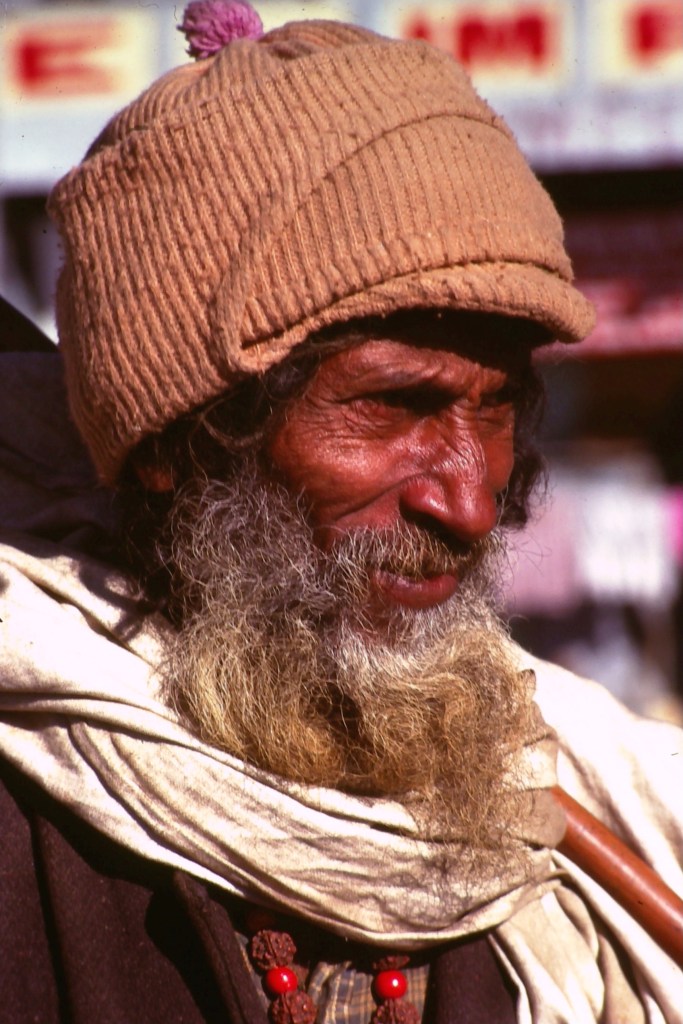
This piece was written in January 1989 while on a holiday in eastern India. The image is called ‘Mussoorie baba’ It is NOT a portrait of the Silent One of Puri, but of a wanderer I met in the hill station , Mussoorie, where I did my pre-university education in a storied boarding school. Such men could be classified as sadhus or sanyasis but are more endearingly referred to as baba. The former terms have a spiritual connotation; that one’s wandering is part of one’s spiritual practice. Baba on the other hand is a more generic term for men who amble around the countryside with no precise motive or destination. It is also sometimes used to refer to young boys. I was referred to as Nate baba, while growing up, by many older Indians.
The photo was one of the first of mine to be published by a company in the Twin Cities that published brochures for churches!



 Missionaries, Mercenaries and Misfits