

If you don’t know by now, let me lay it out there once and for all: I am in love with the music of the 1970s. It’s when my musical ears started to grow up. I am emotionally tied to the ‘70s, the years that took me from a 13-year old dork to a married man in 1980. University, travel, losing the Big V, jobs, drinking too much, etc. Formative years.
This doesn’t mean I spend my days listening only to peak Elton and Born to Run. I spend a lot of time in the weeds in music from around the world, especially the Indian barsageer, and contribute to the profits of Bandcamp quite faithfully. But with age comes many things. One of which is a dropping away of the need to be considered hip. Another is going deep into things. The music of the 70s may be comforting and familiar but in the same way I knew nothing of India until I came to America, it is only in the 3rd decade of the 21st century that I’ve begun to try to really listen to what was going on in the popular music of those years.
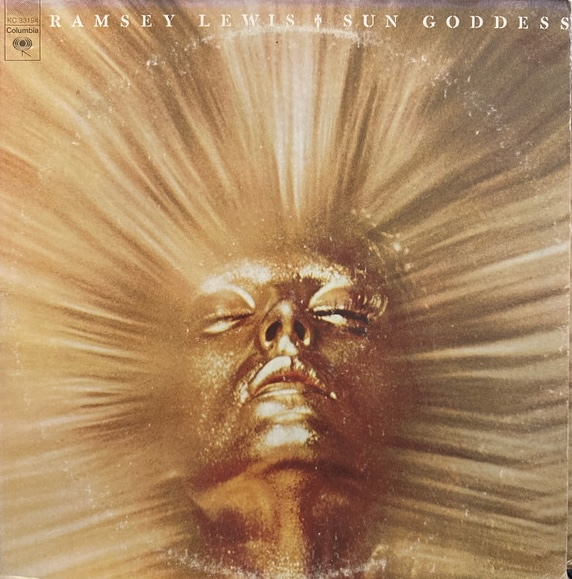
I knew of Ramsey Lewis from regular visits to the local record store. His albums of that time, especially Sun Goddess (1974) and Salongo (1976) were very attractive. Covers that stood out from the mass that called out to be picked up handled. Being poverty struck I was never going to put $4.98 down to actually buy one, but man, I really did love the look of those albums.
Ramsey had got his start in Chicago in the mid-50s. He played what I call club jazz. A sort of diet-Jazz that was accessible, occasionally funky and generally soothing. You’d hear it in small clubs in big cities across America. Les McCann and Lou Rawls, would be there the week before you, maybe Willis Jackson or Brother Jack McDuff, the week after.
Ramsey was a very accomplished pianist/keyboard player and a warm person. But the overseers of ‘Jazz’ showered him with putdowns like lightweight, mainstream, ‘happy clappy’ and bland. He didn’t care. Some of the giants of jazz, including the Duke himself, were fans and mentors. And besides, he was actually making money and had a mixed audience of black and white fans who liked his cross-pollination of styles.
When jazz synced up with R&B and became soul-jazz in the late 60s and allowed George Benson, Grover Washington Jr., and the like to become pop stars in the 70s, Ramsey fit right in. He’d been laying the foundations of soul-jazz for years.
Sun Goddess was released at the end of 1974. The cover pictured the gilded face of a beautiful woman set against what looks like a background of liquid silk shooting out like rays of the sun. Bold & beautiful. Confident. Daring & intriguing.
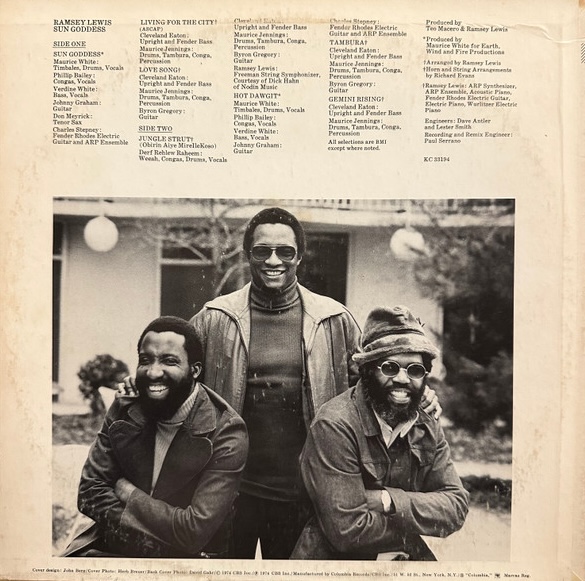
When the stylus hit the wax that lush, warm sound of the times filled the room. Maurice White and several mates from Earth, Wind & Fire were in the studio as players and producers which gives several of the tracks, especially the title and opener, a funky EW&F feel. Maurice and Ramsey went way back. Maurice had been picked up as a session drummer by Ramsey after the departure of Redd Holt in 1966. They had stayed together for several years until Maurice laid out his idea for a large, dance, funk and pop group to Ramsey around 1970. Ramsey smiled and wished him every piece of luck as Maurice moved to LA.
By 1974 White’s group was about to release their breakthrough That’s the Way of the World which included the Billboard Number 1, Shining Star. That EW&F were in essence Ramsey’s backing band on Sun Goddess no doubt gave him and the album a huge boost of street cred.
The music exemplifies that strain of African-Americana which is confident, unapologetic and intensely positive. On the charts in those years were songs like Love Train (The O’Jays), Wake Up Everybody (Harold Melvin & The Bluenotes) and Black Wonders of the World (Billy Paul). Sun Goddess is the sonic realisation of the popular slogan, “Proud and Black”.
Scratch guitars look forward to disco, about the happiest music ever created, but which was still an underground phenom. Ramsey’s keyboards, on piano or Fender Rhodes, always stand out even though he is surrounded by some of the best musicians working at that time. Critics consider Sun Goddess to be a deliberate attempt by Lewis to cross over to R&B. Could be. But there is no sense that he is out of his depth or uncomfortable with the increase in funk that defines the sound. He’s perfectly at ease and as accomplished and classy as ever.
If you’re interested in understanding the music of the 1970s, then you’ve got to get this record.
I wish ‘they’ still made music like this.
Bob Dylan: King of Country Music
Taking the voice of both subject and object, in 1964, Bob Dylan put out one of his defining public statements in the song, All I Really Want to Do.
He assures his lover that he has no interest in classifying, categorising, advertising, finalising, defining or confining her. The same lyrics can be read as well, as a plea to his fans for a reciprocal respect.
And yet, here I go.
Alongside the many ‘Hello! My name is…’ stickers we’ve slapped on his lapel—voice of a generation, Nobel Laureate, fundamentalist whack job, protest singer—I would like to suggest the following: Bob Dylan, King of Country Music.

I’ve sensed this forever, but as I listened to a mixtape I posted recently, it has become clear as day.
Dylan was not just inspired by Hank Williams, Cash and Woody Guthrie, he has throughout his career, drawn deeper on the well water of country music than any other so-called genre. It wouldn’t be too hard to argue that very few albums in his vast catalogue are NOT country or country-rock albums. Bringing it All Home; Highway 61 Revisited; Street Legal jump to mind immediately. Of course there are some others too, but generally the sonic atmosphere of country music and his approach to his art is heavy and sticky with Mississippi mud.
I will go further.
Dylan is a better country singer than a rock ‘n’ roll singer. His voice tends to divide the public. A lot of people can’t stand it. Croaky, wheezy, shallow, awful, they saw. I am obviously not in that camp though it’s hard to deny that of late it is pretty tuneless and frail. I prefer the adjective, quirky. Country music loves quirky; Bob’s nasally and rough delivery fits perfectly alongside that of others like Kris Kristofferson, Jimmie Dale Gilmore or even Willie Nelson. So too his quirky pronunciation and phrasing. Very country.
It works another way too. Some of his quirkiest songs, like Dogs Run Free, a wired and weird folk-jazz oddity on New Morning (1970), is transformed into a perfect country ballad on Another Self Portrait (1969–1971): The Bootleg Series, Vol. 10. Nothing weird or wired. A curly song like this works much better as straight-ahead country. As I’ve mentioned before Dylan’s Bootleg Series are chocker block with alt.country versions of almost every song he’s ever sung. And often these studio scraps are better than his more famous rock and folk stuff. Honestly.
My I admit as evidence, One of Us Must Know (Sooner or Later) a sparkling, sneering gem from Blonde on Blonde (1966 and recorded in Nashville with country session players). An all time personal favorite. But he also released an instrumental version on The Bootleg Series, Vol. 12: 1965–1966, The Cutting Edge. The song works in both idioms and as a western canter, outshines, for its short duration of 4 minutes 57 seconds, any Chet Atkins instrumental.
At the height of his artistic powers he could release two outstanding albums in the same year, 1975. Blood on the Tracks, his mid-period masterpiece and The Basement Tapes, a double LP of random musical experiments and frolics that qualifies as the first perfectly formed album of ‘Americana’ music. Both albums are perennial near-the-top finalists in every ‘Best Albums of Dylan’ list ever published.
What followed in TBT’s wake (recorded 1967-68 but released in 1975) were John Wesley Harding (1967) a proto-Outlaw country album, and Nashville Skyline (1969) pure country pop in which Dylan channels Jim Reeves.
Even during his ‘lost 80’s’ period, some of his most memorable songs were his country ones: You Wanna Ramble & Brownsville Girl (Knocked Down Loaded/1986); Silvio & Shenandoah (Down in the Groove/1988); The Ballad of Judas Priest (Dylan & The Dead/1989). The last is really a Grateful Dead track. Dylan’s singing is pushed along by the band’s amazing rhythm section and Jerry Garcia’s delicious guitar, but it demonstrates that other masters recognised the country potential of his words and tunes.
Let me wrap this up by asking you to listen to this version of I Shall Be Released, recorded live with Joan Baez on the Rolling Thunder tour. Dylan’s voice is absolutely beautiful here. And Joan’s subtle but essential supporting vocals makes a fucking good song, a fucking masterpiece. It is such a spiritual, earthy rendition, with no artifice whatsoever.
Bob never is so relaxed as when he sings his country stuff. His unique timbre and phrasing don’t grate or stand out as weird. Sure, he was only 34 when he recorded this, but his voice is not just physically strong, his performance is one of complete commitment. Whereas his mid 60s stuff sometimes comes off as angry and performative, in this and most of his other country-flavored repertoire, he is nothing but authentic and true.
There is an ultra-thin niche in the Ameri-Euro music business that is best described as ‘world fusion’. Colourful, mostly upbeat music, played by globalised musical combos or artists that draw on all manner of culture and creeds for their musical inspiration and membership. Indian wedding bands alongside southern funk outfits. Spanish flamenco coloured by qawwali. Politically-charged West African hard rock. Reggae played by Mexicans. Indian ragas recreated in a bluegrass style.
I actually don’t know, but as a rusted-on fan of this sort of music, I would suspect this sub-sub-no-genre is not huge. Certainly not in Australia and the States, the two Western countries I think I know the best. Even in the home countries of many of the performers of this music, their following is tiny compared to hip-hop, J or K pop or the dozens of local musical styles. It is a hybrid music which can seem to the casual listener to be contrived. Forced rather than natural. A sort of international muzak for weirdos. Exactly the sort of thing missionaries, mercenaries and misfits would love. Among my own circle of friends, few, I reckon, would echo my pro-‘world fusion’ sentiments.
I’ve not spent time reflecting on who the ‘ideal market’ segment for this music might be, but fans seem to be generally well-read musically and well-travelled in life. Immigrants, refugees, aid workers, guestworkers, academics, third culture kids, diplomats and children of missionaries, such as myself. World fusion lovers usually have some significant personal or emotional connection with WF’s endless, restless creativity.
I find this musical omnium gatherum–corny as a lot of it sounds to the vast majority of music listeners–as essential to my comfort zone as shag carpet was to our homes in 1972. I may not listen to it every day but I could never not enjoy listening to it.
I was born and lived most of my pre-University years in India. I’ve had the unbelievable privilege of working as an ‘aid-worker’ in every continent bar Antarctica and South America. Though I didn’t seriously listen to and pay attention to the ‘world music’ that I had been exposed to, be it an all-night Ravi Shankar concert in Delhi or the soukous bubbling out of every taxi in Nairobi until I began blogging in 2010, I have always enjoyed keeping my ears open to the music of wherever I happened to be at any given moment.
I’m not interested in defending or attacking the marketing category known as ‘world music’, one of the more pointless ways to spend time. I’m not in any position to write a ‘history’ of world music if even such a history could be written. What I am interested in exploring is why I so love ‘world fusion’.
World music is arguably the loosest, broadest and most inclusive genre out there. I mean, it’s music. From the world. The usual line in the sand that it must be from non-English speaking countries/artists, has always been misleading. Taj Mahal, to cite just one quick example, is as much a world music artist (starting with his very nom du chanteur) as Nusrat Fateh Ali Khan. If you doubt me, check out Mkutano or Music Fuh Ya’ (Musica Para Tu) only two of his several ‘world fusion’ discs.
The much-loved Reddit debates about breaking music into sub and sub-sub categories is the second most pointless debate. Spotify the evident source of all important musical data has come up with a list of over 1300 genres from #1 A Cappella to #1383 Zydeco. It’s hilarious but kind of useful. There are those, like my nephew, who eschew noting any genres in their music collections. I empathise with that policy but find some sort of labelling is essential for me to keep track of a sprawling digital music hoard. I generally cram everything into one of two dozen genres and forget about it. But I’m wandering here.
On Spotify’s master genre list, just barely holding on by its fingernails at #1370, is a genre they call ‘world fusion’. And that’s what I’m on about here.
I have no idea how ‘world fusion’ is actually defined by the Scandihooligans as I don’t have a sub to Spotify, but I would guess it would include everything from spa music to Buddha Bar and not much else.
Here’s my definition.
World fusion music is a style, performed primarily by groups rather than individuals, that consciously mixes musical traditions, instruments, languages, singing styles from one or more cultural/musical traditions. The purpose is exploratory, adventure-seeking and overlaid with what these days would count as a ‘woke’ ethos; i.e. there is often a deliberate message of the unity of all humans and equal value to all of our cultures; a conviction that playing music with our politically identified enemies is actually a really good way to create some safe spaces in this world. And as such, WF is a threat to the ever more popular “my country is the best” version of nationalism that is spreading across our weary planet. And to that extent, please call me ‘woke’.
Corny? Self deluded? Perhaps, but it’s the music I’m interested in not the political commentary.
In this category are bands like The Kronos Quartet, Tabla Beat Science, Hindugrass, Abrasaz, Bansal Trio, Ifriqiyya Électrique, Bustan Abraham and hundreds more. Bands that freely experiment with blending bluegrass with ragas, rock ‘n’ roll with North African gnawa, Western classical with jazzy Hindustani violin, oud and sitar, jazz and Carnatic horn blowing.
I love this music. It not only reminds me of places, experiences and people I’ve met, worked and lived with over the past 35 years but it keeps me connected to the world. In diminished circumstances, it allows me to travel the world. It is hopeful music in that if global cooperation, respect and decency are not politically palatable at least WF musicians are keeping these things alive notionally. Which is critical in our destructive times. World fusion simultaneously connects my personal story with a once and future state of mind. It is an almost invisible way to Resist.
On a more mundane plain ‘WF’ inspires me to dig into a particular instrument (kamancheh; duduk) which often leads to learning about musical movements in which some of the artists or bands participated. It helps me appreciate what a particular music scene was like in a particular country at a particular moment (pre-Revolutionary Iran; 1980s Somalia). All of which feeds back into my understanding and appreciation of the many places I’ve lived and visited. The music adds tonal depth, colour and additional realities to places like Angola and Afghanistan which during my sojourns there were understood almost entirely in political or humanitarian terms.
While some of the musical blends WF comes up with (bluegrass with Hindustani classical?) can seem contrived or dead-upon arrival, many times it works far better than you can imagine. As I listen more and more to this music I marvel at how natural and organic it sounds. It turns out the tabla is one of the most versatile and expressive drums ever invented; it sounds good almost anywhere. The oud of Araby has a strong resemblance to the lute of Europe and both pair well with sitar. The Afghan rubab is fucking exhilarating when used as a lead guitar. Bansuri, the Indian bamboo flute, is another instrument that seems universally suited to almost any other strain of music.
World fusion can slip into dinner background music. It’s generally very melodic and interesting rhythmically. Maybe too much like smooth jazz for some ears. I for one don’t mind pleasant music playing in the background when I’m cooking or paying the bills or chatting over chocolate pudding. Much as I love soft rock, chill-out, lo-fi or Top 40. In the right context anything can do the trick.
But when I pay attention, the better bands or groups amaze me with their inventiveness. Such as the group Abrasaz, a Germany-based collective with members from Austria, Turkey, Singapore and Japan. A true ‘world fusion’ outfit who came together to release a single album, Biraminket, in 2008.


There is a strong South Asian atmosphere here with Ravi Srinivasan’s tabla featuring prominently throughout, especially on the opening track in which a racing pattern of drums and steady, plucked bass line (Akira Ando) set the stage for an intense musical hymn to Maya Wati, the mother of illusion and magic. Paul Schwingenschlögl’s trumpet/flügelhorn keeps the feel edgy and like Srinivasan’s drumming is the other magical part of this record.
On Samraat, Srinivasan, in addition to keeping the beat going, joins Mustafa el Dino in vocalising lines of one of South Asia’s great qawwalis, Shams-ud-duhaa Badr-ud-dujaa Teri Bari Tauqir Hai, which switches over to jazz scatting while Schwingenschlögl solos on flügelhorn.
Lhasa opens with a lovely piano alaap played by Schwingenschlögl which then he turns into an equally beautiful semi-ballad. Pentagram introduces the Kashmiri dulcimer (santoor) played by Srinivasan, whose slivery-steely tones immediately move us to a dream-like plain. The flügelhorn alternates between drone and improv.
Though Indian/Pakistani themes and titles abound, none of the performers is actually from those countries. Yet they have been able to build on that platform to explore the limits of their instruments and voices in interesting directions. Purists of all types would find much to be offended here and sometimes it does seem that things are being thrown against the wall to see if the spaghetti sticks. For me that is what makes this album so endlessly entertaining. Because they owe no professional loyalty to qawwali or khayal they are able to approach each as a discrete musical element that can be tested to see if it fits. Thus, scatting against the Indian musical scale or picking out a line or two of a traditional much more famous piece, means they can connect to both European and Indian ears. The sound is familiar enough to both but neither pure jazz nor Indian. Or anything else. Oiwake, based on a much-loved Japanese folk song, allows Ando to foreground his bass before singing inspired by khayal soars above the driving rhythm, ultimately creating a twirling dervish chant. The transition is as seamless and satisfying as George Harrison’s ‘hallelujah’ to ‘Hare Krisna’ chorus on My Sweet Lord.
If there is one thing that I wish I could change it would be highlighting more of the saz, the only stringed instrument featured here. The saz, like its cousin the bouzouki, is suited to both rhythm and solo and always adds excitement to the proceedings. Unfortunately, it is heard far too little here but has a nice turn on Kalbimiz Bir and Abraxis II.



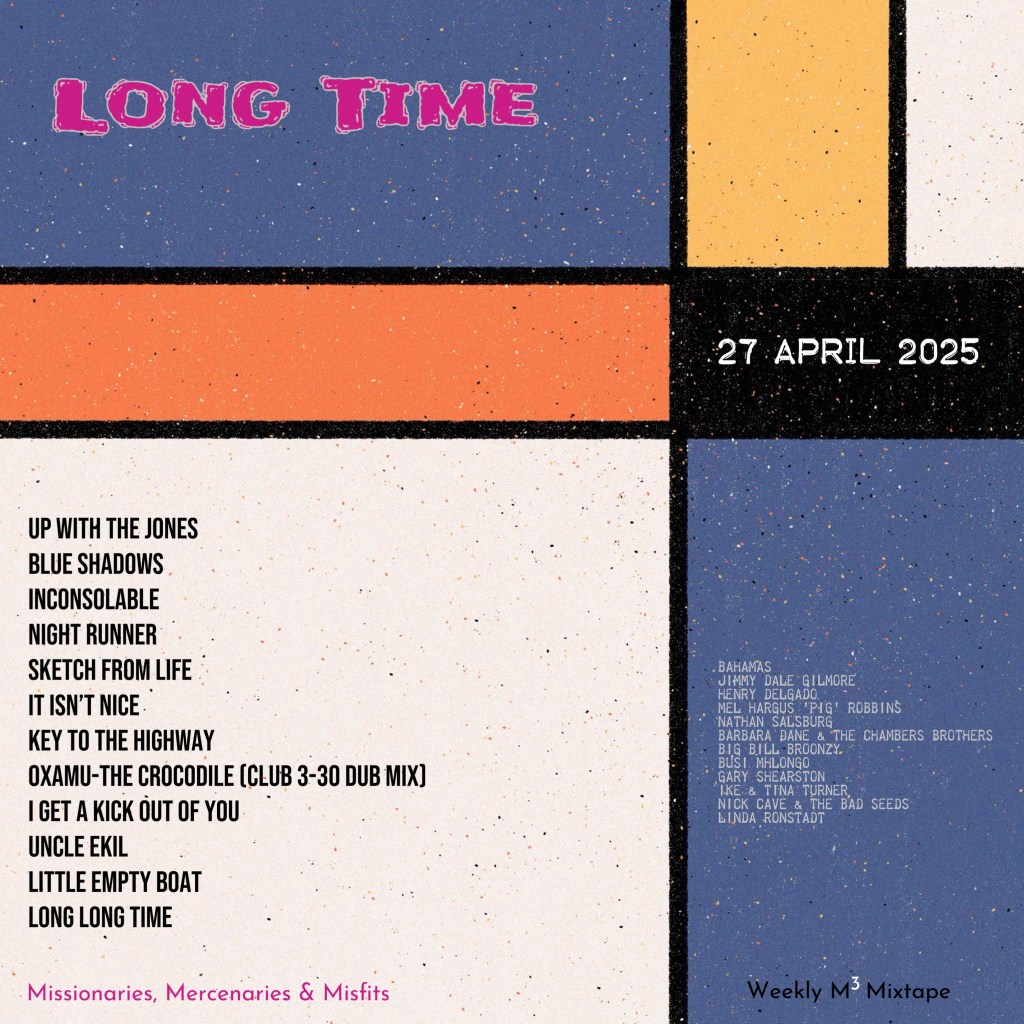


 Missionaries, Mercenaries and Misfits