Sometimes I Lie Awake at Night and Wonder

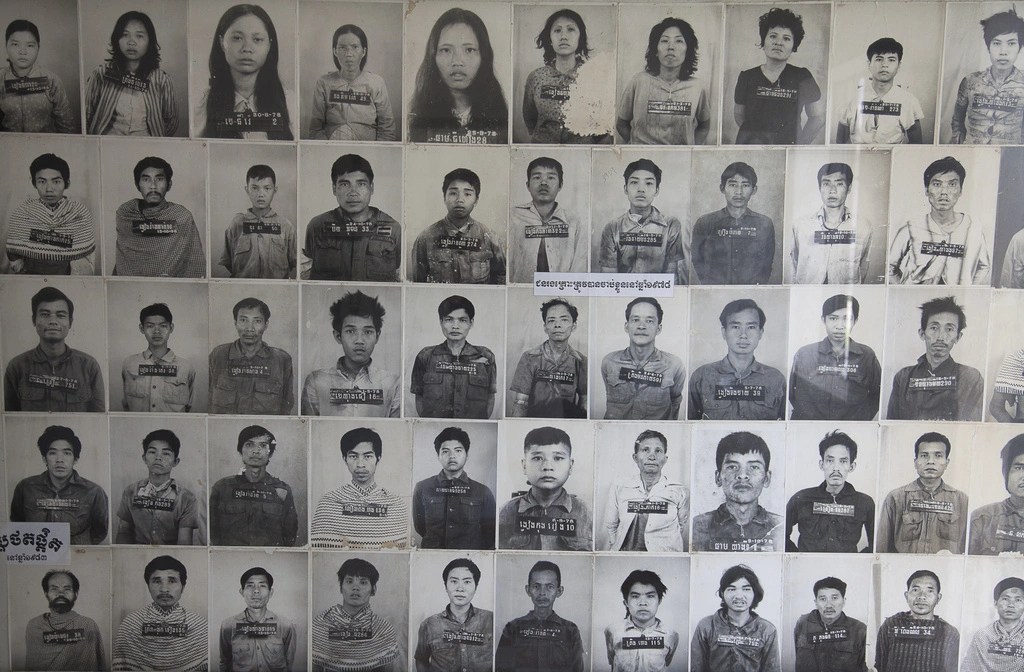
Some of Pol Pot’s victims, S-21 Prison. Phnom Penh

Tonight I’m in Phnom Penh and can’t sleep. I seem to always wake up at this time, when the day is still dark and the only sound is that of lazy thoughts shuffling inside my head. On the other side of the hotel window a boat bangs softly against the jetty.

It is windy and the monsoon is nearly at an end. I was told Cambodia is a land of dusty sunsets but I find the county resplendent with green paddy and the gurgle of the pale brown Mekong in flood. I expected, too, to meet a morose and sullen people. But the Cambodians are warm and can’t repress their smiles.

Throughout the town small but smart restaurants cater to the foreigners that work for the NGOs and UN agencies that finance and prop up the social welfare system of struggling countries like Cambodia. Banners pronouncing tourism as a ‘tool to build cooperation’ droop in the thick air. The tourists are back. Backpackers from Australia, packs of Japanese and most ominously, ugly aging men on the prowl for sex with young Khmer girls and boys. Cambodia is challenging Thailand as the premier destination for sex tourism. Such are the hairline cracks of a poor country’s development.

There is another macabre little industry in Phnom Penh centred around the horrific torture chamber known as Tuel Sleng or S-21. Tucked deep inside a residential neighbourhood the former high school transformed by the Khmer Rouge into a laboratory of evil, S-21 is a ‘must see’ for any visitor to Cambodia.  Along with the temples of Angkor, part of the grand tour.  Moto drivers call out to you, ‘Tuel Sleng. Look at Khmer Rouge jail’. You can buy T-shirts with disgusting recreations of faces behind bars on the backs.  They also sell bags and skirts made of bright Khmer silk right next to building B where Pol Pot’s most important enemies were kept in tiny wooden cages before being cut open like animals and fed to the demon, Angkar, ‘the Organization’. 

I certainly remember the name Pol Pot but his crimes were still unknown outside of Democratic Kampuchea in those years, 1975-1979. It’s an old story now, how this country was transformed, almost overnight, into a giant slave camp. Cities were evacuated and left empty and the population forcibly moved from province to province to reshape the face of the land. Canals were gouged out of the earth. Dams glued together. Millions of paddy fields planted. All done without the help of machinery, with only bare hands and fingernails. Machines were deemed impure and imperialist. Money was abolished as was religion, privacy and even talking. Democratic Kampuchea was a massive experiment in applied paranoia. The people were starved and then themselves became fodder: sustenance for Angkar. Hundreds of thousands, even more than one million, perished. There is not a family here that doesn’t harbour the loss of a sibling, parent, child or spouse.

Why didn’t we hear of this when it was happening, I wonder?

I recall an exhibit at S-21. Instructions painted on a signboard to those under torture. Among the many protocols is the command not to ‘yell out or make any sound when you are beaten with electric wire’.

The single most important factor in the success of Pol Pot’s revolution, according to most scholars, was the carpet-bombing by American B-52s between 1970-1975.  By the time Phnom Penh fell the people of Cambodia were massively traumatized from years of dodging falling explosives that wiped out their villages, families and animals.

I used to work in Iraq. One night the Kurds went wild and fired their machine guns into the air. We lived in tents against the side of a hill. We ate under a thatch and open sided cabana. For several minutes I felt the terror of having no control over my well being. Shells from the celebrating Kurds’ guns rained down from the sky thwacking into the earth and cracking into rocks. I ran for cover but why, I don’t know. There was nowhere to hide. How was a canvas tent to protect me from a hot piece of iron falling from the sky?

And how was a Cambodian peasant to protect himself from a massive cluster bomb falling from an unseen American warplane? And not just once but night after night, week after week? When the Khmer Rouge came to town they didn’t have to ‘recruit’. The people swarmed to anyone who claimed they could stop the bombing.

Daylight is breaking over the city.  I can hear street children laughing now and the sky is white. It’s going to rain some more today.

I wonder.

In the 1970s an American President doggedly pursued the ‘national interest’ and filled the air with airplanes and bombs and mighty words about the need to stop communism from sweeping across the world.  More quickly than Presidents Johnson, Nixon or Ford could have imagined and certainly more inelegantly than the American people were led to believe, communism and the horror that the planes and bombs were to supposed to eliminate, ran the Americans out of town. And tore apart the people and society they were supposed to save.

A year ago another American President began massive bombing against another weak and troubled Asian country. “We’re going to get him dead or alive” the world was told. And something else too. “This time we’re not going to let the Afghan people down. We’ll change the leadership, establish the rule of law and stick around to rebuild the country.”   One year on the Taliban are gone but still active on the periphery. Osama is neither confirmed dead nor alive, apparently relegated to the ‘too hard basket’.  The rule of law remains a fantasy in Afghanistan and donor fatigue has already set in. Of the billions pledged to rebuild Afghanistan to ensure that terrorism has no room to hide, much has not been delivered. The Afghans, it appears have once again been sold a line by their ‘saviours’.

President Bush is once more in dogged pursuit of American interests. Come hell or high water, right or wrong, support or not, we are told he must “change the leadership in Iraq, establish the rule of law and get the UN to pay the billions needed to rebuild the country”.

Sometimes I lay awake at night and wonder.

What sort of new horror is going to arise from the ashes of Afghanistan and Iraq, similar to that arose here in Cambodia? Will Americans wake up and see the links between their crusades against communism and their wars against terrorism and the misery and hatred that follow in their wake?

Phnom Penh, Cambodia 2003
Early Morning

Early morning.

Listening to the most amazing birdcall I have ever heard.  A loud series of confident, audacious chirrups, growls, clicks, whistles and scratches.  At times a low coarse growl (very un-bird like) then a piercing whistle or two. Now, one, two, three, four; the strange almost metallic sawing sound like the inner workings of an old office chair that hasn’t been oiled in years. Just as quickly the creature finds its birdness again and lets loose a lovely syncopated series of crystalline, round, delicate squeaks. For a moment it is silent, then as if it were a one-man band playing an upbeat number, (thumping the loose bass strings, the tinkle of the cymbal, the squeak now and then of a sax and a droning harmonica) the concert begins again. Right outside my window.  She taps her beak against the branch on which she is perched, like a maestro tapping the podium. And then as that elongated moment of expectation stretches out, at last, the music, in a frantic tumble of tones, begins again.

This experience, this birdsong, is rare or seems so in this place. It has a lustiness and vibrancy of a tropical setting: a Thailand or southern India.  Not a bleak washed out Central Asian winter morning. But it is lovely and nearly humourous.  She’s a prophet. A voice from God reminding us that He is always with us-even in the most alien, isolated and uninhabitable places.

It is quiet now. The bird has gone.  In the distance further away and more subdued and barely audible above the morning traffic that is starting to whoosh through the streets, I can hear the slight, timid calls of a flock of small birds. This is how I will recall Russian Asia. Ordered, unspontaneous, uninspired. But how also will I remember Khojand—-in the winter nonetheless-—for the laughably unexpected concert that woke me up and got me on my way.

Khojand, Tajikistan. 2001

A Note on the Image

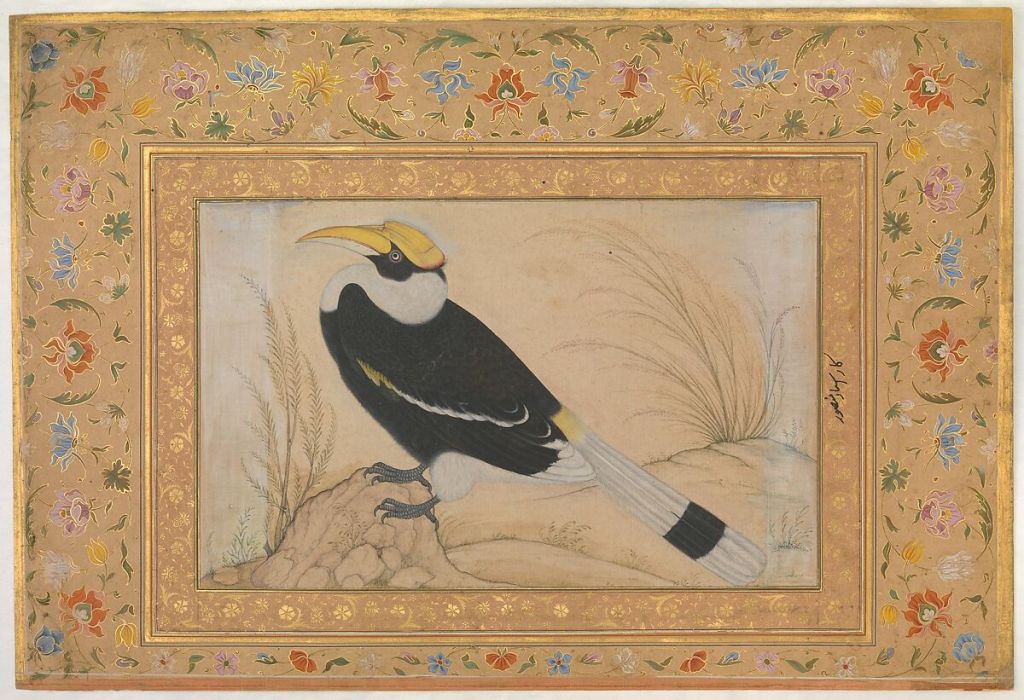
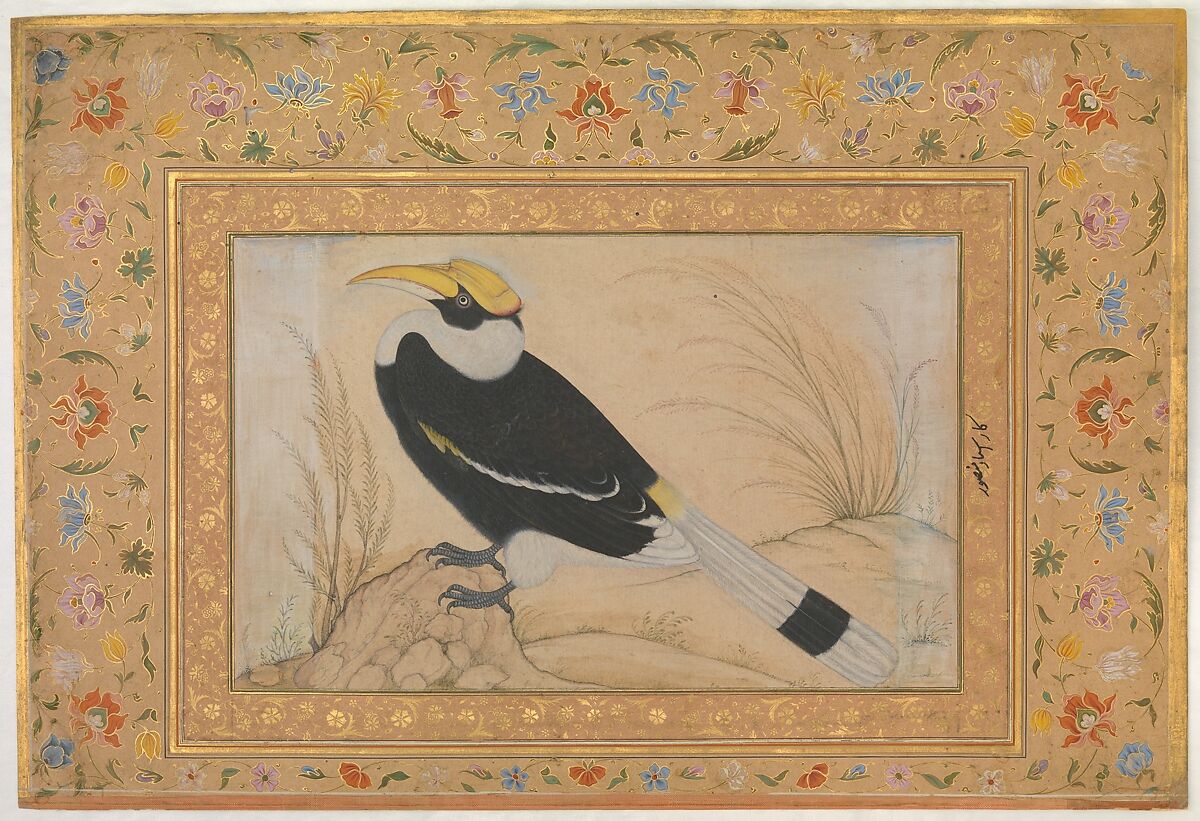
Titled ‘The Great Hornbill’ this painting dates from between 1620-40 C.E. (1030-50 Hijri). The artist, Mansur, was a leading nature painter at the court of the Mughal emperor Jahangir; around 1600, he briefly also practiced as an illuminator. The emperor took a passionate interest in the natural world and established a compendium of natural history with Mansur’s help.


Mansur was extraordinarily talented for scientific documentation. His detailed careful depictions of plants and animals avoided all personal expression and are extremely valuable for their scientific accuracy as well as their artistic perfection. He became known as Ustad Mansur (‘Master Mansur’), and the emperor bestowed him with the title Nadir-ul-`Asr (‘Miracle of the Age’). The artist accompanied Jahangir on some of his travels and was then in charge of the documentation of plants and animals. Many of his paintings were left unsigned, and only one of his flower paintings can be clearly attributed to him today.

The Mughals (a corruption of the word, Mongols) were at their imperial apex at the time of Emperor Jahangir. They had conquered India several generations earlier and traced their lineage to the fearsome warrior/ruler, Tamerlane (Timur). I wrote this piece in the ancient city of Khojand (Leninabad), an ancient Silk Road city situated at the entrance to the Fergana Valley, the ancestral homeland of the Mughals.

What’s in a name?

The phrase that names this blog is a hackneyed one and one that seems to have popped simultaneously and spontaneously into a number of heads at the same time.  It is now a dull commonplace that elicits grunts of acknowledment rather than laughs of revelation which it was designed to do.

It’s been used as a descriptor of all those who toil in ‘Aidland’ the vast global financial, institutional and spiritual infrastructure of those involved in delivering ‘aid’ to people in the ‘developing world’ or ‘global South’. Those people in the blue vests and red or orange hats with their employer’s logo splashed across them whom we see on TV in the immediate wake of a flood, tsunami, war or earthquake.

There is a whole school of research and writing on these people (of whom I am one) and perhaps one day I’ll read some it.  But I am not interested in Aidland, or aid workers here in this piece.  Rather, I’m interested in understanding why, when it came to naming this blog, this phrase jumped instantaneously to mind.

I was born into an actual missionary family in India.  I am an MK, a missionary kid.  I have done some pretty mercenary things in my life and know the temptations of that character.  As for misfit? Aren’t we all?

What has inspired this blog is a frustration with how I make sense of my world. Of my experience as a mid-60s male who has had a privileged life. And there is an urge within me to, in some way, document my journey. Not because it is particularly unique or dramatic but because I have never had the time or space to reflect on it.  To see how and whether and why these three strains of my personality and identity come together. Or don’t. Perhaps they are just frayed loose ends.

I’ve thought of writing a memoir. Perhaps an autobiography. What about a fictionalized life of a former missionary kid turned aid worker called Nate? But all attempts have fizzled. I haven ‘t been able to summon the energy to finish such a project.

But I have been writing all my life.  Short pieces, novels, the first draft of a history book, text books, articles on music, politics, ‘Aidland’ and strange figures of history. I’ve written sitreps and reports on humanitarian disasters, and hundreds of funding proposals.  I’ve translated books from Urdu to English. I’ve edited newsletters. I’ve written thousands of letters (though none in the last 25 years). Writing things down is how I validate myself and express myself.  Some people like to chat.  I write.

I’ve been blogging a long time too. I began in 2010 and since then have launched many blogs mostly on music, but also about photography and memoir. It’s a medium I know and understand and enjoy.  After months of hemming and hawing about whether to join Substack, I’ve decided to remain a blogger.  And use this new blog as a sort of laboratory, factory and think-tank; a messy sangam of the various streams that make up each of our lives.

Rather than a single volume ‘memoir’ this blog fills in as my ‘autobiography’.  Read this and you should get a pretty good idea of who I am and how I got from a missionary hospital in south India to the suburbs of Melbourne, Australia. 

Before I leave, let me riff on the triple-barreled phrase that fronts this blog.

How can you tell how long a missionary has been in India?  Notice how they react to fly in their tea.  1-2 years, they grimace and politely push the cup of tea away. 5 years, they delicately pick the fly out and flick it on the floor.  10 years or more, they squeeze the fly of all the tea juices that have entered his drowned body and continue to sip the tea.