



In 1996 I visited Afghanistan and Pakistan for an Australian NGO. The Taliban had just captured Kabul a fortnight earlier and thrust, very momentarily, the plight of everyday Afghans back into the international media’s spotlight. Given the current state of Truskland I think these voices are worth revisiting.
He was as new to town as I.
“I came here from Kabul the day before last. My name is Hashim.” He wore a hesitant smile and a blue waistcoat. He had been watching me walk up through the gardens and toward the street. “Will you make my photo?” he asked.
He posed with his arms across his chest and gazed away from the camera with a cinematic expression. I took his picture and asked what had brought him to Mazar-e-Sharif.
“My father told me to get of of Kabul as the Taliban are capturing all young me to fight. I’ll go back when my father tells me. I am staying in a hotel as I have no relatives in Mazar. Its very expensive. All day I sat here watch people in the garden. I sit and think but I try not to think of my family. We had a shoe factory in Kabul. But when the mujahideen came to power they stole everything. Now I am jobless. In Kabul I study English and also kung-fu. But now everything is closed. I don’t go out because it is too dangerous. I am Turkoman. The Taliban are against us. And the Tajiks and Hazaras.
“I saw Najibullah hanging in the street. It made me sad. None of these groups are Muslims. They only kill anyone who doesn’t agree with them. ‘Grow a beard!’ ‘Wear a hat!’ ‘Don’t go outside!” And if you disagree to grow a beard it is the end. For the last 5 years I have seen these people. They are not Muslim.
“See that man there, singing. He’s gone mad. I’ll go mad, too. I sit here everyday. I want to get out of here, to Germany or to an English speaking country but its too expensive.”
*****
“How is my English? I have been studying for two years but most foreigners do not like to speak with me. Why is that? One time I asked a foreign man what time it was. He told me, ‘Sharp 4 o’clock!’ That was that. He said no more to me.” Khaililullah spoke excellent English. He was a northern-Pashtun–dark, almost Indian in appearance. But he had born north of Mazar and had recently returned from over 10 years as a refugee in Pakistan.
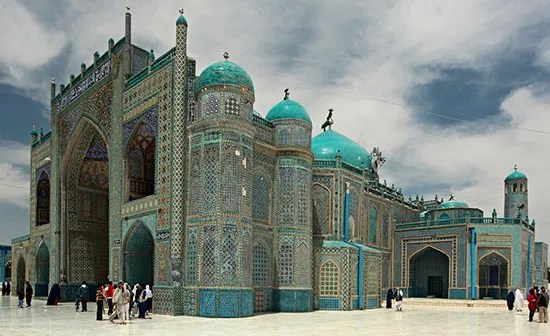
“I teach English. In Monkey Lane. Will you come and visit our class?” I told him I would come but not today. Today I was interested in visiting the shrine of Ali, the grand blue-tiled mosque around which this desert town spills. I told Khalilullah how much I admired the mosque and its color. “You’re lucky to live so close to such a beautiful building.”
“By the grace of God we have a good leader. General Dostum. He used to be a communist but now he prays five times a day–he’s very good. And powerful. The Taliban are the trouble. They want to keep girls from school And this forcing men to pray in the mosque five times a day. Even our Prophet Mohammad himself only prayed 4 times a day sometimes So who are they to force us?
“Of course. There were excesses in Najib’s time. He gave too much freedom and too quickly. Especially to women. This corrupted us. Women went about barefoot–without shoes and wore nothing at all on their heads. According to Islam, a woman’s head should be covered. But not completely hidden. Both the Taliban and Najib are wrong. God save us from that much freedom. On the other hand under Najib, women and girls were educated and worked. That was good. So he was not entirely bad.”
Najibullah felt that the public hanging of Najibullah was inevitable. In his mind it was a justice of sorts for having allowed women to go barefoot and to be judges. But what he told me next I heard many times during my visit.
“Before they killed him they ordered him to sign his own release papers. He refused. He had denounced communism and discovered patriotism. He did not feel he had to confess to any crimes. But I know from an accurate source that he had memorised the entire Quran. But he refused to sign the papers confessing to anything. So they killed him. But in that, he was right. All Afghans respect Najibullah now. He wasn’t afraid to die. He was a true Afghan.”
When I visit Khalilullah’s school a few days later he refused to discuss anything except English and non-political subjects. “What do you call this?” he asked me, pointing to a shelf. He made not of my response, “A mantel.”
He and his fellow students discussed music and literature as if nothing was wrong with their country. The school had 600 students, women and men, learning English every day. “We want to prepare ourselves for the future. Today you must have knowledge of two things, English and computers, if you want to succeed.”
Jamil was adamant. “What do you believe will happen to Afghanistan?” Before I could respond he went on. “We are fanatics. This is no way to bring universal peace anywhere. And there is no way our people will talk. No way they can win in fighting either. I don’t know what will happen. This fighting will continue. All I know is that I will go to English class and then I’ll go home. Tomorrow? God only knows. Who sees beyond today? We are ready for anything though. My father is not a commander. We are civilians. We want peace and normality. Things like sports and music. My name is Jamil. It means beautiful. We want to help ourselves by learning English but our pronunciation is all bad. What do you think?”
*****
*****
“Welcome! Just have a look, no need to buy.”
The huge bearded Afghan stood beckoning to me from the doorway of his carpet shop in Peshawar’s Khyber bazar. It was a typical sales pitch but it soon changed when I enquired about the man who owned the shop next door. He was the son of a friend from Melbourne.
“You want to see Hamid?” he glared at me.
I nodded.
“Communisti!” The word hissed out of mouth like air leaving a tyre. His companions in the shop immediately turneds toward me and smiled sheepishly.
“Hamid is no good man. He is a foreigner. And communist. He supported Russians and speaks their language.” The man stumbled about for words to express his dissatisfaction with his neighbor. He spoke broken English and felt limited in what he could say.
“Communists. Uzbeks. Hazaras. Very bad.” He made a gesture with his finger slicing across his neck. “They are not Afghans. They are Angrez!”
I asked what he meant by calling Uzbeks and Hazaras, the most Mongol-featured of Afghans, Englishmen.
“He means they are foreigners. They have come to Afghanistan only recently. They are not true Afghans. We Pashtuns are real Afghans. The others are not. They are so small in number, not like us. Pashtuns are 60% of Afghan people. The others are only few. Miniorities, you know.” This man who spoke better English wouldn’t tell me his name but he did identify himself as working as a ‘spokesman’ for the Taliban office in Peshawar. “I know very well the Taliban. They are very good. They are against Communism and foreign domination.
“You see, we are refugees in Pakistan. It is not good for us to say that we want to control Pakistani politics of government. This is not our right. We should only sit quietly and do our business. It is not right for us to force our desires on the Pakistani public. And so it is with Uzbeks and Tajiks–though Tajiks are not so bad. But Uzbeks and Hazaras. They are refugees, not true Afghans. They came only in the last 40 years and now they want to dominate the whole country. But it is for us Pashtuns to control Afghanistan. This is our country. Uzbeks should return to Uzbekistan and Tajiks to Tajikistan. Why should they stay in Afghanistan?”
The bearded carpet seller broke in again. It is very dangerous here these days. Every day the Shi’a are attacking Sunnis. We must kill the Shi’a.”
Most Hazara Afghans, the poorest and historically most discriminated against of all Afghan minority groups, are Shi’a.
The TV in the shop began broadcasting an old Pakistani film romance. The men ignore me and lay down on the carpets in front of the TV. A woman danced through a rose and fountain garden to a lively folks tune. The men smiled as they watch the star dance.
I didn’t bother to ask them about the Taliban’s attitude toward women.
*****
The next day I had tea with an Afghan refugee family. They had come to Pakistan after the fall of the Najibullah government in 1992. They were secular, non-Pashtun Afghans. Educated abroad and middle class. For four and a half years they had lived in Peshawar.
The matriarch of the family, Hafeeza (not her real name) has lost a husband, two sons and two daughters. Her husband, a senior figure in the PDPA (People’s Democratic Party of Afghanistan), the Soviet-backed party that ruled Afghanistan from 1978-1992, was assassinated in 1989. Her eldest son and daughter were kidnapped in 1992 by triumphant and vengeful mujahidin in Kabul. “I have no idea why they were taken from me. These people hate everyone…especially people who they consider communists or Russians.
“My eldest daughter was a doctor. Since the day of her marriage I have not seen her. She may be dead. Or she may be living secretly someplace. But I’m sure she is dead because even if she was in Mazar or overseas she would contact me.”
Hafeeza had been the principal of a large school in Kabul. In Peshawar she had tried to get a job as a teacher but had been turned from every door, called a communist and foreigner. “I have even tried to have young children come here to our house for tutorials but parents forbid their children from attending because they believe I will teach them wrong things.”
She smiled ironically. Another member of the family took over. “In the schools here in Peshawar, which are controlled and run by the mujahidin and Taliban, Afghan children are taught to kill people like us.”
She puled out a text book which looked like any normal grade-school primer. Poorly drawn figures and large simple sentences filled each page. Instead of apples and kitten the lessons used AK-47s as object lessons. 1 Kalashnikov plus 2 Kalashnikovs equals how many Kalashnikovs? On the following page, a similar arithmetic problem used grenades.
“What will happen to our children? What is the future of our country if they are taught such things? They are taught to hate and kill. Their masters in school teach them that if they kill 3 Communists or kafirs they will become ghazi. No wonder they hate us. Our lives are in danger. We cannot get work and we are afraid to move about in the streets.” Hafeeza broke down.
The other family member told me, “Just six weeks ago, her only remaining son was kidnapped here in Shaheen town. He was going to an English class be he never returned. He had been threatened and warned by some bearded people a few times, ‘we know who your rather was. You are a communist and Russian.’ Hafeeza asked him not to go out but he was young and wanted to learn something. But now he’s gone and I’m sure he’s dead.”
Hafeeza stared blankly at the floor. Her only remaining child, a 19 year old daughter, comforted her mother, though she herself was in tears. “They do not go out at all these days. They are afraid after what happened. Who will protect us? We are not communists and we are not Russians. Our fault is we are not Pashtun and we oppose the Taliban. For this they want to kill us.”
The family has siblings and parents in Melbourne. But their repeated attempts to get visas to come to Australia have failed.

I was born in India in 1957. The youngest of four siblings in an American missionary family from small town North Dakota and Minnesota. We were evangelicals. Conservative in a Protestant theology heavily influenced by the Holiness movement of the 19th century. Small sect Methodism that believed all sinners could be completely ‘sanctified’ or perfect, in their lifetimes. Among other things of course.
I was born in the southern Tamil temple city of Madurai but we lived 850 kilometers northwest in a Kanarese speaking area of what is now the Indian state of Karnataka. Dad’s employer, the Oriental Missionary Society or OMS, had established a bible training college in the town of Gadag, famous for producing one of classical Indian music’s noblest performers, Pandit Bhimsen Joshi, and a lively printing industry.
Dad taught theology and related subjects to young Christian men and women from the surrounding areas. He regularly preached at outdoor revival meetings with his colleagues and students. Mom helped out wherever she was needed, sometimes as the bookkeeper for the college, sometimes she would join the pastors’ wives in their rural evangelizing campaigns but mostly she raised us kids.
They had landed in Bombay after a long voyage across several oceans from New York in February 1952. They were appointed to join another American family, The Davises, who had two boys round about the same age as my two brothers, and a jolly, tubby spinster from Baltimore, Mary Ella Taylor.
Mike my oldest brother was 5. Gregg, next up was 3. My sister Rebecca would arrive 3 years later, in 1955 and I brought up the rear in ‘57. There is a good case to be made that another sister was stillborn before I came along.
We lived on the campus of the Karnataka Bible Seminary, whose red brick buildings dated back several decades. It was well shaded at least in the front part and served as a safe, walled but sprawling little world for me to explore as a kid.
We were generally happy and normal. Among our subcultured circle of missionaries anyway. In fact, compared with the Davises, mom and dad were liberal youngsters, which did cause ongoing friction between them over the years. As is the wont of every child what they see in their homes they project onto the entire Universe. There was nothing different about us. We all believed broadly the same things about the Bible and God and Jesus. We shared a barebone existence with few physical comforts. It was simple, filled with good food, devotions, trips to exotic places like the temples of Hampi, Shravanabelagola and the beaches of Karwar. Of course, “we” in these instances refers to other OMS missionaries or white folk in India more broadly.
It was impossible not to notice that most everyone else around us and among us did not believe these things. But then, that was the whole point of our landing up in rural southern India. To try to get as many of them as possible to come over to our team. A spiritual kabaddi match.
Only recently have I begun to distance myself from the lived experience of my childhood. To look at it not from within but from a distance of 60 year; and from the outside. How did this rural, poor family from Minnesota end up in the villages of central India, speaking strange tongues and eating strange food? Why? What was going on in India at the time? And how did being surrounded by religion and spirituality, in the home or everywhere you went in India, and speaking Kanarese simultaneously as fluidly as English and having Indian friends to whom I was closer than to my brothers who were away in boarding school?
What does /did this niche childhood-–Minnesota, Holiness Methodists, missionaries, newly Independent India, bilingual communication–influence who I am today?
This is about that.
India has been an indivisible aspect of my life since 10 July 1957. At times some have found it irritating and maddening. Others have seen it as fascinating and exotic. Most just shrug, especially now in this tiny world we live in, in the 2020s.
My connection to India is something I’ve always loved but haven’t known how to incorporate into my story. Or stories. It depended on the audience of course, as all stories do. My wives have felt threatened by India which is so easy to love in comparison with a real complex woman. So, there is shame and protection mixed in with my love of India. I’m sure many, including myself, thought I would outgrow my romantic childhood when I became an adult and that its influence would settle into a manageable and quaint curry now and then and perhaps one grand tour with the family when the kids are old enough to enjoy an adventure.
But it hasn’t happened that way. The older I got the more attached and fascinated by and in love with the place I become. I chose to study Hindi rather than Latin or French in high school. At the University of Minnesota, I jumped from majoring in Anthropology and Journalism and English before settling on South Asian Studies and History. I studied Urdu as well as Hindi. I spent a year after university studying in Lahore Pakistan. I was thinking of doing a PhD on one of the most important figures in modern South Asian Islam, Maulana Maududi. But then I got a job with the UN in Islamabad and began a career that took me around the world. India faded into the background for those years but never died.
I began blogs about South Asian music and wrote a novel set in Pakistan. I read books on the caste system, Tamil anti-Brahmanism, Aurangzeb and the film industry, travelled and photographed across India whenever I could, did an ongoing deep dive into south Asian music and film and wrote a weekly column on the subject for an Indian online paper. I was asked to write a history of the Pakistani movie industry and now I’m thinking of leading tours to the sub-continent.
India is not fading away like it was supposed to.
Many of my kind (Missionary Kids from India and Pakistan) break into song when asked by Indians to explain ourselves.
Mera juta hai Japani
Yeh Patloon Englstani
Sar pe lal topi Russi
Phir bhi dil hai hindustani
(I wear Japanese shoes and English trousers, The red hat on my head is Russian but still my heart is Indian)
It’s a hackneyed trope but does capture the essence.
My first blog I named, the Washerman’s Dog which is the English version of another famous Indian aphorism: na ghar ka na ghat ka, dhobi ka kuta (neither of the ghat nor the home, the washerman’s dog)
Both sets of lyrics resonate with me. I do feel homeless in a way, neither from here nor there. But also completely blended in with India.
Hence, it seems appropriate to name this column, My Desi Heart. A place where I’ll explore the story of my love-affair with the sub-continent.
The decision by Trump/Musk to do away with USAID should be a development we are not surprised by. But I am. It does not bode well for millions of people and communities around the world whose American tax-payer-funded assistance will cease. But its certainly, a huge nail in the nearly completed coffin of the aid sector as we know it.
The move to disappear stand-alone aid agencies is not new. Canada did it. Boris Johnson did it. And it happened here in Australia in 2013 when a pugnacious let’s-move-back- to-the-past Prime Minister mandated the death of AusAID.
Everywhere it has happened it has had a similar effect. The quantum and impact of the ‘aid’ decreases dramatically. Experts with decades of experience and knowledge are turfed out and replaced by graduates and bland bureaucrats with no interest in the subject matter. When Australia did its downsizing over a decade ago, the budget for international aid had been growing steadily and significantly every few years. Both parties, pledged to make Australia a good global citizen and set a target of .7 GNI (gross national income) to be the annual goal. This would have taken Australia from a medium sized supporter of community development and humanitarian response to the major leagues.
When Tony Blair became Prime Minister of Britain in 1997, he removed the ’Aid’ office from the Foreign Office and created a separate and well-funded agency which dominated the sector for the next 15 years. DFID, as it was known (Department for International Development) was very well funded, filled with recognised technical experts and championed new ideas. It was the thought leader of the global sector, respected by all for its commitment to addressing some of the inherent problems that exist in such an agency.
USAID was the Daddy Warbucks of the industry. The agency with the deepest pockets, largest infrastructure and a pioneer in the financing of major infrastructure projects like dams and roads that were critical for countries to building their sense of nationhood and post-colonial economies. It had its political constraints imposed by Republicans (no support to abortion or reproductive services, for example) but it was so big these things got lost in the shuffle.
As a kid in India, one of the regular features on the landscape were American men sporting crewcuts and white shirts running around in the most remote places laying the groundwork for or directing the building of such projects. I attended school with several kids whose parents were in India or Bangladesh or Burma or Ceylon for a few years, working for USAID or the Canadian aid agency on these massive projects.
It seems those days are now gone forever. I lament not the white men and crewcuts or even the massive projects, but that governments no longer consider soft power and aid to be something of value. And the implicit if unspoken belief that poverty can be defeated. And that the ‘West’ has a degree of responsibility for taking steps to reduce that poverty and vulnerability.
DFID is no more. BJ smooshed it back into the Foreign Office and its budget was stripped to support other brilliant schemes like sending asylum seekers to imaginary camps in Rwanda. And to support other underfunded Tory projects. Where if once was a beacon, Britain’s aid program, like so much else in the UK, is flickering candle in a rainstorm. Canada means well but has lost its importance as an aid donor.
Australia, flying high with billions of dollars and ambitious plans to support climate change around the world, is now a sick, in-house joke. Rather than .7% of GNI, the aid budget represents .19% GNI! The lowest level since the 1950s! It’s important presence in South Asia, Africa, and SE Asia has disappeared. It’s only significant programs are in Papua New Guinea (former colony) and a few other Pacific Island nations. Its priority is pro-business and infrastructure. Issues like public health, agricultural support, education support or humanitarian response is as thin as the storyline the politicos spin in front of the cameras.
For well over a decade now, Interntional non-governmental organisations (INGOS) have been struggling to find a reason to stay alive. This is a long and inglorious story of strategic blindness, consolidation and refusal to face the reality of a changing world. In this way, perhaps Trump’s bull-in-a-China shop approach will finally bring on the crisis that will at last bring reality crashing through the cubicle partitions. That could be good. But the damage will be massive and the chances of it leading to anything but chaos and corruption, extremely low.
More likely what we will see is the aid budget going to support Trusk designed projects (Trump hotels in Myanmar, rocket ships for Kazakstan, oil drilling in South Sudan, shopping malls and data farms in Greenland). And huge disruption to the financial viability of INGOs around the world that have built themselves into large often-bloated institutions whose main source of revenue is USAID. Which is now shuttered.
I just tapped in “USAID.gov”

Stay tuned for further developments on this front.


This photo was taken at the massive Pirwadahi bus station in Rawalpindi. It is from Pirwadahi that long haul buses commence and it is at Pirwadahi that they end their journeys. At least up it was until the early 1990s, when my time in Pakistan came to an end.
I took this photo at my favorite time of day, an hour or so before sunset. It was winter, probably January or February 1989/90 giving the light a warm golden hue. The bus’s windscreen and body had just been washed so the usual dust and streaks of wipers are not a hinderance.
Pakistani bus decorating is one of the country’s great folk arts. What often looks like garish sticker-mania in fact often can be decoded. In this instance starting from the lower left: a religious poster depicting Hazrat Hussain, the Prophet Mohammad’s (PBUH) grandson and spiritual icon to Shi’a Muslims all over the world. The large script at the top of the windscreen is a Q’ranic or other spiritual saying and at the very top you can the words 1988 Model. Signifying the year not of the manufacture of the bus but of the decorations. Multiple stickers of vases and flowers reference one of the most popular design motifs from the Persian world. Scholars find many pre-Islamic references and continuities in such images. In this case, I would imagine the bus’s owner (a Shi’a) has used the stickers merely as pretty decoration, just like the image of the two kittens in the far right lower corner. The open palm stickers, like in many ancient cultures, represent an attitude of blessing and protection as well as invitation. Signaling to the passengers, “Come in, god Bless and protect you on your journey.” As these iron behemoths are not insured, its about as much assurance as you can expect. The calligraphy that balances the Hussain poster notes the destination of the bus, Tarbela Dam, one of Pakistan’s major pieces of infrastructure completed between 1968 and 1976. The pièce de ré·sis·tance is the pair of drapes which can be pulled close when the sun is too bright!
The following piece appeared first on my original blog Washerman’s Dog (17 May 2012). It included a mixtape of music you would be likely to hear on such a trip. The road system in Pakistan has improved immensely since I lived there (’86-’91.) And the music is a bit dated to that era. If you would like to download that mixtape check out the Downloads page.
When I first landed up in Pakistan I was surprised to discover that the way you got around between major cities was not by train, as in India, but by road. Unless your destination was Karachi or Quetta, in which case you flew. And for your road trips you had several choices of transport: bus, Flying Coach or wagon.
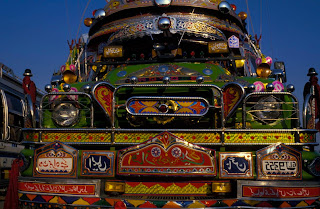
Bus: usually a Bedford, gloriously liveried in multiple colours, decorated with beaten tin, twinkling lights, curtains, festooned with flowers (plastic, real and painted) and covered with pithy aphorisms like ‘Maa ki dua/Jannat ki hawa’ (A mother’s prayer is a breeze from heaven). Clientele: general public; those who have more time and less money.

Flying Coach: a no-nonsense and business-like large Mazda or Toyota mini-bus with hydraulic doors that sigh when they open, excellent air conditioning and in most instances reclining seats. Clientele: businessmen, foreign students; those who want to get ‘there’ quick.

Wagon: a Ford van imported from England by Kashmiris. Painted only one colour. Body dented. A few perfunctory invocations of Allah’s blessing on the front. Seats hard. No aircon. Clientele: the slightly better off member of the general public; those with high-risk appetites.
One of the several issues confronting those who choose to travel long distance by road in Pakistan is that the vehicles (with the exception of the Bedford buses) are imported. They can move quite quickly and powerfully, designed as they are for motorways in Japan or UK. The Pakistani highways, alas, are narrow, rutted, poorly lit and crowded. The combination, especially when blended with a driver who is exhausted, just learning his trade or stoned on charas (all three at once, is a permutation I’ve encountered) can give rise to anxiety.
I shall never forget the dear driver (with me in front seat right beside him) who, as we sped into the fast-setting sun that nearly blinded us, decided to change the cassette and light a cigarette at the same time. He did it! And we made it to Gilgit in one piece 12 hours later!
For some reason whenever I found myself on the road it was evening heading into night. Though the hazards increased significantly once the sun went down, I found barreling through the night in some strange way, relaxing and appealing. Probably because there was inevitably a good concert of music to be had. After the first 45 minutes of the journey, most passengers were nodding off or whispering quietly to their companions. The driver would light another cigarette and turn up the cassette and entertain us with a selection of current and evergreen hits.
Inevitably, the concert would include the patron saint of all vehicle drivers, Attaullah Khan Niazi. Indian film music, qawwali and few sharabi ghazals, some folk and other odds and ends like a piece or two from the driver’s home region, often the Northern Areas around Gilgit.
I loved those trips because I was introduced, anonymously, to so much good music.
 Missionaries, Mercenaries and Misfits