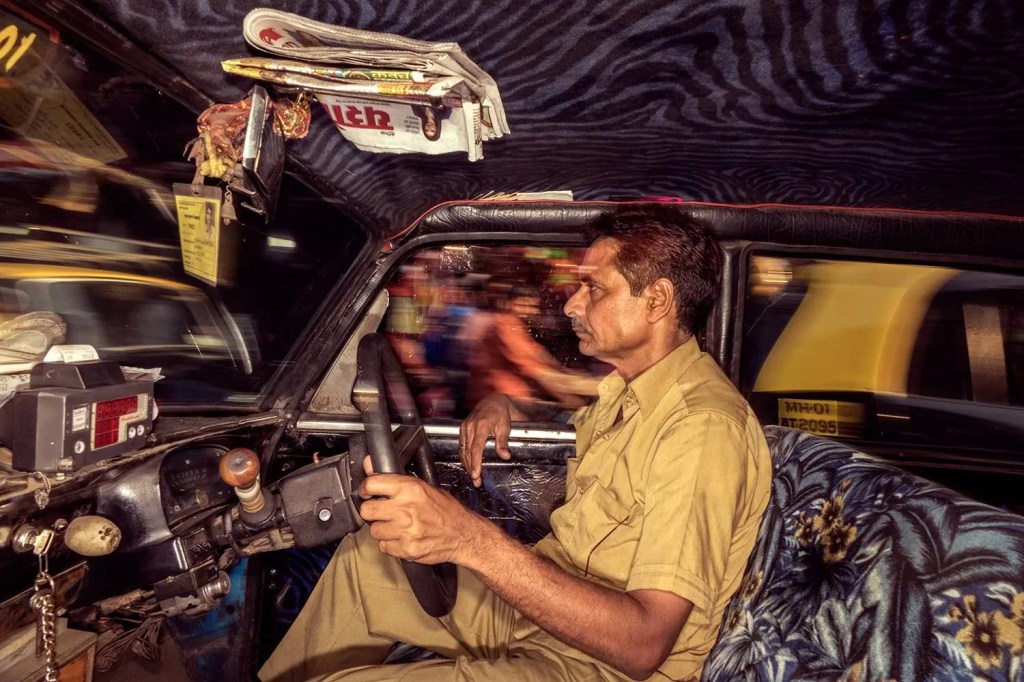
For the first several minutes he said nothing, just guiding his yellow and black Suzuki taxi through the clamorous traffic of midday Delhi. My daughter wanted me to ask him what his name was. “Jai Bhagwan,” he said. “An old-fashioned name.” His smile is half apologetic.
“You’ll be going to Jaipur? That’s a beautiful city. They call it the Pink City. Its a five hour drive from Delhi and Pushkar is another 2 or 2 and half hours further. You’ll stay in Pushkar for a few days? No? I see, just for a day. Ajmer is just half hour more away. What a place that is. Moinuddin Chisti…the Emperor of India! Will you be taking the train from Ajmer to Varanasi? No, from Agra. Ok. I see, your agent arranged it that way. Watch out for these agents. They’re in it for themselves, a lot of them.
This traffic is like this but not for too long. There’s a fly over up ahead and the road narrows so everything slows down to a crawl. But soon we’ll be moving again. Yes, that metro line was made for the Commonwealth Games in 2010. What a rip off! The organizers stole 80% of the investments. Only 20% was spent on the infrastructure. The main crook, Kapladi is in jail but what does it matter. It won’t change anything. The rich and our netas don’t give a shit. All the rules are for the poor, not one of them is for the rich. It never changes.
My people used to own the land around the airport. A long time ago the government came and forced us off the land and gave us Rs1.40 per square meter! A very low price. But they got what they wanted. You know Gandhi? They say he is the father of the nation. We say he’s the number one Thief. Don’t believe me? What did he ever do for us? Did he do anything to improve our lot? He and Nehru did everything for themselves and to make their own money and name. Gandhi, the old bastard, used to feed his goat grapes while the rest of the country starved.
The real hero of India was Subhas Chandra Bose. What a guy. You know what his slogan was? Give me your blood and I’ll give you freedom! He was a man of action. That’s why they killed him. You know Gandhi could have freed Bhagat Singh but he didn’t. He let him hang. All for his own glory.
Ambedkar? Yeah, he was a good man too. He wrote the Constitution. No one else could have done that. He was a great man actually. I have nothing bad to say about Ambedkar.
Right, we’re almost at your destination. Just 5-10 minutes more.”
One of those albums that sunk like a stone. Released and then gone. Mores the pity, because this collection of 11 songs by Sierra is more than just alright.
Sierra was a single-album band of refugees from a bunch of country-rock and rock bands of the late 60s. By 1977, when their only and self-titled record was unleashed upon the buying public by Mercury, the individual players were in the sort of professional limbo that comes about regularly but is usually swept under the carpet in the biography. Which is too bad and a bit unfair, because Sierra was made up of some formidable names with very respectable curricula vitae.
Gib Guilbeau, on rhythm guitar, had played in a whole series of country-rock and proto-Americana bands like The Flying Burrito Brothers, Swampwater and the legendary Nashville West. On drums, Mickey McGee had credits as the drummer for Jackson Browne (Take it Easy), JD Souther, Linda Ronstadt, Chris Darrow, and Lee Clayton (Ladies Love Outlaws), not to mention an early country-rock outfit Goosecreek Symphony. Oh, and late Flying Burrito Brothers! Eddie’s nephew Bobby Cochran contributes blistering lead guitar and lead vocals. ‘Sneaky’ Pete Kleinow’s steel has graced hundreds of rock and country rock albums and was first brought to wide attention as a founding member of The Burrito Bros and New Riders of the Purple Sage. On bass, Thad Maxwell, another vet of the 68-75 scene, and band fellow of Gib in Swampwater. Felix Pappalardo Jr. produced and contributed piano parts. A storied figure, throughout out his life Pappalardi supported or produced everyone from Tom Paxton to Cream, not to mention his own weighty Mountain.
So, no slouches these guys. They were not suburban lads looking for a break. Their combined talent and credits were formidable. In the parlance of job advertisements they had a “proven track record” of making excellent music.
But alas, here the sum of the parts didn’t add up. Which is not to say this a shit album. Far from it. Sierra is a very good record of late 70s American pop and deserves to be hauled up from the bottom of the deep lake of forgotten country-rockers.
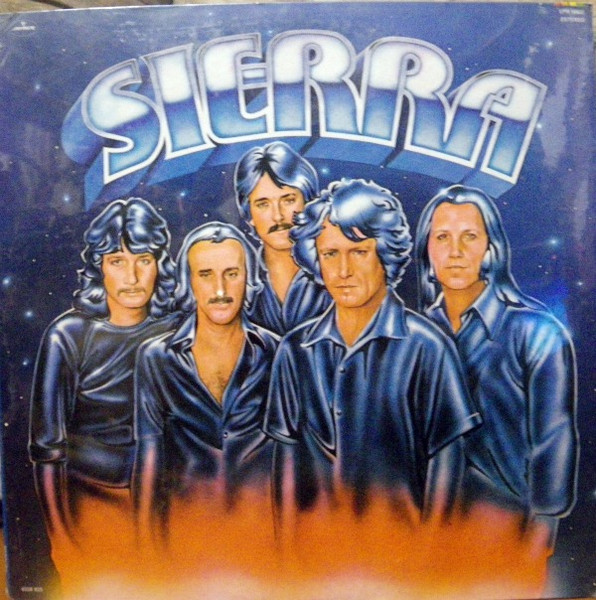
The art work is a put-off and no doubt played a big part in the record’s stillbirth. A perfect example of a cover designed by some free lance artist with no idea about the sort of band Sierra was. Many styles did they play, but spacey country-disco was not one of them. You could be forgiven however for thinking this was in fact, their speciality, if you had access only to the dumb, lifeless cover art.
On the black wax we are treated to high quality examples of soft rock (Gina; If I Could Only Get to You), So Cal country-rock (Farmer’s Daughter; She’s the Tall One), British blues (I Found Love), top 40 slick pop (Honey Dew), boogie, rock ‘n’ roll (Strange Here in the Night; I’d Rather be With You) all sauted in the spicey warmth of the Tower of Power horns. (In this era if you were good enough to entice the ToP to record with you, you were ensured at least one extra star from the reviewer.)
But it didn’t work. The album suffered not from a dearth of talent or poor production. It sank because it had no focus. Spaghetti was all over the wall, perfectly al -dente no doubt, but spread across too wide a plane. For country-rockers in search of Gilded Palace of Sin or even One of These Nights, this was bland stuff. Waaay too poppy, man!
But for this old guy living 50 years in the future, and slightly anxious about the coming extinction of human made music, Sierra deserves 7 stars out of ten, for capturing several trends of America popular music current in 1977. Especially the eternal wrestle between Country and Rawk.
There are some blatant and pointless rip-offs like You Give Me Lovin, which is essentially a copy of the Eagles,Already Gone, but what did more than the front cover to kill this album, is its refusal to rise above the very good level. The album should really have been titled, Bob Cochran and Sierra, as he is the real star. It is Bob (the only non ex-Burrito), who shows the most excitement here. His guitar is sharp and always stands out. His high-tenor voice fits perfectly in both soft rock and pop—audiences the record label was clearly trying to attract. Sadly, the band of sages behind him seem content to play perfectly, expertly, confidently but, alas, with very little real energy or pizzaz.
Ratings:
Musicianship-8/10
Listenability-8/10
Energy: 6/10
Songwriting: 5/10
Cover: 3/10
Historic Value*: 7.5/10
*a subjective ranking of combined significance & interest to the history of North American (mainly) popular music of the 1970s. Judged by myself on a particular day. Significance could include the musicians, the cover art, the producer, production quality, songwriting, influence, innovation, listen ability etc.
My first novel was published in London in 2000. It was nominated for a couple of awards including the Guardian First Novel Award. I will be serialising it here as it is out of print.
AUTHOR’S FOREWORD
The Book of Accounts is a work of fiction and imagination. The inspiration comes from the many Iraqi friends and refugees with whom I have worked, who have endured the hell of torture.
Although this novel is fictional many of the events described — including the gassing of Halabja, the hostage-taking incident and the Muhyi-Ayash conspiracy — are historical facts. The organisations mentioned: al Amn al Khas, Mukhabarat, Estikhbarat and Jihaz Haneen are real. In the case of Jihaz Haneen very little is known of the organisation even within Iraq, and therefore any description of its structure in the Book of Accounts is based largely (but not entirely) on speculation. These organisations are integral to maintaining Saddam Hussein’s and the Ba’ath Party’s grip on the Iraqi people.
Other than Saddam Hussein, Muhyi Rashid, Mohammad Ayash and ‘Chemical’ Ali, and one or two very minor personalities, all characters in the book are fictional, though some have been based on historical personalities. All revolutionary parties, including the People’s League, are also fictional.
The historical context of the novel is the recent past of Iraqi history from the late 1950s to the late 1980s. Unlike the characters almost all locations in the book are actual villages, towns and neighborhoods. I have provided a historical timeline of the major events referred to in the novel as well as a glossary at the end of the novel.
For the reader who knows Iraq and who may find some of the liberties have taken for the sake of the story irksome, I beg your indulgence.
_________
PROLOGUE
He lay shivering on the stone floor in a cell in Baghdad that had become colder as the storm outside built in intensity. He hugged himself tightly and let out a sharp sneeze.
‘Oh! Lucky boy. Someone is thinking of you!’ laughed the guard.
For two nights no one had bothered him. But on night number three as he lay sleeping, pushed up against the stone wall, they called his name. ‘Please,’ he said, ‘it is very cold,’ but the words were lost somewhere between his mouth and the wall. Two men in grimy uniforms pulled him from the cell; one of them held him tightly while the other tied a band around his eyes then reached down to secure the young man’s hands behind his back. When he was pushed forward into the corridor, a lady guard stepped towards him and whispered, ‘This way. Your time has come.’
The small party made its way through the building. He tried to imagine the surroundings. When they didn’t leave the building he thought, Executions must be carried out inside. I only wish I could see. Why stop me from seeing if I am to be killed? I am glad they didn’t give me any warning. I wonder if this is how everyone feels. He felt calm. He did not feel self-pity. Thoughts of his family, and of picnics and parties, of books unread and questions unasked, seemed tiny and hard to pick up. He remembered the soft fullness of his lover’s breasts, and for a moment he even thought he caught her scent.
The lady guard pressed the prisoner’s shoulder as a signal to stop. A door opened and the prisoner was nudged forward. He thought he
saw a room with no back wall. A line of men with rifles stared straight ahead with dull eyes. White billowy clouds and a blue sky. He felt the wind on his neck as he took up his position against the openness. Each man raised his rifle but he saw only one; an eye squinting, a finger resting against the trigger. An arm wavered slightly as the marksman took aim. The bound man stared directly into the one open eye and for a second the executioner hesitated, then a bullet shot forward. The prisoner watched as it spun through the air. The woman guard wore a crooked smile. Suddenly the prisoner felt warm.
‘Sit down here and wait. Do not try to see anything.’ It was the voice of the lady guard, who pushed him firmly into a chair and removed his blindfold; a cloth hood fell over his head as a substitute. She squeezed the prisoner’s shoulder then left him alone in the room.
The hood over his head was damp and stank of fear. He stared at his feet on the floor until the opening of the door diverted his attention. Footsteps on one side of the room. A chair scraped against the concrete. Must be the man with the gun.
As the newcomer came in, did he even notice the shivering figure tied like a rabbit to the chair? Or did he see him and feel only scorn? What was he thinking? This is him. Disgusting dog. His mind was already familiar with the territory ahead. The map was drawn.
The newcomer, the invisible one, was eager to proceed. He lifted his head and stared at the hooded prisoner in front of him. He sized him up like a chicken in the market. They shared the silence and the relief an actor feels when the curtain goes up on the last night.
The chair scraped across the floor again and the hooded prisoner’s muscles tensed involuntarily. His saliva tasted sweet and cool. He sensed the other behind him and waited. But for what?
A blow?
A shot?
He was lost without a compass. Is he still behind me or has he moved to my right? The hood was hot and suffocating. He was being stalked by a lion and prepared his body for the pounce. But nothing happened. The beast was examining its catch. Admiring another fish in the net. The big one at last? But after what seemed an hour, the hunter still had not slapped or even clawed his captive. Slowly — he was back behind the boy again — the invisible man lifted the bloodstained woollen hood from the prisoner’s head and let it drop to the floor.
He had decided that his prey deserved to see his tormentor from the beginning. And he was determined to enjoy the young man’s fright
If you don’t know by now, let me lay it out there once and for all: I am in love with the music of the 1970s. It’s when my musical ears started to grow up. I am emotionally tied to the ‘70s, the years that took me from a 13-year old dork to a married man in 1980. University, travel, losing the Big V, jobs, drinking too much, etc. Formative years.
This doesn’t mean I spend my days listening only to peak Elton and Born to Run. I spend a lot of time in the weeds in music from around the world, especially the Indian barsageer, and contribute to the profits of Bandcamp quite faithfully. But with age comes many things. One of which is a dropping away of the need to be considered hip. Another is going deep into things. The music of the 70s may be comforting and familiar but in the same way I knew nothing of India until I came to America, it is only in the 3rd decade of the 21st century that I’ve begun to try to really listen to what was going on in the popular music of those years.
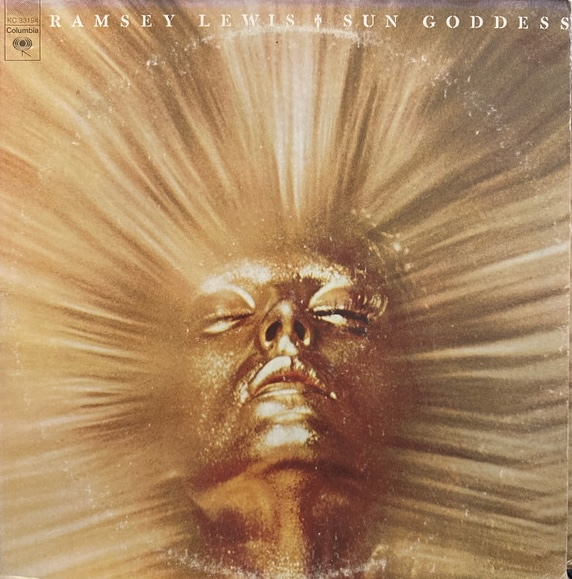
I knew of Ramsey Lewis from regular visits to the local record store. His albums of that time, especially Sun Goddess (1974) and Salongo (1976) were very attractive. Covers that stood out from the mass that called out to be picked up handled. Being poverty struck I was never going to put $4.98 down to actually buy one, but man, I really did love the look of those albums.
Ramsey had got his start in Chicago in the mid-50s. He played what I call club jazz. A sort of diet-Jazz that was accessible, occasionally funky and generally soothing. You’d hear it in small clubs in big cities across America. Les McCann and Lou Rawls, would be there the week before you, maybe Willis Jackson or Brother Jack McDuff, the week after.
Ramsey was a very accomplished pianist/keyboard player and a warm person. But the overseers of ‘Jazz’ showered him with putdowns like lightweight, mainstream, ‘happy clappy’ and bland. He didn’t care. Some of the giants of jazz, including the Duke himself, were fans and mentors. And besides, he was actually making money and had a mixed audience of black and white fans who liked his cross-pollination of styles.
When jazz synced up with R&B and became soul-jazz in the late 60s and allowed George Benson, Grover Washington Jr., and the like to become pop stars in the 70s, Ramsey fit right in. He’d been laying the foundations of soul-jazz for years.
Sun Goddess was released at the end of 1974. The cover pictured the gilded face of a beautiful woman set against what looks like a background of liquid silk shooting out like rays of the sun. Bold & beautiful. Confident. Daring & intriguing.
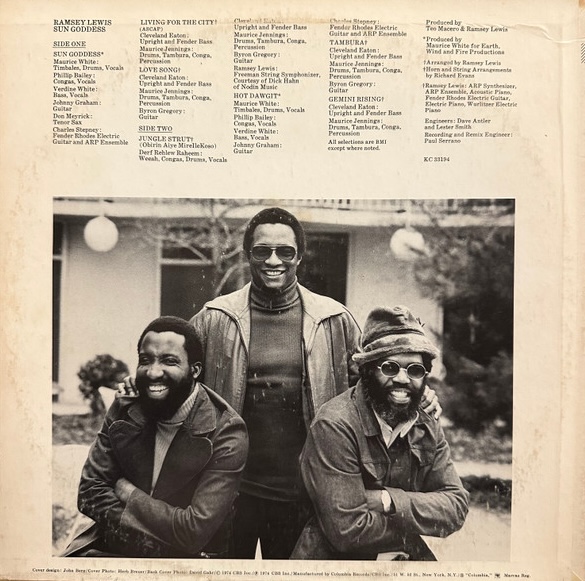
When the stylus hit the wax that lush, warm sound of the times filled the room. Maurice White and several mates from Earth, Wind & Fire were in the studio as players and producers which gives several of the tracks, especially the title and opener, a funky EW&F feel. Maurice and Ramsey went way back. Maurice had been picked up as a session drummer by Ramsey after the departure of Redd Holt in 1966. They had stayed together for several years until Maurice laid out his idea for a large, dance, funk and pop group to Ramsey around 1970. Ramsey smiled and wished him every piece of luck as Maurice moved to LA.
By 1974 White’s group was about to release their breakthrough That’s the Way of the World which included the Billboard Number 1, Shining Star. That EW&F were in essence Ramsey’s backing band on Sun Goddess no doubt gave him and the album a huge boost of street cred.
The music exemplifies that strain of African-Americana which is confident, unapologetic and intensely positive. On the charts in those years were songs like Love Train (The O’Jays), Wake Up Everybody (Harold Melvin & The Bluenotes) and Black Wonders of the World (Billy Paul). Sun Goddess is the sonic realisation of the popular slogan, “Proud and Black”.
Scratch guitars look forward to disco, about the happiest music ever created, but which was still an underground phenom. Ramsey’s keyboards, on piano or Fender Rhodes, always stand out even though he is surrounded by some of the best musicians working at that time. Critics consider Sun Goddess to be a deliberate attempt by Lewis to cross over to R&B. Could be. But there is no sense that he is out of his depth or uncomfortable with the increase in funk that defines the sound. He’s perfectly at ease and as accomplished and classy as ever.
If you’re interested in understanding the music of the 1970s, then you’ve got to get this record.
Lollywood: stories of Pakistan’s unlikely film industry
This brings to a close ‘the background’ story of Lahore. The next sections will deal directly with the movies and movie-making culture of Lahore.
Bahut ghoomi ham ne Dilli aur Indore ki galiyan Na bhooli hai na bhoolengi Lahore ki galiyan Yeh Lahore hai Punjab ka dil/Jis zikr par aank chamak uthi hai dil dharak urdthe hain
I’ve roamed the lanes of Delhi and Indore, but I’ve never forgotten nor ever can forget the lanes of Lahore. This is Lahore. The heart of Punjab whose very mention causes the eye to sparkle and the heart to skip a beat
These opening lines of the 1949 Indian filmLahoresum up the deep affection and nostalgic sentiment millions of South Asians feel for the city of Lahore.
**
Lahore, modern Pakistan’s cultural capital, is one of those cities that lives in the very soul and DNA of its residents. Like a handful of other cities across the continents it occupies a place not just on the map but in the imagination of those who know it. It is at once an indivisible part of people’s self-image and something beyond capture. As residents of the city say, Lahore, Lahore hai (Lahore is Lahore). So profound and all encompassing is the city’s essence that the simple acknowledgement of its existence is enough to conjure an entire world.
There’s a small but passionate genre of writing that centres on the city. Novelists, poets, journalists and emigres, displaced at the time of Partition, wax lyrical in their books and gatherings in praise a city they all remember as sophisticated, vibrant, classy, tolerant, full of tasty food, and shady boulevards. Its fabled history and stunning architecture. It’s unique urban culture. If, as they say, nostalgia is a narcotic, then Lahore is one of the subcontinent’s biggest addictions.
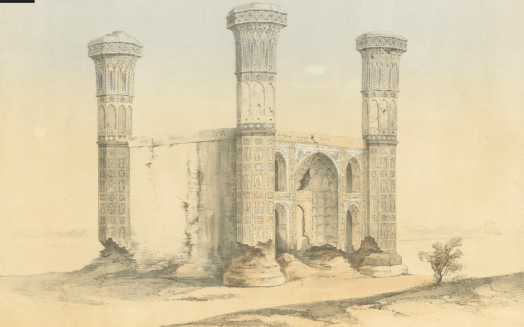
It certainly is an ancient city and the millennia have added a depth of colour and richness that most other cities can only envy. But Lahore has also experienced long periods of cultural and physical devastation when the city’s palaces and shrines were little more than crumbling ruins. When its resplendent gardens lay overgrown and unattended. And it was this sort of Lahore that the East India Company’s redcoats grabbed away from the Sikhs who had ruled Punjab for much of the 18th and early 19th centuries.
Chauburji. Gateway to a large Mughal garden completed in 1646. This depiction is by an unnamed English woman whose husband served with the EIC in Lahore. This is from 1852, three years after the British annexation of Punjab and indicates how run-down this great city was at that time.
After ‘annexing’ Punjab, the British set about rebuilding Lahore. Though the Sikhs, under Maharaja Ranjit Singh, had added some new buildings and gardens to the old city, in general the once glorious imperial city, famous throughout the world for a thousand years, was in an awful state. Amritsar, 80 kms to the east was the Sikh’s spiritual home and a booming commercial hub; Lahore, their world-weary political capital. Important more for what it had once represented—the imperial grandeur and awesome power of the mightiest Empire of the medieval world– than what is now was: a cramped, unhygienic, walled city down on its luck.
The storied tomb of Anarkali, 1852. As drawn by an unknown English woman.
At the time the British narcotic-peddling businessmen defeated the Sikhs in February 1849 the suburbs surrounding the old city were little more than ruins. “There is a vast uneven expanse interspersed with the crumbling remains of mosques, tombs and gateways and huge shapeless mounds of rubbish from old brick kilns,” wrote an Englishman who visited the city around this time. Though the Sikh sardars had not gone out of their way to destroy existing Mughal-era buildings they displayed no hesitation in stripping the creamy, jewel-encrusted Makrana marble off the walls of the tombs and palaces to adorn their own havelis.
More than with other cities, the British sensed that in Lahore they had indeed captured a jewel. Milton’s reference to the city in Paradise Lost had been rather cursory. More elaborate and accessible was Thomas Moore’s Orientalist fantasy Lalla Rookh which in the early 19th century had become hugely popular across Europe. Based vaguely around an imagined romance of a Mughal princess in the time of Emperor Aurangzeb (1658-1707), the poem introduced the name and idea of Shalimar into Western consciousness.
They had now arrived at the splendid city of Lahore whose mausoleums and shrines, magnificent and numberless, where Death appeared to share equal honours with Heaven would have powerfully affected the heart and imagination of Lalla Rookh, if feeling more of this earth had not taken entire possession of her already. She was here met by messengers dispatched from Cashmere who informed her that the King had arrived in the Valley and was himself superintending the sumptuous preparations that were then making in the Saloons of the Shalimar for her reception.
The development of Lahore into one of British India’s premier cities—and a place where a sophisticated industry like movie making could thrive– has to be understood as part of the development of British rule in India. The great riverine plains of Punjab–a stretch of geography that historically included Delhi at the eastern edge and touched the Afghan border in the west–were the last big chunk of agricultural land available in northern India. They marked the final frontier of British India. The Empire’s very existence not to mention the Company’s business model depended on a perpetually growing revenue base collected primarily from raw agricultural products and oppressive taxes on those who worked the land. By the time they reached the Punjab, the Company was the unassailable political and military force in politically fluid landscape. But at the same time, their purely extractive approach to governing had reached its limits too. Beyond Peshawar, a largely Afghan city but in the early 19th century an important Sikh holding, towered the rugged mountains of the Hindu Kush, the historic barrier dividing South from Central Asia. These were a useful security asset but absolutely bereft of economic value.
Soon after wresting control of Punjab the English were confronted with the first substantial resistance to their rule. In 1857 soldiers in the employ of the British East India Company ‘mutinied’ and for over a year engaged their European masters in an armed conflict that engulfed much of north India, saw the destruction of Delhi and the final collapse of the (by this time, entirely symbolic) Mughal Empire. A shocking number–800,000–Indians lost their lives either directly or indirectly as a consequence of the uprising. The European community estimated at around 40,000 in all of India at the time, lost about 6000 people. Though a much smaller number, proportionally it meant that about 1 in every 7 Europeans perished. If it did nothing else, the war exposed the underlying vulnerability and inherent instability of European rule in India. And though they would rule for nearly another century, everything that happened in India after 1857 in some way can be seen as a reaction or delayed response to the conflict.
Though the uprising was ultimately quelled the British were shaken to their core. The East India Company, which over the previous 150 years had demonstrated itself to be little more than a rapacious business enterprise intent on asset stripping the richest country in the world was disbanded by an act of Parliament. India was reconfigured as a Crown Colony under the direct purview of Her Majesty Queen Victoria. The British realised that things had changed. And if they were to continue to benefit from their Indian Empire they would need to experiment with different management techniques including setting up a system that at least appeared to take some interest in good governance rather than simply syphoning off India’s great wealth. One of the immediate, visible signs of the new era was the rise and promotion of the Punjab as a ‘model’ province. A place where the noble intent and attributes of a Pax Britannica could be readily demonstrated and accessible.
Punjab was a vast piece of land but it was by no means uniform. The eastern and to some extent, central districts of Punjab were rich, well-watered agricultural lands with relatively dense populations. The much larger western part of the province spreading out towards the northwest and southwest of Lahore were arid, sparsely populated and agriculturally unproductive lands. In terms of the colonial economy, eastern Punjab was valuable; the west, not so much.
It didn’t take long for the administrators of Punjab to understand that this was unsustainable. It wouldn’t be long before the eastern/central portions of the province would be overpopulated and the land overused. Productivity and more importantly, revenue for the British Exchequer would fall. Also, never far from British minds was the prospect of rising social tensions that an unmet demand for land represented. No one wanted to risk another 1857. Especially not in the land of the fabled Sikhs, who had been consistently lionised by the British as a great “warrior race” and upon whom they were banking to be the backbone of their own security and military apparatus. To use contemporary language they needed to keep the Sikhs sweet.
And so, beginning in the 1880s, with the intention of keeping the Sikhs happy and the Punjab prosperous, the government tilted imperial policy in Punjab toward investment rather than mere extraction. The vast, underutilised and dry western tracts of the province became the focus of a massive economic and social experiment. Construction began on a network of massive canals that diverted water from the Jhelum and Chenab rivers, that by 1920 had turned 10 million acres of ‘formerly desert lands, most of which had been the hitherto uninhabited and worthless property of the Raj’ into some of the richest agricultural land in India. Six districts including the rural areas around Lahore experienced a demographic and economic revolution as hundreds of thousands of people, mostly Hindu and Sikh farmers, were encouraged to move from the eastern parts of Punjab to the west. They settled in new purpose-built towns along the canals to produce wheat and cotton on a scale India had never seen before. And as the biggest city in Punjab (and the largest between Istanbul and Delhi) Lahore itself, the urban hub from which the new Canal Colonies were managed and supported, entered a fresh era of prosperity.
Reimagining Lahore
From the moment the Sikhs were defeated, the British set about rebuilding the crumbling historic city they had inherited. The new administrators were bewildered and not a little intimidated by the old walled city, which they left largely to its own devices. Instead, the English concentrated on the ruins that lay outside the walls. With a fearsome industriousness they cleared the plain to the southeast and laid out a European style suburbia. Christened Donald Town after Donald McLeod, an early Lt. Governor of Punjab, the main thoroughfare in this new part of town was christened McLeod Rd. On either side, a residential and business area for Europeans sprang up including an important and large military base or cantonment, further south in Mian Mir. By the 1930s, the place where McLeod Road crossed Abbott Rd, a junction called Laxmi Chowk, would become (and remains to this day) the central locus of the city’s film industry.
Between 1860 and the early 1900s Lahore found new life as a hugely important regional centre for education, communications, publishing and culture. Delhi, the age-old capital of northern India had been savagely destroyed during the fighting of 1857. The city’s famous tribe of musicians, writers, poets, artists and thinkers fled the capitol in search of more secure places; some headed south to Hyderabad and others east to Lucknow. And with its newly acquired territory in the northwest the British government deliberately identified Lahore as an alternative cultural hub to which they encouraged émigré artists and intellectuals to settle.
Several prominent Urdu language writers and poets did move west to settle in the city where educational institutions were springing up under official sponsorship but also with the investment of wealthy Punjabi landowners and businessmen. Though the city had no real affinity with or history of speaking the Urdu language, a combination of official policy and organic economic development saw Lahore become one of India’s most important Urdu centres. Though the city’s residents continued to speak their beloved Punjabi, using Urdu only for official work or to get a job, Lahore was transformed rather quickly into a bi-lingual town. Their easy facility with both languages and often with English as well, in time would give Punjabis a huge advantage in the nascent Indian film industry.
Lahore’s publishing and printing industry produced newspapers, books, religious texts and magazines in multiple languages including Urdu, English, Persian, Punjabi but also Arabic and Sindhi. The city, already famous for its literary culture, refreshed its traditions with poetry recitations called mushaira which drew poets from across north India as well as significant audiences from the city’s many colleges. By the turn of the century a hundred or more newspapers were available across the Punjab most of which were in Urdu including many published in Lahore, such as Kohinoor, Mitra Vilas and Punjab Samachar. In addition, though catering to a much smaller audience, but widely read and highly regarded were two English dailies, The Tribune and the Civil and Military Gazette, most famous today for it’s most famous resident journalist, Rudyard Kipling.
Rudyard Kipling
The number of prominent Urdu writers who were born, educated or settled in Lahore is too vast to mention: Agha Hashr Kashmiri, Taj Imtiaz Taj, Faiz Ahmed Faiz, Hali, Rajinder Singh Bedi, Krishen Chander and of course, in the last years of his life, Sa’adat Hasan Manto many of whom developed a connection with both the local and national film industries.
Northwest India’s educational Mecca
In the late 1830s and 1840s the British laid out the basic parameters of an education policy for India. The ultimate purpose of the policy was very much in keeping with the political agenda of the EIC which was all about control, avoidance of undue investment and efficiency of administration. As such, to the extent that official British efforts were to be focused on educating Indians, it was as a means to advance the Company’s and then Britain’s, commercial and political ends: to create a loyal group of Indian elites who would be conversant in the English language, imbibe European values and culture and be dependent upon Official patronage. In the famous words of William Macaulay a senior and prominent 18th century administrator of the Company, “we must at present do our best to form a class who may be interpreters between us and the millions whom we govern.”
And to that end government efforts were to be focused on developing and supporting a system that preferenced higher education as opposed to mass primary education and which was to be delivered entirely in English through institutions modelled on those in Britain, especially the great universities in Oxford and Cambridge.
By the time the final piece of the India puzzle, Punjab, was tapped into place these ideas were fresh in the minds of the English. And so, in keeping with their intent to make the province an exemplar of the colonial project, Lahore was developed into the premier educational city of northwest India. Beginning in the 1860s and continuing up through the first decades of the 20th century, the British supported or sponsored the establishment and development of a number of colleges that became famous as some of the best in India and whose alumni included several generations of elite leaders including multiple Prime Ministers of both Pakistan and India.
Schools like Forman Christian College, founded by an American missionary in 1865, and Government College a year earlier, provided English/Western education to the first generation of Punjabis to live under British rule. These schools were complemented by pioneering medical training colleges (King Edward Medical College) or absorbed into more prominent larger institutions like the University of Punjab in the 1880s. Secondary colleges, especially the world-famous Aitchison College (1864) prepared the young sons of the princes and the landed aristocracy of the Punjab to enter the elite colleges and ultimately, service in the bureaucracy. Being educated in Lahore became almost compulsory if you wanted to pursue a career in business, science, government or the arts. Students came to the city from all across the northwest and in the 1930s Lahore was said to have a student population of nearly 100,000 students enrolled in 270 colleges and schools.
Actor and Hindi movie superstar Dev Anand and his equally talented brothers came to Lahore from Gurdaspur in the east to be educated at Government College, part of the University of Punjab. At the same time, from Rawalpindi further to the northwest, came Balraj Sahni, who established himself as one of India’s finest cinema artists after the Partition. We could fill several pages with the lists of prominent politicians, sportsmen and academics, not to mention military leaders who graduated from Lahore’s elite schools but just a few provide a flavour of the quality of education the city provided. Imran Khan (former Prime Minister of Pakistan and international cricket star), Abdus Salam (1979 Nobel Laureate in Physics), Inder Kumar Gujral (Prime Minister of India), Pervez Musharraf (President and Chief of Army Staff of Pakistan), Allama Mohammad Iqbal (writer and philosopher), Kuldip Nayyar (prominent Indian journalist), Krishen Chander (pioneering Urdu writer), Har Gobind Khorana (1968 Nobel Laureate in Medicine) and Faiz Ahmed Faiz (modern Urdu’s greatest poet).
While Dev Anand and Balraj Sahni were able to attend the elite colleges most of Lahore’s film industry personalities were either educated on the job in the studios and sets or attended a set of schools established to cater to the middle class Hindu and Sikh communities who controlled Lahore’s economy. Schools like DAV College founded by the reformist Arya Samaj educated tens of thousands Hindu and Sikhs. Islamia College, long associated with Allahabad University, offered higher education to Muslims who were a little more sceptical of attending the heavily westernised University of Punjab or Forman Christian College.
The learning environment of Lahore extended to female education as well and the city had a reputation for its relatively progressive attitude towards women participating in public life. Kinnaird College, established by missionaries in 1913 as a counterpart to Forman Christian College, educated the daughters of Punjab’s best and brightest families. Writers Bapsi Sidhwa and Sara Suleri, academics of all disciplines, the human rights lawyer and campaigner, Asma Jehangir and Hindi film actress Kamini Kaushal all graduated from Kinnaird.
Migrants, not only from eastern Punjab but the rest of India came to Lahore to get in on its vibrant economy and cultured society. By the 1920s the city was known not only as a premier destination for higher education but a city of ideas. Hindu reformist movements such as the Arya Samaj and Brahmo Samaj, from Bombay and Calcutta respectively, found fertile ground in Lahore and in the case of the Arya Samaj enjoyed significant growth and popularly in the city.
Political flashpoint
The many educational institutions created an environment in which ideas of all sorts were traded, debated and contested; Lahore slowly gained a reputation as a political hotspot. The British policy of building up a class of loyal Indians ready to fight for the Raj may have been the stated outcome of education in British India but too often things don’t go exactly to plan. With so many students enrolled in hundreds of schools things were bound to get out of control.
In response to the missionaries’ evangelising, each of Punjab’s three major religious groups took upon themselves to reform their own faiths turning Lahore into a site of new self-styled progressive religious teaching. Though founded in Gujarat to the south, Lahore became the main centre of the Arya Samaj, a Hindu reformist group which championed education, women’s participation in public life, a return to Vedic Hinduism as well as an aggressive anti-Muslim, anti-Christian stance. Many of the Hindu middle classes of the city were attracted to its teachings and sent their children to the Samaj’s schools and the influential D.A.V College.
Initially, middle class Sikhs were welcomed and participated in Arya Samaj activities but eventually split from the movment over, among other things, the Samaj’s aggressive campaign of mass reconversion of rural Sikhs to Hinduism. In response, the Sikh community sought to distinguish themselves from the Arya Samaj and began preaching a more exclusive and purist form of Sikhism which focused on the reformation of the government-sponsored ‘clergy’ that controlled Sikh places of worship. The Akali Dal, a group that arose out of activist Sikhs, many from the new Canal colonies, quickly took on an anti-British political agenda which the British promptly labeled as a greater threat to the stability of Punjab and India then Gandhi and the Congress Party. The Sikh Sabha and Akali movement was active across Punjab but especially in Amritsar and Lahore, whose branch was seen as the more radical and political.
Several Muslim communities found themselves developing new identities and leaders too. in the 1930s and 40s, the rural agricultural Muslim communities bounded together with similar rural groups to form a loyal pro-British political coalition. But other groups, such as the Ahrars, established in 1929, articulated a strong anti-British, nationalist and anti-feudal agenda. At the same time, it spearheaded a religious reform agenda that among other things was the first to demand that the small but successful Ahmadiya community be declared non-Muslim.
Though reform and purification of faith were the starting point of all these movements, by the 1920s they had blurred the line between religion and politics. The British kept close tabs on them and openly interfered in their colleges (Khalsa, DAV, Islamia) in an attempt to try to weed out nationalist thought. But it was not to be. The massive economic success of the canal/irrigation projects not only transformed and enriched certain groups but at the same disenfranchised many others, especially the urban middle class Sikhs and Hindus, who were the backbone of Lahore’s economy.
The British state was strong and able to quash most rebellious ideas before they became widespread but in 1907 as a result of a number of pieces of legislation that further pressured and alienated the very population of rural Punjabis that the security of India depended on, violent protests broke out in the Canal Colonies. The cause was championed and given an anti-Raj colour by leaders like Lala Lajpat Rai in Lahore. The British were caught flat footed, and unprepared. Repression and suppression followed quick smart which for a few years seemed to work.
But after WWI Lahore continued to gain a reputation not only for high quality education and culture but as a political hot bed. So much so that its reputation spread far and wide. In 1922 newspaper a rural newspaper in faraway Australia reported “The visit of the Prince of Wales to Lahore, which has been looked forward to with deep anxiety by those responsible for his safety, will, it is believed not be marred by disturbance of any kind. The tension has relaxed in the native city in the past week and it is too much to expect a general attendance of Indians to join the official welcome on Saturday afternoon for Lahore is the notorious centre of political unrest in Northern India but the Prince will not touch even the fringe of the bazars during his four days stay.” (Tweed Daily, Muwrillumbah 25 Feb 1922)
T.E. Lawrence during his time in NW India (1920s)
Around that very time T.E. Lawrence (of Arabian fame) was reported to be in Lahore and causing trouble in Afghanistan. Indeed, possibly in the very weeks leading up to Lawrence’s stealthy escape back to England, a young Sikh revolutionary who had been educated in Lahore, Bhagat Singh, assassinated a senior British police official in a case of mistaken identity. Though he escaped and a few months later exploded several smoke bombs while the Central Legislative Assembly in Delhi was in session, he allowed himself to be arrested and imprisoned by the Indian government. Using his imprisonment and trial to denounce the Raj, Bhagat Singh became a national cause celebre. Anti-British protests broke out all across India and the chant “Bhagat Singh ke khoon ka asar dekh lena Mitadenga zaalim ka ghar dekh lena” (Wait and see, the effect of Bhagat Singh’s execution: The tyrant’s home will be destroyed, wait and see) became a popular public cry. Though he was hanged in 1931 for his crime, Bhagat Singh’s trial and resistance to colonial oppression made him an exhilarating figure around which the nationalist and Independence movement rallied. Even today he is hailed as a beloved historic martyr across the political spectrum.
Bhagat Singh (back row 4th from right) during his college years in Lahore
Bhagat Singh and ‘co-conspirator’ jailed for their involvement in the Delhi Assembly bombing case (1929)
Culture and Arts in Colonial Lahore
Intrinsic to Lahore’s self-image is the world of art and culture. It has always been the cultural capital not just of Pakistan but at various times throughout the past, especially during the Mughal period, one of the major cultural centres in all of South Asia.
With the advent of the British, art and art education, like everything else in Indian life, became a project to be moulded into something that served Imperial outcomes. Most British administrators and educationists dismissed Indian art as primitive or bizarre. In the words of John Ruskin, British artist and critic, the only art Indians were capable of was drawing ‘an amalgamation of monstrous objects’. As such, British administrators saw yet another deficit gaping to be filled. In 1875 the Mayo School of Arts, the first such institution outside of Bombay, Calcutta and Madras, was established in Lahore. As in education more generally, the purpose of the school was “to initiate the native into new ways of acting and thinking” and of course provide skills that could be put to economic purpose.
John Lockwood Kipling, father of Rudyard, was appointed as the College’s first principal with a mission to introduce Western drafting and realistic drawing skills to traditional artisans and craftsmen. Kipling himself saw much to admire in Indian art and did what he could to promote it among his colleagues and students, all the while delivering a skills-based, industry-facing curriculum which eventually included the new-fangled medium of photography.
Interestingly, Bhagat Singh, the young political radical had cottoned on to the great potential of photographic images to educate and mobilise the masses against the British. Prior to his arrest and trial, as leader of the radical Hindustan Socialist Republican Association, Singh had used a magic lantern, an early proto-slide projector, in his lectures and political activities. It’s intriguing to consider that perhaps it was a piece of equipment that the Mayo College of Arts had introduced to its students and wider public in Lahore.
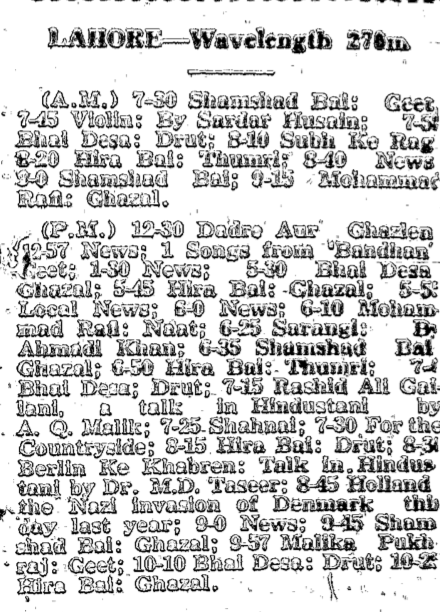
Soon to be superstar Mohammad Rafi sings on Lahore All India Radio in May 1941.
Lahore was a part of the classical music circuit of music conferences which brought a range of classical artists together to perform and compete. The local All India Radio station broadcast live sessions of local residents such as the eminent female singer Roshan Ara Begum and sitarist Ghulam Hussain Khan. And not just classical music. Three years before he broke onto a film scene he was to dominate for the next three and a half decades, in May 1941, a young Mohammad Rafi had a gig singing live on Lahore’s All India Radio station at 9:15 am and again at 6:10 pm.
But it was not just formal art education. Lahore was a city famous for its writers and poets. Its poetry reciting contests, were famous across north India and drew poets, as well as audiences, from far and wide. Music, especially classical music, had a long history of patronage in Lahore. The Bhatti Gate area in the old city, from where some of the earliest film personalities emerged in the early 20th century was renowned for its venerable tradition of classical music. Such luminaries as Ustad Bade Ghulam Ali Khan, considered one of the finest voices of modern times, Pandit Amar Nath, and later the brothers Amanat Ali and Fateh Ali Khan of the Patiala gharana, entertained listeners often in their own homes.
Indeed, the city was in love with music. So important a musical centre was Lahore that by the 1930s and 40s several international record companies including Columbia, RCA and HMV had offices in Lahore. The city had been on the talent recording circuit for European companies as early as 1904-5 when two Europeans, William Sinkler Darby and Max Hampe, representatives of Gramophone Records, popped up in Lahore. They made a large number of recordings of women singers, apparently tawaifs (courtesans) who had entertained men for centuries in Lahore’s fabled red light district, Hira Mandi (Diamond Market). In 1906 an ad in a London newspaper read as follows:
Shunker Dass &Co. Nila Gumbaz, Lahore, are prepared to invest a considerable sun, in conjunction with a thoroughly practical firm of makers or factors, to open a Manufactory in India, in order to supply the ever increasing demand for talking machines.
It seems Mr Shunker Dass was unable to generate the capital to set up his talking machine business, as records were known in those early days. But such an ad is evidence of Lahore being on the cultural radar that not only did Mr Dass feel confident to advertise in England but that he had the vision to see an opportunity that was just beginning to emerge when he ad was placed.
With a sizeable but not overly large population of European and American residents, Lahore attracted performers from around the world and catered to the needs of its non-Indian community. According to the Melbourne Age in January 1947 one of that city’s citizens, a dance instructor by the name of Frank Webber, was on his way to Lahore for a season of dancing at one of the city’s prominent hotels, Falettis. The city regularly hosted travelling dramatic troupes from Europe and America in its theatres not to mention the British community’s love to amateur theatrics which added to the city’s cultural lustre.
Much of the music and poetry and dance took place in and around Hira Mandi, the city’s famous red light district and from whose residents the film industry drew many of its musicians, singers and actresses. During the early days of cinema, actresses who had originally come out of the world of traditional dance, gave recitals to great acclaim and massive audiences before and after their movies.
One local dance troupe the Opera Dancers founded by a Siraj Din from ‘a poor family…passed his matriculation from Punjab University in 1932 and started a troupe to entertain the public with Sarla (a famous danseuse) as his chief artist’. Pran Neville in his book tells of how Miss Sarla drove audiences wild in between shows at local cinema houses
Responding to the loud applause of ‘Mukarar’ (Say it again) from the audience, Sarla advanced gracefully towards the front of the stage. With the burst of a song she turned around with such vigour that the loose folds of her gown expanded and the heavy embroidered border with which it was trimmed fanned out from her waist, showing for an instant the alluring outline of her lower form. She displayed remarkable muscle control and coordination as she worked herself up to reach the climax of her dance. The music went on in waves of tumultuous sound, with the musicians falling more and more under the hypnotic influence of their instruments, crying out ‘Wah Wah-Shabash’ to encourage the dancer. The audience burst out in applause, which manifested itself not only by loud clapping but by the showering of coins onto the stage. The tinkling sound of the coins drove the musicians to a new pitch of enthusiasm just as Miss Sarla made her exit.
Siraj Din and Ms Sarla and the Opera Dancers featured regular shows in Lahore but also entertained Indian and foreign troops during wartime through a special vehicle he called Fauji Dilkhush Sabha (Soldiers Happyheart Association).
V.D. Paluskar and The Gandharva Mahavidyalaya
The story of V.D. Paluskar, one of the most significant figures in modern south Asian cultural history probably illustrates better than any other the sort of city Lahore was in the early part of the 20th century and how many of the necessary elements for a film industry came together in the city. Paluskar himself had only a tenuous relationship with the film world but as an influential cultural figure his ten year sojourn in Lahore is a wonderful window into how the city provided the perfect environment for new cultural ideas.
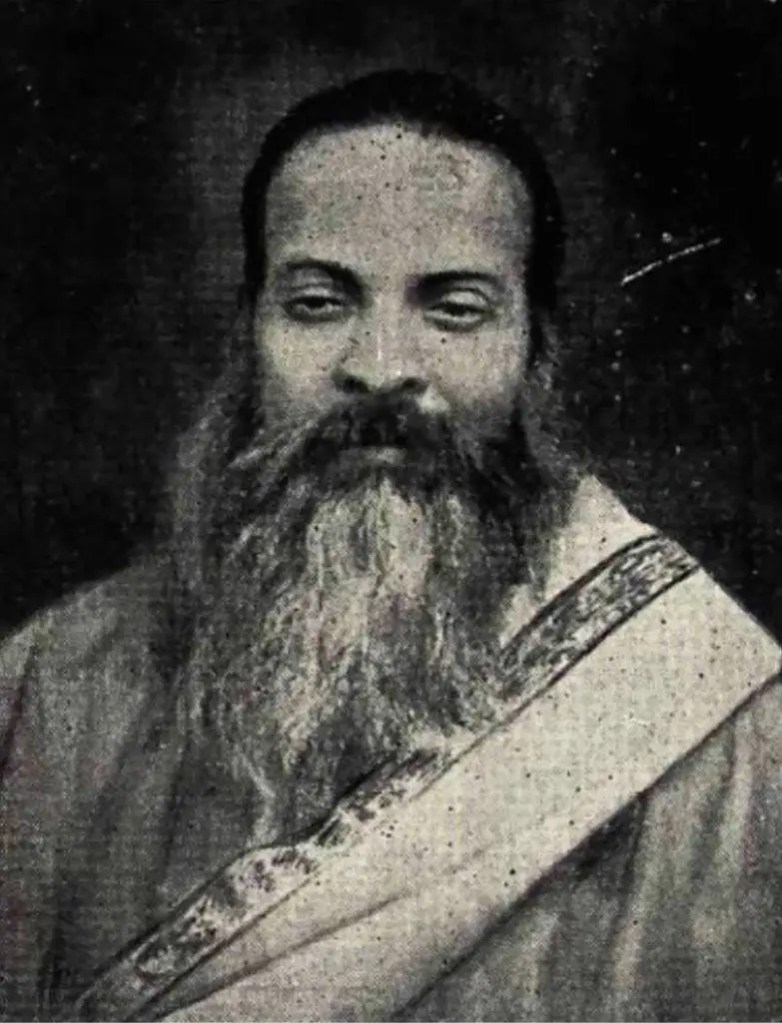
Vishnu Digambar Paluskar
Vishnu Digambar Paluskar was born into a traditional musical family in Maharashtra, western India in 1872. Fired with a deep spiritual need to blend traditional classical music, Hindu devotional practice and education Paluskar was in essence a missionary of sorts. After spending the first 24 or so years of his life as a paid musician in the courts in several small princely states in southern Maharashtra he set out on his own to find a different sort of patron then the small minded autocratic and often musically limited petty royalty his family had been used to serving.
On his travels through western India, Paluskar encountered, at a hilltop shrine, a Hindu ascetic who among other things advised him to head north and to the Punjab in particular. The ascetic instructed him to set up a school in order to live out his destiny. And so the young singer headed north stopping to perform and build his reputation in Gwalior, Delhi, Amritsar and the market center, Okara. In 1898 he made one final move, 130 kilometers NE to Lahore where he began immediately, despite knowing no one or speaking any of the city’s three main languages (Punjabi, Urdu and English), to put together plans for the establishment of a music school.
His choice of Punjab’s capital—now in the midst of rapid development and growth under the British—was unlikely to have been random. Even though he had no connections, the city was well networked and open to exactly the sort of innovative, even revolutionary ideas, Paluskar had banging around in his mind.
To get his idea of a school off the ground he had to raise money and so turned to the middle class Hindu community who were embracing Hindu reform movements like the Arya Samaj which, though founded in Gujarat in Western India, found Lahore to be one of its most important, if not most important site in north India. Arya Samajis were urban and salaried and had both the education and the money as well as the motivation to support causes like Paluskar’s musical-devotionalism. Lahore’s fast developing reputation as a city of education, politics and economic opportunity meant that the the elite and rulers of the many princely states from Baluchistan, Kashmir, and Punjab maintained ties and often residences in the city. Many, especially the maharaja of Kashmir offered Paluskar and his academy, the heavily Sanskritised named Gandharva Mahavidyalaya, critical financial support and patronage.
And though he may not have been conversant in Punjabi or Urdu, Lahore was attracting migrants from all over India. Its economic and strategic rise in importance meant that national vernacular newspapers often had correspondents reporting on events in the city. One such Marathi newspaper, Kesari, began publishing stories about Paluskar’s activities. And though most of his students were local , many were immigrants like himself from Maharashtra including a large number of Parsis who though small in number were prominent as retailers of European goods and services, including owners of Lahore movie halls.
That Lahore and western parts of Punjab were heavily Muslim also had an appeal to the Hindu activist. Paluskar’s entire understanding of north Indian music was that it only could be truly understood and appreciated when performed within the context of a personal Hindu faith. Furthermore, Hindustani classical music, not to mention most of Indian culture, had been debased by Muslims . He believed Muslims performed music only for entertainment and often risque, morally suspect entertainment like courtesan dance recitals, at that.
Paluskar’s vision of a purely Hindu musical world was influential. In nearby Jalandhar where India’s first annual musical festival the Harballabh festival had since 1875 been a place where Punjabi musicians of all creeds and persuasions, but especially Muslim dhrupad artists, performed, Paluskar’s sectarian and vigorously anti-Islamic/anti-Punjabi stanct, made the festival unwelcoming for some of the greatest Muslim classical musicians of the era.
Though Paluskar’s vision and mission could be interpreted as being conservative and traditionalist in that it sought to reclaim the north Indian music system from Muslims and restore it to its rightful place as part of true Hindu faith and practice, (however, contentious that position was/is) there were several elements that should be seen as radical. The most important being his musical notation system. North Indian classical music has traditionally been an oral tradition; Paluskar himself never received formal training and his own teacher never even shared with him the names of the ragas he was learning. It was a secretive and territorial business with performers and gharanas fiercely committed to protecting their styles, innovations and knowledge. This was done through a guru to whom a student devoted his life and fulfilled the role of servant until he was accomplished enough —after many years—to take on his own students. Unlike in Western music, no music notations had ever been committed to writing.
A sample of Paluskar’s notation system published in 1928
Paluskar’s musical notation system, which he had begun to put down on paper while living for some months in Okara, became of his first projects upon arriving in Lahore. With the support of Hindu supporters, Paluskar was to publish the system which formed a fundamental part of the curriculum of his school.
The Gandharava Mahavidhalaya became another of Lahore’s many and varied educational institutions. It offered a rigorous traditional 9 year (!) course of intense training but also shorter teacher training courses called updeshak, for poor students. The school also actively recruited middle class women, revolutionary step for the time. Paluskar not only used the press to promote his work but tapped into the booming printing industry of Lahore to publish short instructional texts in pamphlet form on various instruments and music themes.
His student body grew and included a relatively large number of women and especially Parsi women but also Maharashtrians who had migrated to the city. Within several years his school was well established and financially sound but Paluskar still felt he needed a higher national profile if he was to really have an impact. Once again, Lahore, his adopted city, was able to provide the opportunity.
In 1906 a ‘durbar’—a public ceremony to honour the visit of royalty—was organised to mark the birth of King George V’s son. Paluskar recognised that if he could get on the program as part of the entertainment the eyes and ears of the entire country would be upon him. Through his own Lahori and royal connections he was able to secure a 15 minute slot which he used to promote his vision and school even further. By 1907/8 his school was not only well established but the Paluskar name as a educationist, a Hindu cultural reformer, an innovator and as an accomplished singer in his own right was secure. Though he left Lahore to return to Bombay in 1908 where he set up another branch of the GMV, Lahore was the city in which, as the sadhu had predicted, he would meet his destiny. The GMV in Lahore continued to operate until 1947 and the Partition when it’s heavily Hinduised curricullum and patronage became unviable.
Several of Lahore’s greatest musical names such as Pandit Amar Nath had associations with the GMV either as students or instructors and throughout the 1940s contributed musical scores for Lahore’s film industry. Paluskar himself probably felt films were exactly the sort of entertainment classical music should NOT be associated with but before his death in 1955, his son, D.V., performed in two films, the most famous of which, Baiju Bawra, he surprisingly performed a duet with the Muslim vocal maestro Amir Khan!
I recently moved from Melbourne’s ‘leafy’, wealthy suburbs of Armadale/Toorak to the well-settled northern suburb of Coburg. It’s been like moving to a different country. In a good way.
Coburg, originally named Pentridge, was carved out of the traditional lands of the Woi Wurrung Aboriginal people, in the 1830s. The site of one of Australia’s most notorious prisons, Pentridge, residents changed the name to honour Queen Victoria’s deceased consort, Prince Albert’s, German family, Coburg, in 1870. Throughout the 19th century Coburg and surrounds provided its famous heavy bluestone to other parts of Melbourne as well as hay, some fruit and grapes.
The town was incorporated in the 1920s and has a long history of progressive social and political causes. A stronghold of the then new Australian Labor Party (which just kicked the Conservatives out of existence last weekend) the community pioneered child health facilities that were among the first in the State.
Sydney Road runs through the heart of the area and is one of Melbourne’s many local communities. Today its home to recent immigrants (Afghan, Iraqi, Syrian, Somali, Ethiopian, South Asia) as well as small group of older Italians and Greeks. Young people like the endless number of farmers’ markets, cafes and used bookstores. They wear black, dye their hair bright blue and bling themselves up with tattoos and all sorts of silverware.
I took a stroll down Sydney Rd on Saturday, after voting.
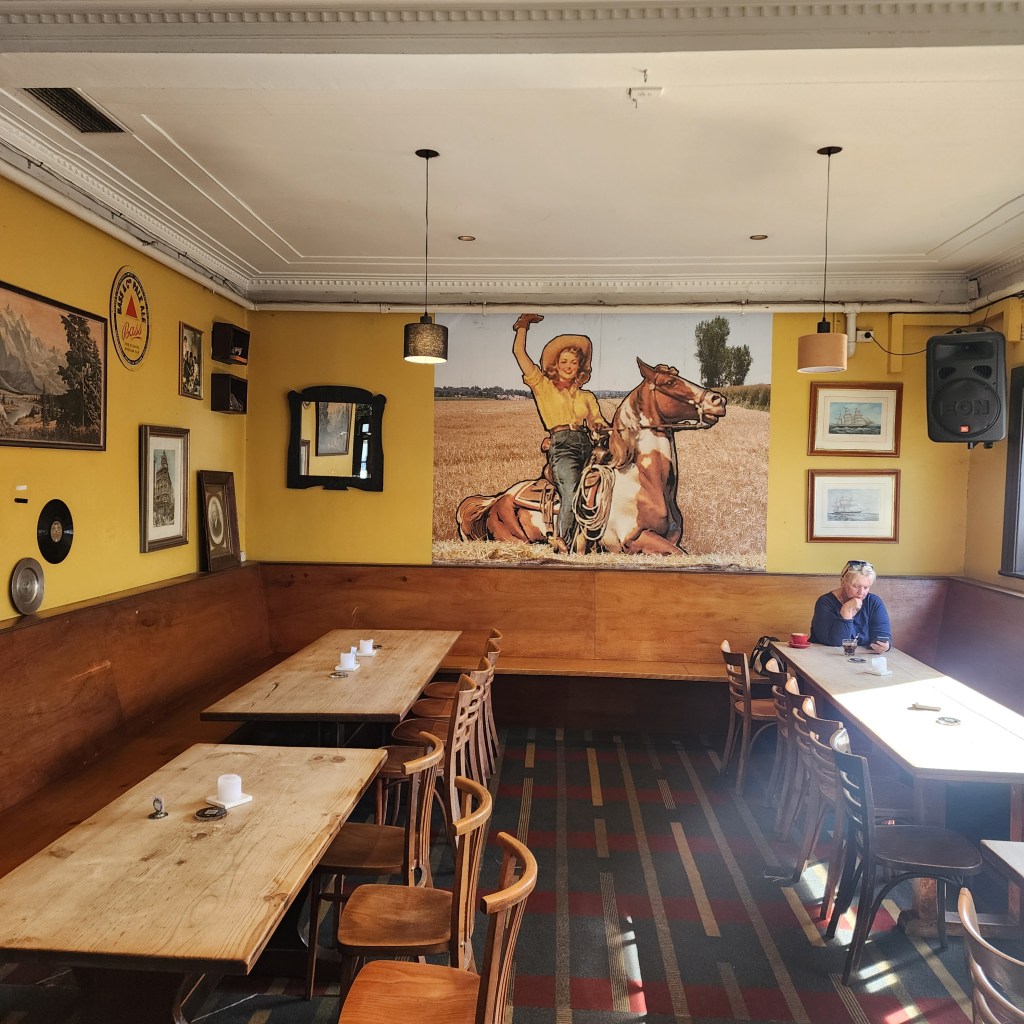
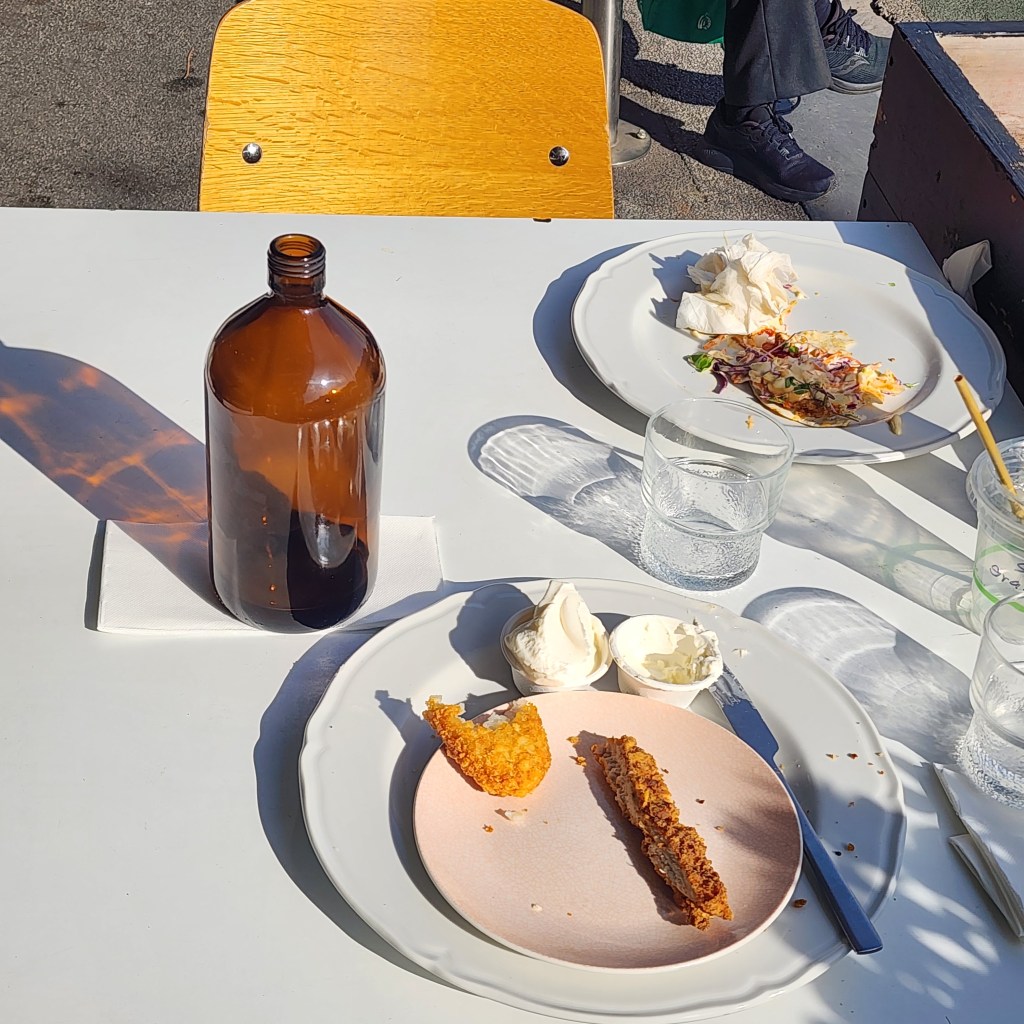
A quiet drink in the Edinburgh Castle Hotel.Local hero.What the hell has happened to the price of beer?Remnants of brunch.Halal meats for recent immigrants.Coburg Motor Inn, Sydney Road.














 Missionaries, Mercenaries and Misfits