My Desi Heart: Intro

Allahabad, 1965

I was born in India in 1957.  The youngest of four siblings in an American missionary family from small town North Dakota and Minnesota. We were evangelicals. Conservative in a Protestant theology heavily influenced by the Holiness movement of the 19th century. Small sect Methodism that believed all sinners could be completely ‘sanctified’ or perfect, in their lifetimes. Among other things of course. 

I was born in the southern Tamil temple city of Madurai but we lived 850 kilometers northwest in a Kanarese speaking area of what is now the Indian state of Karnataka. Dad’s employer, the Oriental Missionary Society or OMS, had established a bible training college in the town of Gadag, famous for producing one of classical Indian music’s noblest performers, Pandit Bhimsen Joshi, and a lively printing industry. 

Dad taught theology and related subjects to young Christian men and women from the surrounding areas. He regularly preached at outdoor revival meetings with his colleagues and students. Mom helped out wherever she was needed, sometimes as the bookkeeper for the college, sometimes she would join the pastors’ wives in their rural evangelizing campaigns but mostly she raised us kids.  

They had landed in Bombay after a long voyage across several oceans from New York in February 1952. They were appointed to join another American family, The Davises, who had two boys round about the same age as my two brothers, and a jolly, tubby spinster from Baltimore, Mary Ella Taylor. 

Mike my oldest brother was 5. Gregg, next up was 3. My sister Rebecca would arrive 3 years later, in 1955 and I brought up the rear in ‘57. There is a good case to be made that another sister was stillborn before I came along. 

We lived on the campus of the Karnataka Bible Seminary, whose red brick buildings dated back several decades. It was well shaded at least in the front part and served as a safe, walled but sprawling little world for me to explore as a kid.  

We were generally happy and normal. Among our subcultured circle of missionaries anyway. In fact, compared with the Davises,  mom and dad were liberal youngsters, which did cause ongoing friction between them over the years.  As is the wont of every child what they see in their homes they project onto the entire Universe.  There was nothing different about us. We all believed broadly the same things about the Bible and God and Jesus. We shared a barebone existence with few physical comforts. It was simple, filled with good food, devotions, trips to exotic places like the temples of Hampi, Shravanabelagola and the beaches of Karwar. Of course, “we” in these instances refers to other OMS missionaries or white folk in India more broadly.  

It was impossible not to notice that most everyone else around us and among us did not believe these things. But then, that was the whole point of our landing up in rural southern India. To try to get as many of them as possible to come over to our team.  A spiritual kabaddi match. 

Only recently have I begun to distance myself from the lived experience of my childhood. To look at it not from within but from a distance of 60 year; and from the outside. How did this rural, poor family from Minnesota end up in the villages of central India, speaking strange tongues and eating strange food? Why?  What was going on in India at the time? And how did being surrounded by religion and spirituality, in the home or everywhere you went in India, and speaking Kanarese simultaneously as fluidly as English and having Indian friends to whom I was closer than to my brothers who were away in boarding school?

What does /did this niche childhood-–Minnesota, Holiness Methodists, missionaries, newly Independent India, bilingual communication–influence who I am today?   

This is about that.  

India has been an indivisible aspect of my life since 10 July 1957. At times some have found it irritating and maddening.  Others have seen it as fascinating and exotic. Most just shrug, especially now in this tiny world we live in, in the 2020s.   

My connection to India is something I’ve always loved but haven’t known how to incorporate into my story. Or stories. It depended on the audience of course, as all stories do. My wives have felt threatened by India which is so easy to love in comparison with a real complex woman. So, there is shame and protection mixed in with my love of India. I’m sure many, including myself, thought I would outgrow my romantic childhood when I became an adult and that its influence would settle into a manageable and quaint curry now and then and perhaps one grand tour with the family when the kids are old enough to enjoy an adventure.  

But it hasn’t happened that way. The older I got the more attached and fascinated by and in love with the place I become.  I chose to study Hindi rather than Latin or French in high school. At the University of Minnesota, I jumped from majoring in Anthropology and Journalism and English before settling on South Asian Studies and History. I studied Urdu as well as Hindi. I spent a year after university studying in Lahore Pakistan. I was thinking of doing a PhD on one of the most important figures in modern South Asian Islam, Maulana Maududi. But then I got a job with the UN in Islamabad and began a career that took me around the world. India faded into the background for those years but never died.  

I began blogs about South Asian music and wrote a novel set in Pakistan. I read books on the caste system, Tamil anti-Brahmanism, Aurangzeb and the film industry, travelled and photographed across India whenever I could, did an ongoing deep dive into south Asian music and film and wrote a weekly column on the subject for an Indian online paper. I was asked to write a history of the Pakistani movie industry and now I’m thinking of leading tours to the sub-continent.   

India is not fading away like it was supposed to.  

Many of my kind (Missionary Kids from India and Pakistan) break into song when asked by Indians to explain ourselves.   

Mera juta hai Japani 

Yeh Patloon Englstani 

Sar pe lal topi Russi 

Phir bhi dil hai hindustani 

(I wear Japanese shoes and English trousers, The red hat on my head is Russian but still my heart is Indian)  

It’s a hackneyed trope but does capture the essence. 

My first blog I named, the Washerman’s Dog which is the English version of another famous Indian aphorism: na ghar ka na ghat ka, dhobi ka kuta (neither of the ghat nor the home, the washerman’s dog) 

Both sets of lyrics resonate with me. I do feel homeless in a way, neither from here nor there. But also completely blended in with India.  

Hence, it seems appropriate to name this column, My Desi Heart. A place where I’ll explore the story of my love-affair with the sub-continent. 

Letter from Dushanbe

Rudaki Square, Dushanbe

LETTER FROM DUSHANBE 
 
There are two things that could kill you in Tajikistan these days. The first is a massive earthquake. Tajikistan, the poorest of the former Soviet Central Asian republics with a population of six million, is the place where four major mountain ranges meet as the Indian subcontinent inexorably crushes and grinds northwards into Europe. You feel the earth tremor here almost every week: sometimes just a low quiver; at others a quick chiropractic snap that rattles your windows and creaks the walls. 

The second way you can be deprived of your life is to be slammed by a vehicle with tinted windows (could be a Jeep Cherokee, could be a tiny Lada 1500) whizzing dangerously through the shaded intersections of Rudaki Avenue, equally scornful of traffic signals and pedestrians as of the sour-faced militia that hang thick as bats along the main drags of the capital, Dushanbe. Not too long ago the odds on being kidnapped and then murdered, or shot in the crossfire of street fights were definitely better than the first two scenarios. 
 
So, on the face of it, things have improved in Tajikistan. Gangsters may be bad drivers but at least snipers aren’t drawing a bead on you when you go shopping. Tajikistan’s society fell apart the same moment the Soviet Union declared itself null and void. Seventy years of communist wall papering had done nothing but thinly cover the rifts that had been cracking across the landscape for centuries. Northern Tajiks, long the “blessed ones” of the political system began to squabble with uppity, uncouth Southerners. Democrats from Dushanbe and Islamicists from the isolated, honey producing Karategin valley joined forces against Communist party hacks. Ethnic Uzbeks, Russians and Germans were attacked, harassed and forced to quit the country. Fighting broke out in the streets of Dushanbe and carried on for five years. Tens of thousands of Tajiks fled into Afghanistan (could there be a worse place on earth to seek refuge?) as hundreds of thousands more became displaced within the country. 

Tajikistan, like many other recently independent states, is one of the lost nations of our world. Though not yet a failed state, Tajikistan is falling with increasing velocity towards the bottom of the misery stakes. It has always been a poor country and except for a couple of centuries a millennium ago, when Tajiks were the undisputed rulers of this part of the world, holding the northern borders of the first Islamic Persian empire, the Tajik people have always been lesser partners in the power arrangements of Central Asia. The fabled cities of Bukhara (ascetic and spare), and Samarkand (opulent and gregarious), are their proudest contribution to world civilization. But with the gradual loss of the northern realms to Turkic tribes the Tajiks were unequivocally usurped and subjugated to a life of cultural domination and political irrelevance. Until, that is, 1924, when the new Soviet state carved out a Tajik Autonomous Region. For the first time the Tajiks began to imagine themselves as a distinct national group. The Tajiks’ feelings toward the Soviet Union were, not unnaturally, largely positive. They were grateful for bringing them into the world. And being part of a sprawling powerful Union gave the tiny land-locked country much greater security and prosperity than it would have been able to acquire on its own. If there was any doubt about what their fate could have been without the Soviet Union, one only has to glance south of the border to the basket case called Afghanistan. Ten years ago, when Tajikistan followed the general trend and declared its independence the occasion was a cheerless event. Those once fond feelings have given way to bitterness and regret. The civil war that broke out almost immediately achieved little of positive consequence. The industry, farms and orchards of the most dependent economy of the former Soviet Union (40% of the budget had come in direct subsidy from Moscow) fell into utter neglect and disrepair. Nothing was produced and very little grown. Factories stood as empty as the revolutionary slogans that had suddenly fallen out of vogue. Bazaars were deserted. Restaurants were beyond imagination. Since an UN-brokered peace settlement four years ago Tajikistan has struggled to find its way in the big bad frightening world marketplace. It will be years before the people of this country enjoy the standard of living they had as Soviets when time extended securely into the future and holidays in Georgia were assured. 
 
Ten years after independence there remains little warm feeling for the capitalist, free market and democratic jargon their leaders mouth each day in the smudgy, thin, state-controlled newspapers. Hunger and poverty are growing in Tajikistan. The World Bank estimates that 96% of the people live on less than $28 a month. More than a third live on less than $5. Forty one percent of children under five years of age are seriously malnourished and weigh less than children their age in all except the poorest countries. Basic buying power is the issue in this country. Most Tajiks don’t have any. There is no work and what is available pays a paltry sum. Many agriculture workers working the old state and collective cotton farms have not seen a wage for three years. In most households outside of the capital (and increasingly here as well) the day’s meal is a loaf of round naan bread and tea. Russians, once the prime beneficiaries of the system, but now among the poorest, have taken to stewing dogs in some urban centers. Poverty can be measured in any number of ways. But if you calculate the degree to which a people’s standard of living has fallen (evaporated nearly overnight) then the collapse of most of the Soviet-dependent societies has produced one of the cruelest forms of privation. Recently I visited the home of a deaf pensioner who receives a small donation of American wheat flour and vegetable oil. The effects of a stroke twist his face. His flat, on the first floor of a concrete tower on the outskirts of Dushanbe, is shabby and dark. His trousers are pinned together and his shirt collar is worn; old spectacles off kilter. “I used to be a highly skilled type setter at a publishing house. Now all I can do is cry.” As I left the building I recalled what one man said to me when I asked him what he thought of the new world order. “The Russians used to say ‘We’ll screw you but then we’ll feed you.’ Now we are being fucked but there’s no food.” 

This piece appeared first on the blog Hackwriters in 2003

I lived and worked in Dushanbe, Tajikistan between 1999-2001. Dushanbe is the Tajik word for the second day of the week, (Tuesday) and was named for a historical weekly Tuesday market that had been held in the area for centuries. During the Soviet era the city was known as Stalinabad (1929-1961). With the ‘thaw’ that followed the death of Josef Stalin, the ancient historical name was reinstated.

Dylan’s Turn of Phrase

I was lucky to get a pass to a pre-release viewing of A Complete Unknown, the new Dylan biopic, this week.  The event included a free drink (which turned out to be a Thatchers Gold Apple Cider in a can, which is so wrong on several levels) and an ‘Australian exclusive’ interview with director James Mangold and leading man, Timothée Chalamet. A great night. 

The film itself was very good. I can’t think of another film where an actor captured a character many of us think we know intimately, with near perfection. It was almost as if Dylan himself had morphallactic-ly returned to his early years in the physical form of Chalamet. All the essentials were there. His smirking disdain, his obsessions, his hair, the shades and the voice, bursting at the seams with creativity.  A stellar artistic performance by the actor.   

[Not to be discounted is Edward Norton as Pete Seeger. His understated performance as Dylan’s early champion is worth the price of a second ticket. The crushing disappointment he conveys when Woody Guthrie makes it clear Dylan is to be his successor, not Pete, is so good.] 

The Australian exclusive interview was prerecorded. It featured a local B grade entertainment interviewer who knew little of Dylan’s mystique or music and who received each response from Chalamet with a cooed ‘Ooo, that’s so great!’, more appropriate to an interview with parents of a severely disabled child or a granny fighting back against online scams.  Chalamet was pissed and swilled big gulps of vodka straight from the bottle. His answers were disjointed, sometimes coherent. He seemed to be channelling Dylan’s own irritated approach to dumb interviewers. For his part Mangold tried to keep disaster at bay by praising the drunken luvvy next to him and speaking of how they had ‘sculpted’ the performance and their relationship over ‘many years’.  O.K.

Definitely go see this film. 

As I walked to the cinema, I reflected for the umpteenth time on what it is about Bob Dylan that I love so much. I’m sure I could dig out several dozen reasons but the one that immediately jumped to mind was his ability to turn a phrase.  Though I’m a Dylan lifer, there are few if any songs of his that I could recite in their entirety. Maybe Blowing in the Wind if the wind were behind my back.  But I can rattle off dozens of phrases that absolutely live within my soul every day. 

All I really want to do, is baby be friends with you 

It ain’t me babe 

He not busy being born is busy dying 

She wears an Egyptian ring that sparkles before she speaks 

I contain multitudes 

Flesh-colored Christs that glow in the dark 

I used to care, but things have changed 

Lincoln Country Road or Armageddon? 

A few words, seemingly simply, even thoughtlessly, placed together stand out like sparkling jewels throughout his work.  They are adornments. In Indian/Sanskrit aesthetics these are known are ‘alankara’, poetic ornaments or decorations designed to enhance the joy and delight of the reader/listener. 

I find myself repeating Dylan’s phrases at random moments and situations.  I get a kick out of marrying Dylan’s words with the situations and events of my meagre life. That feeling of delight, according to the ancient Indians, is the entire purpose of poetry, music, art and literature.  According to Vijay Kumar Roy, Associate Professor of English, University of Allahabad, “all artists are expected to have a kind of gift, through which imagination can provide the reader [something to] ‘savour’ or ‘relish’, [rasa, in Sanskrit], which is the highest form of joy or supreme bliss (delight). (1) 

Sometimes Dylan seems to throw all manner of phrases together, seemingly indifferent to whether they make sense as a whole narrative.  For years scholars and fans have tried to unpack and dissect the meaning of each of Dylan’s songs to find a coherent message.  Yet if you look at a song like It’s Alright, Ma (I’m Only Bleeding) the phrases pile up and it’s hard to draw direct links of meaning between them. 

Darkness at the break of noon 
Shadows even the silver spoon 
The handmade blade, the child’s balloon 
Eclipses both the sun and moon 
To understand you know too soon 
There is no sense in trying 

Temptation’s page flies out the door 
You follow, find yourself at war 
Watch waterfalls of pity roar 
You feel to moan but unlike before 
You discover that you’d just be one more 
Person crying 

These verses are full of brilliant lines. Indeed, each line is full of meaning, but you’d be hard put to say exactly what he’s singing about. A simultaneous solar and lunar eclipse? Is the page of temptation a book or a young lad? I’ve seen waterfalls but don’t know what a waterfall of pity is and what that has to do with said page.  

But as the song progresses it’s clear Dylan is conjuring a scene of madness, darkness and confusion.  He is describing a disjointed disconnected modern society and so there is a certain rasa/taste to this song. Indian aesthetics identify 8 main ‘rasa’ or flavors that an artist may induce in a reader, observer or listener. One of them is Raudra: The Rasa of Anger and Fury which Dylan employs to demonstrate his righteous fury over the state of his country, society and times. It’s a heavy song. It’s got the weight of Jeremiah or Isaiah. But it is decorated and ornamented with the most beautiful turns of phrase. 

Darkness at the break of noon 
Shadows even the silver spoon 

While money doesn’t talk, it swears 

You never know how future generations will view yesterday’s heroes but it’s hard to imagine Dylan’s writing being forgotten.  His turns of phrase, dozens of them, have entered our daily banter.  

The times they are a changing.  

Blowing in the wind.   

It ain’t me, babe. 

You gotta serve somebody 

Pick up any of his records, or read his poems/lyrics on line and you’ll discover hundreds of magical delightful phrases that capture the whole gamut of human emotions. But which also mark Dylan as one of the greatest manipulators of words. 

Here is one of his phrases I use regularly, in a lot of situations. 

A change in the weather is known to be extreme 
But what’s the sense of changing horses in midstream? 
I’m going out of my mind, oh, oh 
With a pain that stops and starts 
Like a corkscrew to my heart 
Ever since we’ve been apart 

(You’re a Big Girl Now, Blood on the Tracks, 1974) 

  1. Roy, Vijay Kumar. 2012. “Indian Aesthetics and the West” In Explorations in Aesthetics, edited by Alka Rastogi. New Delhi: Sarup Book Publishers. 


Sometimes I Lie Awake at Night and Wonder

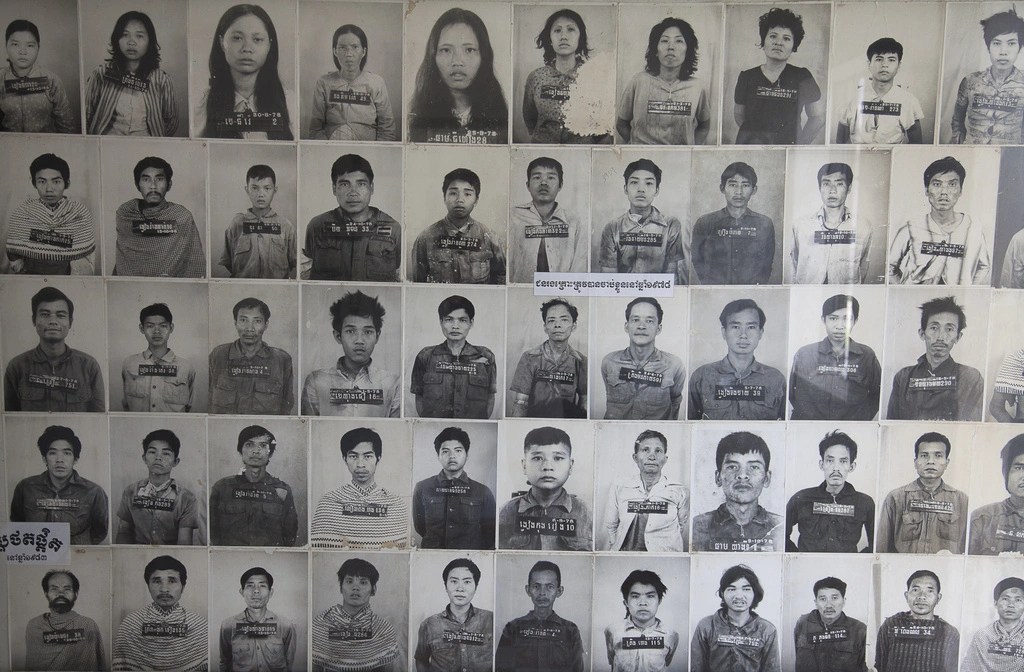
Some of Pol Pot’s victims, S-21 Prison. Phnom Penh

Tonight I’m in Phnom Penh and can’t sleep. I seem to always wake up at this time, when the day is still dark and the only sound is that of lazy thoughts shuffling inside my head. On the other side of the hotel window a boat bangs softly against the jetty.

It is windy and the monsoon is nearly at an end. I was told Cambodia is a land of dusty sunsets but I find the county resplendent with green paddy and the gurgle of the pale brown Mekong in flood. I expected, too, to meet a morose and sullen people. But the Cambodians are warm and can’t repress their smiles.

Throughout the town small but smart restaurants cater to the foreigners that work for the NGOs and UN agencies that finance and prop up the social welfare system of struggling countries like Cambodia. Banners pronouncing tourism as a ‘tool to build cooperation’ droop in the thick air. The tourists are back. Backpackers from Australia, packs of Japanese and most ominously, ugly aging men on the prowl for sex with young Khmer girls and boys. Cambodia is challenging Thailand as the premier destination for sex tourism. Such are the hairline cracks of a poor country’s development.

There is another macabre little industry in Phnom Penh centred around the horrific torture chamber known as Tuel Sleng or S-21. Tucked deep inside a residential neighbourhood the former high school transformed by the Khmer Rouge into a laboratory of evil, S-21 is a ‘must see’ for any visitor to Cambodia.  Along with the temples of Angkor, part of the grand tour.  Moto drivers call out to you, ‘Tuel Sleng. Look at Khmer Rouge jail’. You can buy T-shirts with disgusting recreations of faces behind bars on the backs.  They also sell bags and skirts made of bright Khmer silk right next to building B where Pol Pot’s most important enemies were kept in tiny wooden cages before being cut open like animals and fed to the demon, Angkar, ‘the Organization’. 

I certainly remember the name Pol Pot but his crimes were still unknown outside of Democratic Kampuchea in those years, 1975-1979. It’s an old story now, how this country was transformed, almost overnight, into a giant slave camp. Cities were evacuated and left empty and the population forcibly moved from province to province to reshape the face of the land. Canals were gouged out of the earth. Dams glued together. Millions of paddy fields planted. All done without the help of machinery, with only bare hands and fingernails. Machines were deemed impure and imperialist. Money was abolished as was religion, privacy and even talking. Democratic Kampuchea was a massive experiment in applied paranoia. The people were starved and then themselves became fodder: sustenance for Angkar. Hundreds of thousands, even more than one million, perished. There is not a family here that doesn’t harbour the loss of a sibling, parent, child or spouse.

Why didn’t we hear of this when it was happening, I wonder?

I recall an exhibit at S-21. Instructions painted on a signboard to those under torture. Among the many protocols is the command not to ‘yell out or make any sound when you are beaten with electric wire’.

The single most important factor in the success of Pol Pot’s revolution, according to most scholars, was the carpet-bombing by American B-52s between 1970-1975.  By the time Phnom Penh fell the people of Cambodia were massively traumatized from years of dodging falling explosives that wiped out their villages, families and animals.

I used to work in Iraq. One night the Kurds went wild and fired their machine guns into the air. We lived in tents against the side of a hill. We ate under a thatch and open sided cabana. For several minutes I felt the terror of having no control over my well being. Shells from the celebrating Kurds’ guns rained down from the sky thwacking into the earth and cracking into rocks. I ran for cover but why, I don’t know. There was nowhere to hide. How was a canvas tent to protect me from a hot piece of iron falling from the sky?

And how was a Cambodian peasant to protect himself from a massive cluster bomb falling from an unseen American warplane? And not just once but night after night, week after week? When the Khmer Rouge came to town they didn’t have to ‘recruit’. The people swarmed to anyone who claimed they could stop the bombing.

Daylight is breaking over the city.  I can hear street children laughing now and the sky is white. It’s going to rain some more today.

I wonder.

In the 1970s an American President doggedly pursued the ‘national interest’ and filled the air with airplanes and bombs and mighty words about the need to stop communism from sweeping across the world.  More quickly than Presidents Johnson, Nixon or Ford could have imagined and certainly more inelegantly than the American people were led to believe, communism and the horror that the planes and bombs were to supposed to eliminate, ran the Americans out of town. And tore apart the people and society they were supposed to save.

A year ago another American President began massive bombing against another weak and troubled Asian country. “We’re going to get him dead or alive” the world was told. And something else too. “This time we’re not going to let the Afghan people down. We’ll change the leadership, establish the rule of law and stick around to rebuild the country.”   One year on the Taliban are gone but still active on the periphery. Osama is neither confirmed dead nor alive, apparently relegated to the ‘too hard basket’.  The rule of law remains a fantasy in Afghanistan and donor fatigue has already set in. Of the billions pledged to rebuild Afghanistan to ensure that terrorism has no room to hide, much has not been delivered. The Afghans, it appears have once again been sold a line by their ‘saviours’.

President Bush is once more in dogged pursuit of American interests. Come hell or high water, right or wrong, support or not, we are told he must “change the leadership in Iraq, establish the rule of law and get the UN to pay the billions needed to rebuild the country”.

Sometimes I lay awake at night and wonder.

What sort of new horror is going to arise from the ashes of Afghanistan and Iraq, similar to that arose here in Cambodia? Will Americans wake up and see the links between their crusades against communism and their wars against terrorism and the misery and hatred that follow in their wake?

Phnom Penh, Cambodia 2003

What’s in a name?

The phrase that names this blog is a hackneyed one and one that seems to have popped simultaneously and spontaneously into a number of heads at the same time.  It is now a dull commonplace that elicits grunts of acknowledment rather than laughs of revelation which it was designed to do.

It’s been used as a descriptor of all those who toil in ‘Aidland’ the vast global financial, institutional and spiritual infrastructure of those involved in delivering ‘aid’ to people in the ‘developing world’ or ‘global South’. Those people in the blue vests and red or orange hats with their employer’s logo splashed across them whom we see on TV in the immediate wake of a flood, tsunami, war or earthquake.

There is a whole school of research and writing on these people (of whom I am one) and perhaps one day I’ll read some it.  But I am not interested in Aidland, or aid workers here in this piece.  Rather, I’m interested in understanding why, when it came to naming this blog, this phrase jumped instantaneously to mind.

I was born into an actual missionary family in India.  I am an MK, a missionary kid.  I have done some pretty mercenary things in my life and know the temptations of that character.  As for misfit? Aren’t we all?

What has inspired this blog is a frustration with how I make sense of my world. Of my experience as a mid-60s male who has had a privileged life. And there is an urge within me to, in some way, document my journey. Not because it is particularly unique or dramatic but because I have never had the time or space to reflect on it.  To see how and whether and why these three strains of my personality and identity come together. Or don’t. Perhaps they are just frayed loose ends.

I’ve thought of writing a memoir. Perhaps an autobiography. What about a fictionalized life of a former missionary kid turned aid worker called Nate? But all attempts have fizzled. I haven ‘t been able to summon the energy to finish such a project.

But I have been writing all my life.  Short pieces, novels, the first draft of a history book, text books, articles on music, politics, ‘Aidland’ and strange figures of history. I’ve written sitreps and reports on humanitarian disasters, and hundreds of funding proposals.  I’ve translated books from Urdu to English. I’ve edited newsletters. I’ve written thousands of letters (though none in the last 25 years). Writing things down is how I validate myself and express myself.  Some people like to chat.  I write.

I’ve been blogging a long time too. I began in 2010 and since then have launched many blogs mostly on music, but also about photography and memoir. It’s a medium I know and understand and enjoy.  After months of hemming and hawing about whether to join Substack, I’ve decided to remain a blogger.  And use this new blog as a sort of laboratory, factory and think-tank; a messy sangam of the various streams that make up each of our lives.

Rather than a single volume ‘memoir’ this blog fills in as my ‘autobiography’.  Read this and you should get a pretty good idea of who I am and how I got from a missionary hospital in south India to the suburbs of Melbourne, Australia. 

Before I leave, let me riff on the triple-barreled phrase that fronts this blog.

How can you tell how long a missionary has been in India?  Notice how they react to fly in their tea.  1-2 years, they grimace and politely push the cup of tea away. 5 years, they delicately pick the fly out and flick it on the floor.  10 years or more, they squeeze the fly of all the tea juices that have entered his drowned body and continue to sip the tea.