Of Mangoes and Politics

The political weather had been getting rough for a while.  It seemed as if everybody had a knife sharpened for the bijou General with the face of a hawk.  Gorby warned the Americans they were going to do a hit job on him. India always hated the guy. Najibullah, the barrel-chested leader of communist Afghanistan had thousands of agents in Pakistan looking for the opportunity. Even the Yanks were sick of his repeated moving off script. Oh, and don’t forget all the generals he had jumped ahead of when he was appointed Chief of Army Staff by the PM, Zulfikar Ali Bhutto, who he then turned around and deposed and had hung in his first spurt of manly Islamic machismo.  The entire political class, civil society and media resented him. He had spent the last three months hunkered down inside his heavily protected residence,  some say humming the blues lament, ‘Nobody loves me but my mother, and she could be jiving too.’

General Mohammad Zia-ul Haq

Dark clouds indeed.

But the 17th day of August 1988 showed not a cloud in the sky.  Today, the “ill man with ill intentions”—the summation of his military commanding officer several years previous—was flying down to the deserts of southern Punjab to witness a field test of General Dynamics’ Abrams M1 tank.  His American sponsors had been twisting his arm to buy a bunch of them.  The American Ambassador, Arnold Raphel, and his military attaché would meet the President in the desert. Zia, as per his usual practice, would be accompanied by several of his top generals including his presumptive successor, Gen. Akhtar Abdur Rahman.
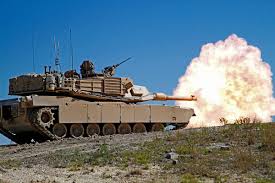
The Abram M1 no doubt missing its target

The Abram tank proved to be a dud. The Americans were embarrassed that it missed its targets and repeatedly sputtered to a halt, unable to handle the clay-laden dust of the Thar desert. Zia and his men were openly relieved. What they really wanted were AWACS.  Still, the party was surprisingly cordial given the deflating exhibit of American tech and general ill-will swirling around the figure of the President.

After a nice lunch, the President invited the Ambassador and his attaché to join him in Pak-1, Zia’s Hercules C-130 transport plane with its specially fitted airconditioned VIP capsule for the hour-long flight back to Rawalpindi. No hard feelings, Mr. Ambassador. Now about those AWACS.  
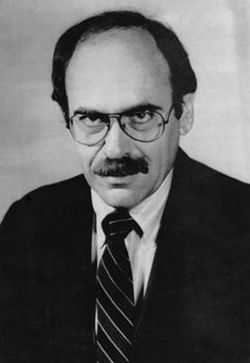
Ambassador Arnie Raphel

As everyone settled into their seats a couple crates of local mangoes of the best variety were stuffed on board.  At 3:40 pm the giant aircraft lifted off. Eleven minutes later it nose-dived into the desert killing everyone on board bringing Zia’s unpopular eleven-year reign to an emphatic conclusion.

Strange things began to happen pretty quick smart. An order was given (probably by both countries) to do no autopsies. Why not? The FBI, who had just a year or two earlier been mandated by Congress to investigate every terrorist attack in which an American was killed was denied entry to Pakistan for a year. And when they did arrive, they seemed less interested in the crash then in sightseeing. Ohkaay. The Pakistanis settled on sabotage. The Americans on mechanical failure. After the tank debacle you’d think they were probably right but then again, no evidence has ever  been produced along those lines. So, the Pakistanis were probably right. Right.

But what kind of sabotage and by whom?  The latter was too hard to answer. Everyone wanted this prick out of the picture. How, was somewhat easier to answer. Eyewitnesses on the ground claimed they saw no smoke, no explosions, no missles hitting the plane. Remember it was a clear hot summer day. Just the damn plane genuflecting up and down and then smash.

Elaborate proposals involving military men and fast acting, time and altitude activated nerve gas were put forward. Ultimately, too much was at stake for the truth to be ever told and within a few months the drama and official curiosity was over.  Pakistan had a woman PM, Benazir Bhutto, the daughter of the man Zia had murdered. To her the crash had been “an act of God”. The Soviets had been routed and the Yanks were heading home.  Good riddance all round.

Sindhri mangoes

But what about those mangoes?  No one denied they were put on board in the desert. Some claim every single piece (around 60) were checked by security. Highly unbelievable. Others claim they were shoved on at the last minute with no scrutiny. Much more credible.

Early reports appeared that traces of chemicals were found on the skin of some of the mangoes recovered from the wreckage.  Had the nerve gas been hidden inside the fruit? The public loved this idea. And it remains the most popular explanation until today. A novel, The Case of the Exploding Mangoes got quite a bit of press in the late aughts.

Hmmm. No one can say for sure what actually led to the death of a dictator, his general staff and an American Ambassador. Leastwise, no one’s talking. But isn’t  it interesting that those crates of luscious juicy mangoes were a late inclusion on the plane?

On another August day, twenty years before, another case of Pakistani mangoes, from the same region as those hitching a ride on Zia’s plane, did a star turn that has to be remembered as one of weirdest sidebars in modern political history.

Pakistan and China have been best friends forever. But their friendship was especially strong in the 1960s when Pakistan was still young and China was caught up in the whirlwind of an endless series of self-induced crises with Cinemascope names. The Great Leap Forward. The Great Famine. The Great Proletarian Cultural Revolution.  China didn’t have a lot of friends; the Pakistanis needed a big power to balance the friendship of India with the USSR.

In August 1968, the Pakistani Foreign Minister on an official visit to Beijing, gifted Mao Ze Dong (The Great Helmsman) a case of Sindhri mangoes, considered by many as the King of all mango varieties.  Mao didn’t like the look of them. In fact, the fruit was pretty much unknown in China at the time, so the following day, as a token of his personal gratitude he re-gifted the funny fruit to a group of ‘workers’ who earlier in the week had subdued some angry students at Qinghua University.

Things were messy in China. In fact, the place was a real shitshow. Two years previous with the slogan, ‘Sweep Away All Monsters and Demons!’ the People’s Daily announced The Great Proletarian Cultural Revolution. With the stated aim of ridding society of all remaining bourgeoisie elements, the CR seemed to be more about Mao remaining the unchallenged leader of China, a position he feared was on somewhat shaky ground. 

A poster depicting what happens to monsters & demons. 1967

What ensued was a period of chaos in which students, with direct and active support from the Communist Party, formed themselves into bands of Red Guards denouncing, killing, destroying buildings and otherwise wreaking havoc against officials and political foes of Mao. The main cities across China turned into battlegrounds. Factions of Red Guards each claiming to be the true executors of the Chairman’s will, battled other factions of Red Guards. Public executions and torture sessions, wanton destruction of public property and street battles became the order of the day. Mao and the Cultural Revolution Group of senior Mao loyalists watched quietly; some in horror, others with glee.

But by the time the Pakistani Foreign Minister stopped by for a visit, even Mao realised he had unleashed a red wave of terror that even he could no longer control.  A fresh slogan, ‘The Working Class Must Exercise Leadership In Everything’ was promoted and Mao invited workers to oppose the wild students. 

After their victory at Qinghua University, Mao sent the Pakistani mangoes to various work sites as a gift. In a way that only those who live in such mad situations can make out, this was seen as a signal that power was shifting and the Red Terror of the students was over. Things were bound to better from here on in. And this strange fruit from friendly Pakistan was to symbolise that (unwarranted, as it turned out) faith.
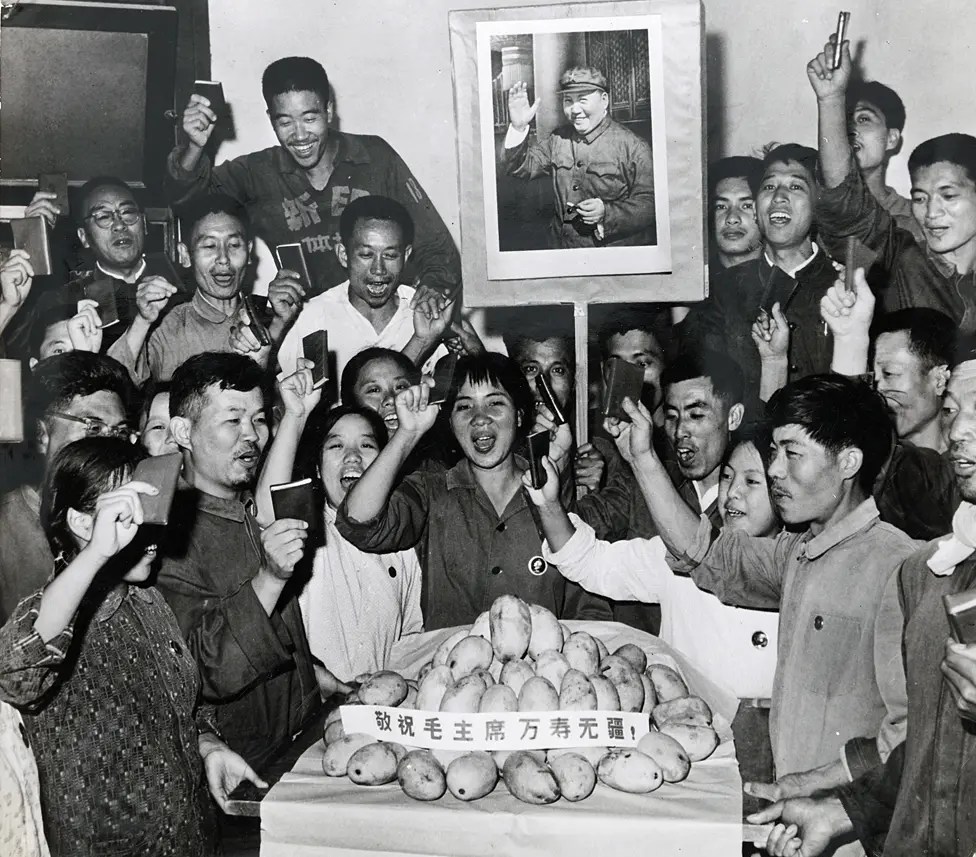
The worker-peasant propaganda team in Qinghua cheers the gift of mangoes – the ribbon reads: “Respectfully wishing Chairman Mao eternal life”

Not sure whether they should eat it, one factory sunk their mango into a jar of formaldehyde to preserve it for posterity.  In other factories people crowded around to sniff the fruit and stroke its smooth skin.  Some boiled the rotting pulp—I mean mangoes are great but they don’t last more than a day or two or three—in water which they claimed became holy.  If you took a sip, you were in direct touch with the Great Helmsman. A cottage industry popped up to produce wax replica mangoes encased in glass which were given pride of place in factories and workplaces. These wax mangoes became relics. Like the hair of the Prophet for Muslims or a Piece of the Cross for Catholics.  Mao was amused but didn’t intervene. In fact, the Mango became a stand-in for the Great Man himself.

Mangoes were carried ceremoniously in parades on national holidays, flanked by portraits of the Chairman. The mangoes were toured around the country. In one case a plane was chartered to deliver a single mango to Shanghai.  At a time when Mao had felt his personal following to be waning, the mango re-invigorated the Chairman’s personality cult. Mango posters, tea cups and plates appeared in the shops. There were reports of workers bowing in front the wax mangoes each morning as if it were an ancestor shrine from pre-Communist days.

From ‘68-’71, now feeling a bit more in control, Mao shifted his focus to the countryside. Millions of students and other bad characters were sent into the fields of China to learn from the peasants.  Millions died. Others were not permitted to return to the cities ever again. Life across China was yet again completely disrupted. The economy severely damaged yet again.  

The mangoes inevitably were forgotten as people struggled to survive, working the land with few tools, no wages and in inhuman conditions.  All that remains, like the mango skins in the wreckage of Pak-1, is the story.
Chapter Two: Of Tea and Opium

Lollywood: stories of Pakistan’s unlikely film industry


Of Tea and Opium

That movies were instantaneously embraced in the new, purpose-built metropolises of British India is no surprise. Bombay, Calcutta and Madras were the throbbing hubs of an expansive world power at the peak of its self-belief. These great new empire cities were magnets for people of all persuasions, creeds, backgrounds and regions. The only requirement to be a success in this brave new world was to be open to new ideas.  And quick on your feet. Being coastal cities, the three great colonial cities served as entrepôt  to the Jewel in Queen Vic’s crown, guarding and servicing the shipping lanes which were the new global trade routes that connected an expanding Europe with the wealth of Africa and Asia.

And not just Indians, but people from all over the world sought their chances in India’s boom and bust emerging economy.  Armenian merchants, American missionaries, German scholars as well as businessmen, administrators and artists of all types and nations including some of America and Europe’s finest jazz men and women, all sensed that Bombay and Calcutta were the place to make their names and fortunes.  The cities were linked not only to Paris, London and New York but other colonial metropolises like Shanghai, Johannesburg and Singapore. The cities were part of a new international order tied together by a globalizing modern culture in which film was the shiniest element.

Built on marginal lands—often, malarial swamps—and leased by the British East India Company from local rulers, Madras, Calcutta and Bombay were in conception and culture European cities. They just happened to be located in Asia.  Their European quarters and administrative districts were laid out like European cities and they looked outward, to the future for inspiration.  What happened in the mofussil (interior, countryside) across the vast plains of India was of interest only to administrators and scholars. In 1857, after a brutally fought war launched from within the East India Company’s own Indian troops, the British crown took direct control of India from the East India Company and ushered in a century of high imperialist rule.  To the British administrators in Calcutta and London 1857 marked the end of Indian history.  Henceforth, under their enlightened stewardship, India would exemplify the very best of Britain’s civilizing Will. The great Indian past would now be an object of wonder best gawked at in museums. And the great cities of Bombay, Madras and Calcutta were the ultimate symbols of Light’s victory over Darkness.

Though the absolute number of Europeans and non-Indians living in India was was its peak in 1911, it never exceeded between 150,000-200,000 depending on how you identified the various groups. The population of India in 1911 was about 300 million souls. Even though Europeans counted for less than 1% of the population their presence had a massive impact on the culture of the cities. Christian missionaries influenced the way Hindus and Muslims understood and organised themselves.  Religious groups like the Arya Samaj and Brahmo Samaj, adopted reformist, educational and progressive social agendas that were in form if not doctrine heavily influenced by similar movements in Europe and North America.

Educational systems and curricula that emphasised Western sciences and philosophy and cultural institutions that pumped new, so called modern ideas and technologies into the daily lives of Indians sprang up.  The new trade of journalism was quickly embraced by writers, marking the beginnings of modern India’s lively, vibrant press. The publication of the Urdu novel Umrao Jan Ada in 1899 was the first in what would be a glorious and still current run of South Asian prose writing.  After some initial resistance, musicians realised they could reach a much bigger audience by recording their music on phonographs and radio.  In a relatively short space of time economically empowered Indians in the major coastal cities became both the consumers of new technologies and creative adapters of tradition. 

**

 The Parsis, Zoroastrian refugees from Persia, had been settled in Gujarat for centuries by the time the British took possession of a swampy, malarial set of islands from their imperial rivals, the Portuguese. The seven islands were known collectively as Bombay and with the establishment of a British fort, the settlement began to draw migrants from the hinterland. Dorabji Nanabhoy, the first Parsi to make Bombay his home arrived in 1640 but he was joined by a steady stream of thousands of others, mainly weavers and artisans from upcountry Gujarat, who began transforming themselves into one of India’s elite and most influential business groups.

An entrepreneurial community with a sense of adventure, the Parsis had been engaged with Europeans before the British became the dominant Western power in India. Joining Dutch and Portuguese traders operating out of Gujarati ports like Surat and Khambay in the 17th century, they showed themselves to be expert traders and developed a refined taste for European luxury goods.  The East India Company’s trade with China began in the early 18th century and immediately a number of Indian traders, including two Parsi brothers, Hirji and Mancherji Readymoney, established themselves in Canton.  Of all the groups it was the Parsis who were the most successful. By the early 19th century they dominated the China trade; nearly half of all the Indian trading companies in China were Parsi owned.

The only product that really mattered in the China trade was tea. Initially the British offered English wool and Indian cotton for the little black leaves which had taken Blighty completely by storm from the day it was first introduced in the late 1650s–just about the same time the East India Company was setting itself up in Bombay.  Sensationally, tea became the single biggest import into Britain during the late 17th century. Though at first it was the exclusive drink of the aristocracy and royal family by the mid-1700s it was the undisputed national drink, displacing the traditional gin and beer whose declining sales alarmed the King who personally and financially depended on the taxes from these drinks. More than 2000 tea shops sprang up in London alone. 

But wool–heavy and hot–did not exactly suit the Chinese climate and was rejected by the Chinese who, upon the Emperor’s orders, demanded silver in exchange for their liquid gold.  The Company had no option but to oblige and approached the government for access to the country’s silver stocks.  So insatiable were the appetites of both English tea drinkers and the Chinese merchants, that the tea trade came dangerously close to draining the English treasury of its bullion reserves and seriously jeopardising the English economy. Despite the best efforts of Parliament to legislate away the negative impacts of the tea craze—including slapping a 119% tax on tea which only opened the way for smugglers to set up elaborate networks up and down the country’s bounteous coastline– by the early 1700s it was obvious that the East India Company would need to find something far more sexy and attractive than tweed and wool to  offer the Chinese hongs (licensed traders).  

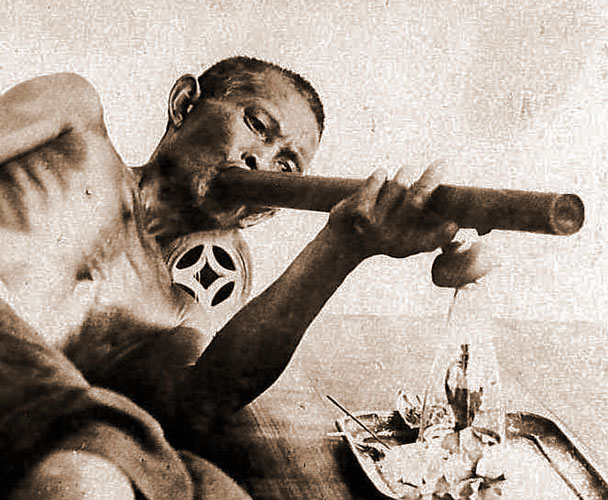
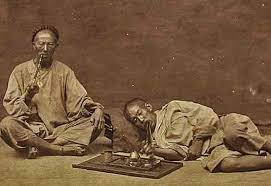
The Dutch had been peddling Indian opium across SE Asia and China where it had been valued as both a medicine and recreational narcotic since the mid 1600s.  The Dutch had invented the long opium pipe which made the smoking experience far more potent and addictive than eating opium which was how Indians preferred to consume the drug. It was the long pipe that proved so deadly to the Chinese population and that caused so much havoc over the next centuries. 

By the mid-18th century with the opium fields of Bihar and Bengal firmly within their control, the East India Company (EIC) took its first steps into the opium trade and was rewarded with instant success.  The company quickly established a monopoly on Indian opium—claiming a right that the Mughal Emperor Akbar had initially established–and watched their main city Calcutta and British power surge beyond imagination as the product was introduced as a new currency in the tea trade.

The importation of opium had been banned by the Chinese Emperor for a hundred years by the time the British entered the racket. And as the EIC had multiple interests in China it arranged for the opium to be sold to licensed third parties—many of them Parsis—who stored the narcotic in British-controlled warehouses along the SE coast near modern Guangzhou. Corrupt hongs completed the transaction by smuggling the narcotic into the countryside beyond the British zone. As one writer summed up the neat arrangement, “the British East India Company was thus able to deny responsibility for importing opium and retain its other trading rights with China.”  But still reap incredible profits from the trade.  By the early decades of the 1800s, China was home to millions of addicts—some estimate as many as 10-12 million—and the once shaky, threadbare English Exchequer was bursting with opium derived revenue. Ten percent of all British tax revenue came from the trade and as for the EIC, with 16% of its entire revenue coming from this single source, the further conquest and development of the Raj in India was secured.

But on the western coast of the subcontinent, Bombay, a lonely, underdeveloped and rather neglected British settlement struggled to justify its existence.  While Bombay enjoyed one of the great natural harbours in Asia the political realities of strong regional—mainly Maratha—Mughal successor states in western and central India meant that the EIC was unable to find a political or economic footing.  The EIC chiefs in Calcutta and London had grown weary of Bombay’s drain on Company subsidies. As Gov. General Cornwallis’ (the very same who had surrendered to George Washington a few years prior) complaint to Prime Minister William Pitt shows, were the Company was even ready to abandon Bombay as a city.

 “I have reflected most seriously and have conversed with the most sensible men in this country, on the utility of the civil establishment at Bombay and I am perfectly convinced that the Company derive no benefit from it.”

Something had to be done. If Bombay was to survive, a source of revenue had to be secured. And quick. At last, in the late 18th century, Dame Fortune smiled and caused the political winds to blow in such a way that the Company was able to exercise indirect control of large parts of the hinterlands to the north of Bombay, including the central Indian opium producing area of Malwa.  Though the Company still held a monopoly on the cultivation and production of opium in the east region of India, in Bombay, unlike in Calcutta, the Company made the decision to not take a direct role in the actual transport and sale of opium to China. This it left to local enterpreneurs, among which a number of Parsis immediately came to prominence, including the first Indian to be knighted, Sir Jamsetji Jejeebhoy. 

The Chinese Emperor, alarmed at the havoc opium continued to wreak upon his people, despite repeated bans on its import, began in the 1830s to make moves to crack down on the trade. Traders were forbidden from repatriating their profits to India.  Tensions were rising between the Emperor and western nations, that now included American trader/smugglers (including the forebears of a certain Franklin Roosevelt).

In March 1839, the governor of Canton forcibly confiscated and destroyed 1.2 million kgs of Indian opium held in the traders’ warehouses.   Jejeebhoy, Readymoney and the other Parsi and Indian traders could do nothing as they watched 500 Chinese laborers work for 23 days straight mixing their precious opium with lime and salt and tossing it into the sea. In all, not one rupee of compensation was paid. Incensed that an Asian despot would dare threaten their smuggling operation so dramatically the British navy immediately launched an attack in what has become known as the First Opium war.  The war ended in the defeat of the Chinese three years later. The British received Hong Kong as part of the settlement,  from where the smuggling operations continued for years to come.

The disruptions of the Opium Wars caused many Parsi families to diversify their interests. Given their background as producers of fine textiles many Parsi opium lords switched to cotton production thereby establishing the mills of Bombay as major world players.  In the 1860s, when Civil War in the United States temporarily interrupted the global supply of cotton, the Parsi Sethias happily filled the gap and reaped yet another windfall.  By this time the Parsis were the wealthiest and most influential group in Bombay. They used their fortunes made in China and cotton to go into banking and insurance and played a critical role in establishing Bombay as India’s financial capital. The Sethias (a professional name often used for powerful businessmen) in fact, laid many other foundations of modern Bombay: its culture of philanthropy, its museums, educational and social institutions, its wealth and its world of entertainment.

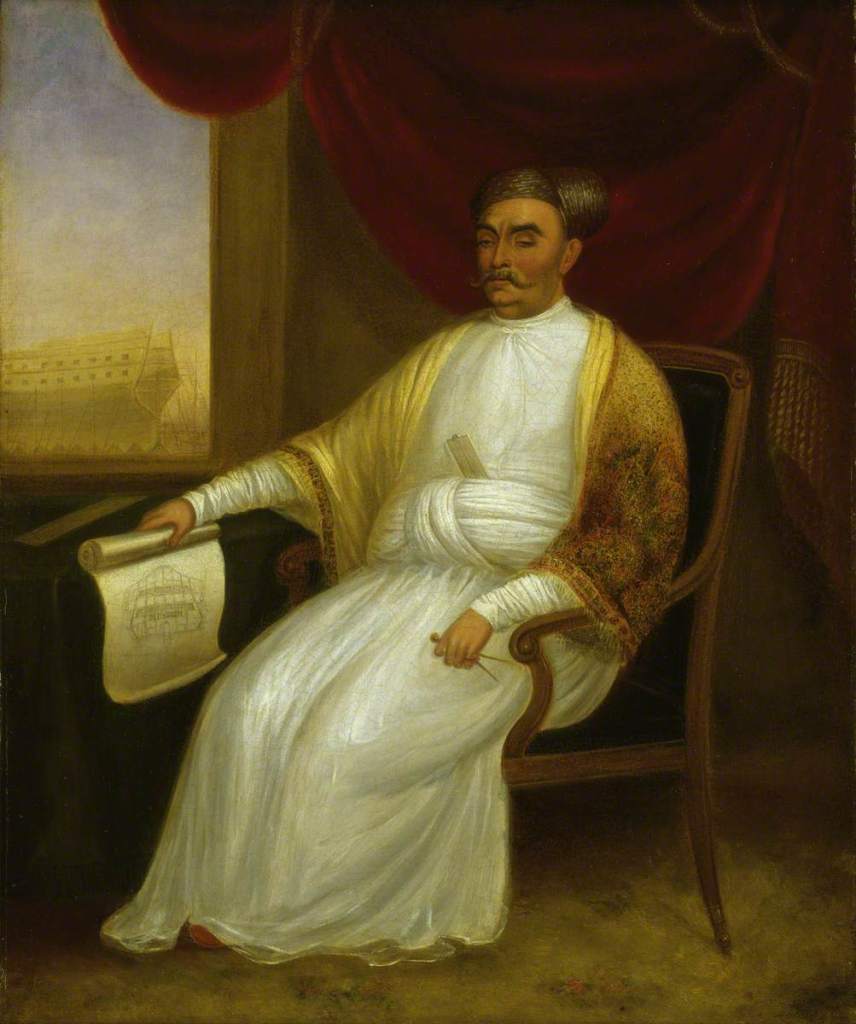
Jamsetjee Bomanjee Wadia (1756-1821) painted by J. Dorman. The Wadias were for many years one of the most influential and powerful Parsi families in Bombay and played a significant role in the development of the South Asian film industry.

A way into India

I’ve been trying to write about India all my life.  

And failing. 

 Over the weekend I began to organise my old drafts and re-drafts of things I’ve written since 1980.  It appears that I’m a frustrated memoirist. Certainly, a bit of a narcissist too.  There were several drafts of a piece I wrote about Varanasi which I think I ultimately did (unsuccessfully) submit for publication. I remember struggling with that, trying to understand what I actually wanted to say about the city. What to include, what to leave out. Most versions were a mix of the travel section of your weekend paper, heart-felt expressions of my love for the city and passages which sounded as if they had been written by an AI bot decades before the stuff was even thought of.   All in all, it is awful. 

Of course, Varanasi is the kind of place that even the most sensitive or knowledgeable of writers struggle to write about.  It is one of those subjects that exists in history, in imagination, in the spiritual realm, on the map, in art and in philosophy. It is as big a subject as any in this world. So, I take my failure to capture it as inevitable. 

There were lots of other much shorter pieces too. One, on an obscure south Indian puja. Several recollected conversations with people along the way. A bunch of false starts and dead ends on my two hometowns of Mussoorie and Allahabad.  

What tied them all together was my inability to find the right voice to express what I wanted to say about India. Sure, I was learning a craft and had little command over my thoughts, let alone the words to describe those ideas. But there were other things in the way. Inarticulate passion & emotion which derailed things almost immediately. But more than anything the subject itself—India–seemed to block my path. 

India is a country and a state of mind that people tend to love or hate. Even if you haven’t been, you’ve probably got an opinion about it.  It is the ultimate in exotic. It is the place where ‘everyone everyday is steeped in spirituality,’ and where everyone wears ‘colouful, garish, brightly hued clothing’ where the bazars are jammed with ‘teeming humanity and mountains of red, yellow and black spices that amaze the casual visitor’. Where the ‘extremes of human experience’ reveal themselves against a background of ‘fabled monuments and ancient temples built by long dead dynasties’.   

Heat and dust. 

It’s creative writing 101 crossed with National Geographic.    

India ‘overwhelms the senses’, ‘drowns one in ‘sensory overload’. India is romantic. An enigma. A land of gurus and maharajas and the world’s best cricket players.  It is pastiche and projection.  

It is cliche. 

Speaking of National Geographic, that fine publication’s contribution to this way of looking at the world is immense.  As a budding photographer my favorite subject was India (and within India it was Varanasi). For years the National Geographic approach to visualising India, epitomized by Steve McCurry, was what I emulated. I wanted to capture the best close-up portraits of Indian faces.  I wanted to capture the Himalayas, grand and snowcapped and the temples silhouetted at dusk. I did get lucky from time to time but never came within a mile of McCurry or Raghubir Singh who seemed to have such a knack for uncovering those shots. 

Raghubir Singh himself grew so fed up with this approach that he devoted an entire book to looking at his country with a new eye. It’s called A Way Into India. I highly recommend you go to the library or your bookstore and check it out.  In essence he used the iconic Indian car, the Hindustan Ambassador, as a lens to see his country with fresh eyes.  And in the process, all those noble portraits, disappeared. What he revealed were glimpses of things every other photographer dismissed as irrelevant or ugly. Details or scenes that are often hard to decipher. It gave his photography new life and has cemented his place in the pantheon of great modern photographers. 

All this is to say I’m still struggling with how to write about and visualise India. It bugs he hell out of me and frustrates me. I should be able to do this, I say to myself. Why can’t I get beyond the ‘garish saris’ and ‘wizened old sadhus’?   The closest I’ve come is by letting Indians I meet along the way, speak to me in their own words.  In this blog you’ll find several such conversations. I try not to embellish them or add my judgements to them.  Just let them speak about their Indian experience.   

But that is still not what I’m searching for.  I want to tell my story. I’m searching for a way into India that is true to both my experience and to the subject, Mother India.

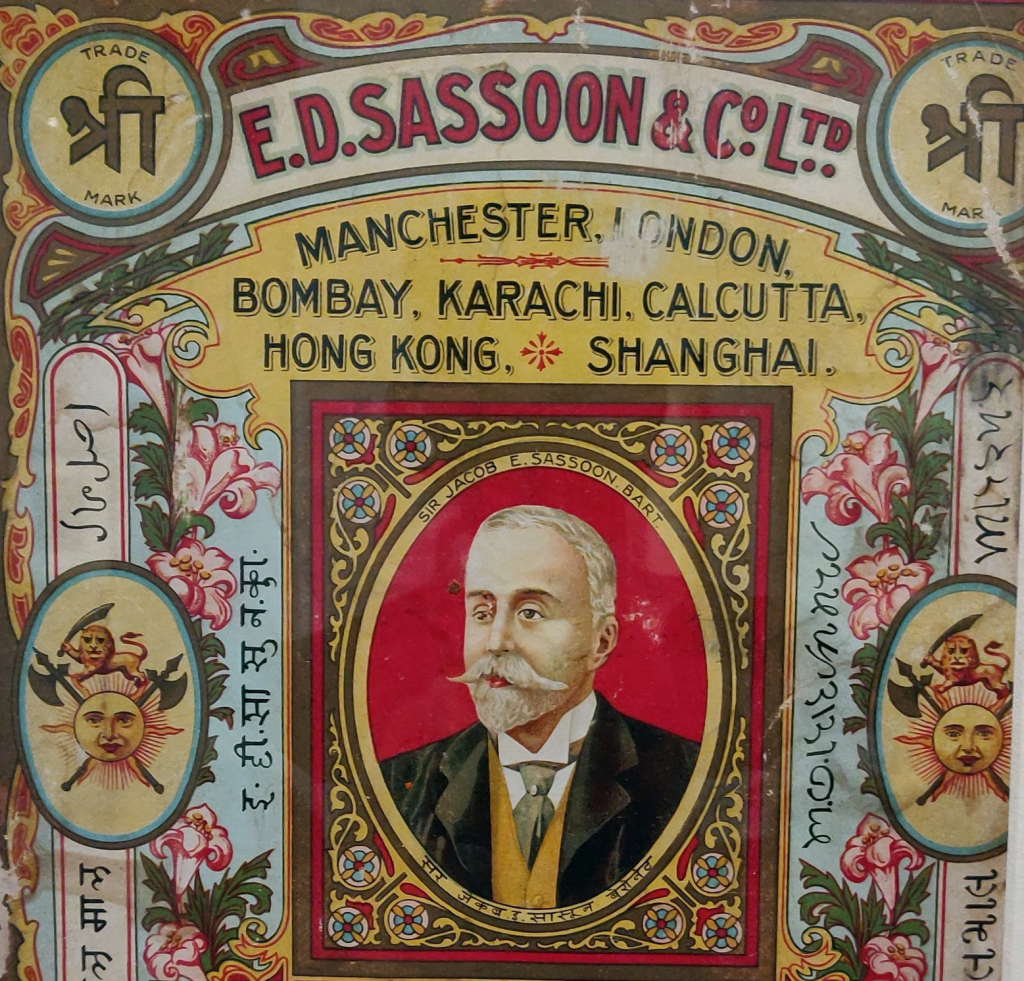
A note on the image at the top of this post. An advertisement (could have been from a calendar or a biscuit tin) for the Sassoon commercial house. The Sassoons were Baghdadi Jews who landed in India in 1830 and went on to become a leading pillar of that city’s economic and cultural heritage. The image is a cultural melange of scripts and symbols, recognisable to Indians and foreigners. The scripts mostly transcribe the family name. Sir Jacob Sassoon was the third or fourth generation to run the business. As the image depicts, he expanded operations to Karachi (now Pakistan) and Shanghai. The family, like so many of Bombay’s elite families was involved in the opium, tea, silver racket that financed the rise of the English empire. More on that in the future.