
Lollywood: stories of Pakistan’s unlikely film industry
Mughal Stories
From day to day, experts present books to the emperor who hears every book from beginning to end. Every day he marks the spot where they have reached with his pearl-strewing pen. He does not tire of hearing a book again and again, but listens with great interest. The Akhlaq-i-Nasiri by Tusi, the Kimiya-yi-sa’adat by Ghazzali, the Gulistan by Sa’di, the Masnavi-i-ma’navi by Rumi, the Shahnama by Firdausi, the khamsa of Shaikh Nizami, the kulliyats of Amir Khusrau and Maula Jami, the divans of Khaqani, Anvari and other history books are read out to him. He rewards the readers with gold and silver according to the number of pages read.
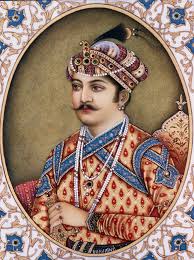
It was between the 9th and 19th centuries when north India was ruled by a series of Muslim sultans that Lahore reached its cultural apogee. And especially under the Mughals who built India into the medieval world’s grandest empire. Akbar, the greatest of all the Mughal emperors of India loved books and stories. The snippet above, from his biographer Abul Fazl, is a fascinating glimpse into the cultured atmosphere that permeated the courts of the ruling elite of northern India. The royal library, Abul Fazl proudly noted, included books written in Hindavi (early Hindustani), Greek, Persian, Arabic and Kashmiri. Akbar’s sons and grandsons and many of his senior nobles continued to add to the library, composing their own works but also drawing to the great darbar (court) of Lahore the greatest talents from all across India, Afghanistan, Central Asia, and even as far away as Iraq.
The Mughals looked to Persia for their notions of culture and gave pride of place not just to the Persian language but to the great poets and thinkers of Iran. And it was from Persia that many of the grand stories they loved so much and which they adopted and were absorbed into Indian culture first came. The elites of northern Indian during this period adopted a number of Persian poetic and literary forms in which they preserved their histories, but also stories, poems and philosophies.
Several of these forms, especially the qasida, which was a poem in praise of the monarch, remained a novelty of the darbar and did not influence broader society, but several others did. Chief among these was the qissa, an extended poem that combined elements of moral and linguistic instruction as well as entertainment. The subject matter were stories of military valour, spiritual attainment, love and romance. The Mughals, especially Akbar and his son Jahangir enjoyed the qissa Dastan-i-Amir Hamza which relates at great length and with vivid imagination the fantastic adventures of the Prophet Mohammad’s uncle Hamza. So much did Akbar appreciate this work that he commissioned a massive project to illustrate the entire epic. Completed over a period of 14 years (1562-77) the final product included 1400 full page miniature paintings and was housed in 14 volumes.
Qissas were not just stories but in the control of a good narrator, complete one-man performances/ shows. Some of the royal qissa-khawans (story tellers) are recorded as demonstrating all manner of expressions, body movements and vocal tones in their telling, sometimes even transforming themselves, in the words of one critic of Lucknow, into tasvirs (pictures). Thus, introducing for the first time into Lahore the concept of moving pictures! Akbar so loved the story that several times he is described as telling and acting out the qissa himself in front of courtiers and guests. When Delhi was sacked by the Afghan Nadir Shah in 1739 the reigning emperor Muhammad Shah pleaded that after the peacock throne what he most desired to be returned to him was Akbar’s Hamzanama which had illustrations ‘beyond imagination’.

The critics of the day stressed both telling and listening to stories were beneficial to the soul with some claiming that in the cosmic order of beings, poets and storytellers were ranked second, right behind Prophets and before Emperors! Though this is undoubtedly a minority view, the best qissa-khawans were indeed highly esteemed.
In 1617, Emperor Jahangir, son of Akbar the Great, recorded the following event:
Mulla Asad the storyteller, one of the servants of Mirza Ghazi, came in those same days from Thatta and waited on me. Since he was skilled in transmitted accounts and sweet tales, and was good in his expression, I was struck with his company, and made him happy with the title of Mahzuz Khan. I gave him 1000 rupees, a robe of honor, a horse, an elephant in chains, and a palanquin. After a few days I gave the order for him to be weighed against rupees, and his weight came up to 4,400 rupees. He was honored with a mansab of 200 persons, and 20 horse. I ordered that he should always be present at the gatherings for a chat [gap].
It was under the reign, and patronage of Jahangir that Lahore became the favoured city of the Mughals. The emperor is remembered for ruling over a stable and prosperous Empire and for patronizing painting, poetry and architecture. A man of artistic inclinations it was during this time that story forms like masnavi which told of current events and wonderful victories and ghazal a short romantic-mystical form of poetry superseded other forms of literature. The ghazal in particular was championed by Jahangir and his son and successor, Shahjahan.
The ghazal both facilitated a large appreciation of poetry outside the circles of the aristocracy, among people of all walks of life, and began to be composed and recited in all sorts of settings including by women, in private homes, in public houses and in competitions. The masnavi quickly declined because compared to the ghazal it was a bit lengthy and rather tedious. The ghazal on the other hand, was snappy, called for clever word play and rarely ran more than a few verses. Mushaira, poetry recitations that centred around the ghazal, became one of the most popular forms of entertainment in Lahore during this period.
Many tales are told of courtly mushaira presided over by the Emperor who believed that when expertly delivered, a ghazal was full of magical power.
One night a singer by the name of Sayyid Shah was performing for the Emperor and impersonated an ecstatic state (sama). Jahangir questioned the meaning of one line from the ghazal
Every community has its right way, creed and prayer
I turn to pray towards him with his cap awry
From the audience the royal seal engraver, one Mulla Ali gave an explanation of the line which was written by Amir Khusrau and which his father had taught him. As soon as he finished telling the story, Mulla Ali collapsed and despite the best efforts of the royal physicians to revive him, passed away.
Of course, this literary world of elaborate illustrated tomes, royal qisse and the like was not uniquely Punjabi. Rather it was the literary province of the elite and as such, familiar to most urban literate North Indians. But the mass of people was not literate and had no access to the libraries, the texts, treatises and poets of the nobility. And yet beyond the forts and palaces and even beyond the urban areas of Mughal India there pulsated a great tradition of storytelling that influenced the emergence of films in the early 20th century.
To name all of the genres of Punjabi storytelling would be nearly impossible. In addition to qissa and ghazal there were afsane (stories), dastan (heroic tales), latifa (jokes), katha (Puranic stories), naat (poetry in praise of the Prophet), kafi (sufi poems), boliyan (musical couplets sung by women), dhadhi, kirtan, bhajan, swang, sangit, nautanki , marsiya, mo’jizat kahanis (miracle stories of Shi’a Muslims), mahavara (proverbs) and so on.
These forms of storytelling were a part of everyday life for the people of Lahore and the Punjab. Though they may never have seen the beautiful courtly books produced by the Emperors, the characters, plotlines and themes were deeply embedded in the consciousness and culture of common folk.
One story in particular, Heer Ranjha, based on the Arabic classic Laila Majnun, was especially beloved by Punjabis. Compiled originally in the time of Akbar by a storyteller named Damodar Gulati, Heer Ranjha tells the story of a beautiful girl, Heer, who is wooed by a flute-playing handsome young man Ranjha. Rejected by Heer’s family because he belongs to a rival Punjabi clan, Ranjha turns toward a spiritual path. He spends time in Tilla Jogian, the premier centre of Hindu ascetism in the medieval period, and becomes a powerful kanpatha (pierced ear) jogi. His identity is uncovered by Heer’s friends who convince her to run away with him which ends badly with the death of both lovers.
The tale is the greatest of the many similar legends known as tragic love stories, the speciality of Punjab. Sohni Mahiwal, Sassi Pannu and Dhola Bhatti are taken from the same tradition and have been told, acted and sung to rapt audiences for centuries. Stories such as these and others, like Anarkali, whether recorded in royal tomes or told under a tree by a wondering minstrel formed the foundational inspiration for Lahore’s movie makers. By 1932, just four years after the Lahore produced its first film, Heer Ranjha had already been made into a movie four times!
Performing Arts
Though the earliest Punjabi stories were written down during the Indus Valley civilization, once Harappa and the other cities were abandoned, India would not use writing again until the rule of the emperor Asoka, more than 1500 years later.
The Vedas were memorised and passed on word for word from generation to generation through a caste of priests, the Brahmins. And though many of the later Buddhist tales and eventually, even the Mahabharata and Ramayana were put into written form, writing, reading and access to these skills were confined to the very thinnest layer of elite society. The stories of Punjab survived because they were remembered, retold, performed on stages, recited in poems, acted out in the streets and reimagined with each generation. This oral and physical transmission, this retelling and telling again, kept the stories fresh and alive, changing, not only depending on who was doing the dancing or singing but whether the context was spiritual, secular, public or private.

As with its oral and written literature, Punjab is likewise blessed with a huge variety of musical styles and musician groups. Broadly referred to by the public as mirasi, the society of hereditary Punjabi musicians is complex, and highly differentiated. Though musicians, singers and dancers were uniformly relegated to the outer limits of the caste and class system they played an important, even essential role in Punjabi society. They were the repositories of significant parts of family, folk, clan culture and history. When the movies arrived, the mirasi provided many of the musicians, dancers, singers and composers of what more than any other single trait exemplifies Pakistani/Indian popular movies, the song.
Certain groups of singers have had a direct and enduring connection with the film industry. The dhadhis, wandering minstrels and balladeers who trace their lineage back to the times of Akbar the Great, were particularly active in Punjab. Accompanying themselves on an hourglass-shaped hand drum (dhadh) and a variety of bowed instruments, dhadis specialised in singing heroic tales (var) of local chieftains, especially Sikh rajas ,as well as the tragic love tales such as Heer Ranjha and Sohni Mahiwal. Qawwals, who are sometimes considered part of the dhadhi tradition, were associated with the Sufi shrines and sing an intense trance (sama) inducing music that is so identified with South Asian Islamic practice. Qawwali was a form that was quickly picked up by film makers who inserted it into scenes as light relief or as a sonic representation of an Islamic character or theme.
Also associated with spiritual singing were a class of Muslim singers known as rubabis (after the Afghan stringed lute, rubab). The Sikh gurus employed rubabis to sing kirtans and shabad, essentially the sayings of the various Sikh gurus sung in their temples (gurdwara) as part of Sikh worship. These musicians had respected musical pedigrees and were expert on the rubab, harmonium, drums and other instruments. Being largely a Muslim group, most moved to Pakistan after 1947 and several played critical, pioneering roles as musical directors in the film world that grew up in Lahore.
The brass wedding bands that became an urban phenomenon in north India in the 19th century drew their members from yet another group of hereditary musicians known variously as Mazhabi (if they were Sikh), Musalli (if they were Muslim) and Valmiki (if they were Hindu). These musicians provided services including acting as town criers and news readers. They would make community announcements while beating their drums and playing their horns and clarinets. During festivals and celebrations they entertained people from their vast repertoire of religious and secular songs. As the forms of entertainment changed in the 20th century and especially when sound and music were incorporated into movies in the 1930s, these skilled players formed the backbone of the studio orchestras that produced the amazing soundtracks of the films.
In addition to singers and musicians a universe of street performers, actors and magicians made up part of the Punjabi landscape as well. There were bazigaars (acrobats and contortionists who also sang and acted), bhands (comics) who interrupted weddings and other events to make fun of prominent members of the family and their guests with quick jokes and bawdy repartee for small sums, madaars (jugglers and magicians) who with their magical powders and wands would make birds, eggs and even people disappear and reappear at will.
These groups performed publicly on the streets, in city squares or open fields and bazaars. At any fair (mela) or ‘urs’ (sufi celebration at a shrine) all of these and more would be part of the entertainment. Indian diplomat, Pran Neville, writes in his memoir of Lahore, “we had but to walk into the streets to be entertained by one or the other professional jugglers, madaris (magicians), baazigars (acrobats), bhands (jesters), animal and bird tamers, snake charmers, singers, not to mention the Chinese performers of gymnastic feats who would be out on their daily rounds.”[1] Like the mirasi, many of these castes of public entertainers found that the new film studios popping up in Lahore could be an unexpected source of livelihood.

If Parsi Theatre inspired the early film makers of Bombay, in Punjab other forms of theatre were just as important: swang, naqqali and nautanki. Each of these theatrical codes were common across the Punjabi countryside where performing troupes travelled and performed a rich variety of dramas.
The most important of the traditional theatres in Punjab was a form of nautanki known locally as swang. In essence swang which takes its name from the Sanskrit word for music (sangit) is informal folk opera. The production incorporates liberal portions of singing and dance and often all the parts are sung rather than spoken.
A performance would generally take place in an open part of a village where a local dignitary had invited the troupe to play. After a day of preparation during which the excitement built as stages were erected and children ran amok amidst the activity. The performers prepared by singing for hours with the heads facing downwards into the village’s wells, a practice that allowed them to improve their range and enhance their projection. The actual performance would finally begin late in the evening and continue till the early hours of the morning. If the plot was a long one this would continue over a number of evenings.
Audience participation–hissing, shouting, calling out requests for songs or jokes to be repeated–was expected and happily accommodated. The performers were masterful singers who had to project their voices over the audience noise and often compete against a rival troupe performing in another part of the village. It was said that some of the best singers could be heard more than a mile away. One only needs to listen to the resounding voice of Noor Jehan, Pakistan’s Queen of Melody, and one of the greatest film singers of the subcontinent, to get a sense of the amazing power of these traditional singers.
Long before Nargis played Radha in Mother India (1957) or Prithviraj Kapoor played Akbar in Mughal-e-Azam (1960) these open-air travelling opera companies were laying the essential template of and sketching out the iconic roles for South Asian popular cinema.
The City as a Story
Lahore, the cultural capital of the greater Punjab region was itself was a city of a million tales. In many ways Lahore, a city so fabled for so long, was the most famous of Punjab’s myriad stories.

The origins of Lahore stretch back to one of the two foundational epics of Hinduism, the Ramayana. In a storyline familiar to all movie lovers in South Asia, we are told that Sita, Rama’s wife and a goddess in her own right, becomes pregnant making her jealous husband, Rama, question her fidelity. Falsely accusing her of adultery, Rama turns Sita out of the house. Deep in a forest Sita gives birth to twin boys, Lav and Kush, whom she raises with great love and devotion. In a dramatic twist of Fate, years later, the boys are reunited with their father whom they have never met. They take him into the forest to meet their mother. Ram is stunned and realises his mistake but despite Rama’s protestations and desperate apologies, Sita is swallowed up by the earth and returned to the Heavens. Rama goes on to rule his kingdom with his two sons by his side in a Golden Era of peace and stability. When the time comes, he sets Lav and Kush up in the far West of his country where they establish themselves in two cities. Kush in Kasur, 52 km southeast of Lahore on the Indian border, and Lav in Lavapuri, modern Lahore, where even today, inside the fort of Lahore, there is still a small temple dedicated to this son of Lord Rama.
Despite its hoary Hindu roots, and being described as early as 300 BCE by the Greek historian Megasthenes as a place ‘of great culture and charm’, Lahore’s greatest glory was experienced when it was the capital of various Muslim sultanates and states. Throughout the medieval period when northern India was ruled by a succession of ethnic Turkish rulers who promoted a heavily Persianised culture, Lahore was a city of prime strategic, commercial and cultural significance. And despite its oppressive summer heat a reputation of luxury, elegance and sophistication attached to the city. Its guilds and craftsmen were heralded throughout the region and beyond; its poets, some of the most beloved, even in Persia. Like a handful of other cities around the world—modern Paris and New York for example—Lahore has developed a special atmosphere which has caused both natives and visitors to fall in love with it. Way back in the 12th century, Masud ibn Said al Salman one of the city’s most popular poets found himself imprisoned far from his home city for pissing off one of the city’s rulers. Pining away in his cell he wrote a lamentation.
Lahore my love… How are you?
Without your radiant sun, oh How are you?
Your darling child was torn away from you
With sighs, laments and cries, woe! How are you?
Each of the four great Mughals (Akbar, Jahangir, Shahjahan and Aurangzeb) did their bit to build, extend and refurbish the city. Along with Agra and Delhi and for a while Fatehpur Sikri, Lahore served for years at a time as the Imperial capital and was heavily fortified as a military hub. As it enjoyed the presence of the Emperor himself, artists, administrators, philosophers and emissaries hailing from all across the world came to Lahore to live, seek patronage and practice their speciality.
Poets such as ‘Urfi’ of Iran made Lahore their home finding the relatively tolerant and inclusive atmosphere a delicious change from the claustrophobic Shi’a Islam of his home country. He and other poets employed by the durbar [court] produced sublime poems which were sometimes reproduced on paper reputed to be as delicate and as thin as butterfly wings. Artisans brought their skills and looms to the royal city which by the 16th century had an international reputation for producing exquisite silken carpets which, in the words of one historian, made “the carpets made at Kirman in the manufactory of the kings of Iran, look like coarse” rugs.
The painters who made Lahore their home—both immigrants from Iran and the hills of Punjab and Kashmir, as well as natives—brought glory and awe to the city and its rulers. Ibrahim Lahori and Kalu Lahori, two painters in the court of Akbar illustrated a book called Darabnama (The Story of Darab) which set out the exploits of the young Akbar, sometimes in fantastic detail, just after he had decided to leave his new purpose-built capital, Fatehpur Sikri, to take up residence in Lahore. Their miniatures brought to life the Persian text which told wild tales of dragons swallowing both horses and their riders in one awesome gulp, as well as radical illustrations of naked humans which according to art historians were never before so accurately depicted by Indian artists. The Darabnama which is recorded as being one of the emperor’s favourite story books also depicts scenes from courtly life such as Akbar being praised and honoured by rulers from other parts of the world and India. Ibrahim Lahori along with miniaturists like Madhu Khurd are credited with bringing a fresh and naturalistic realism to portraiture. It was in Lahore-produced books like the Darabnama that for the first time individuals with all their physical quirks—bulging pot bellies, monobrows, turban styles—could be identified as real historical individuals.

The city’s countless mosques and Sufi dargah (tombs) honouring Lahore’s many saints and pirs are not just revered places of devotion but subjects of and characters in stories filled with miracles and magic that are still told today. The city’s storied inner walled city dominated by the domes of the Jam’a masjid but filled with hundreds of other havelis (mansions), shrines, tombs, pleasure palaces and gardens are themselves characters in the various storylines. How many poems, songs, operas and movies, including made in Hollywood, include the name Shalimar—those famous Mughal-era gardens of Lahore?

Probably the most famous of Lahore’s many stories and one that has been retold in film in both Pakistan and India many times, is that of Anarkali. Like all tales that have been passed down through generations this one has several different tellings but the most famous and popular one is the tragic one.
One day a Persian trader came to Lahore for business and brought with him members of his family. In his caravan was his beautiful pink complexioned daughter Nadira also known as Sharf un-Nissa. Her beauty stunned the bazaars of Lahore and word quickly reached the Emperor himself that there was a woman as splendidly gorgeous as a pomegranate seed in his city. He summoned the merchant to his court and upon seeing the young woman fell immediately in love with her graceful charm. The young woman’s father was only too pleased to accede to the great Mughal’s request for Nadira to be allowed to join the royal harem.
Much to the chagrin of his wives and other concubines Akbar seemed completely fixated upon the beautiful Iranian girl who was rechristened Anarkali (pomegranate seed) by the King himself. The only time she was not by his side was when he was away from Lahore, conquering yet more lands and expanding the glory of his family and empire. And so it happened when Akbar was leading his armies in a campaign in central India, Anarkali and the crown prince, Salim, later to rule as Jahangir, developed an intimate relationship. The gossip hit the bazaars and everyone spoke of how much the two loved each other. Salim it was said was ready even to renounce his right to the throne of India for a life with Anarkali.
When Akbar returned to Lahore he called for Anarkali but immediately sensed something different in the way she approached him. ‘What is the matter,’ he cooed but she resisted his embrace and made an excuse to retire to her chambers as swiftly as possible. Akbar was upset and soon livid when his spies and courtiers informed him of the fool Anarkali had made of him during his absence. ‘The bazaar is echoing with jokes that say Your Highness is too old to water such a lovely tree as Anakali’.
The next day Anarkali was summoned to the Emperor’s chambers. ‘Is what I am told true? That you love Salim more than me?’
Anarkali tried to demur but the wizened old ruler knew a lie when it was uttered no matter how lovely the lips that spoke it.
He sent his favourite concubine back to the harem and then called his chief wazir and instructed him to arrest Anarkali before the night was through. ‘You should bury the witch alive and leave no marking of her cursed tomb’.
In the years that followed Lahore was abuzz with rumours and theories of what happened to Anarkali. Salim was depressed as she was nowhere to be seen. Had she been banished back to Iran?
Eventually the old Mughal died and Salim ascended the jewel encrusted throne of Lahore. One of his first acts was to build a simple tomb on the spot where Anarkali had been so heartlessly murdered. Inscribed upon the tomb is a couplet from the love-lorn Jahangir himself, If I could behold my beloved only once, I would remain thankful to Allah till doomsday
[1] Pran Neville. Lahore: A Sentimental Journey. (New Delhi: HarperCollins, 1997), 60.
Lollywood: stories of Pakistan’s unlikely film industry
Of the many Parsi clans who leveraged their interaction with the British in Bombay to establish themselves as economic powerhouses, even to this day, the shipbuilding Wadia family is worth a closer look.
Even before the community fled Persia to seek refuge along India’s western coast, the Zoroastrians were renowned ship builders and sailors. During the reign of King Darius (522-486 BCE) the Persians had learned well from the Phoenicians (1200-800 BCE) and become the acknowledged shipbuilding and maritime empire of the epoch. Though their numbers were tiny in their new home in India, (never more than 100,000) the community kept these ancient skills alive.
Settled and working out of Surat, the Wadia (Gujarati for ‘ship builder’) clan, interacted with the various European trading nations—Portugal, Netherlands, France—that sought trade with the Mughal empire and its wealthy business communities of Gujarat. When the rather slow-starting English received the islands of Bombay from the Portuguese, Parsis began to migrate from the hinterland south. One of Surat’s most prominent shipbuilders, a Parsi named Lovji Nusserwanji Wadia who had built ships for a number of European trading firms in Surat, was invited by the English to establish a branch of the family business in Bombay. And so, beginning in 1736, Lovji along with his brother Sorabji set to work building Asia’s first dry docking facility where EIC ships could be drawn entirely out of the water to be repaired and refurbished. This single bit of infrastructure increased the economic and strategic value of Bombay immensely. It brought to the foreground Bombay’s exceptional qualities as one of the best deep water harbours (the city’s name derives from the Portuguese words Bom (good) and Bahia (harbour)) from which the British, with their new infrastructure and world-class Parsi shipbuilders, were able to not only vanquish the Portuguese, Dutch and regional Indian naval powers but also clear the Arabian Sea of pirates which led to a steady increase in traffic and trade. By the mid-19th century Bombay had become a major international commercial and naval port and the most important city in British India.
By 1759 the dry dock was operational. At the same time the brothers Wadia were providing many of the ships that carried cotton and spices and eventually that fateful black gold, opium, from India to China and other Asian ports. Given the EIC’s monopoly on the Indian trade and the massive growth in the economy opium facilitated, particularly in the first part of the 19th century, the Wadia’s became immensely wealthy. Theirs was a full-service enterprise, building single-sailed sloops, water boats that managed trade up and down the west coast, beautifully sleek, fast-moving clippers, well armed frigates and man-o-wars for the military as well as cutters, schooners, and eventually steamships for the Asian/Chinese trade. Using teak, rather than English oak for the hulls, the Wadia’s ships were lighter and more resilient than ships made in Britain. Over the years, the family built over 400 ships for the EIC’s Maritime Service and others including their fellow Parsi sethias.
Lovji’s grandson, Nusserwanji Maneckji continued the family business and in addition to servicing the British became a much sought after local agent for early American traders building up the trade between India and New England. Maneckji Wadia was so well regarded by the Americans that he and his relatives enjoyed a virtual monopoly on the Yankee business with many American traders exchanging effusive letters with him in which his ’impeccable character’ is praised and his family compared to ‘satraps’. Both sides profited handsomely. In the words of one Yankee businessman, they profited ‘monstrously’, recovering up to 300% on the Indian textiles and other goods sourced by the Wadias.

One of Nusserwanji’s sons, Jamshetji Bombanji, was appointed Bombay’s Master Builder[1], a role usually held by an Englishman, but which the Wadia family was to hold for 150 years running. Several of Bomanji’s ships found their way into the larger events of the time, including the first man-o-war built in India—a huge warship with three masts and loaded with 74 large cannons—the HMS Minden. When it set sail in 1810 a Bombay newspaper, the Chronicle, praised “the skill of its architects” and went on to note that with “the superiority of its timber, and for the excellence of its docks, Bombay may now claim a distinguished place among naval arsenals”. Several years later, on the night of 13 September 1814, the HMS Minden was tied to a British ship in Chesapeake Bay, along the east coast of the United States, after a local lawyer, Francis Scott Key, had helped to secure the release of an American prisoner-of-war held by the British. Fighting between the Americans and British was intense with the night sky flashing red and yellow. The frightening spectacle inspired Key to write a poem, The Star Spangled Banner, which was eventually adopted as America’s national anthem.
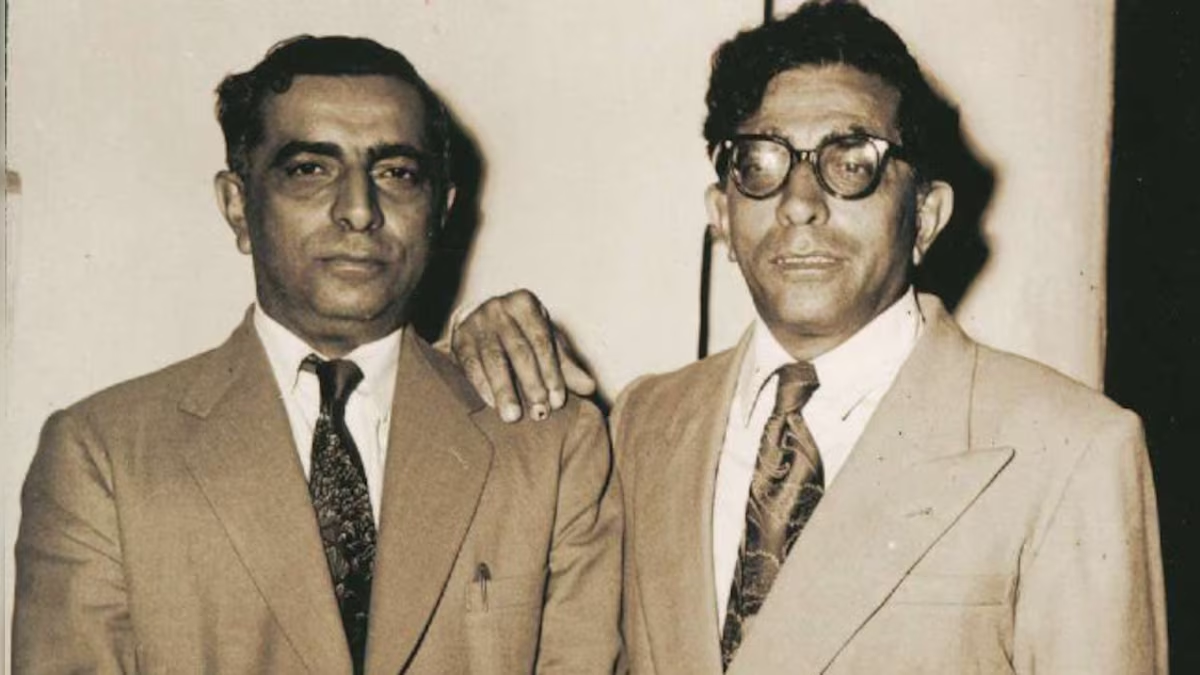
Steel eventually replaced teak in the building of ships and steam took over from wind. The Wadias, like many Parsis diversified initially into textile production where steam-derived technologies helped to propel the Wadia’s Bombay Dyeing mill into one of the most successful and iconic of India’s modern businesses. And when the movies came to India, two great-great grandsons of Lovji Nusserwanji took the daring decision to turn their back on textiles and ships altogether and embrace the world of moving pictures.
Jamshed Boman Homi Wadia, known as JBH, was only 12 when Dadasaheb Phalke exhibited Raja Harishchandra, but spent his youth captivated by the Hollywood films that were becoming an increasingly common form of entertainment in Bombay. Though well-educated as a lawyer JBH horrified his family with his announcement that he intended to make films for a living. He quickly found work with the then prominent Kohinoor Studios producing a dozen films for the studio, some of which saw moderate success. But being an entrepreneur JBH didn’t want to work for anyone else, so, joined by his younger brother Homi, launched his own studio, Wadia Movietone in 1933, retaining the family’s shipbuilding past as part of the studio’s logo.
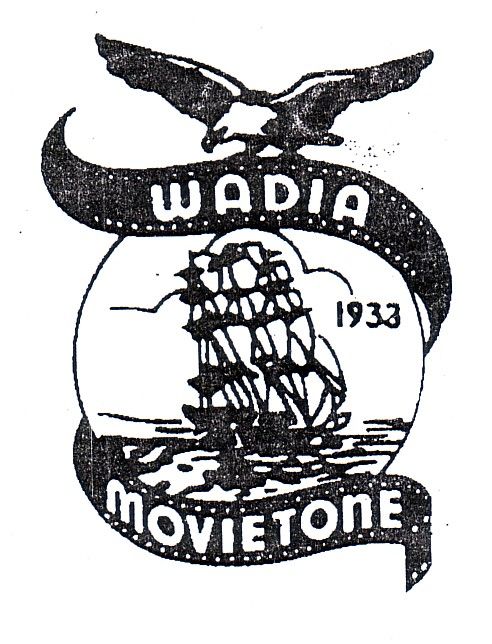
The brothers became icons of the early Indian film history and throughout the 30s and 40s Wadia Movietone was the most profitable of all Indian filmmaking enterprises.
Wadia Movietone studios was financially backed by several other Bombay Parsi families-including the famous Tatas-and grew into one of the most successful and consistently profitable studios of the 1930s. The brothers were basically in love with stunts and action. They especially adored derring-do characters like Zorro and Robin Hood played by Douglas Fairbanks Jr, and blatantly copied many of Fairbanks’ movies for Wadia Movietone. When Fairbanks visited Bombay, JBH made sure the actor visited his own studio; so impressed was his American idol that Fairbanks agreed to sell the Indian rights of his mega hit Mark of Zorro to Wadia Movietone.
The brothers proudly low-brow fare of fistfights, speeding trains and masked heroines dominated India’s box offices throughout the 30s and became the most popular genre in India at the time. Sadly, as film historian Rosie Thomas states, Indian “film history was rewritten”, by starchy Hindu nationalists who objected that stunt films did not inspire sufficient pride in India’s Hindu classical past. The whole stunt movie genre was effectively eliminated from most histories of Indian film giving virtually all attention on the more staid and far less fun, middle-class targeted ‘social’ melodramas focusing on family and relationships.
At their height, however, the Wadia brothers’ studio was the rage of the box office. Their greatest success was without a doubt a series of action films which in today’s parlance might be called a franchise, starring a stunning white woman they billed as Fearless Nadia.
Mary Evans, a West Australian girl of Scottish-Greek extraction, moved in 1911, at the age of three, to India where her father served with the British army. Settled and schooled for several of her early years in Bombay, Evans father was killed in 1915 while fighting in France and eventually moved to Peshawar to live with an ‘uncle’ who in fact was a friend of her deceased father. It was the wilds of the NW frontier of India that stimulated Mary’s tomboy personality to blossom. She discovered a love for the outdoors, sports and horse riding and with a mother who had once been a belly dancer, found herself singing (often bawdy songs) and dancing on stages across the NW and Punjab. Between 1927 and 1934, Mary performed as a dancer and singer in various troupes and circuses as well as a solo performer, travelling across the Indian subcontinent performing for wealthy maharajas as well as illiterate labourers. It was a risky job for a slightly big boned, well-built blonde-haired woman, travelling (often) alone across India, speaking only English and Greek, working at night in (often) seedy venues but it was one that seemed to suit her. When an Armenian fortune teller predicted a bright career for Mary, they used tarot cards to select a stage name, eventually settling on Nadia.

Sometime in the early 1930s, a Mr. Langa, the owner of Lahore’s Regent Cinema, saw one of Mary’s stage shows. Given that cinemas in those days regularly booked dance troupes to complement the movie, it is possible Langa hosted Mary at the Regent itself. Whatever the circumstances, Langa was taken by her presence and striking looks. He offered to introduce Evans to a friend of his, someone named JBH Wadia, who ran a movie studio in Bombay. Was she interested? With sparkling blue eyes and blonde hair, Nadia hardly fit the bill as the ideal Indian woman but she was not alone. Throughout the silent era and even into the age of Talkies, many of India’s initial generation of female starlets were in fact Anglo-Indian (mixed European and Indian heritage), European and Jewish women. At a time when acting was considered a dishonourable career by most Indians, non-Indian women felt less inhibited socially to take to the stage. Most adopted Indian stage names and worked hard to improve their unmistakably foreign accents. Still, the basic assumption was that actress was a synonym for prostitute. German film historian, Dorothee Wenner, whose biography of Evans, Fearless Nadia, sums up the situation as follows:
The connections between theatre, dance, music and prostitution remained so closely entwined well into the twentieth century that any official attempt to limit prostitution simultaneously represented a threat to the dramatic arts. The consequences for cinema were first felt by the father of Indian cinema, D.G. Phalke. He knew that filming made different demands on the realism of scenes than the stage did and therefore he wanted a woman to play the female lead in his first film Raja Harischandra. It was 1912 when he went looking around the red-light district of Bombay for a suitable performer. Although the impoverished director offered the few interested parties more money than they would normally earn, all the prostitutes turned the film work down…it was below their dignity!”[2]
When they met, Wadia immediately understood Evans’ appeal and potential. He suggested that the Australian change her name to Nanda Devi and wear a plaited dark wig. But Mary refused. “Look here Mr Wadia,” she said, undeterred of her future employer’s power or status, “I’m a white woman and I’ll look foolish with long black hair.” As for the name change, she scoffed. “That’s not in my contract and I’m no Devi! (goddess)” She pointed out that her chosen stage name, Nadia, resonated with both Indian and European audiences, and also just happened to rhyme with his own name, Wadia. JBH, not used to be spoken to so boldly by an employee, let alone a woman, figured she just might have what it takes to make it in the movies. He hired her on the spot.
An agreement was reached and in 1935 the brothers tested her in a couple of small roles in two films. Her charisma, not to mention her stunning and exotic looks, were obvious. She stood out like a ghost at midnight. Immediately, she was offered the lead in a Zorro-like picture called Hunterwali (Lady Hunter) which became a smash hit and is now considered one of the most significant milestones in South Asian film. The Wadia brothers had been unable to find a distributor for their extravagant production. Most considered it too radical and unsuitable for local tastes. A white masked woman, cracking a whip, smashing up villainous men, riding a horse and sporting hot pants that revealed her very white fleshy thighs? Absolutely not!
Unbowed, the brothers pooled their resources and sponsored the film’s premier at the Super Cinema on Grant Road, on a wet June evening in 1935. This was make or break. The Wadias believed in Nadia even though everyone else did not. Not without a little trepidation rippling through the cinema the lights dimmed and the show began. Fifteen minutes in, as Nadia pronounced that ‘From now on, I will be known as Hunterwali!’, the working class male audience stood up, cheered and clapped and in their own way pronounced the coronation of the Queen of the Box Office, a title she would hold for more than a decade.
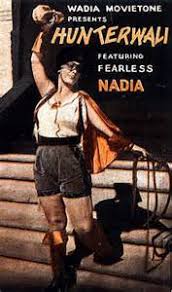
The Wadia’s, as indeed most of their countrymen and women, were politically active (supporting Independence from Britain) and socially progressive. They championed women’s rights, Hindu-Muslim solidarity and anti-casteism. Though official censorship prohibited open discussion of these themes the Wadias made sure their superstar made casual references to them. As Nadia herself said, “In all the pictures there was a propaganda message, something to fight for.”[3]
The girl from Perth via Peshawar and Lahore, was now a superstar of action and stunt film with millions of fans. Known and billed as Fearless Nadia she insisted on doing all her own stunts be it fistfights on the top of a fast-moving train, throwing men from roofs or being cuddled by lions. She starred in nearly 40 pictures most made by the Wadia brothers (she married Homi in 1961) with such fantastical titles as Lady Robinhood, Miss Punjab Mail, Tigress, Jungle Princess and Stunt Queen.
In 1988 a version of Hunterwali, perhaps the most famous of all of Nadia’s films was released in Pakistan, starring Punjabi movie icons, Sultan Rahi and Anjuman.
[1] A highly critical and strategic role that oversaw ship design and construction but innovation, compliance with international shipping regulations and development of the shipbuilding industry.
[2] Wenner, Dorothee. 2005. Fearless Nadia: The True Story of Bollywood’s Original Stunt Queen. Penguin. Pg. 79.
[3] Thomas, Rosie, “Not Quite (Pearl) White: Fearless Nadia, Queen of the Stunts”, in Bollyword: Popular Indian Cinema through a Transnational Lens, ed. Raminder Kaur & Ajay J Sinha (New Delhi: Sage Publications India Pvt Ltd, 2005) 35-69.
Lollywood: stories of the Pakistani film industry
From Punch houses to Parsi Theatre
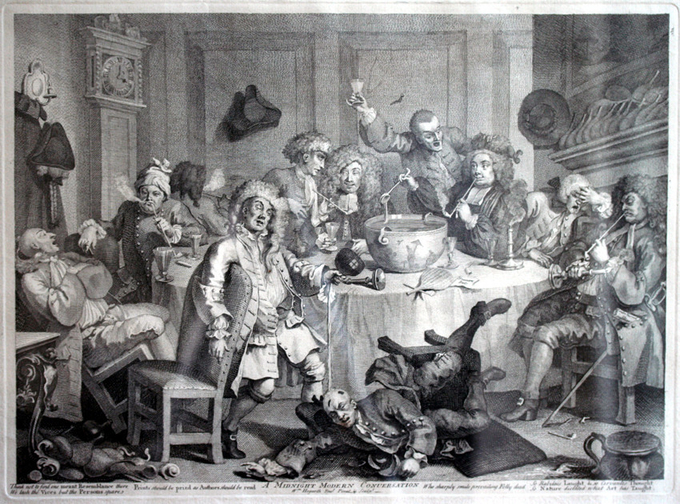
Though the early years of the East India Company are remembered in history as a time when hundreds of British men came to India and rapidly became very wealthy, life in a small up-country district was tough. Though the British public, to the extent they had time to care, resented the new ‘nabobs’ who returned home to England full of ill-gotten wealth and social swagger, relatively few servants of the company actually made fortunes. Many stayed on in India after their tours setting themselves up as indigo planters or scrounging for work in the big cities. For those not part of the elite ‘Covenanted Officer’ class which included most non-Indians, the Englishman’s daily round involved three essential things: work, avoiding illness and drink, with the last usually combined with the first two. Alcohol consumption was both a way to stay alive–especially since local water supplies were contaminated—and a way to pass the time. The highest rungs of British society had access to a variety of European wines, porters and spirits. The sailors, soldiers and planters, on the other hand, could mostly only afford locally brewed (and occasionally, deadly) concoctions that mixed ingredients like coconut spirits, chillis and opium.
Though the origin of its name is contended (does it refer to the 500 litre wooden barrel that held it, known as a ‘puncheon’ or to the Hindustani word, panch, for the number 5, the number of ingredients) punch was an alcoholic innovation invented in India by early European residents who wanted a lighter, sweeter drink than the local spirits or fiery rum. Experimentation found that by mixing rum or arrack, sugar, lemon/citrus juice, rosewater and spices in water a very tasty and potent beverage emerged. As early as the 1630s, Englishmen were writing home about this new drink they called ‘punch’. When the Company’s ships returned from India loaded with exotic luxuries, the ships’ crew and locals enjoyed evenings together drinking Punch on the docks. Though the many of the individual ingredients (lemons, nutmeg) were expensive in Britain, punch became ‘the tipple of choice for English aristocrats’ for the next hundred years and since then has become a regular offering at parties, weddings and even church potlucks across the English-speaking world.
In India, however, the grimy taverns where such alcoholic drinks were sold became known as punch houses. Not dissimilar to the famous jook joints in the southern United States, famous for their cheap booze and violence, punch houses were perfect venues for drinking binges, rowdy roughhousing, fisticuffs and whoring by bored sailors, down on their luck Europeans and soldiers. Indeed, one Englishman summarised the entertainment available for the British lower classes in India as amounting to “drinking hells, gambling hells or other hells.” For the upper-class elite, punch houses were a definite ‘no go’.
By the early decades of the 19th century this public drunkenness and violence was so pervasive in the three colonial cities as well as smaller outposts across the country that the authorities grew increasingly alarmed at the damage such behaviour was doing to the image of European and Christian superiority. Serial campaigns were launched. Multiple strategies tested. Workhouses were built, as were insane asylums. Forced religious conversion was tried out, so too was jail time. None was very successful and the problem of European drunkenness remained forever an embarrassing black spot on the rulers publicly promoted sense of moral superiority.
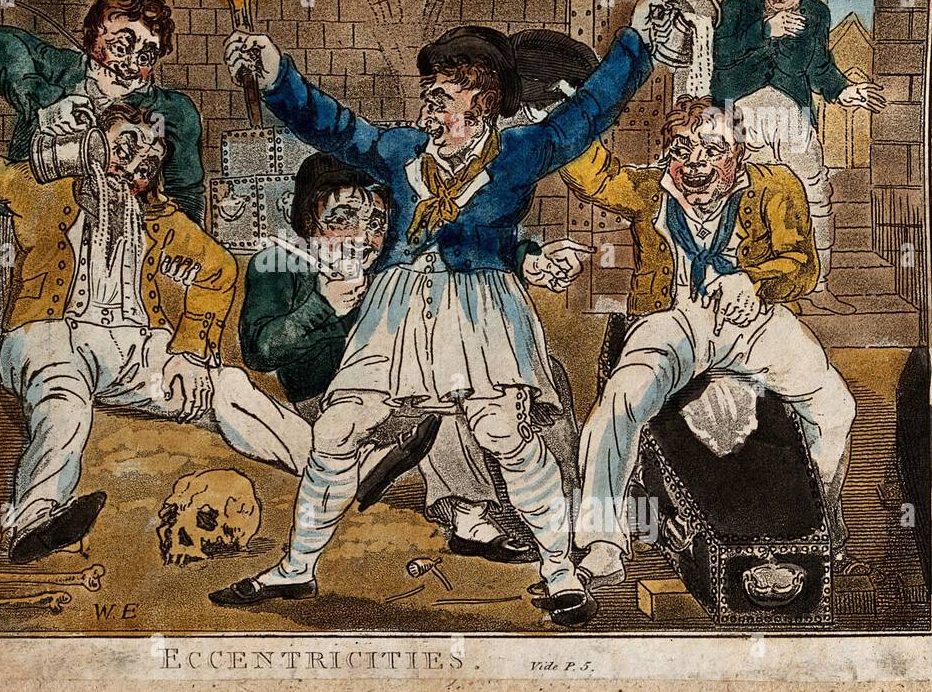
Though alcohol abuse remained a problem among the British, over time the raw violence of the punch house gave way to other forms of entertainment. Musical evenings, card games and regularly scheduled visits to other European homes were popular among the ‘better’ classes. The rowdier types (i.e. drunken sailors high on Punch) were drawn to disrupting dramas and causing havoc at dramatic performance at a number of theatres that began to pop up across Bombay.
Bombay’s first theatre opened in 1776, situated on a space known as ‘The Green’ surrounded by other official buildings. The Bombay Theatre, as it was christened, catered to officials and their families and staged performances by amateur drama enthusiasts from among the European community. It experienced a difficult life through the early years of its existence and ultimately stood shuttered and unused for many. It was eventually bought by the city’s post prominent businessman, Jamsetjee Jeejeebhoy, a Parsi opium and shipping magnate, who never bothered to reopen it.
By the mid 1840s, the city was wealthy and large enough (thanks in large part to the illegal trade of opium smuggling) to demand better entertainment. Wealthy Indians, again mostly Parsis, championed theatre building as an important part of their civic duty which grew to include funding public charities, colleges and museums. The Grant Road Theatre opened on the northern edge of the city in 1846, at the time, quite a distance from the Fort area inhabited by the elites of the Company. Though opened with an eye on that market few English found the prospect of travelling into underdeveloped outer suburbs, where hygiene and other surprises lay in wait, attractive. Very quickly the financiers opened the halls to local artists who staged plays in Bombay’s most widely spoken languages, Gujarati, Urdu and Hindi.
Somnath Gupt, who wrote a history of Parsi theatre summed up the transition this way. “As long as it was patronized by the governor and high-level officials, the theatre was frequented by people of good family. Because of the location on Grant Road, however, their attendance decreased. Some Christian preachers also opposed the theatre as depraved and immoral. The Oriental Christian Spectator was chief among those newspapers that wrote in opposition to Hindu drama. In consequence, the theatre was attended by sailors from trading ships, soldiers and traders. A low class public came and made the theatre foul-smelling with their smoking. The performances began to start late, and etiquette deteriorated. Drunken sailors and soldiers behaved rudely with the women. It began to be necessary to bring in the police to keep order. This audience was…inherited by the Parsi theatre.”[1]

The Grant Road Theatre hosted international troupes enroute to and from Australia when they showed up but the 1850s saw Parsi-owned theatrical troupes mushroom to fill the supply of plays, actors and audiences. Based on the European proscenium-style theatre that featured a huge arch over the stage as a frame for the action, the Parsis saw the theatre as a way to both entertain and educate Bombay’s growing middle class.
What quickly became known as Parsi theatre was an instant hit. The plays set the imagination of Bombay-ites on fire. Many of the plays were wildly popular, running to packed houses night after night for years on end. A whole new class of Parsi actors, playwrights, directors, composers and producers grew up, many of whom moved seamlessly into the film world in the early 20th century. Many companies toured the countryside, not just around Bombay but to far flung parts of the interior and even to places as far away as Sumatra, Malaya, Burma and Ceylon. Drawing on local talent and tales from Hindu, Islamic and Persian epics, Parsi theatre became a uniquely Indian and lively form of entertainment many aspects of which—song, dance, bawdy humor, melodrama—were directly absorbed by the subcontinent’s early film makers.
Along with the companies and cohort of professional players, more theatres were built with names like the Elphinstone, Gaiety, Novelty and Tivoli. The staging of dramas was by the 1870s and 80s a huge part of Bombay’s entertainment scene. Jamshedji Framji Madan “the Parsi actor-turned-wine merchant-turned owner of the largest chain of theatres and cinemas in India in the first three decades of the 20th century”[2] exemplifies the central role the Parsi community played not just in whetting the Indian appetite for staged comedic and dramatic entertainment in purpose built buildings, but of leading the transition from Parsi Theatre to what would become one of the most consequential film industries the world has ever seen.

Madan started his career in the theatre first as an actor but he made a considerable fortune in y securing large contracts to provision British troops with the wine that the governing classes so condemned for corrupting Her Majesty’s troops. Sensing greater opportunities in the capital of British India, Calcutta, and loaded with money from his wine-provisioning business, Madan in 1902 set up a diversified business group, J.F Madan & Co., with interests in everything from insurance to film equipment and real estate. He also began buying up Calcutta theatres (the Alfred and the Corinthian) where playwrights including Agha Hashr Kashmiri, aka India’s Shakespeare, plied their trade. Kashmiri, though from Banaras, moved to Lahore in his later years where he also wrote for films, an early example of the cross fertilisation of cinematic talent between India and what would soon become Pakistan.
Immediately after arriving in Calcutta, he set up the “Elphinstone Bioscope Company and began showing films in tents on the Maidan before opening the first dedicated movie house in Calcutta, the Elphinstone Picture Palace.”[3] The venue not only was Calcutta’s and India’s first dedicated movie hall but marked the beginning of India’s first cinema hall chain. In 1917 his company, Far Eastern Films, partnered with Maurice Bandman, an American entertainment magnate based in Calcutta to distribute foreign films in India. “In 1917 his company Madan’s Far Eastern Films joined forces with Bandmann to form the Excelsior Cinematograph Syndicate dedicated to distributing films as well as owning and managing a chain of cinemas. In 1919 Madan, like Bandmann, floated a public company, Madan Theatres Ltd, which incorporated the other companies. It was this company that formed the basis of the remarkable growth of the Madan empire.” Madan’s multiple interests in theatre and commerce led him to producing his own films, including the first commercial length feature in Bengali, Bilwamangal (1918).
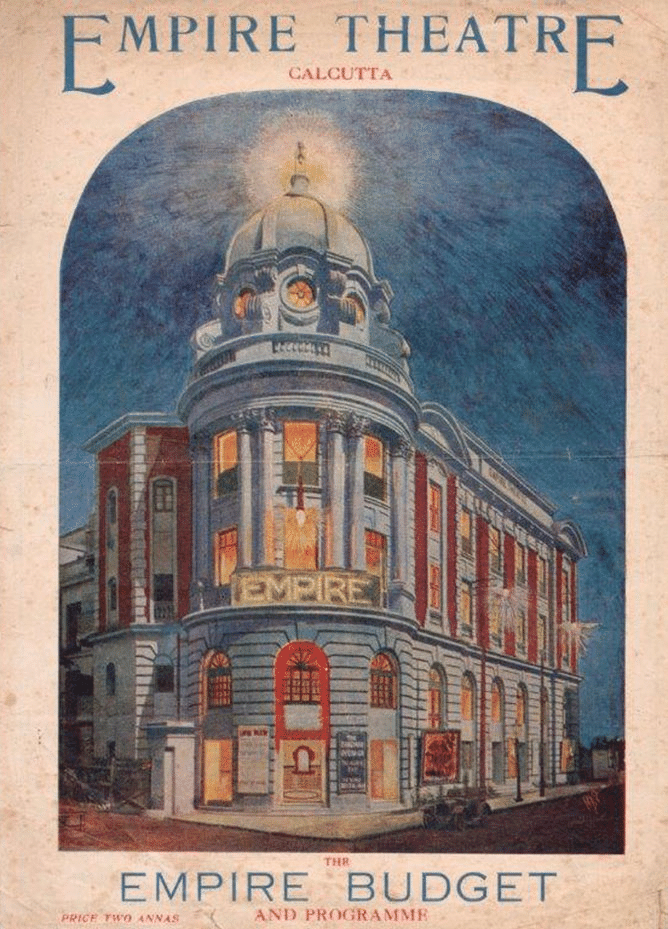
Madan’s strong commercial eye recognized that the medium would need its own venues and screening halls, rather than relying on established theatres. By 1919 the Madan Theatres Limited was in business and set to become India’s largest integrated film production-distribution-exhibition company with assets located not just across India but in Ceylon and Burma as well. Madan issued shares that generated Rs. 10 million and through effective management practices was able to procure a huge number of theatres across South and SE Asia. Though film making was picking up steam in India, the vast majority of films shown were foreign. In 1926 only 15% of films were Indian. 85% were foreign, mostly American, movies. By partnering with the French company Pathé Madan’s theatres were to a significant degree responsible for creating an audience for American and European films in India by importing and screening Hollywood films, such as the Perils of Pauline, The Mark of Zorro and Quo Vadis.
By the mid-1920s Madan controlled half of all revenues from the Indian box office and owned 127 movie houses. His hiring of foreign directors such as the Italian, Eugenio De Liguoro who directed 6 films for Madan Theatres, gave many of his films a sheen of expertise and craft that was not yet visible within local ranks. In essence, Madan had monopolised India’s nascent film industry.
**
The Lumiere brothers may not have understood the commercial viability of their inventions but it seemed that many Indians did. The great colonial cities of Bombay and Calcutta both quadrupled in size between 1850 and 1900 to be home for nearly 1 million people. Bombay and Calcutta were now world cities. It was not surprising that this most modern and hypnotic of new technologies would catch on in places like this. But Bombay, Calcutta and Madras were not alone. Far to the West, on the far frontier of British India another city was starting to make waves in the movie world too.
[1] Hansen, Kathryn. (Translator) 2001, “The Parsi Theatre: Its Origins and Development (Pt 2).Pdf.”
[2] Balme, Christopher. 2015. “Managing Theatre and Cinema in Colonial India: Maurice E. Bandmann, J.F. Madan and the War Films’ Controversy.” Popular Entertainment Studies 6: 6–21.
[3] Ibid.
 Missionaries, Mercenaries and Misfits