I didn’t really learn about India until I left to attend University in Minnesota. I had lived there virtually all my life up to that point and had a slightly above average knowledge of Hindi but it was pretty rough. I understood India as the place where I felt most at home in the world. A place I identified as ‘home’. But I had only the sketchiest understanding of Indian history; the sitar and Hindi movies summed up Indian culture.
My world was largely European/American/white/Christian. Though I grew up speaking an Indian language as early as or even before English, though I had many Indian playmates and in school, close mates, and though my family in no way tried to isolate ourselves from Indians or Indian culture and society, by dint of another culture and tradition I knew precious little about, that of evangelical missionaries in India, Indian culture remained a vague notion with very few points of clarity and authentic appreciation.
This came home to me in my early semesters in University. I got into mid-level Hindi class only to discover how limited my vocabulary was and how ungrammatical was my speech. I really didn’t know how to write a coherent paragraph. The name Mohammad Rafi had never registered with me. Whilst reading a passage from a newspaper aloud in class (my pronunciation/accent was always very good) I stumbled at the reference to ‘Rafi’. As there are no capital letters in written Hindi I didn’t realise it was a name; the sentence didn’t make any sense. Ultimately, the professor, who himself had never been to India, had to tell me that Rafi was a proper name and referred to India’s most famous male singer, Mohammad Rafi.
I think my choice of South Asian Studies as my undergrad major and then my Masters in Modern South Asian history, were attempts to make up for this huge ignorance about the place I said I loved and that I called home.
After formal education my years in Pakistan enlightened me about the impacts of Modern Indian history and how tangled and fascinating is the relationship between Pakistan and India.
In 2010 I began blogging about music. All kinds. But I understood that I could create a bit of niche and a following by focusing on South Asian music, another subject about which I was almost completely ignorant. And so, my learning and education about India (in the broadest sense of that term) continued. My current research on the history of the Pakistani movie industry a.k.a. Lollywood, is the same. It seems I have an unsatiable desire to learn ever more about the subcontinent.
There was no subject more unknown to and less understood by me then the world of Hindu philosophy and religion. Naturally, missionary children were not encouraged to learn too much about it for obvious reasons. To fight this ‘dark force’ was what had brought my parents to India in the first place. But also, I had enough of spiritual instruction and religious activity in my daily life already. Daily prayers and Bible readings, devotions, camps, Bible clubs, spiritual conventions and tent meetings, church services and baptisms. The idea of trying to figure out a second religion was the last thing on my mind. Creedence and the Beatles, Dev Anand and Zeenat Aman were far more exciting fields to plough.
I still know so little about it, though I do love reading the many stories behind the many aspects of God that Hindus and Indians have concocted and pay homage to.
I was in Kerala on business. One evening I hired a taxi to visit a friend who lived near Trisshur. I wasn’t going to take my cameras but after the quiet voice reminded me, “Take your camera with you everywhere you go,” I headed out.
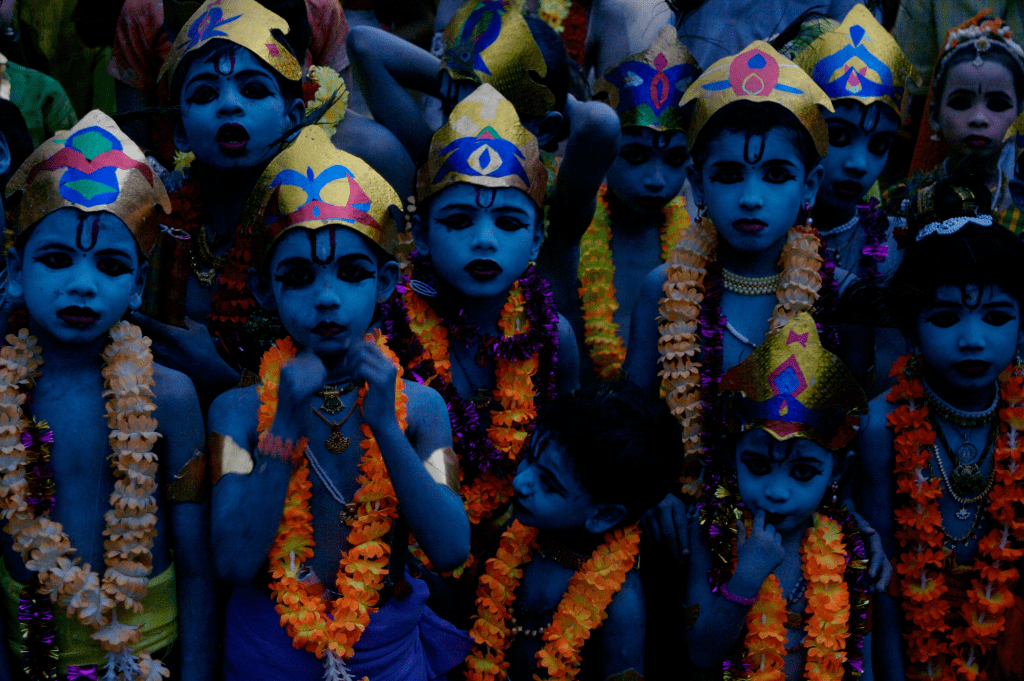
About half way there we turned a corner to find the road blocked by these young fellas.

A couple villages were celebrating Krishna Janamasthami the annual festival of Krishna’s birth. Families celebrate by swinging their youngest son around in circles and then painting young boys in blue, placing cardboard crowns on their heads and wandering around the village singing, laughing and pretending to play the flute, Lord Krishna’s instrument of love. Later, entire busloads of villagers will visit the Guruvayur Shri Krishna Temple in Thrisshur for more ritualistic and formal acts of worship. Like many places, the temple claims to trace its history back 5000 years (doubtful) and is one of southern India’s largest places of Krishna worship, something usually associated with north India.
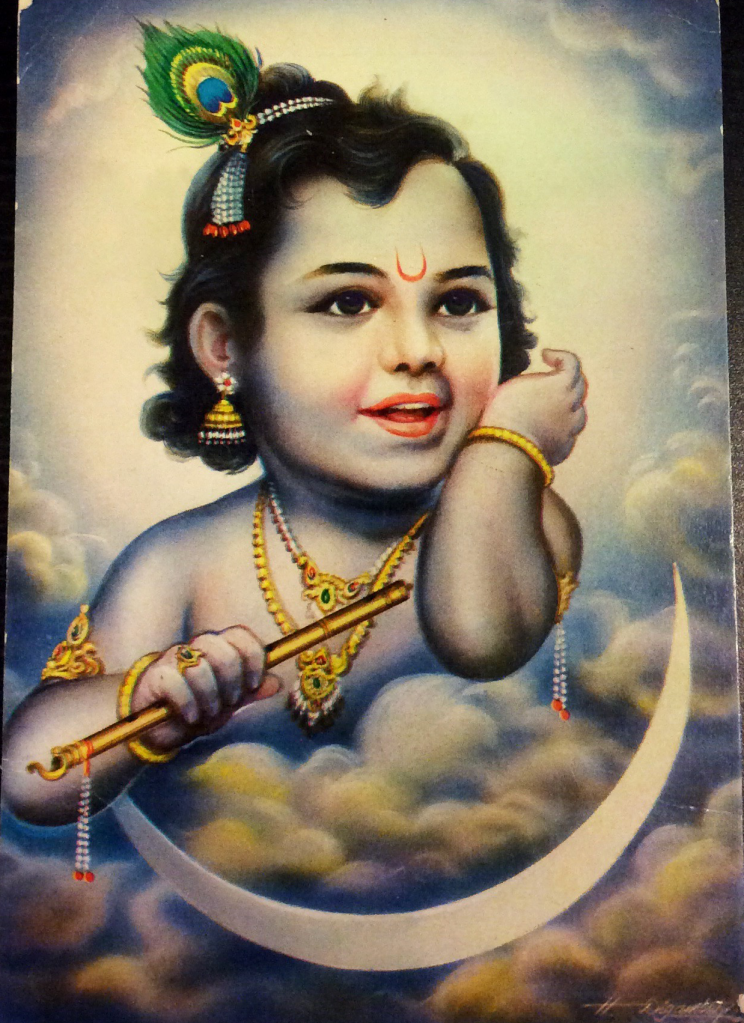
Krishna in his infancy and boyhood is known as Balakrishna, (literally, child Krishna). A stage on his life remembered for his mischievousness and antics. He is depicted in books, magazines, murals, calendars and stickers with chubby cheeks, rolls of fat on his little belly and often with his hands full of butter which he has stolen from his mother.
The following bhajan tells that story.
 Missionaries, Mercenaries and Misfits