Recalled Conversations: Taxi driver, Delhi.

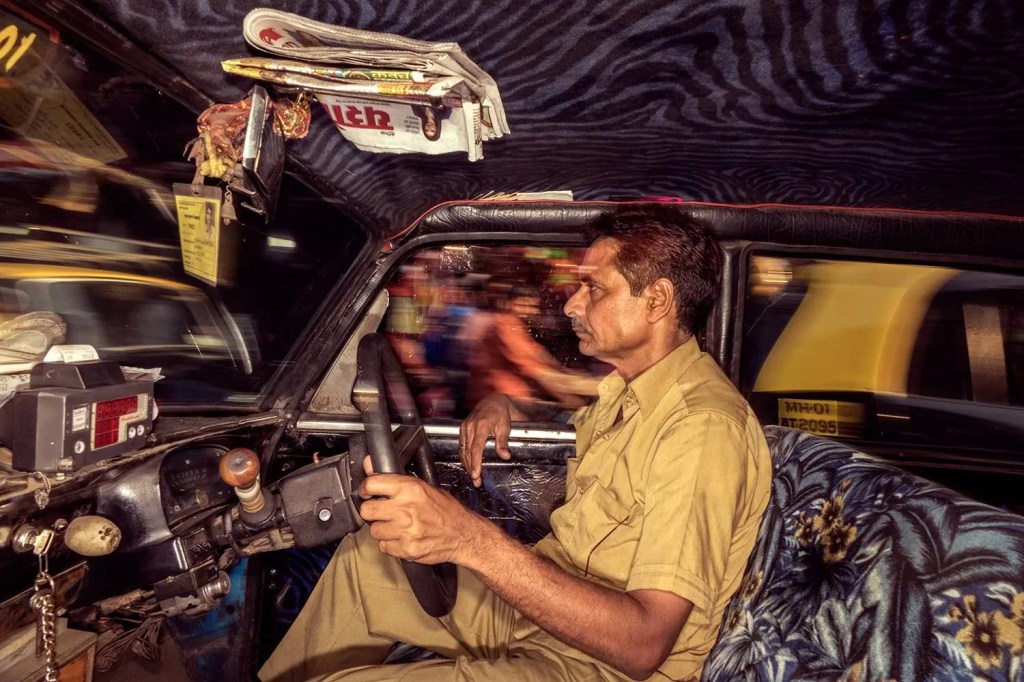
Photo by Dougie Wallace

For the first several minutes he said nothing, just guiding his yellow and black Suzuki taxi through the clamorous traffic of midday Delhi.   My daughter wanted me to ask him what his name was.  “Jai Bhagwan,” he said. “An old-fashioned name.” His smile is half apologetic.

“You’ll be going to Jaipur? That’s a beautiful city. They call it the Pink City. Its a five hour drive from Delhi and Pushkar is another 2 or 2 and half hours further.  You’ll stay in Pushkar for a few days? No? I see, just for a day. Ajmer is just half hour more away. What a place that is. Moinuddin Chisti…the Emperor of India!  Will you be taking the train from Ajmer to Varanasi?  No, from Agra. Ok. I see, your agent arranged it that way. Watch out for these agents. They’re in it for themselves, a lot of them.

This traffic is like this but not for too long. There’s a fly over up  ahead and the road narrows so everything slows down to a crawl. But soon we’ll be moving again.  Yes, that metro line was made for the Commonwealth Games in 2010. What a rip off!  The organizers stole 80% of the investments. Only 20% was spent on the infrastructure. The main crook, Kapladi is in jail but what does it matter. It won’t change anything. The rich and our netas don’t give a shit. All the rules are for the poor, not one of them is for the rich.  It never changes.

My people used to own the land around the airport.  A long time ago the government came and forced us off the land and gave us Rs1.40 per square meter! A very low price. But they got what they wanted. You know Gandhi? They say he is the father of the nation. We say he’s the number one Thief. Don’t believe me? What did he ever do for us? Did he do anything to improve our lot? He and Nehru did everything for themselves and to make their own money and name.  Gandhi, the old bastard, used to feed his goat grapes while the rest of the country starved. 

The real hero of India was Subhas Chandra Bose. What a guy. You know what his slogan was? Give me your blood and I’ll give you freedom!  He was a man of action. That’s why they killed him. You know Gandhi could have freed Bhagat Singh but he didn’t. He let him hang. All for his own glory.

Ambedkar? Yeah, he was a good man too.  He wrote the Constitution. No one else could have done that. He was a great man actually. I have nothing bad to say about Ambedkar.

Right, we’re almost at your destination. Just 5-10 minutes more.”

My Missionary Family: Part 1

There is no generic missionary.  There is no single description that all missionaries would agree on.  Missionaries were/are as diverse as any other group of humans. They had a variety of motivations for being in India, vastly differing theologies and lifestyles.  Many didn’t like each other, even when they worked for the same ‘mission board’. Some were world class historians and biologists and linguists. Some developed new nutritious products for the emerging middle class. Some led the world in the treatment of blindness and leprosy. Some ‘went native’. Others went mad and had to be shipped back to Ohio. Some believed every word of the Bible was historically accurate and spiritually true. Others could not find their way to 2 Chronicles. One even became a leading White Supremacist. 

What follows is what my missionary world looked like.  

My parents came to India in 1952.  Dad was 27. Mom 30.  Dad had been appointed by ‘the Mission’ to teach in a small Bible college in a not-very-significant district town in what was then Bombay Province but which, in 1956, was included within the freshly minted Mysore State that was renamed again in 1973 as Karnataka State. 

Home for both Mom and Dad was the upper Midwest: Minnesota and the Dakotas.  Both families were of German extract and both were equally poor.  And both families belonged to the ultra-small, ultra-conservative Holiness Methodist denomination. 

Mom was older than Dad by three years. She had grown up a farmer’s daughter and harbored the suspicion that she was an ‘afterthought’.  She always claimed to have enjoyed a loving childhood but one that was lonely and isolated. Her siblings were 10-15 years older and the farms she grew up on, first outside the northern Minnesota town of Detroit Lakes and later near Paynesville, in Stearns Country–heavy German immigrant territory– were several miles from civilisation.  She loved (and dreamed of) sharp clothes, baking and reading.  

Going on to High School was a major aspiration for most of her social network. Though her father lost his farm in Detroit Lakes during the early days of the Depression, forcing him to become a sharecropping dirt farmer, mom did graduate high school and went on to Business College in Minneapolis just as WWII began.  She admitted to having a few boys from the community make eyes at her, even a few handsome lads, but she never made eyes back. Mainly because it was clear to her that they had no desire to go to High School.   Or they smoked. Had no real prospects. One boy, however, did stand out–Melvin Finger. She liked the look of him and noted with approval that he was ‘serious-minded and read TIME magazine’. 

She grew up loved, she said. She also said, she felt as if her mother, a devout and extremely soft-spoken woman, had hoped she would be a boy because she confessed to hoping that her final child would be a ‘preacher or missionary’.  To mom, these were clear signals that she had disappointed her mother by being a woman. I think she carried that feeling of being ‘second best’ with her throughout life. 

Her dad, a tall and toothless man with a hearty laugh and a 19th century outlook, was not particularly religious. He’d go to church occasionally but did nothing to encourage Christian faith in his children. That was their mother’s role. He was too busy scraping enough sustenance together from the tiny Minnesota plots he farmed.  

Her upbringing was stifling. Though she accepted the conservative Christian values and faith of her family and neighbors she knew early on that she needed to escape rural Minnesota.  In later years she would cackle over the thought of her being a Minnesota farmer’s wife, something that bemused and terrified her.  When a recruiter from Minneapolis Business College laid out brochures of a nine-month secretarial course in the Big Smoke, she didn’t hesitate.  Minneapolis was a ‘magical city’ for her. Shops full of wonderful dresses and shoes and a place where she could be surrounded by people but still keep to herself.  

In their memoir Mom wrote:  

Though I didn’t know exactly what I wanted to do or be, I was SURE I did not want to spend my life on a farm! Dad and mom had worked their fingers to the bone for years, and what did they have to show for it?  I wanted to have a nice home and some stylish clothes—admittedly I was ‘materially’ minded. Attending business college offered me a way out of Paynesville and an escape from the farm.  What could be better? I was excited! 

** 

Dad’s family were more recent German immigrants. Grandpa had arrived with his mother and siblings from what is now western Poland in 1903.  They settled in Guelph, North Dakota, a speck on the prairie not too far from the South Dakota border. The Great Northern Railway that linked St. Paul with Seattle in far west Washington State ran through Guelph and provided jobs for grandpa and his brother Julius. But the hard physical labor didn’t do it for Grandpa, Rudolph Senior, who was still a couple years shy of fifteen. Around that time he was dragged to a ‘revival meeting’, had a spiritual conversion and dedicated himself to ‘full time Christian ministry’. He committed himself to a Holiness theology, serving as a preacher (who often had to move from parish to parish filling in for small rural communities) and eventually General Secretary of the denomination.  Here’s how Dad summed him up in the memoir he wrote with Mom in 2011. 

The Holiness Methodists were a small, struggling denomination with never more than 30-35 churches and preaching points. But they established a small Bible school (Holiness Methodist School of Theology) in Minneapolis. A year or so after his conversion. Rudolph felt God was calling him to the ministry, so went to Minneapolis and enrolled at HMST. After just a year’s study, the church assigned him as a pioneering evangelist to a remote area way out in northern Montana. 

For a year and a half—April 1915 to October 1916—he lived in a small mountain cabin in close proximity to the Pinkham Creek and Fortine lumber camps located a few miles from the town of Eureka. Life in those Rocky Mountain woods was primitive, ultra simple, far from being as romantic as one might think. 

He married a feisty woman named Leona and together produced a large family of 9 children of which Dad was number four.  Grandpa struggled with depression throughout his life (Dad brushed it aside as nothing more than ‘the winter blues’) which is probably one of the reasons he returned to Minneapolis and HMST.  The family could barely put food on the table, especially as Rudolph Senior’s body began to break down with the stress of scraping a living together in the Depression. 

Dad spent most of his youth moving between small towns in South Dakota and Minnesota before completing his high school in Duluth. Like his soon-to-be girlfriend, Eleanore Naugle, that older, lonesome, beautiful farm girl he met at the annual Watson Camp Meeting, Dad knew from a young age that he had to escape this small, loving but culturally isolated world of poor Midwestern farmers and laborers for something more hopeful and spacious. 

Both Mom and Dad spoke fondly of the annual Holiness camp meetings they attended in the tiny Christian enclave of Watson (pop. 290) in south central Chippewa County. A regular feature of rural American Christianity, the camp meeting tradition had its roots in the so-called Second Great Awakening of the late 18th century. The meetings were ten days of hallelujahs, hymns, fire and brimstone preaching and sanctification under a tent in the woods. They were an opportunity for socially isolated people to meet their co-religionists and for preachers and hucksters to reach tens of thousands of people in one place.  And as ever, camp meetings were places for young people to meet up, fall in love and probably do all sorts of unsanctified and sinful things like smooching. 

Dad’s favorite part of the meetings were the sermons of visiting missionaries who told stories of the exotic, colorful and spiritually benighted Hindoos and Mohammadans of India.  

In 1946, now married to Mom, they once more attended the Watson camp meetings.  

There, the camp’s missionary speaker was…China missionary Roland [Rollie] Rice…. I had been thinking quite a bit about India during our last months in Fort Robinson, remarking more than once that I had wished the army had sent me there instead of one of my Camp Dodge buddies.  This friend, Carl, and I corresponded during our Fort time. In one letter he was complaining about some of India’s negatives and wrote ‘You’d be crazy Rabe, to ever want to come to this place!’ 

My interest in India had been kindled years earlier and only kept growing. The stories of India that Rev. F.B. Whistler told [in previous years at Watson camp] had ignited that early-on ‘India interest’. That interest was reinforced (admittedly in a fanciful way) through reading about the country—particularly in the adventure books of Richard Halliburton who wrote about snake charmers, tiger hunting, maharajas with jewel encrusted turbans and other exotic minutia. In one of those ‘I plan to be’ talks in a Denfield high school class, I informed my classmates I planned to join the US Foreign Service. Around that time I also made up a fictitious address in Bombay, gave it to my mother saying, ‘Some day you will be writing to me in Bombay where I’ll be serving as US Ambassador or as some officer for the US Government.’ She smiled and said, ‘Yes, Rudy, I think I’ll be writing to you in India one day, but you’ll be there as an Ambassador for Jesus Christ, not the US government.’  I always thought it interesting that 10 years later when we got to India, our first mailing address included the name Bombay: Gadag, Dharwar District, Bombay Presidency. 

And so it became family history. Dad was the one who had been inspired to be a missionary as a young boy. Eleanore fell in love with him and ‘accepted as part of the deal’ that her commitment to him meant a life far from her family in what must have seemed to her a hostile and harsh environment on the other side of the world. 

But re-reading their joint memoir, I have a much stronger sense of Mom’s agency in this.  She knew exactly who she was marrying.  Rudy had many of the qualities she admitted to liking in men. He was a Christian. He was good looking. He didn’t smoke or drink. He was ‘serious minded and read TIME magazine’ like one of her early crushes Melvin Finger did.  And like him she shared a desire to get away from the stifling atmosphere of rural Minnesota and have a bit of adventure.  And similar to Dad, her mother had already committed her last child to God to be one of His missionaries.  

On the last night of 1946 camp, Dad and Mom both publicly declared their desire to move to India to ‘serve the Lord’.  

The reality, in fact, seems to be, contrary to family oral history, that a career in India was something they both consciously chose. Maybe Dad’s interest in the country was deeper and more longstanding than Mom’s, who probably had zero curiosity about the place, but both of them were excited about the prospect of leaving America in search of adventure and souls to save. 

Years later after attending her high school class’s 50th reunion she commented with obvious, if well-controlled glee: “Although I had been such a shy and unassuming little girl, I probably traveled farther and had a more exciting life than most anyone else. It’s safe to say that Rudy, the man I married, was the secret of my out-of-the-ordinary’ life.”  

Running Home (Pt. 2)

The Russians were easy to find.  I heard their tipsy, vodka-soaked laughter coming from a shady part of the compound. Four or five of them were sitting on adjacent porches of their apartments, their fleshy faces flushed red with heat and drink. 

As I approached, silence fell.  

I smiled, hoping it would break the ice. It didn’t.  

They stared at me, obviously perplexed and irritated that I had interrupted their lunch break. One of the women whispered something to her friend. 

“Excuse me,” I began. 

By now I had my tale-of-woe down pat. I told them my mother was ill and I needed some money. “I need to get to Allahabad, about 700 kilometers from here,” 

“No. No money,” one of them said.   

A couple others joined in the chorus. “No money. Go away.”  A man with huge arms and angry eyes said it louder than the others. With real authority.   

Having spent 8 years in boarding school I knew a lost cause when I met one. I turned back toward the gate.   

But I was dying of thirst. With a drinking gesture I said, “Could I have some water?” 

This second request really set them off.  Amidst the general clamor of, “No water. Go!’, one of the men made a move towards me.  He didn’t follow me but I didn’t have a the courage to turn back and check until I was several meters down the path I had come up just a couple minutes earlier.  When I did turn they were still tense. They glared at me but as I retreated the laughing resumed.   

A mali was sitting in the shade on his haunches watering a guava tree. He beckoned me over.  

He held up the hose for me to drink.  He didn’t say much and I didn’t offer anything.  I have no doubt he had been watching the scene play out from a distance. I sensed it was one he himself was familiar with. I took his kindness as an act of solidarity. 

The thought of a 10 km ride back to Hardwar in the midday sun depressed me, especially as I was no richer for my effort.  I was too spent to formulate my next move, but I knew I needed to be in town where there existed at least the potential of assistance.   

I must have looked miserable pedaling along the highway because out of nowhere a man appeared. He had well oiled, wavy hair that glistened in the sun. He wore narrow legged pants and a plaid yellow shirt.  I can’t remember how it happened but he successfully commandeered my bike, sat me on the rear carrier and began cycling toward Hardwar. 

Despite the heat, we got a bit of breeze going which cooled my cheeks slightly.  I vaguely remember the Stranger talking to me but can’t recollect about what.  Before I knew it we were back at the Station. He dropped me at the cyclewala and even paid the outstanding balance. Then with a nod of his head he disappeared as unexpectedly as he’d appeared. 

** 

I retreated to the relative comfort of the 1st class Waiting Room. I dozed on a rattan lounge chair with extendable arms that doubled as leg rests, one of the distinctive artifacts of railway waiting halls in those days.  But I was hungry. And more than a little anxious about how I was going to make the next leg of the journey. 

A middle class family were the only others in the Waiting Room. The patriarch reclined on a rattan chair like mine, staring blankly at a ceiling fan that swayed as it whirred. From time to time he lifted his buttocks and farted.  But other than that, he didn’t move. 

He may have been oblivious to me but I had been watching him for some time. After one of his farts I cleared my throat and in my best Hindi launched into conversation. I learned they had come to Hardwar on yatra (pilgrimage) and were now heading back home. I asked him about his business (the nature of which I’ve forgotten) and may have said a nice thing or two about his young child.  

As a conversationalist he was unenthusiastic.  

“My mother is ill,” I offered, hoping to pique his interest. 

He may have nodded, but if he did, it was ever so slightly. 

“I need to get home. To Allahabad. But I have no money.” 

“Why do you not have money?” 

“I was robbed,” I found my mouth saying.  I couldn’t believe it. But I was in the water now, so I had to keep paddling.  

“This morning on the way from Dehra Dun, it was very crowded in the bogie and when I got here I realized someone had stolen my money.” 

He looked at me skeptically.  

“Could you provide me with Rs. 20, so I could get a ticket? My mother is very ill.” 

“You must report to the Railway Police, if you have been a victim of theft.” 

As far as he was concerned the conversation was over. The spinning fan captured his attention once more.  I felt foolish but let a decent interval pass before shuffling out of the Waiting Room. 

** 

Once again, 24 hours after the first occasion, I entered the office of an Indian Railways bureaucrat.  I had mulled over what the farting businessman had said. He was absolutely correct in his observation that the Police needed to be notified in the event of a crime.  But in this case there had been no crime committed so fronting up to the Police would not be the smartest tactic.  On the other hand, I was clean out of options. 

The Railway Police office was shabbier than the Station Master’s in Dehra Dun. The man behind the desk had a pot belly and sweat stains all over his khaki uniform.  His closely shaved head sported a choti, the little tuft of hair that identified him as a high caste Hindu.  Unlike the Station Master his face lit up when I stood in front of his desk. 

“Kya baat hai, baba?” he asked. What is it, lad? 

Though he addressed me in Hindi he clearly didn’t expect me to respond in kind. 

“Meri ma bimaar hai, aur mere paas ticket ka kiraya nahi hai,” I said, laying down the by now firm foundation of my story. 

“Arey! Hindi bolte!” His belly jiggled with delight.  “Ay shabaash!” 

Before I could continue with my dishonest story he shot a series of questions at me in an attempt to come to grips with the fact that a white kid could speak Hindi. 

I told him about me. I was American. I studied in Mussoorie. I was born in India. Rajesh Khanna was a good actor, yes.  

Whereas the Station Master in Dehra Dun had instantly linked Woodstock School and my being in his office to funny business, this jolly man didn’t give a stuff.  Indeed, he was hooting to a couple of underlings about what a spectacular thing I was. 

Somehow in the midst of this excitement I managed to explain my dilemma: 700 kms. No money. Sickly mother. 

Before I knew it he grabbed my wrist and dragged me out of his office. A couple of minutes later we were seated at an open air dhaba that sold tea and fast food to the throngs around the station.   

He instructed the dhabawala to give me a plate of curry and a few chapatis. “This fellow is American but born in India! It’s true. And he speaks spasht Hindi! Just listen.”  He could hardly contain himself. 

Though my mouth was full (this was my first food in nearly 36 hours) I knew this was price I had to pay for my dinner. A small crowd had appeared; rather the endless crowd of passersby stopped for a moment to look at me. It was my cue.   

I restated in Hindi what I had told the Policeman a few minutes earlier, that I was American, born in India, lived in Allahabad but studied in Mussoorie. 

People marveled and exclaimed. The Policeman couldn’t have beamed wider had I been his son. He ordered my plate to be filled. I ate up. He continued to hold court but eventually passersby grew bored and the rhythm of the bazaar returned to normal.   

The Police Inspector led me back to his office.  I was grateful for the meal but had no idea how I was going to make it home. 

He pressed a buzzer on his desk which immediately produced an underling.  The underling was sent forth to find others and after several minutes returned with two colleagues who carried rifles and bulleted shoulder straps.  They noisily pushed a pair of prisoners into the office in front of them.  With their legs and wrists in irons the prisoners shuffled and clanged like cheap robots.  

The inspector didn’t move from his desk and in a loud voice told the newly arrived cops that they were to include me in their party.  They were on official duty, transporting criminals from Hardwar to the state capital, Lucknow.  “You take this boy with you to Lucknow but do not let anyone, and I mean anyone, speak with him.” 

With that, the chubby Police Inspector himself walked me to a train and bade me bon voyage.  I was on my way at last. Still with no ticket but a pair of personal armed guards.