The Time Australia Kicked Sinatra’s Ass

Yesterday was the biggest day on Melbourne’s sports calendar, the Australian Football League’s Grand Final. This year the pre-game entertainment featured none other than Snoop Dogg.  A controversial choice to be sure. But then so was Meatloaf back in 2011. Ranked as one of the stupidest moves by the money fiends that control Australia’s beloved, unique form of football, Meatloaf’s appearance was hated by fans (Meatloaf’s included) and forced the Has-Been to publicly apologize for his poor outing. 

It’s the Australian way it seems when it comes to welcoming international superstars. There was Judy Garland in 1964 (deprived of her pills by Australian Customs) who refused to leave her hotel for three days.  And Joe Cocker busted a few years later.

In 2015, Johnny Depp and his girlfriend, Amber Head, were forced to grovel in front on our media and courts to express their regret for failing to declare two pet dogs that accompanied them, thereby avoiding the usual 10-day quarantine.  At one point the fiery (and often inebriated) Minister of Agriculture, threatened the dogs with pet-euthanasia, if the Hollywood power couple refused to pay public penance.   In the words of Depp, “when you disrespect Australian law, they will tell you!”

Frank Sinatra would have 100% concurred with that statement.  Perhaps of all the superstars we’ve harassed, it is somehow appropriate that The Chairman of the Board’s experience sits at the very top of the list.

Frank first toured Australia to in 1955. But from the moment he and 14 year-old Nancy stepped off the plane at Melbourne’s Essendon airport, he was met with derision. Fans who had gathered at the airport hoping to share a bit of banter with their hero, quickly turned hostile when he managed but a single wave and half a smile before stepping into a limo and being whisked away to his hotel.  From Cheers to Jeers went the headlines.

The shows themselves went off a treat. Fans raved how he sounded just like his records. Motorists passing by the West Melbourne Stadium double parked as his voice carried out into the street.  A triumph all round.  Frank loved Melbourne, the fans loved Frank. The (lack of) incident at the airport the day before was forgotten. After all, it had been announced that Sinatra would appear at his hotel for breakfast; fans would surely be able to get a second chance to hear him speak to them.

Alas, the headlines the following day read: Frank Sinatra Fans Miss Out Again. The hotel’s manager was given the task to confront the angry fans and chock it up to a ‘misunderstanding’.

Two years later, a second tour Down Under was scheduled but Ol Blue Eyes abruptly turned around in Honolulu. Apparently, Frank’s decision was based on the fact that sleeping arrangements for his musical director had been overlooked for the onward journey to Australia.

Seven shows were cancelled leaving his promoter the ugly job of refunding 23,000 tickets to ever-more cheesed off Australian fans. In January 1959, Frank tours again. He’s still stand-offish in public but in outstanding form in his shows which are supported by the Red Norvo Quintet.  His private life is dominated by his unsuccessful attempts to regain the love of Ava Gardner, who just so happened to be in Melbourne as well, filming (with Fred Astaire and Gregory Peck) On the Beach.  When a reporter in Melbourne dares to ask him a question, Sinatra grunts, “Misquote me kid, and you’re dead with me. In fact, I’ll sock you on the jaw.”

On the 1961 tour he ignored Melbourne altogether, doing four shows in Sydney and then flying back to familiar Californian shores.

Things got completely crazy in 1974.  After being tsunamied by rock ‘n roll for most of the previous decade, Frank was finding a fresh relevance. He was out and about. Touring the world. Australian fans once again forked out their new Aussie dollars to spend an evening with their Man. 

On 7 July, Frank flew into Sydney as grumpy and aloof as usual. Plane to Rolls Royce to Hotel. Nary a smile or wave to his adoring fans and a press corps salivating at the prospect of a scandalous headline or so. 

On 9 July, Frank’s arrival in Melbourne was memorable in the main for his refusal to acknowledge the press and shoving a fan out of the way.  So harassed did he feel that he ran from his private jet to the awaiting limo. So far, typical Frank behaviour.
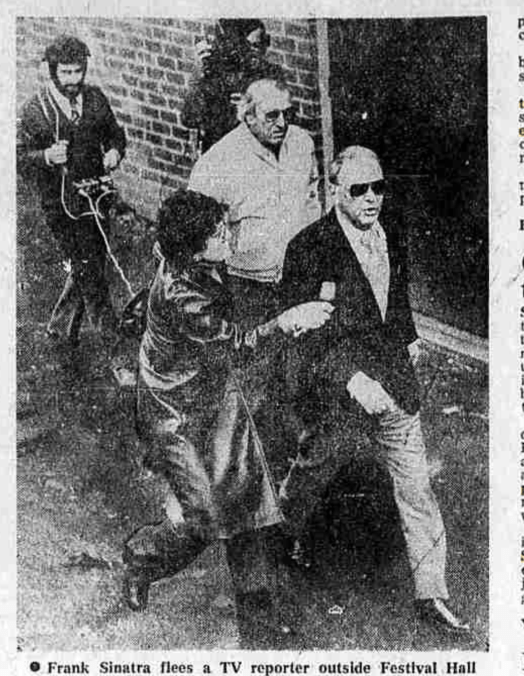
At that evening’s show at Festival Hall, Frank’s first appearance in the city in fifteen years, he delivers what is now considered one of his best live performances.  He’s relaxed, his voice is as good, if not better than it’s ever been.

So relaxed was he that in his first monologue Frank sums up his views on the local press. Horrified and shocked, a couple of local unions (The Professional Musicians Union and the Australian Theatrical and Amusement Employees Association) announce that his second show, scheduled for the following evening, would be cancelled unless Ol’ Blue Eyes issues an apology.  This demand is met with scorn by Sinatra and his entourage. The press, he said, owed him an apology for 15 years of treating him like “shit”.

Now other unions pile on. Frank is not permitted to leave his Boulevarde Hotel room. He places a call to his pal, Hank, aka Henry Kissinger, asking him to intervene. Word on the street has it that Jimmy Hoffa has also been contacted to threaten his Aussie counterparts.  An international incident is brewing.

The foam in the mouths of the press can no longer be hid. After the first show in Melbourne, his bodyguards, beefy mafia types, assault a news cameraman nearly chocking the man to death.  The unions respond with a ‘black ban’. He is to benefit from no public services whatsoever. No security. No police escorts. No room service. No fuel for his plane. No passport checks. Nothing. Frank Sinatra is a prisoner.

The overlord of all of Australia’s powerful trade unions, a certain Bob Hawke, is persuaded to step in. In the initial meeting neither party budges. Frank sends word to Hawke, “I’ve never apologized to any one and I’m not about to start now.”  As the unions huddle Sinatra’s entourage sneak him out of the hotel and race to the airport where the media reports, he will meet with Hawke.  But his private jet defies air traffic control and takes off to Sydney, leaving an embarrassed and royally pissed off Hawke looking like a chump.

Unfazed but seething, Hawke flies up to Sydney.  In response to Sinatra’s lawyer’s demand for his plane to be refueled, Hawke delivers a classic Aussie ultimatum. This brings the Chairman of the Board out to meet Hawke for the first time. Hawke issues his ultimatum again to the Man himself.  After several minutes of ‘nattering’ Sinatra returns and asks Hawke for suggestions of what to put in the apology. Within an hour or so they agree on the words, and Frank’s lawyer descends to the press and reads the statement. Frank Sinatra apparently “did not intend any general reflection upon the moral character of working members of the Australian media” and regretted both “any physical injury resulting from attempts to ensure his safety” and the inconvenience to patrons.

A few days later at Carnegie Hall, Frank told his audience, “A funny thing happened in Australia. I made a mistake and got off the plane.” He then went on to target Rona Barret, a prominent female journalist of the day, by saying, “What can you say about her that hasn’t already been said about… leprosy?”

As it happens, Snoop Dogg’s show was the bomb. Most punters on social media are saying it’s the best show the AFL has ever put on.  As for Frank, well, he did return to Australia 14 years later, in 1988. Bob Hawke was now Prime Minister.  Upon arrival Frank meets with the press and even poses with the ‘bums and parasites’.  He may have been an asshole but he was no dummy.

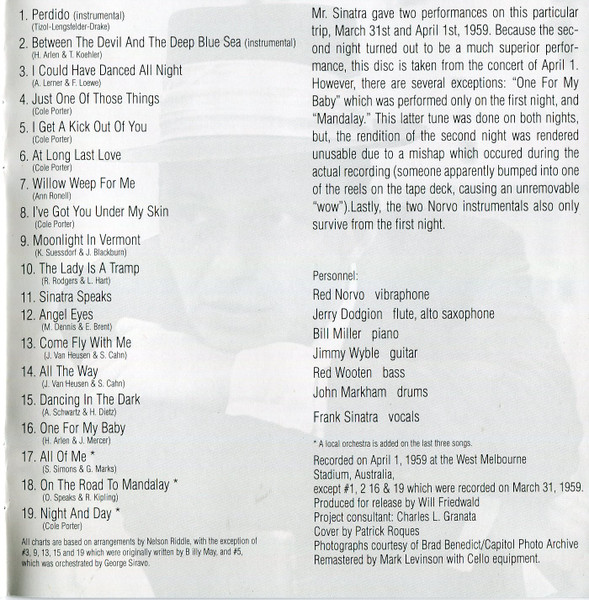
Here is the famous first Melbourne show in March 1959.

Long the favorite of collectors, who have cherished their bootlegged copies of the concert for years, Frank Sinatra with the Red Norvo Quintet — Live in Australia 1959 was finally released officially in 1997, nearly 40 years after the concert was given. In many ways, the wait was actually positive, because Sinatra’s loose, swinging performance is a startling revelation after years of being submerged in the Rat Pack mythology. Even on his swing records from the late ’50s, he never cut loose quite as freely as he does here. Norvo’s quintet swings gracefully and Sinatra uses it as a cue to deliver one of the wildest performances he has ever recorded — he frequently took liberties with lyrics while on stage, but never has he twisted melodies and phrasings into something this new and vibrant. The set list remains familiar, but the versions are fresh and surprising — “Night and Day,” where the song is unrecognizable until a couple of minutes into the song, is only the most extreme example. And the disc isn’t just for the hardcore fan, even with its bootleg origins and poor sound quality — it’s an album that proves what a brave, versatile, skilled singer Sinatra was. It’s an astonishing performance. [All Music Guide]
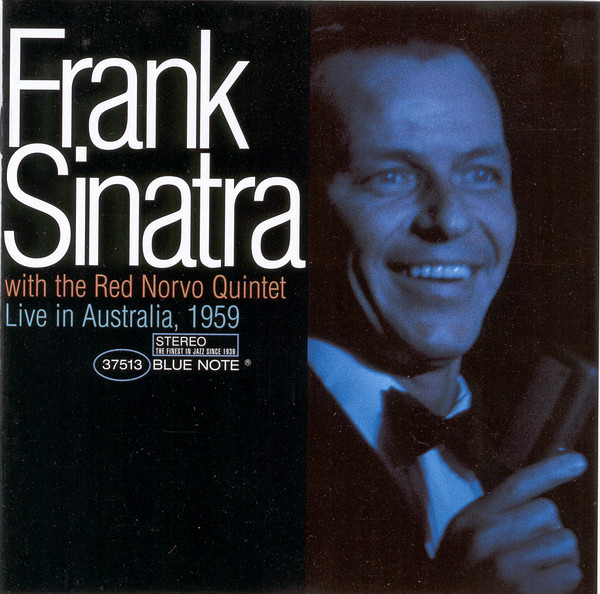
1959

Sydney Road and Coburg: my new neighborhood

I recently moved from Melbourne’s ‘leafy’, wealthy suburbs of Armadale/Toorak to the well-settled northern suburb of Coburg. It’s been like moving to a different country. In a good way.

Coburg, originally named Pentridge, was carved out of the traditional lands of the Woi Wurrung Aboriginal people, in the 1830s. The site of one of Australia’s most notorious prisons, Pentridge, residents changed the name to honour Queen Victoria’s deceased consort, Prince Albert’s, German family, Coburg, in 1870. Throughout the 19th century Coburg and surrounds provided its famous heavy bluestone to other parts of Melbourne as well as hay, some fruit and grapes.

The town was incorporated in the 1920s and has a long history of progressive social and political causes. A stronghold of the then new Australian Labor Party (which just kicked the Conservatives out of existence last weekend) the community pioneered child health facilities that were among the first in the State.

Sydney Road runs through the heart of the area and is one of Melbourne’s many local communities. Today its home to recent immigrants (Afghan, Iraqi, Syrian, Somali, Ethiopian, South Asia) as well as small group of older Italians and Greeks. Young people like the endless number of farmers’ markets, cafes and used bookstores. They wear black, dye their hair bright blue and bling themselves up with tattoos and all sorts of silverware.

I took a stroll down Sydney Rd on Saturday, after voting.

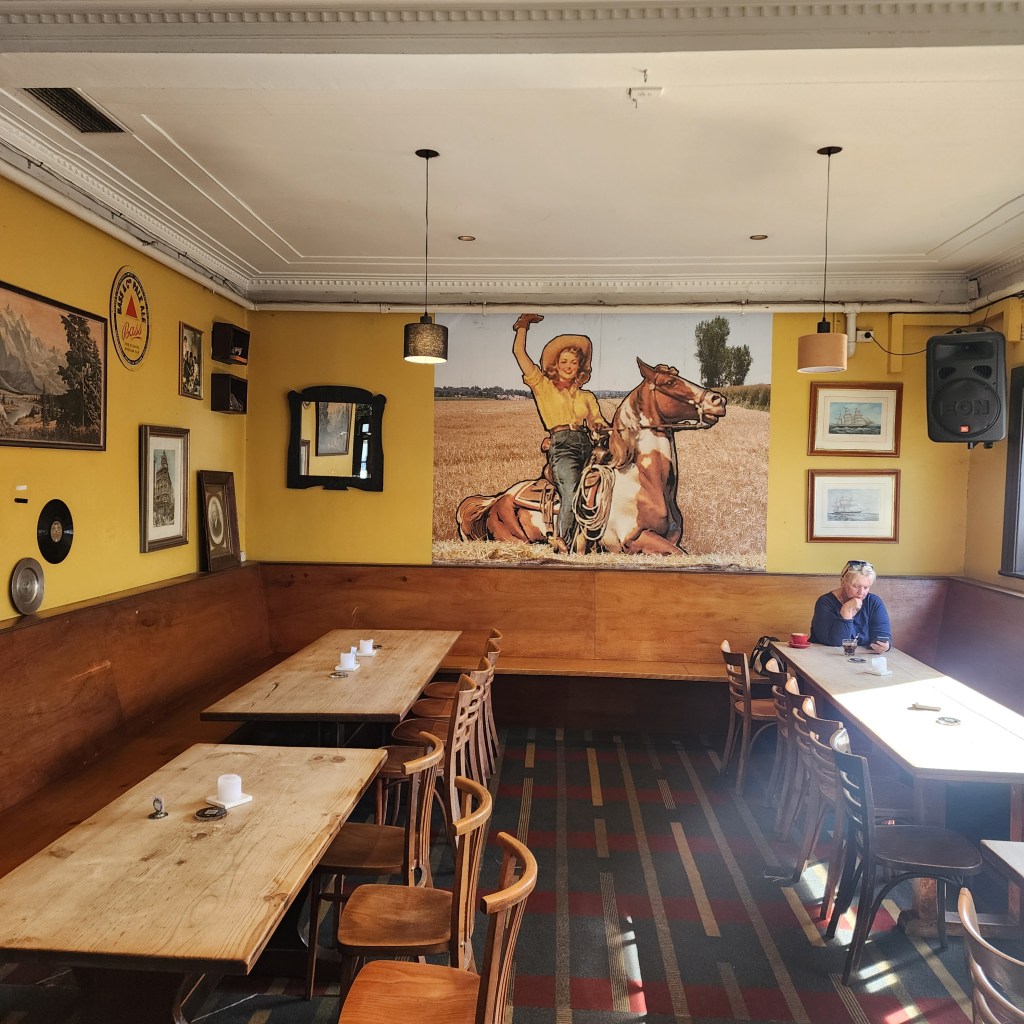
A quiet drink in the Edinburgh Castle Hotel.
Local hero.
What the hell has happened to the price of beer?
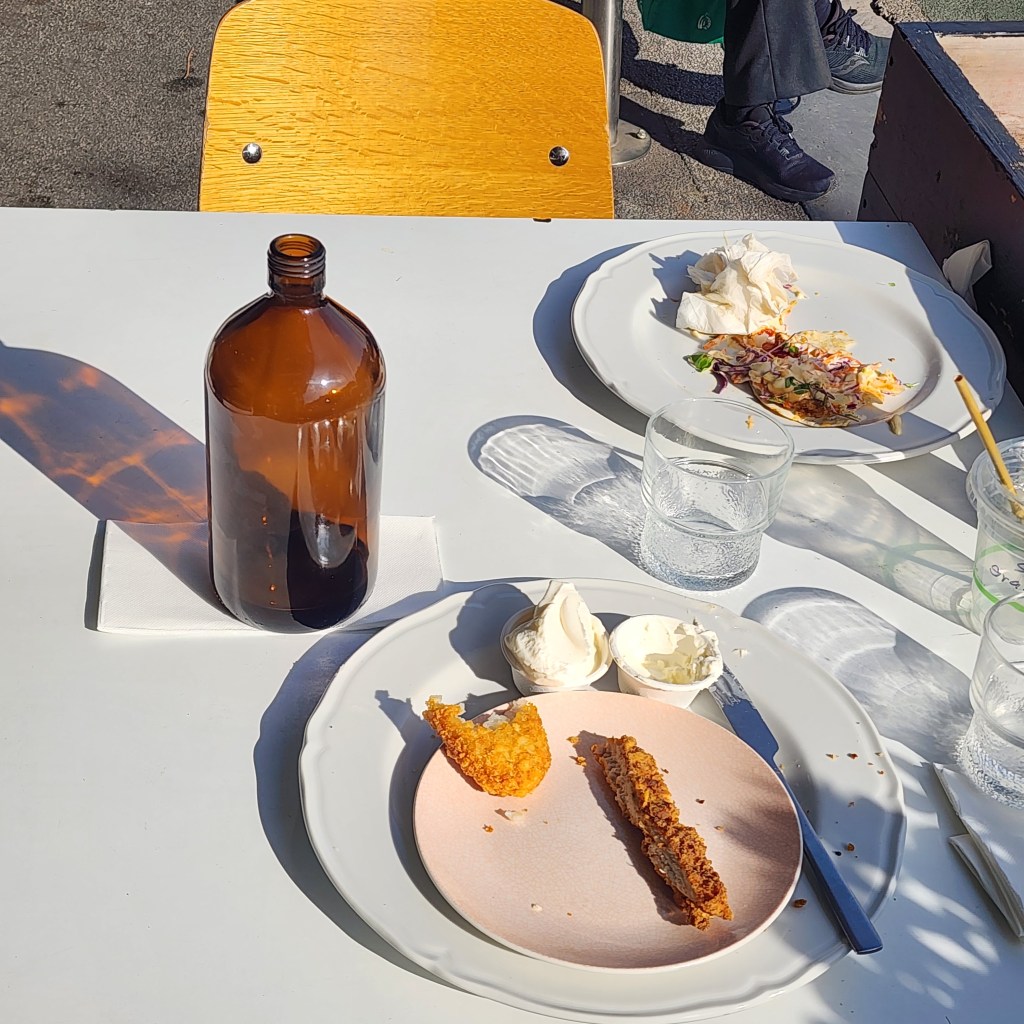
Remnants of brunch.
Halal meats for recent immigrants.
Coburg Motor Inn, Sydney Road.

One Kalashnikov + two Kalashnikovs.

In 1996 I visited Afghanistan and Pakistan for an Australian NGO. The Taliban had just captured Kabul a fortnight earlier and thrust, very momentarily, the plight of everyday Afghans back into the international media’s spotlight. Given the current state of Truskland I think these voices are worth revisiting.

He was as new to town as I.

“I came here from Kabul the day before last. My name is Hashim.” He wore a hesitant smile and a blue waistcoat. He had been watching me walk up through the gardens and toward the street. “Will you make my photo?” he asked.

He posed with his arms across his chest and gazed away from the camera with a cinematic expression. I took his picture and asked what had brought him to Mazar-e-Sharif.

“My father told me to get of of Kabul as the Taliban are capturing all young me to fight. I’ll go back when my father tells me. I am staying in a hotel as I have no relatives in Mazar. Its very expensive. All day I sat here watch people in the garden. I sit and think but I try not to think of my family. We had a shoe factory in Kabul. But when the mujahideen came to power they stole everything. Now I am jobless. In Kabul I study English and also kung-fu. But now everything is closed. I don’t go out because it is too dangerous. I am Turkoman. The Taliban are against us. And the Tajiks and Hazaras.

“I saw Najibullah hanging in the street. It made me sad. None of these groups are Muslims. They only kill anyone who doesn’t agree with them. ‘Grow a beard!’ ‘Wear a hat!’ ‘Don’t go outside!” And if you disagree to grow a beard it is the end. For the last 5 years I have seen these people. They are not Muslim.

“See that man there, singing. He’s gone mad. I’ll go mad, too. I sit here everyday. I want to get out of here, to Germany or to an English speaking country but its too expensive.”

*****

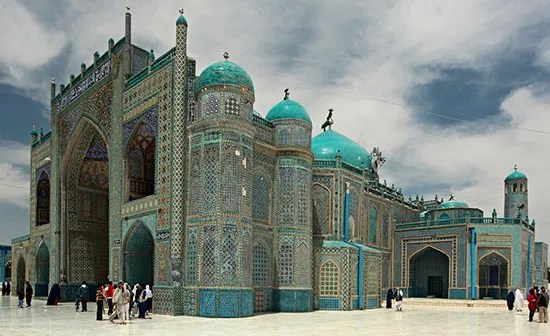
Blue Mosque/Tomb of Ali, Mazar-e-Sharif

“How is my English? I have been studying for two years but most foreigners do not like to speak with me. Why is that? One time I asked a foreign man what time it was. He told me, ‘Sharp 4 o’clock!’ That was that. He said no more to me.” Khaililullah spoke excellent English. He was a northern-Pashtun–dark, almost Indian in appearance. But he had born north of Mazar and had recently returned from over 10 years as a refugee in Pakistan.

“I teach English. In Monkey Lane. Will you come and visit our class?” I told him I would come but not today. Today I was interested in visiting the shrine of Ali, the grand blue-tiled mosque around which this desert town spills. I told Khalilullah how much I admired the mosque and its color. “You’re lucky to live so close to such a beautiful building.”

“By the grace of God we have a good leader. General Dostum. He used to be a communist but now he prays five times a day–he’s very good. And powerful. The Taliban are the trouble. They want to keep girls from school And this forcing men to pray in the mosque five times a day. Even our Prophet Mohammad himself only prayed 4 times a day sometimes So who are they to force us?

“Of course. There were excesses in Najib’s time. He gave too much freedom and too quickly. Especially to women. This corrupted us. Women went about barefoot–without shoes and wore nothing at all on their heads. According to Islam, a woman’s head should be covered. But not completely hidden. Both the Taliban and Najib are wrong. God save us from that much freedom. On the other hand under Najib, women and girls were educated and worked. That was good. So he was not entirely bad.”

Najibullah felt that the public hanging of Najibullah was inevitable. In his mind it was a justice of sorts for having allowed women to go barefoot and to be judges. But what he told me next I heard many times during my visit.

“Before they killed him they ordered him to sign his own release papers. He refused. He had denounced communism and discovered patriotism. He did not feel he had to confess to any crimes. But I know from an accurate source that he had memorised the entire Quran. But he refused to sign the papers confessing to anything. So they killed him. But in that, he was right. All Afghans respect Najibullah now. He wasn’t afraid to die. He was a true Afghan.”

When I visit Khalilullah’s school a few days later he refused to discuss anything except English and non-political subjects. “What do you call this?” he asked me, pointing to a shelf. He made not of my response, “A mantel.”

He and his fellow students discussed music and literature as if nothing was wrong with their country. The school had 600 students, women and men, learning English every day. “We want to prepare ourselves for the future. Today you must have knowledge of two things, English and computers, if you want to succeed.”

Jamil was adamant. “What do you believe will happen to Afghanistan?” Before I could respond he went on. “We are fanatics. This is no way to bring universal peace anywhere. And there is no way our people will talk. No way they can win in fighting either. I don’t know what will happen. This fighting will continue. All I know is that I will go to English class and then I’ll go home. Tomorrow? God only knows. Who sees beyond today? We are ready for anything though. My father is not a commander. We are civilians. We want peace and normality. Things like sports and music. My name is Jamil. It means beautiful. We want to help ourselves by learning English but our pronunciation is all bad. What do you think?”

*****

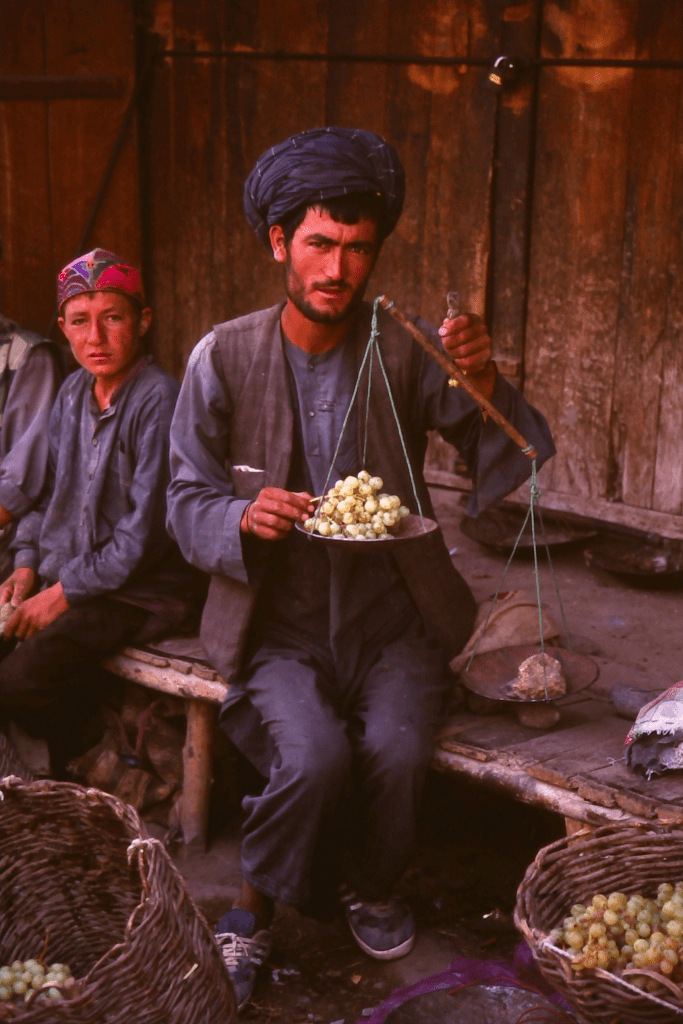
A Tajik grape seller, Faizabad, Afghanistan 1999

*****

“Welcome! Just have a look, no need to buy.”

The huge bearded Afghan stood beckoning to me from the doorway of his carpet shop in Peshawar’s Khyber bazar. It was a typical sales pitch but it soon changed when I enquired about the man who owned the shop next door. He was the son of a friend from Melbourne.

“You want to see Hamid?” he glared at me.

I nodded.

“Communisti!” The word hissed out of mouth like air leaving a tyre. His companions in the shop immediately turneds toward me and smiled sheepishly.

“Hamid is no good man. He is a foreigner. And communist. He supported Russians and speaks their language.” The man stumbled about for words to express his dissatisfaction with his neighbor. He spoke broken English and felt limited in what he could say.

“Communists. Uzbeks. Hazaras. Very bad.” He made a gesture with his finger slicing across his neck. “They are not Afghans. They are Angrez!”

I asked what he meant by calling Uzbeks and Hazaras, the most Mongol-featured of Afghans, Englishmen.

“He means they are foreigners. They have come to Afghanistan only recently. They are not true Afghans. We Pashtuns are real Afghans. The others are not. They are so small in number, not like us. Pashtuns are 60% of Afghan people. The others are only few. Miniorities, you know.” This man who spoke better English wouldn’t tell me his name but he did identify himself as working as a ‘spokesman’ for the Taliban office in Peshawar. “I know very well the Taliban. They are very good. They are against Communism and foreign domination.

“You see, we are refugees in Pakistan. It is not good for us to say that we want to control Pakistani politics of government. This is not our right. We should only sit quietly and do our business. It is not right for us to force our desires on the Pakistani public. And so it is with Uzbeks and Tajiks–though Tajiks are not so bad. But Uzbeks and Hazaras. They are refugees, not true Afghans. They came only in the last 40 years and now they want to dominate the whole country. But it is for us Pashtuns to control Afghanistan. This is our country. Uzbeks should return to Uzbekistan and Tajiks to Tajikistan. Why should they stay in Afghanistan?”

The bearded carpet seller broke in again. It is very dangerous here these days. Every day the Shi’a are attacking Sunnis. We must kill the Shi’a.”

Most Hazara Afghans, the poorest and historically most discriminated against of all Afghan minority groups, are Shi’a.

The TV in the shop began broadcasting an old Pakistani film romance. The men ignore me and lay down on the carpets in front of the TV. A woman danced through a rose and fountain garden to a lively folks tune. The men smiled as they watch the star dance.

I didn’t bother to ask them about the Taliban’s attitude toward women.

*****

The next day I had tea with an Afghan refugee family. They had come to Pakistan after the fall of the Najibullah government in 1992. They were secular, non-Pashtun Afghans. Educated abroad and middle class. For four and a half years they had lived in Peshawar.

The matriarch of the family, Hafeeza (not her real name) has lost a husband, two sons and two daughters. Her husband, a senior figure in the PDPA (People’s Democratic Party of Afghanistan), the Soviet-backed party that ruled Afghanistan from 1978-1992, was assassinated in 1989. Her eldest son and daughter were kidnapped in 1992 by triumphant and vengeful mujahidin in Kabul. “I have no idea why they were taken from me. These people hate everyone…especially people who they consider communists or Russians.

“My eldest daughter was a doctor. Since the day of her marriage I have not seen her. She may be dead. Or she may be living secretly someplace. But I’m sure she is dead because even if she was in Mazar or overseas she would contact me.”

Hafeeza had been the principal of a large school in Kabul. In Peshawar she had tried to get a job as a teacher but had been turned from every door, called a communist and foreigner. “I have even tried to have young children come here to our house for tutorials but parents forbid their children from attending because they believe I will teach them wrong things.”

She smiled ironically. Another member of the family took over. “In the schools here in Peshawar, which are controlled and run by the mujahidin and Taliban, Afghan children are taught to kill people like us.”

She puled out a text book which looked like any normal grade-school primer. Poorly drawn figures and large simple sentences filled each page. Instead of apples and kitten the lessons used AK-47s as object lessons. 1 Kalashnikov plus 2 Kalashnikovs equals how many Kalashnikovs? On the following page, a similar arithmetic problem used grenades.

“What will happen to our children? What is the future of our country if they are taught such things? They are taught to hate and kill. Their masters in school teach them that if they kill 3 Communists or kafirs they will become ghazi. No wonder they hate us. Our lives are in danger. We cannot get work and we are afraid to move about in the streets.” Hafeeza broke down.

The other family member told me, “Just six weeks ago, her only remaining son was kidnapped here in Shaheen town. He was going to an English class be he never returned. He had been threatened and warned by some bearded people a few times, ‘we know who your rather was. You are a communist and Russian.’ Hafeeza asked him not to go out but he was young and wanted to learn something. But now he’s gone and I’m sure he’s dead.”

Hafeeza stared blankly at the floor. Her only remaining child, a 19 year old daughter, comforted her mother, though she herself was in tears. “They do not go out at all these days. They are afraid after what happened. Who will protect us? We are not communists and we are not Russians. Our fault is we are not Pashtun and we oppose the Taliban. For this they want to kill us.”

The family has siblings and parents in Melbourne. But their repeated attempts to get visas to come to Australia have failed.