

I’ve been scanning a few articles and posts on LinkedIn about the crash&burn approach to USAID of the new Trusk administration. There are two broad schools of thought being advocated.
The Insider School: this is the worst possible and most unfair action taken against an agency that strives to do only good. The hardship faced by many tens of thousands employee, contractors and implementing partners down the food chain is the main objection, with many expressing solidarity with this newly and unexpectedly large cohort of jobless humanitarians. Suddenly everyone has the green halo around their profile picture; I’m Open to Work.
Indeed, this is a shitful way to begin a new year. I am not directly impacted by Trusk’s actions but suddenly my already slim chances of finding employment within the sector I’ve worked in my entire career are as close to nil as they can possibly be.
Imagine a series of ponds connected by a stream. The one at the top is full with just a few fish in it. The middle pond has lots of water but also a huge number of fish. The stream has been silting up for time and some fish have been struggling to breathe for years. Yet, for the most part the pond has just enough water and oxygen to maintain the status quo. In the third pond, the water levels are really low but the fish are smaller and seem to be able to do ok though they are constantly aware that the stream from the middle pond is getting dammed and blocked.
Overnight the top pond is drained of all its water. In a panic, the fish there move into the middle pond. But this is not a solution because the largest feeder stream is dry and the pond’s water supply has dropped by nearly 50%. But there are a huge number of new fish to accommodate.
In the third pond, fish are dying fast. Not to mention the many animals surrounding the ponds that depend on the water to survive.
It’s easy to understand the solution demanded by this group school of thought. Reinstate USAID and all its funding immediately. Turn the tap back on and let the water flow once more.
The Opportunity School of Thought: This is advocated mainly by (many) fish in the middle and lower ponds. And fisheries experts who work at think tanks and write blogs. The basic argument is: the structure of the ponds and streams was inherently unfair and broken. The top fish have always determined the quantity and quality of the water flowing to the lower ponds and for the fish in the lower ponds and the animals who depend on the water in the pond, the emptying of the top pond is probably an opportunity to rebuild the system so that it is more equitable.
No one has yet articulated what a new system might look. The prescriptions are finely articulated statements of principle that have been echoing around Aid-Land forever. They all appear to ignore the cruel reality that we fish, and the animals we support, need water. And if we are going to support a lot of animals and really attack the problems that the animals face, we need lots of water for a long, long time.
Ok, enough already of this silly analogy.
The point is that large scale development and humanitarian responses require large volumes of money. And on a steady basis. Governments are generally the only source of such largesse. Sure, there are billionaires and rich corporations but their interests are extremely narrow and self-serving. The private sector will never be a reliable source of base funding for humanitarian or development work.
So, I’m sceptical of the Opportunity school. Of course, if USAID is gone for good NGOs will adjust. Many will cease to exist altogether (not bad in itself); almost all will downsize, shrink their ambition and keep their heads down even lower. But I’m not holding my breath for a new government led aid infrastructure and financing system to emerge that will be better than the one we love to hate currently.
And there is a lot to hate. Bureaucracy. Hypocrisy. Conditionality. Compliance over assistance. Risk transfer. Salaries. Bad CEOs with no accountability. Lack of diversity at the top. Recycled thinking. Opaque transparency. Salaries. Sexual harassment and abuse. Baked-in white middle-class privilege. Over-weening earnestness. Commerical firms who market themselves as humanitarian but are profit making machines for shareholders.
But the one thing, above all other things, that sucks about the aid business is the donor-implementing partner (be they big hairy international behemoths or a local disabled persons NGO in the south Pacific) relationship. Governments are not just the only viable source of sustainable financing for aid but they call the shots. Their Congresses and Parliaments put so many ridiculous conditions on the receipt of and spending of their funds that many NGOs spend as much time, if not more, filling out reports for donors to ensure they are not violating an ever-growing number of conditions, as they do actually helping actual people.
For all our claims to be innovative and independent, we have always been beholden to what the State Department or Foreign Office wants.
This doesn’t put me in the Insider’s camp. I sympathize with those who lost their jobs. Doing away overnight with such a major pillar of the Aidland superstructure will be nothing but disastrous. And given how most countries take signals from the White House the impact on Aidland is going to be widespread and indefinite.
I don’t have a solution but frankly I cannot think of any group that can replace government funded aid agencies. 100 Soros’ can’t compete. I don’t see new scalable financing models emerging. Innovation will happen but at the local level only. Like democracy, government funded aid is the best of many flawed systems.
The Golden Age of International NGOs and AID is well and truly over. Maybe the Dark Ages weren’t really so bad.
I didn’t really learn about India until I left to attend University in Minnesota. I had lived there virtually all my life up to that point and had a slightly above average knowledge of Hindi but it was pretty rough. I understood India as the place where I felt most at home in the world. A place I identified as ‘home’. But I had only the sketchiest understanding of Indian history; the sitar and Hindi movies summed up Indian culture.
My world was largely European/American/white/Christian. Though I grew up speaking an Indian language as early as or even before English, though I had many Indian playmates and in school, close mates, and though my family in no way tried to isolate ourselves from Indians or Indian culture and society, by dint of another culture and tradition I knew precious little about, that of evangelical missionaries in India, Indian culture remained a vague notion with very few points of clarity and authentic appreciation.
This came home to me in my early semesters in University. I got into mid-level Hindi class only to discover how limited my vocabulary was and how ungrammatical was my speech. I really didn’t know how to write a coherent paragraph. The name Mohammad Rafi had never registered with me. Whilst reading a passage from a newspaper aloud in class (my pronunciation/accent was always very good) I stumbled at the reference to ‘Rafi’. As there are no capital letters in written Hindi I didn’t realise it was a name; the sentence didn’t make any sense. Ultimately, the professor, who himself had never been to India, had to tell me that Rafi was a proper name and referred to India’s most famous male singer, Mohammad Rafi.
I think my choice of South Asian Studies as my undergrad major and then my Masters in Modern South Asian history, were attempts to make up for this huge ignorance about the place I said I loved and that I called home.
After formal education my years in Pakistan enlightened me about the impacts of Modern Indian history and how tangled and fascinating is the relationship between Pakistan and India.
In 2010 I began blogging about music. All kinds. But I understood that I could create a bit of niche and a following by focusing on South Asian music, another subject about which I was almost completely ignorant. And so, my learning and education about India (in the broadest sense of that term) continued. My current research on the history of the Pakistani movie industry a.k.a. Lollywood, is the same. It seems I have an unsatiable desire to learn ever more about the subcontinent.
There was no subject more unknown to and less understood by me then the world of Hindu philosophy and religion. Naturally, missionary children were not encouraged to learn too much about it for obvious reasons. To fight this ‘dark force’ was what had brought my parents to India in the first place. But also, I had enough of spiritual instruction and religious activity in my daily life already. Daily prayers and Bible readings, devotions, camps, Bible clubs, spiritual conventions and tent meetings, church services and baptisms. The idea of trying to figure out a second religion was the last thing on my mind. Creedence and the Beatles, Dev Anand and Zeenat Aman were far more exciting fields to plough.
I still know so little about it, though I do love reading the many stories behind the many aspects of God that Hindus and Indians have concocted and pay homage to.
I was in Kerala on business. One evening I hired a taxi to visit a friend who lived near Trisshur. I wasn’t going to take my cameras but after the quiet voice reminded me, “Take your camera with you everywhere you go,” I headed out.
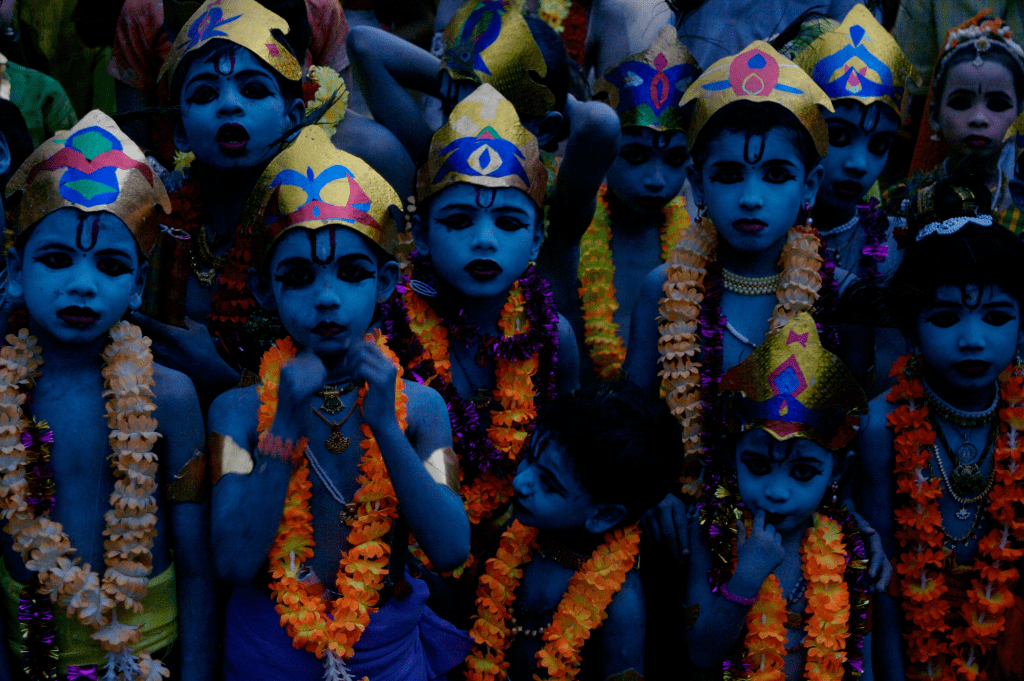
About half way there we turned a corner to find the road blocked by these young fellas.

A couple villages were celebrating Krishna Janamasthami the annual festival of Krishna’s birth. Families celebrate by swinging their youngest son around in circles and then painting young boys in blue, placing cardboard crowns on their heads and wandering around the village singing, laughing and pretending to play the flute, Lord Krishna’s instrument of love. Later, entire busloads of villagers will visit the Guruvayur Shri Krishna Temple in Thrisshur for more ritualistic and formal acts of worship. Like many places, the temple claims to trace its history back 5000 years (doubtful) and is one of southern India’s largest places of Krishna worship, something usually associated with north India.
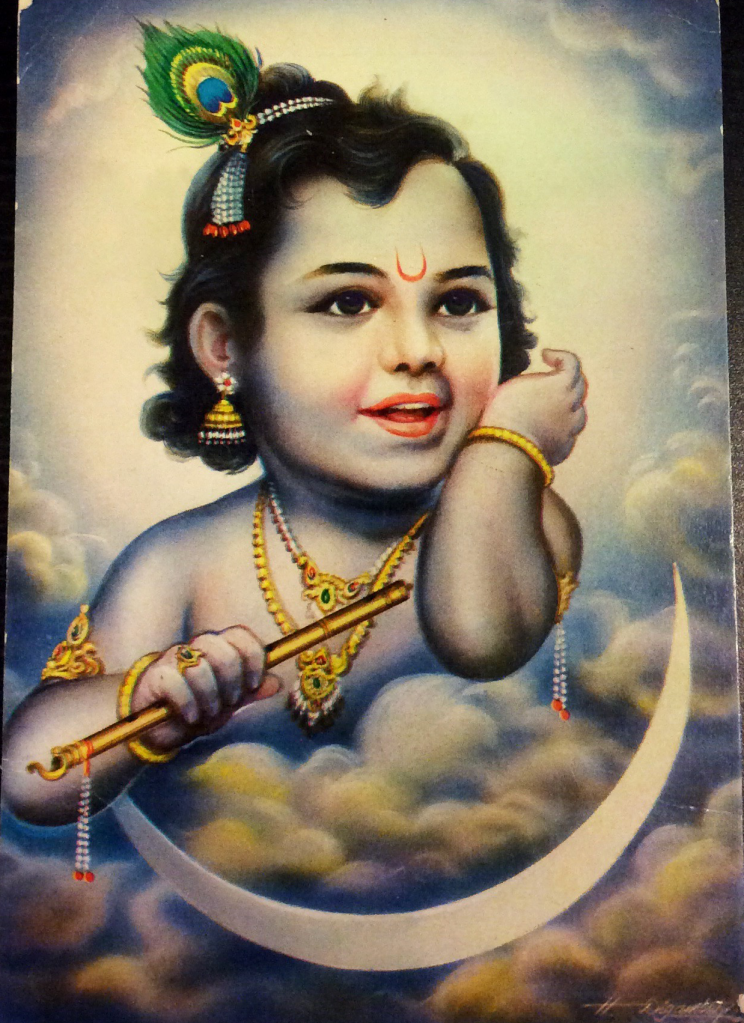
Krishna in his infancy and boyhood is known as Balakrishna, (literally, child Krishna). A stage on his life remembered for his mischievousness and antics. He is depicted in books, magazines, murals, calendars and stickers with chubby cheeks, rolls of fat on his little belly and often with his hands full of butter which he has stolen from his mother.
The following bhajan tells that story.
My bodyguards followed their orders and allowed no one to talk to me. Including themselves. From Hardwar to Lucknow, a journey of 15 hours, they kept their prisoners on a tight leash, taking turns at dozing, sometimes whispering, occasionally sharing bidis. Up on the top tier, I was left alone. Neither uttered a word to me.
When the train pulled into Lucknow, our party clanged and shuffled its way across a platform or two until one of the cops pointed at a train. “That one will take you to Pratapgarh,” he said.
With their duty done, they turned their detainees around once more and left me to my own devices.
An empty train in India is a rare thing. The one I boarded was oven hot and completely quiet. I had the feeling of entering a long steel church. There was a similar air of hope and faith that the train would soon start moving. A handful of passengers lay stretched out here and there, prostrate before the Sun god. I found a window seat on the shady side of the compartment and waited.
Eventually, the train did pull away from the station and onto the dry, scrabbly plain of central UP. I squinted into the wavy horizon. Though it must have been close to 45 degrees, I relished the way the heat burned the monsoon chill out of my bones.
The slow swaying and jolting of the carriages comforted me. I lost myself in the clacking of the rails. I was excited now. Just a couple more hours to go and I’d be home.
I must have nodded off for I was woken by someone tapping my shoulder. In front of me stood a Sikh ticket inspector in a navy blue blazer with worn cuffs. He had his hand outstretched and asked me to show him my ticket.
“I don’t have one.”
Perhaps because a representative of the Indian government itself had deposited me, Special Delivery, on this train my fear was gone.
‘Why?”
“My money was stolen and the Railway Police told me to take this train. My mother is sick in Allahabad and I’m going there.” The further I travelled the longer my opening line became.
The Ticket Inspector eyed me quietly for a minute. As he did, my courage wilted. The same panic I had felt after the Russians had laughed me out of the compound, rushed through me. I was sure the moment of my arrest had arrived.
“You do one thing,” he said after a while. “Just before we enter Pratapgarh Station, the train will stop. You alight there and walk to the city. There will be no issue of ticket-shicket.”
I nodded my assent somewhat incredulously. How was it that a man charged with enforcing the rules was advising me on the best way to break them?
Several minutes later the train did roll to a stop about 200 metres from the station. I, along with what seemed like every other passenger on the train, hopped onto the hot earth and scampered out of the railway premises through a hole in a symbolic fence standing bent and rusty 5 metres from the highway.
I’ll never forget that sardarji.
**
Pratapgarh is a small district town famous for not much. Its main role is as a rail junction and transport hub. I entered a chowk bustling with activity. People were streaming up and down the road toward the station. Buses and Tempos, India’s awkward three wheeler taxis that ferried people to remote villages off the main highway, stood three deep on both sides of the road.
Touts shouted out destinations of nearby towns and villages. Hawkers shouted the prices of their fruit and peanuts. Horns blasted incessantly. Loudspeakers attached to trees blasted Lata Mangeshkar and Rafi songs.
“Illaahabad, Illaahabad. Illahabaaad! Hey kid, why not go with us?”
A man with sweat dripping from his nose and ears and with a soiled handkerchief around his neck motioned me in his direction.
He was standing by a taxi. I couldn’t afford a taxi. I was looking for a bus. I couldn’t afford a bus either but somehow catching a free ride on the latter seemed more feasible than in a taxi.
‘Where you going?”
“Allahabad.”
“Come on. I have one seat left, Rs. 12 is all. Come on, quickly, right over here.”
He pulled me towards the Ambassador.
“I don’t have 12 rupees.”
“No problem, how much do you have?”
“None. But if you stop on Stanley Rd, across from Beli Hospital I can get you some.”
“Done,” he said. “Sit down, here.”
He pulled open a creaky door and shoved me into the back seat. I joined five other adults. Across their laps they carried a charpai, a country rope-bed that had been partially disassembled to fit into the auto. None of them could move from the weight of the wooden legs and the tangle of rope. I squeezed in as best I could, holding the door shut with my arm.
In the front seat sat another four adults. Not one of them was the driver. With his taxi now full the driver began to insinuate himself little by little behind the wheel. After some wiggling and numerous requests for reconfigurations in the passenger’s sitting arrangements, he was able to reach both feet to the pedals. His back was mostly resting against the front door which caused him to maneuver the wheel with distinct awkwardness. As if he was puppet with broken arms.
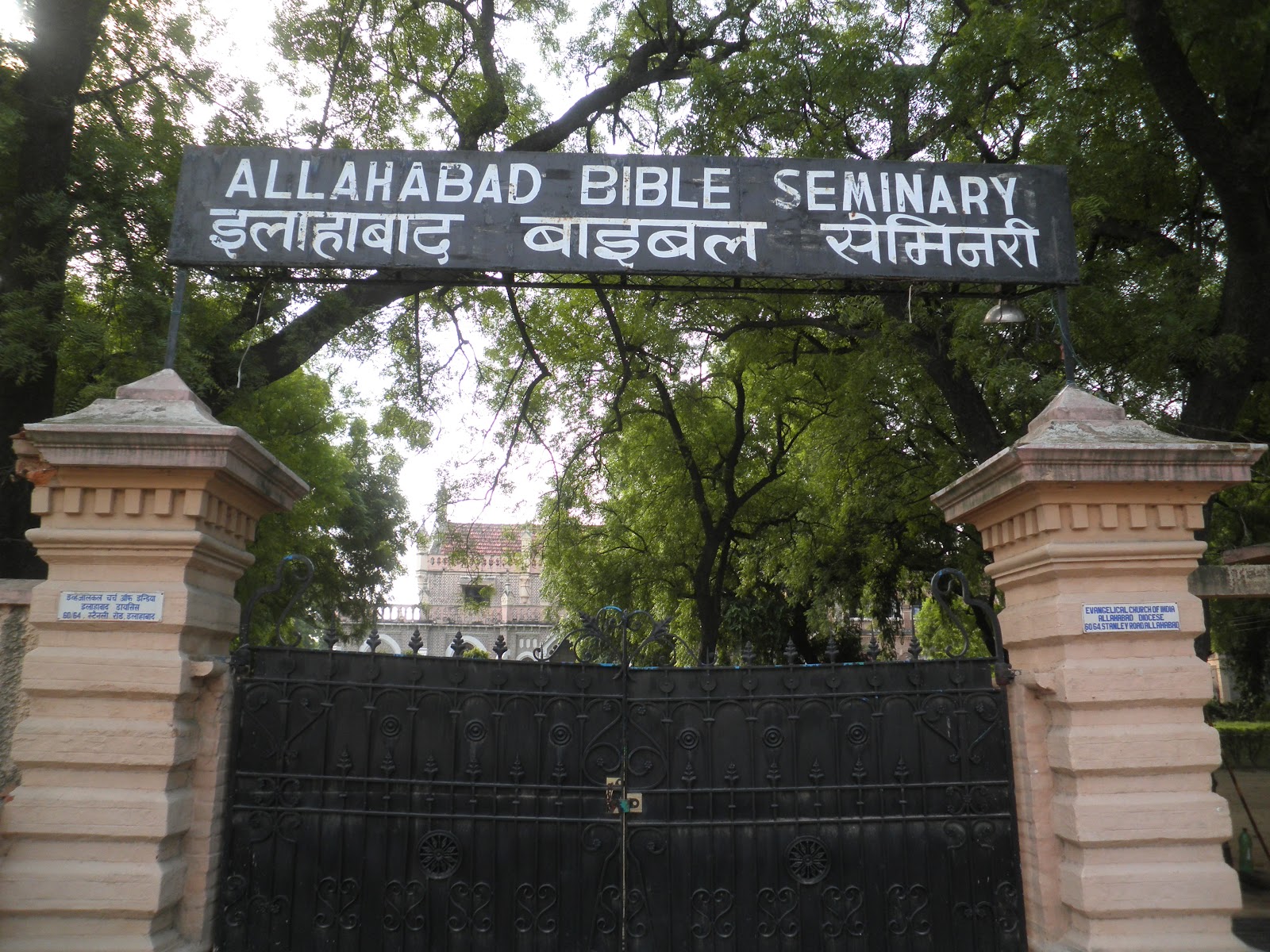
Somehow, by stretching and nudging the gear shift with the very tips of his fingers, the driver got us rolling down the highway. Inconceivably, in every little bazaar we passed through he shouted out loudly, “Illahabad. Kacheri chowk savari. Jaldi aa!” as if he were the only one in the car. Luckily, no one took up his offer and an hour and a half later just as the hottest sun of the day was turning into cool evening, we stopped in front of Allahabad Bible Seminary.
Before I managed to tell the driver to wait while I got Rs 12 from my parents, the car lurched and sputtered down the Grand Trunk Road.
48 hours after leaving Mussoorie I walked into the shady compound of home.
**
My parents were expecting me. Mr. Kapadia had called to inform them that while the school didn’t know my exact whereabouts, “I suspect he’s on his way to you.”
I spent a week at home. When my folks grilled me about what had caused me to take such a drastic step I didn’t know what to say. For the entire journey I had operated on the principle of forward motion. I didn’t doubt my feeling that I needed to be home and had spent no time analyzing why I had bolted.
I had no words to express the oppression I felt inside. The monsoon, the mist, the mountains, the Bible Club, the school, the cold had all worked to make me feel agitated and disconnected. Out of sorts.
My sister Beckie had graduated that summer and gone to the States for college. I was the last of my siblings, so perhaps I felt alone and vulnerable. Without an older brother or sister as a reference point boarding school seemed more scary and hostile. All I knew for sure was that I had an overwhelming but inarticulate need for home.
After a week my dad put me back on the train. “We told Mr Kapadia that he has our agreement to punish you in whatever manner the school decides.”
It was matter-of-fact statement. I didn’t care. My inner battery was recharged.
When I got back to Mussoorie I felt strong and connected. And heroic. People that I had admired or been intimidated by looked at me in awe. “Rabe, you actually ran away! Far out!”
I don’t know if anyone followed my example but for a brief moment I considered myself a trailblazer.
Mr Kapadia informed me that I would be gated for 10 days. No extra curricular activity and straight home after school. I was to serve my sentence in the home of the Harpers, whose son Phil, was a classmate. Mrs Harper, a vivacious, larger-than-life, extremely liberal minded woman welcomed me with love, a no-nonsense attitude and French Toast for breakfast.
“If you ever want to run away again,” Mr Kapadia told me when it was all said and done, “just come to me. We’ll have a talk. If you want a cigarette I’ll let you smoke in my house. Just don’t frighten everyone by disappearing!”

We’ve completed the circle. We Americans have gone out into the world, seen what we’ve seen, come rushing back home slammed the door shut and fitted out the house with surveillance cameras, automatic machine guns, potbellied camo boys with tattoos that scream like John Prine’s* waitress, “Make America Great Again”, a moat slithering with crocodiles and snakes and a steel wall.
We are ugly Americans again. Led by Mr. Uggers himself, DJT. His Pestilence is assisted by a black shirted, Seig Heiling immigrant who fled Apartheid not because he opposed it but apparently because he sensed the USA’s soil was more fertile for such diabolic Dogebags** as he.
They say JFK read the novel The Ugly American and felt shame. Soon afterwards he announced the Peace Corps. And created USAID. Not so every child in Asia could have cotton candy every morning but because he and his bros believed the USA could win friends by being decent.
Now his nephew sparks outbreaks of measles in small Pacific Island states.
We’ve completed the circle. We Americans are ugly again.
* His 1972 song, Rocky Mountain Time, goes:
I walked in the restaurant
For something to do
The waitress yelled at me
So did the food
**A brilliant turn of phrase from Jon Favreau, former speech writer for Obama, who coined it to describe the youngsters tearing down the Republic.
The Russians were easy to find. I heard their tipsy, vodka-soaked laughter coming from a shady part of the compound. Four or five of them were sitting on adjacent porches of their apartments, their fleshy faces flushed red with heat and drink.
As I approached, silence fell.
I smiled, hoping it would break the ice. It didn’t.
They stared at me, obviously perplexed and irritated that I had interrupted their lunch break. One of the women whispered something to her friend.
“Excuse me,” I began.
By now I had my tale-of-woe down pat. I told them my mother was ill and I needed some money. “I need to get to Allahabad, about 700 kilometers from here,”
“No. No money,” one of them said.
A couple others joined in the chorus. “No money. Go away.” A man with huge arms and angry eyes said it louder than the others. With real authority.
Having spent 8 years in boarding school I knew a lost cause when I met one. I turned back toward the gate.
But I was dying of thirst. With a drinking gesture I said, “Could I have some water?”
This second request really set them off. Amidst the general clamor of, “No water. Go!’, one of the men made a move towards me. He didn’t follow me but I didn’t have a the courage to turn back and check until I was several meters down the path I had come up just a couple minutes earlier. When I did turn they were still tense. They glared at me but as I retreated the laughing resumed.
A mali was sitting in the shade on his haunches watering a guava tree. He beckoned me over.
He held up the hose for me to drink. He didn’t say much and I didn’t offer anything. I have no doubt he had been watching the scene play out from a distance. I sensed it was one he himself was familiar with. I took his kindness as an act of solidarity.
The thought of a 10 km ride back to Hardwar in the midday sun depressed me, especially as I was no richer for my effort. I was too spent to formulate my next move, but I knew I needed to be in town where there existed at least the potential of assistance.
I must have looked miserable pedaling along the highway because out of nowhere a man appeared. He had well oiled, wavy hair that glistened in the sun. He wore narrow legged pants and a plaid yellow shirt. I can’t remember how it happened but he successfully commandeered my bike, sat me on the rear carrier and began cycling toward Hardwar.
Despite the heat, we got a bit of breeze going which cooled my cheeks slightly. I vaguely remember the Stranger talking to me but can’t recollect about what. Before I knew it we were back at the Station. He dropped me at the cyclewala and even paid the outstanding balance. Then with a nod of his head he disappeared as unexpectedly as he’d appeared.
**
I retreated to the relative comfort of the 1st class Waiting Room. I dozed on a rattan lounge chair with extendable arms that doubled as leg rests, one of the distinctive artifacts of railway waiting halls in those days. But I was hungry. And more than a little anxious about how I was going to make the next leg of the journey.
A middle class family were the only others in the Waiting Room. The patriarch reclined on a rattan chair like mine, staring blankly at a ceiling fan that swayed as it whirred. From time to time he lifted his buttocks and farted. But other than that, he didn’t move.
He may have been oblivious to me but I had been watching him for some time. After one of his farts I cleared my throat and in my best Hindi launched into conversation. I learned they had come to Hardwar on yatra (pilgrimage) and were now heading back home. I asked him about his business (the nature of which I’ve forgotten) and may have said a nice thing or two about his young child.
As a conversationalist he was unenthusiastic.
“My mother is ill,” I offered, hoping to pique his interest.
He may have nodded, but if he did, it was ever so slightly.
“I need to get home. To Allahabad. But I have no money.”
“Why do you not have money?”
“I was robbed,” I found my mouth saying. I couldn’t believe it. But I was in the water now, so I had to keep paddling.
“This morning on the way from Dehra Dun, it was very crowded in the bogie and when I got here I realized someone had stolen my money.”
He looked at me skeptically.
“Could you provide me with Rs. 20, so I could get a ticket? My mother is very ill.”
“You must report to the Railway Police, if you have been a victim of theft.”
As far as he was concerned the conversation was over. The spinning fan captured his attention once more. I felt foolish but let a decent interval pass before shuffling out of the Waiting Room.
**
Once again, 24 hours after the first occasion, I entered the office of an Indian Railways bureaucrat. I had mulled over what the farting businessman had said. He was absolutely correct in his observation that the Police needed to be notified in the event of a crime. But in this case there had been no crime committed so fronting up to the Police would not be the smartest tactic. On the other hand, I was clean out of options.
The Railway Police office was shabbier than the Station Master’s in Dehra Dun. The man behind the desk had a pot belly and sweat stains all over his khaki uniform. His closely shaved head sported a choti, the little tuft of hair that identified him as a high caste Hindu. Unlike the Station Master his face lit up when I stood in front of his desk.
“Kya baat hai, baba?” he asked. What is it, lad?
Though he addressed me in Hindi he clearly didn’t expect me to respond in kind.
“Meri ma bimaar hai, aur mere paas ticket ka kiraya nahi hai,” I said, laying down the by now firm foundation of my story.
“Arey! Hindi bolte!” His belly jiggled with delight. “Ay shabaash!”
Before I could continue with my dishonest story he shot a series of questions at me in an attempt to come to grips with the fact that a white kid could speak Hindi.
I told him about me. I was American. I studied in Mussoorie. I was born in India. Rajesh Khanna was a good actor, yes.
Whereas the Station Master in Dehra Dun had instantly linked Woodstock School and my being in his office to funny business, this jolly man didn’t give a stuff. Indeed, he was hooting to a couple of underlings about what a spectacular thing I was.
Somehow in the midst of this excitement I managed to explain my dilemma: 700 kms. No money. Sickly mother.
Before I knew it he grabbed my wrist and dragged me out of his office. A couple of minutes later we were seated at an open air dhaba that sold tea and fast food to the throngs around the station.
He instructed the dhabawala to give me a plate of curry and a few chapatis. “This fellow is American but born in India! It’s true. And he speaks spasht Hindi! Just listen.” He could hardly contain himself.
Though my mouth was full (this was my first food in nearly 36 hours) I knew this was price I had to pay for my dinner. A small crowd had appeared; rather the endless crowd of passersby stopped for a moment to look at me. It was my cue.
I restated in Hindi what I had told the Policeman a few minutes earlier, that I was American, born in India, lived in Allahabad but studied in Mussoorie.
People marveled and exclaimed. The Policeman couldn’t have beamed wider had I been his son. He ordered my plate to be filled. I ate up. He continued to hold court but eventually passersby grew bored and the rhythm of the bazaar returned to normal.
The Police Inspector led me back to his office. I was grateful for the meal but had no idea how I was going to make it home.
He pressed a buzzer on his desk which immediately produced an underling. The underling was sent forth to find others and after several minutes returned with two colleagues who carried rifles and bulleted shoulder straps. They noisily pushed a pair of prisoners into the office in front of them. With their legs and wrists in irons the prisoners shuffled and clanged like cheap robots.
The inspector didn’t move from his desk and in a loud voice told the newly arrived cops that they were to include me in their party. They were on official duty, transporting criminals from Hardwar to the state capital, Lucknow. “You take this boy with you to Lucknow but do not let anyone, and I mean anyone, speak with him.”
With that, the chubby Police Inspector himself walked me to a train and bade me bon voyage. I was on my way at last. Still with no ticket but a pair of personal armed guards.


 Missionaries, Mercenaries and Misfits