The Book of Accounts (Instalment #3)

The others were jealous of the little space they shared, and stared at the newcomer with resentment. I want to sleep but my mind wonโ€™t be still. Is this Quetta? Am I a criminal to be kept with these rats? Abdul

Rahman surveyed his companions. Two or three were sleeping but the others averted their cold eyes whenever the newcomer looked in their direction. Iranians. But that one over there scratching his balls, he’s no Persian. Too dark and hairy. Pakistani? Afghani probably.

The itchy Afghan seemed separated from the Iranians by an invisible glass wall. No one spoke to him. He ignored everyone. Was he mute? Someone patted Abdul Rahman’s arm and broke his examination of the Afghan. The Arab turned irritably to see a thin boy with oversized round frames on his nose holding up a cigarette as if it were a major discovery. He made it clear he wanted a match. Abdul Rahman stared at the boy for a few seconds with slowly narrowing eyes then turned his attention back to the Afghan, who yawned and scratched his armpit before shifting his shoulders against the wall as if he believed it was made of silk cushions and not hard hot cement.

โ€˜Marhaba. You’re an Arab isn’t it?โ€™ The kid with glasses had put the cigarette behind his ear. โ€˜I can tell.โ€™

Abdul Rahman muttered, โ€˜Leave me alone.โ€™

โ€˜A difficult request to fulfil,โ€™ said the kid glancing around the lockup. โ€˜How is my Arabic?โ€™

Abdul Rahman said nothing. Refused to look at the squirt. He put his head on to his knees and closed his eyes.

โ€˜I lived in Najaf for three years. Studying the traditions. After Imam Khomeini of course, but still, there were many other wise teachers in the madrassa. Are you from Najaf?โ€™

Lifting his head Abdul Rahman planned to tell the boy his conversation was of no interest. Words started to form but just before reaching his tongue they sank deep within him again, like anchors heading for the ocean floor. Each word carried the weight of years. Who had the strength to pull them up? He closed his eyes and placed his head against the concrete wall and muttered, โ€˜So tired.โ€™

Then he fell asleep.

*

The light and heat bored into the room like a magnifying glass burning dry leaves.

Though he had been asleep, he thought, for hours, his mind was just as wobbly as before. The sun was a long time away from setting. The green door had been opened slightly to allow some air, but the turbans and carbines were still on the other side. The kid next to him had found a match. He was sharing a smoke with a middle-aged man whose purple shirt was ruined by the dry whitish stains of sweat that hung in rings under each arm. The fag passed languidly from one set of fingers to the other. Wisps of smoke moving like a belly dancer in slow motion twisted towards the door. A game of Three Two Five played by the guards was the only sound. Thup. A card slapped the floor. Thup. Thup. The others threw their cards down like gauntlets. Thup.

Abdul Rahman considered his situation. He wanted to select his next move but until he understood where he was, how could he? Who were these others? Must be like me. Crossing into Pakistan without papers. For what? The idea that others might be in the same boat as he, that these men and boys were also running for their lives, seemed ludicrous. Indeed, he had never considered that he was running from anything. More like towards something. But what he couldnโ€™t say. At least not out loud. Or even to himself. The one thing he sought was an impossibility. Don’t be ridiculous, he scolded the part of him which insisted upon whispering her name. But now that his forward motion had been stopped and he found himself under arrest in an airless desert lockup in the middle of nowhere he admitted that he had been running to save his life. He shivered involuntarily.

The feeling of relief, almost joy, which had washed over him when the fat manโ€™s soldiers had pulled him up the hillock to the lockup had been displaced by a stronger feeling of humiliation. How could I have done a deal with that black bastard? Knew he was a snake. And then he saw Bashirโ€™s gaudy hat and his only money disappearing under it and the shame soaked deeper. Such a ridiculous team. But they took me. He would have laughed but it required too much.

The lethargic strings of cigarette smoke caught his eye again. As he followed the swaying movement Abida came into view. His wife had fallen asleep in front of the television; she still clutched the remote control. Her cheeks were pudgy. Abdul Rahman liked them that way. Healthy and baby-like. Suddenly, the Pakistani doctor was rocking his head back and forth telling him about the saintโ€™s tomb but then mid-sentence he disappeared, making way for Zubeida. She was singing his favourite song. And with his head resting against the concrete wall, Abdul Rahman let the song be his lullaby and he nearly return

to sleep, but the ugly dark face of Fuโ€™ad popped into view. He rubbed his eyes as if they were the dials of a radio and tried to recover his daughter’s voice, but as much as he cursed and threatened his mind its power to grasp any idea for longer than a few seconds was gone. His inability to hold the reins of his ideas worried him. Havenโ€™t been thinking properly for weeks. How else could he explain giving money to that black bastard, Fuโ€™ad? And letting those grease monkeys deprive him of the last of his cash without so much as a bleat?

*

The sun set, and with it disappeared the warmth. Sleeves were rolled down and collars buttoned. Some men rubbed their arms because they wore only T-shirts. Abdul Rahman zipped up his leather jacket. The cool evening had everyone talking. The Afghan (obviously not a mute) was arguing loudly with the turbans on the other side; Abdul Rahman thought he understood the Persian word for piss. Iranians chatted in groups of twos or threes, their teeth lighting up slightly as the darkness grew. Fag ends glowed and dimmed like June bugs on a summerโ€™s night.

The kid with glasses smiled and remarked that Abdul Rahman seemed to be very tired and did he feel better now. Abdul Rahman grunted an indistinct and uninformative response but the boy didnโ€™t mind. He appeared satisfied that Abdul Rahman had responded at all. He was about to say something more when the green door rattled open and a dim electric light, lonely under the dust and hanging from the middle

of the ceiling, flickered on. The fat man who had arrested Abdul Rahman earlier in the day stood before the men like a Mexican warlord surrounded by granite-faced, turbaned bandeleros. He was still in bedclothes as far as Abdul Rahman could see, but they were pressed stiffer and whiter than paper.

He spoke. Every time he hesitated or took a breath the Iranians bombarded him with questions and shook their fists. A few minutes passed and then the fat man in white pyjamas turned and waddled away like a ghost receding into the night. Abdul Rahman had understood nothing. The boy scooted closer to Abdul Rahman and said, โ€˜An official from the UN is coming. Here to Nuskhi.โ€™

โ€˜Nushki?โ€™ mumbled Abdul Rahman. โ€˜This is not Quetta?โ€™

The boy giggled. โ€˜Oh no! Quetta is a big city with airport and trains and hotels. And a UN office. They are sending an officer to interview us. That is what the fat man says.โ€™

โ€˜Interview? Why interview? Have we committed crimes? I have never broken the law. Who has the right to interview me?โ€™ Fu’ad had failed to mention the UN was interested in asking questions. Abdul Rahman cursed the African another time.

โ€˜Oh, don’t worry, sir. The UN is not police. The questions they ask are for purposes of helping us.โ€™ Abdul Rahman was dubious. โ€˜Believe me. Truly. Simple questions: your name and why you left your country and your job. On that basis you will receive assistance.โ€™

โ€˜You know quite a bit.โ€™

โ€˜My cousin told me. He came this way two years back. Now he is in Norway!โ€™

โ€˜Norway?โ€™ The concept was laughable. The boy could have said his cousin was on the moon and it would have been more believable.

โ€˜Yes! Sent by the UN!โ€™ The boy beamed in the dim light. โ€˜I intend to join him there.โ€™

Abdul Rahman asked who the fat man was.

โ€˜The District Commissioner, sir. A big shot in this country. He’s the king of this desert. All the way from the border to Quetta, his word is better than Allah’s.โ€™ The boy lowered his eyes as if he had just blasphemed.

โ€˜I must have him release me. When will he return?โ€™

โ€˜Without an interview, no one is to be released. That is what he said,โ€™ the lad rubbed his feet vigorously against the night that was becoming colder each minute. โ€˜How is my Arabic, sir? You have not said. I don’t like to keep asking but I believe it isn’t bad, eh?โ€™

The boy’s presumption that he could just keep on addressing Abdul Rahman like he was his uncle rubbed him the wrong way. But he needed the punk’s information. โ€˜Your plurals need work. What else did the fat Commissioner say?โ€™ Abdul Rahman asked. โ€˜Must speak with him,โ€™ he added but more to himself than to the boy.

โ€˜No one is to be released until the UN interviews us. Then, he said, the UN will decide everything. If they agree, we will be released and

taken to Quetta and given refugee cards. If they, the UN, do not agree he, the fat one, will send us back to Iran. Pakistan has, he said, plenty of refugees already. More than three million. There is no more room for you fellows. That was his phrase exactly. You fellows.โ€™

โ€˜What will he do with me? I am not from your country.โ€™ Something to be grateful for. Abdul Rahman sensed relief creeping back. The fat man thought he was an Iranian asylum seeker like the rest of these brooms in the closet. What he said was for them, not Abdul Rahman.

โ€˜He will send you to your country.โ€™ The boy’s attitude was matter of fact. He spoke as if he were already in a queue waiting to board a plane for Norway, not shivering on the floor of a Pakistani jail. Abdul Rahman did not share the boy’s exuberant naivetรฉ. Iran was a dangerous place to return to. Iraq, certain death. Must get out of here. Must find that fat man again and tell him I am not like these others.

โ€˜I do not want to go to Norway,โ€™ Abdul Rahman was thinking aloud.

โ€˜Oh, don’t worry, sir. Norway is my destination. You can choose Australia or England or Germany or even America. Everyone is eager to go there. I too, but my cousin, he’s in Norway, and he said he will find me work and I can carry on my studies. After learning Norway language, of course.โ€™

โ€˜No country. I do not want to go to any country. Norway, America, England. Nowhere. I want to speak to the Commissioner. That is what I want.โ€™

Unbelievable! The boy could not trust what he heard coming from the Arab’s mouth. โ€˜If you do not want to go to any country,โ€™ he stopped and scratched his ear, โ€˜why then are you here?โ€™

โ€˜They will kill me,โ€™ was all Abdul Rahman said. He turned towards the wall, lost in thought. The boy’s question was reasonable, at least part of it. Why am I here? Until he confessed that he feared for his life he had not thought through his decision to flee Iraq. Certainly the idea of ending up in such a place as Norway had never even suggested itself. I am here because, he started to put the thoughts together, they would have killed me if I had stayed. Where am I headed? He stopped. No answer to that. I had no plan to come even to Pakistan. It was the next place to go and Iran was dangerous. They too, would have killed me. Just for fun. Fu’ad said UN would give me papers and money. But this news about interviews and settling in Europe… I want the papers. Papers are good to have for protection. And I need money. The fat man. He will understand if I tell him I want to stay here. Not here, exactly, in this place. But in Pakistan. I’ll go to Peshawar, that saint’s tomb. Need rest and quiet. I need the fat man. He can save me.

Jumping up as if he had been administered a jolt of electricity Abdul Rahman stumbled over the shoulders of the Iranians and shouted in Arabic, โ€˜Open the door. I want to see the Commissioner. Open the door!โ€™

The Iranians laughed. The guards on the other side of the door banged loudly and yelled something. From the far wall the young kid called out: โ€˜They are telling you to keep quiet. Food is coming. Then we will piss!โ€™

โ€˜I am not hungry. Tell them to open. I need to see the fat man.โ€™ Abdul Rahman banged the door again and yelled, โ€˜Open! Open! Open!โ€™

The Afghan with the itchy balls tugged Abdul Rahman’s jacket and tried to pull him to the floor as he was standing on the Afghan’s foot. Abdul Rahman slapped his hand away and continued to bang on the door.

โ€˜Hey! Saudi donkey,โ€™ the Afghan growled. โ€˜Get it off or I’ll break it off.โ€™ A second more violent pull of the jacket brought Abdul Rahman to the floor and on to an Iranian who had been watching the show with a grin. Abdul Rahman reached out without thinking to steady himself and pulled the Afghan’s thick black beard. From beneath him the squashed Iranian no longer was grinning; he was struggling into a position from which he could push Abdul Rahman off, which he did. Abdul Rahman sailed into the arms of the Afghan. The bundle which Abdul Rahman had not let go of since his ejection from the lorry fell to the floor. He scrambled and reached for it, but the aggrieved Afghan grabbed him by his neck as if he were a lamb and said, โ€˜I would give my mother to the communists to fuck before I let you cause any more trouble. Go back to your little boy and let him lick your wound.โ€™ The Iranians let loose a chorus of whoops and laughter at this but the Afghan didn’t release the Arab. He enjoyed humiliating the man and took the smiles and catcalls of the others as if he had masterfully recited one of Hafiz’s more humorous poems. He was thinking of another thing or two to say when Abdul Rahman’s elbow caught his open chuckling mouth and cracked his teeth together. The Afghan’s grip loosened, allowing Abdul Rahman time to twist around and grab the man’s hair in one hand and, with the other hand, press the blade of a red pocket knife, drawn from no one saw where, against a huge throbbing blue jugular.

โ€˜Time for a shave, hairy monster.โ€™ Abdul Rahman breathed heavily, but his fatigue had left him and his grip was like iron. The blade moved up towards the Afghan’s nose and into one nostril. โ€˜Moustache a bit bushy too.โ€™ As he withdrew the blade the slightest trickle of blood appeared on the Afghan’s nose. โ€˜Mother’s cunt,โ€™ Abdul Rahman spat. The room was silent. โ€˜Tell them out there I want to see the Commissioner.โ€™ Abdul Rahman was looking for the young boy who spoke Arabic with bad plurals. โ€˜Or else this heap of Afghani shit will never live to see his mother buggered by Gorbachev.โ€™

The boy’s voice quivered, but he did what Abdul Rahman said. The guards opened the door and immediately grabbed Abdul Rahman and pulled him off the startled Afghan. On the way out Abdul Rahman scooped his bundle from the floor, and as the doors shut again he smiled. Especially for the Afghan.

*

Another building and into a room. Abdul Rahman looked at the bed with a sheet and pillow, and at the chair. They beckoned like a naked woman. For an instant he actually thought they were for him. Two candles, one nearly burned completely, and a box of matches. Under the bed a small tin suitcase. Two windows, both without glass, made of warped wood painted green just like the door of the lockup.

One of the guards pushed him with unnecessary roughness to the floor and positioned his rifle near his forehead. The second guard ran into the darkness. The man with the rifle muttered under his breath at Abdul Rahman, who could sense the man’s nervousness and that the rifle was probably empty. But he had no plans to keep up his show. They got the message. The fat man will be here soon. He leaned against the wall and crossed his arms over the bundle in his lap.

The bundle was heavy and covered with a faded blue cloth. It was rectangular and appeared to the nervous guard to be a large book of some sort. Like a really nice Koran, the type you buy for 300 rupees and that has gold flowers printed along the edge of each page. Or like the book in the District Commissioner’s office where all the criminalsโ€™ names and particulars are registered. None of the Iranians or this man had been registered. They must be special. This one sure is. The guard poked the rifle at Abdul Rahman as a menace but the Arab didn’t flinch.

โ€˜Arabi?โ€™ the second guard had returned with the fat man who wasn’t speaking. He had the expression of someone whose amorous intentions had been thwarted with a slap. The guard asked Abdul Rahman the question again. โ€˜Arabi?โ€™

Abdul Rahman nodded.

โ€˜Mujrim!โ€™ This was the fat man. Spitting the Arabic word for criminal.

โ€˜La. Ana mohajir.โ€™ Abdul Rahman answered in Arabic, pleased to discover the fat man understood his language.

โ€˜A refugee, huh? That’s what you told me this morning.โ€™ The fat man pulled his white pyjamas up and sat on the string bed. The guard with the rifle jumped away as if he had been singed by the shadow of the Almighty.

โ€˜Exactly,โ€™ said Abdul Rahman. โ€˜I am a refugee. You must help me. I do not…โ€™

โ€˜You have no manners. Fucking Arabs. Don’t know how to address your betters, huh? The same as this morning. Very rude you were. Where are you from? Saudi? Don’t think so. Too much money in Saudi for anyone to want to escape. Syria?โ€™

โ€˜Iraq.โ€™ Abdul Rahman snapped.

โ€˜Ah! Of course. That explains your poor behaviour. How civilisation began in such a place is a deep mystery. Look at you. Without the faintest notion of civilisation.โ€™ For a few seconds he watched Abdul Rahman as a falcon would a small sand mouse. โ€˜They tell me you are a troublemaker. A real Iraqi rabbler, huh? Did you hope to kill that Afghan? Huh? Killings can be arranged.โ€™ The fat man had eyes like dull black buttons.

Abdul Rahman said nothing. His hopes of persuading the Commissioner to sympathy were nearly crushed. But the sand mouse feared nothing and returned the falcon’s stare.

โ€˜What do you want me for? I am just about to make my evening prayers. It will not be good for you if you irritate the Creator as well as me.โ€™

โ€˜I am a refugee. I apologise for my behaviour but I am not in the same class as those boys andโ€ฆanimal, I may say in one case. They are seeking flights to Europe. To join their brothers and cousins in Sweden and such places.โ€™

โ€˜They are also refugees,โ€™ the fat man growled. โ€˜Or asylum seekers hoping to become refugees. Chrysalises bursting to be butterflies.โ€™ His laugh was dry like the air.

โ€˜They are tourists. I am a refugee. I will be killed if you return me.โ€™

โ€˜That is not for me to judge. Perhaps you will be killed. Perhaps you deserve to be killed. I do not know. These are matters for the UN to decide. They are expert. I am not. In such matters at least.โ€™

โ€˜I do not need the UN. If an interview is essential I will tell you. You can ask me what you will.โ€™

โ€˜No interest. None at all.โ€™ The fat man flicked a tiny fleck of snot from his fingers. โ€˜Your life bores me. UN in Quetta has agreed to send an officer to interview all of you as soon as possible. They will decide who is on holiday and who is a refugee. For your sake I hope they find you not to be a tourist as you so confidently accuse others.โ€™

The fat man stood up. His belly was huge but didn’t quiver as Abdul Rahman expected. How he was able to touch his forehead to the mat during prayers was hard to imagine. โ€˜Tomorrow we will find a more suitable location for an anti-social Arab. One more thing. The UN will not be here for a few days. Should I even hear your name mentioned…what is it by the way?โ€™

โ€˜Abdul Rahman.โ€™

โ€˜Mr Abdul Rahman. If I even hear that name between now and the time the UN makes its esteemed decision on your fate, I will personally drive you to Karachi and hand you to the Iraqi chargรฉ d’affaires. Do not doubt me. God bless you, huh. Mr Iraqi refugee.โ€™ The fat man left to pray.

The second guard went out and when he came back he carried a leg iron which he fastened to Abdul Rahman’s left ankle. A steel bar connected the iron ankle ring to a heavy set of chain handcuffs. Then he clanked like a mechanical man and was marched across the sand, back to the lockup. All night he sat on the floor with his leg extended in front of him and his hands chained together. His bundle was kept on the desk where the guards sat. Around ten o’clock he was given a dry chapati, half an onion and a cup of sweet milk tea.

In the morning with the iron still wrapped around like ceremonial garments, he was led down the main road he had walked up the previous morning. Except in the other direction. Camels opened their eyes but didn’t stop chewing their cud as he clanked clumsily along. Buses slowed to let passengers stick their heads out the window to gawk and two boys pushing home-made cars made out of bent wire and beaten tin giggled just behind his heels until the guards stopped behind a petrol pump. A door to a dark storeroom stacked almost to the ceiling with leaking drums of oil and wet rags and reeking with the fumes of benzene and rubber was kicked open and he was pushed inside. A small space had been cleared and a grass mat placed on the dirt floor, which glinted a silvery grey from years of sucking in oil. Thank God, there’s a window. And so there was. It was barred, and towers of oil filters and other auto parts in cardboard boxes blocked

out most of the light. But air would circulate if a breeze bothered to blow. The temperature in the hole was higher than outside, but next to the grass mat, like valets awaiting their master’s orders, stood a plastic five litre jerry can and an enamel mug with an orange rose-like flower painted on one side. The water was lukewarm and the mug was grimy. There was no light and no candle. No matches. Too much oil to risk that.

The guards removed the leg iron and locked the door behind them.

All the comforts of Baghdad. Abdul Rahman forced an ironic smile, but then panicked. His bundle. It was still with the guards. Immediately, he kicked the door and shouted. Nothing in particular just lots of noise and loud.

โ€˜Sisterfucker!โ€™ The door flung open and the turbans stepped in. One grabbed Abdul Rahman’s arms and the other slapped him, first once and then twice more in quick succession. Then again and again. Each time saying, โ€˜Sisterfucker.โ€™ Slap. โ€˜Sisโ€™ slap โ€˜terโ€™ slap โ€˜fuckโ€™ slap โ€˜erโ€™ slap. Abdul Rahman waited until it was over then said hoping they would understand, โ€˜Kitab. Kitab. Book. My book.โ€™ He carved a squarish shape about the size of his bundle in the air and repeated the word again. โ€˜Kitab.โ€™

Some more slaps. โ€˜Low dog.โ€™ Slap. โ€˜Motherfucker.โ€™ Slap slap. โ€˜No. No. No. No book!โ€™ Another tight one for good measure. The man holding Abdul Rahman grew tired and asked his friend to stop. They pushed Abdul Rahman to the ground and locked up again. This time they refused to open the door no matter how loud he shouted, and after more than ten minutes Abdul Rahman fell to the ground, more alone and frightened than he had felt since the day he’d left Baghdad. All

day he paced the small space of the oily shed. The heat had no effect and the darkness and lack of wind he hardly noticed. The book. This is hell. What are you doing, you fool? Have you lost your mind to leave it? They will burn it or shred it and laugh. Animals have no way to value such things. He strained to see if he could find a way out of the hole. The window was impossible: three armed turbans sat slurping tea just waiting to greet him if he should try something stupid. The door was weak. Pop that thing open in a blink, but they’ll shoot me this time. Let them shoot me. I must have it. Never has it been without me. Ever. Not until now. Oh God. What hell have you dropped me in? My mind is going. Unable to keep the simplest things in line.

The day crept by like a snake shedding its skin. Abdul Rahman was in torment. He returned to the window every few minutes, hoping that not only the guards but the bars too would have disappeared. He paced the less than two-metre space, cursing himself and the fat man and the Afghan and that Sudani bandit and the day Zubeida had disappeared. It was from that day, years ago now, that fate seemed to have washed her hands of Abdul Rahman and left him to dangle. Several times he smashed his fist into the brick wall and when he closed his eyes he could see the bundle where he had left it the night before, on the desk in the lockup.

In the evening a guard handed him his chapati and tea. No onion this time. Just a wilted piece of radish lying shamelessly exposed in the breadโ€™s lap. He swallowed the radish and gulped the tea after he had soaked the bread. The jerrycan was nearly out of water. His feet and hands were black from the grease that covered everything in the shed. Inside, he raged at himself. Cursed his name. Spat on his existence and stomped his thoughts into the black dirt below him. At last, a few hours after nightfall, the sound of rattling outside the door

had Abdul Rahman up on his feet again. He knew they were back with the leg iron but he didnโ€™t care. They’re taking me back to the lockup. I’ll recover it now! He was like a child waiting on the night before his birthday party. He nearly jumped with excitement.

Three men with guns greeted him. The slapping-addict stepped forward with a threatening grunt and got to work putting the leg iron and chains on Abdul Rahman’s ankle and wrists. Time for a piss. He was led slightly away from the door then made to stop. He pissed on to the sand next to some old tires. Before he had shaken himself dry, the guards were pulling him back towards the lockup. The fat man was already speaking to the other prisoners, who smiled grimly when they saw Abdul Rahman in his shackles. The Afghan glared like a wolf.

The fat man turned to Abdul Rahman and said, โ€˜The UN is very busy. No one will be able to come here for at least a week. If there is no remedy within that time, I will take my own action. How long will I be expected to feed you and water you? Costs money these things, huh. This is Pakistan. Not UN-istan. Huh!โ€™ As he retreated he squeezed Abdul Rahman’s cheeks as if he were a newly arrived baby. โ€˜Don’t forget, huh! I hear your name and…โ€™

Abdul Rahman was not listening. I’ll piss on your grave. His panicked eyes were focused on the desk where his bundle had lain the night before. It was gone. His eyes tore the room apart but could find it nowhere. The turbans closed the green door again. Was it inside? Does that Afghan have it? I’ll rip his tongue out. He stumbled as the guards pulled and twisted him around. The iron rod poked into his stomach as if it had its own point to make, and for a second he couldn’t breathe. Across the sand to the road and back to the shed.

Off with the iron and chains. No slap for good night. Just a shove this time. The door slammed behind him and that was the end of the day.

Book of Accounts (Installment #2)

Book 1/Part 1

It was one of the self-evident truths of his life that everything has its place. Or consider the proposition conversely, that lifeโ€™s worst eventuality is for things to end up in places they are not supposed to be. The fundamental purpose of his life had been to guard unceasingly against this eventuality. So, when at last he was arrested, the Arab was surprised to feel a relief as satisfying as any he had ever known. The act of being gathered up and placed in a room brought with it a pleasantness unexpectedly reminiscent of boyhood, evening, and his mother.

โ€˜So tired,โ€™ he muttered as he pressed a thumb and a thick index finger deep into the sockets of his eyes as if he bore them a grudge. The others in the tight lockup, mostly Persians sporting chins untouched by razors or water, would have been surprised, had they known that a man such as he shared their space. They, the leftover youth of Iran’s cities in search of an alternate route to Europe; a route unhindered by passport checks, boarding passes or hefty airline fares. He, Abdul Rahman al Fazul. Senior Inspector Abdul Rahman. Or used to be. Now just another cat in the sack. Waiting for someone to tell him if he would be allowed to continue his journey, or if he would be sent back across the border he had crossed just the night before. Illegally. Without papers and cash. And with a half-cocked idea that he’d find a United Nations refugee office in some town called Quetta.

The small, shared space was stuffy. A tiny hole near the ceiling allowed the sharp light of the desert afternoon sun, and all of its heat, to barrel into the room; but it was too insignificant an opening to stir up a breeze. A wooden door painted bright Islamic green and locked from the outside was guarded by men balancing loosely wrapped

turbans on their heads and old double-barrelled carbines on their shoulders. The Arab counted thirteen men, fourteen including himself, standing or sitting on their haunches, as one of the turbans pushed him into the room. The men (there were no women) were like brooms in a closet. Someone asked him something, but the question was in Persian. Being Iraqi he spoke only Arabic. And, of course, a few words of English collected over the years like knickknacks from the television and radio. Hello. Good evening. OK. What is your name? Welcome. Cigarette. Please take a seat. I love you. Thanks God. His arrival in the lockup had the effect of a pebble landing in a pond. Ripples of whispers moved around the room growing dimmer and dimmer until within a few minutes the heat, hanging like a stage curtain, heavy and patient, was all there was.

*

Two months in Iran, always with an eye over his shoulder or fifty metres out in front, on the lookout for Revolutionary Guards or basijis. Forever aware of his accent and afraid that his dark skin would do him in. Speaking nothing more than simple phrases and commands. Moving in the shadows always takes its toll. Zahedan, the border town, wasnโ€™t a problem. Every sort of criminal and smuggler huddled at the bus stand openly discussing the price of hashish and hawking fake Afghan passports. Fuโ€™ad, of course, had been a help. Yet crossing into Pakistan had been the easiest part of the journey.

Fuโ€™ad, a Khartoumi, black and smelly like a backstreet sewer, spotted his accent immediately. โ€˜From which part of Baghdad are you, my friend?โ€™ he hacked as he slid in beside the Arab at a teashop next to the railway station where Abdul Rahman had come in dubious hope of catching a train to Pakistan. The line had been closed since the days of the Shah. Rusted steel track running crazily toward the desert horizon was all that survived of the railway. He’d have to find another way; three hundred american for an Afghan passport was more than he could afford. I’ll walk across if need be. He ordered another cup of tea. When will I enjoy a small sweet glass of coffee again? He didnโ€™t say a thing to Fuโ€™ad, but the black man went on as if the Iraqi had called him over to share a secret.

โ€˜Student in Kirkuk I was. Geological engineering. Visited Baghdad many times. Are the girls still so expensive in al Mansour?โ€™ He inhaled with a hiss and slapped two bony fingers against each other by way of exclamation. โ€˜On a government scholarship I was but when the war began fell victim to the expulsion of all foreigners. Abandoned the academic life. Fish are fatter in these ponds.โ€™ Fuโ€™ad indicated, by rolling his eyes, the pond he meant: this dried-up, gritty corner of the world where the smugglers’ routes mocked the paper borders separating Persia from the Indian sub-continent and both from the madness of Afghanistan. Civilisation from chaos. The past from the dissolution yet to come.

The Arab glanced obliquely at the African, whose uneven false teeth flashed like signals from a ship that everything about the man was crooked and unreliable. He wanted the Iraqi to pick up the conversation, but the Arab remained silent. Not about to start chatting to Africans within walking distance of the borderline. He

sipped at his tea, then made an effort to get up, but Fuโ€™ad didnโ€™t give an inch.

โ€˜Returned to Khartoum I did, but after living in a foreign country for so many years my own seemed somewhat less wonderful.โ€™ The Arab was trapped. Fu’ad must be working for the Revolutionary Guards. Any moment his sidekicks will jump out and grab me. The teashop reeked of goat piss. Tribals in white and yellow turbans, wearing long-barrelled rifles, brassy knives, and leather ammunition straps across their chests, spoke in shouts. They stroked their moustaches with the backs of their huge coppered hands. Fuโ€™ad raved on about living in Saudi Arabia before joining the Afghan jihad. A few years ago he had set up here in Zahedan, the last Iranian town before the border. He had no particular reason to be here except that it was the frontier and should the situation unwind too badly he could disappear across an international border in less time then it took to grease a shipment of Johnny Walker through Iranโ€™s Revolutionary customs.

โ€˜Going to Pakistan?โ€™ he asked. โ€˜Be of assistance I can. Only because you are a Baghdadi like me.โ€™ His laugh broke down into the watery hack of a heavy smoker.

Youโ€™re no Baghdadi. There were plenty of Sudanese and Somalis in Iraq; all part of the fraternal policies of the Baโ€™ath Party designed to attract cheap labour from the Muslim world. They did the shit work. Pumping petrol. Standing by doors all day waiting to open them for more important people. Cleaning up oil spills. They sent home pay packets heavy with oil money, but no proper Baghdadi would allow a black African to eat in his home. Not Lt Colonel Abdul Rahman. It was Fuโ€™adโ€™s over-friendly manner, his insistence that they shared something, ev

to be done with him. But the black man pushed a shoulder into Abdul Rahman โ€” foul breath undermining his flashy smile โ€” and whispered. โ€˜A contact. In the army. Pakistani that is; Iranians only do business with themselves.โ€™ Another short cough and a quick look over his shoulder. โ€˜Arrange things for him. Logistically I do. Time to time. Friday he’s running a convoy from here to Chaman on the Afghan border. For a very reasonable price,โ€™ he took a moment to look his prey up and down, โ€˜only two hundred and fifty american, I can have you dropped in Quetta.โ€™

โ€˜What is Quetta?โ€™

โ€˜Quetta is nothing. Like a camelโ€™s fart, it is has no substance. But for you it is heaven.โ€™ The sweating black face floated closer to Abdul Rahman’s. โ€˜In Quetta you will find a UN office and there you will receive your ticket to breathe freely. The UN will give you a card that certifies that you are a refugee, and then no one will bother you. You will be protected by the world. If you are lucky you may even go to America or Germany with that card.โ€™

None of this impressed Abdul Rahman. He was not in the habit of believing the words of strangers, especially when they spoke of freedom or heaven. His life had been dedicated to doubting and challenging the statements of others, and besides, visiting a UN office was the same as registering with the Revolutionary Guards; a place to avoid, not seek out.

And what if he did not stop in this Quetta? If he paid more would Fu’ad’s contact arrange to take him to Peshawar? One of Abdul Rahman’s ironclad rules had always been never to trust anyone’s plans except his own. In Tehran a few weeks ago he’d met a Pakistani

doctor who had sold him some strong pills for the pain that never seemed to leave his head these days. โ€˜If pain persists, your only hope is a visit to the tomb of Zinda Pir near Peshawar,โ€™ the doctor had confided, as if he knew his medicines were useless. โ€˜Visit the tomb, sir. Its powers are appropriate for all disorders. Physical, mental, and those of the spirit. And of course, your sexual desire will dare not slacken after the saint accepts your prayer.โ€™ Dead saints held no interest for Abdul Rahman and he had put the conversation out of his mind. But he distrusted Fu’ad, and suddenly the doctor’s advice came back to him from nowhere.

โ€˜Of course. Drop you anywhere he will. Peshawar. Lahore. Even Karachi. But why?โ€™ The African smiled again. Then burped. โ€˜What is your number one problem? Money? Papers? Money and papers. Without these you will not leave even this place.โ€™ He rolled his eyes around the teashop and the bright white heat beyond. โ€˜But visit the office in Quetta. Not only will you receive papers you will not need money. All refugee cardholders receive a monthly salary from the UN until they are resettled in America or Europe. Both problems solved. You see, Mr…Mr… โ€™ Fuโ€™ad wanted his new friend to fill in the blank but Abdul Rahman ignored him. โ€˜See, the UN office in Quetta will give you a card. Will make you a refugee. And when you become a refugee the world feels it owes you for the suffering you have endured. And I can judge myself that you have endured more than enough. Now. What do you say?โ€™

Abdul Rahman was no longer wary of Fuโ€™ad. If he had come to grab me he would have made his move long ago. In the end it was agreed. Abdul Rahman paid only one hundred and twenty five dollars: more than he wanted, but far below the bazaar price. They met the following day at the same teashop; Fu’ad introduced him to Bashir

who would drive him across the border in his lorry. Bashir spoke no Arabic and Abdul Rahman was glad. He didnโ€™t want talk of any kind. Sleep more than anything was what he craved. He handed the money over to Fuโ€™ad who instructed him to be at the terminal at nine thirty on Friday night.

The next night Bashir showed surprise (or was it disappointment?) that his Arab passenger had no bags. Abdul Rahman held out two small bundles. โ€˜Only this.โ€™ He tried the words out in Persian but didn’t like their sound, which struck him as effeminate and pompous. The lorry driver sniffed and pulled his passenger into the cabin. From behind the wheel a boy, no more than sixteen, scanned Abdul Rahman through red eyes. They were barely open but they penetrated with the viciousness of a mistreated dog. The truck lurched into motion even before Abdul Rahman had time to shut the door.

It was only when they had left Zahedan city behind and were crawling into the desert โ€” the fifth lorry in a convoy of seventeen trucks, like a trail of ants โ€” that he realised how easy the border crossing had been. His companions were absolutely unperturbed by him sharing their lorry and made no attempt to hide him. They passed through Iranian checkpoints unchecked. At the first one Abdul Rahman caught a glimpse of a Persian officer โ€” big plate hat, brown uniform, ugly as a turd โ€” counting a tabletop full of notes. Bashir saw him too and grinned insanely, then sniffed; he rubbed his thumb and finger together as if he were counting the notes. He laughed out loud, but the angry boy kept his bloodshot eyes unblinkingly on the red dots of the taillights in front.

After passing into Pakistan, Bashir gave Abdul Rahman a plate of meat and bread, which he ate in the cabin. The Iraqi stayed awake until three in the morning. Then, at last, he fell asleep.

Bashir shook him awake and offered a drag from his cigarette. Abdul Rahman declined. I would rather share tea with smelly Fuโ€™ad than smoke with a dirty simpleton like you. The red-eyed boy was sleeping; his head tapped an irregular beat against the steel window with every bump, but he didnโ€™t wake. Bashir had taken the wheel. The sun was shining brightly and already hot; the sleeping boyโ€™s sweating body cooked in the heat and made Abdul Rahman’s stomach queasy.

08.00 a.m.

A milestone flashed by. Someplace. 28 kilometres.

An hour and a half later the trail of ants stopped. Or rather, the fifth of the seventeen teeny mechanised bugs crawling across the sand pulled to one side of the narrow tarmac strip. Lorries rumbled by like monsoon thunder and when the last one was nothing more than a shimmering bit of sound on the horizon Bashir turned toward Abdul Rahman with a knife. He sniffed and smiled but didn’t bother to explain. What would an Arab know of the language of the deserts of Baluchistan? Abdul Rahman didn’t move except to notice that the boy had woken up. A kalashnikov peered at Abdul Rahman’s freshly cropped head. As if he were reaching for the flesh of a young girl’s breasts, Bashir patted Abdul Rahman’s chest and delicately twiddled his fingers in the pockets of his shirt. Nothing there except three twenties; they went under Bashir’s purple and orange skullcap, whose

small cracked mirrors sparkled in the early sun. It seemed that anyone who didn’t have a turban wore one of these sparkly hats. Abdul Rahman observed himself being thieved in silence, as if the sound on the television was turned off. The boy pulled him from the cabin giving him no time to reach for the small plastic bag with an airlineโ€™s faded imprint on both sides, containing the only clothes he had except those on his back. All night he had held his other bundle in his lap, and now that he was on the ground and the truck was shifting prematurely into third gear he was thankful that at least they had not taken that.

Fu’ad was right. There was nothing here of substance. The sun blinded his eyes, but Abdul Rahman thought he could make out a few buildings right about the place on the horizon where the lorries had faded from view. He moved towards them like a camel that smells water. Within twenty minutes a village had grown out of the desert sand. A handkerchief around his neck to protect him from the sting of the sun came off and he wiped his face. Adjusted his eyes. Nothing suggested coolness or rest. But a desert animal doesn’t lie down to die. It keeps moving until it finds the water it needs.

Flies rose to his lips and eyes as he stepped over the swollen, stiff corpses of three dead goats. Exactly what I expected of Pakistan. His money, thanks to Bashir and the slit-eyed boy, was finished, but it didn’t register with him yet to consider how he was to continue his journey. The sun chewed into the back of his neck. Sweat drew out his strength and left it to evaporate.

A man with a loose white turban and long shirt hanging below his knees watched the Arab from inside a thatch hut. He called out, โ€˜Mohajir. Repyugeeโ€™, motioning to the stranger with his hand. When

Abdul Rahman didnโ€™t move he strode out of the hut and demanded, โ€˜Irani?โ€™

Abdul Rahman stood motionless.

โ€˜Iraqi? Kurdi?โ€™ he yelled Unable to communicate, he kept on trying neverthless; rattling on for several minutes and flapping his arms. At last he stopped shouting and laughed. He grabbed the Arab’s hand. Abdul Rahman pulled away but the grip was like rock. He was pushed on to a sting bed and a cup of sweet milky tea appeared in his lap. โ€˜Chai. Chai,โ€™ the turban laughed. The slurping sound he made reminded Abdul Rahman of a donkey. Out of the horizon a white jeep, with its horn sounding, skidded to a stop outside a walled compound. Gates opened from within and the jeep entered.

Nothing stirred.

The tea man nodded his turban at the compound where the jeep had just entered. The Arab approached the gate and knocked, then began kicking, but there was no response. The heat against his back made him weak. Still no response. On the far side of the road some donkey drivers stopped to stare. A head wrapped in a red pressed turban with a gold medallion on the side emerged unexpectedly from a small door in the gate. More abuse. Another push. The onlookers across the road laughed. One or two even clapped as if Abdul Rahman were a dancing bear. He continued to bang on the tin door, but not for long. The gate swung open and the jeep that had just gone in came out. It stopped in front of Abdul Rahman. A fat man in bedclothes rolled down the window and rattled something off at the sweating Iraqi.

Abdul Rahman shouted. โ€˜I am refugee. Refugee.โ€™

โ€˜No refugee office. Go to Quetta.โ€™ The fat man spoke a mix of Persian and Arabic, just like everyone in the borderlands. The glass rolled slowly up again sealing off the fat man from the heat. And Abdul Rahman. The obese man motioned his driver to proceed but Abdul Rahman jumped in front of the jeep and yelled again, โ€˜I AM REFUGEE.โ€™

The fat man, probably some sort of local big shot, spoke quickly, but Abdul Rahman understood nothing. Again the driver was instructed to move but Abdul Rahman stepped in front of the jeep and shouted, โ€˜Refugee. I am refugee.โ€™

Armed men jumped from the back of the jeep as if they had been shot from a rocket, and pinned Abdul Rahman to the ground. The onlookers across the road had stopped clapping. The fat man harrumphed out of the air-conditioned jeep and squeezed Abdul Rahman’s face with strong, fleshy hands. His foot rested on the Arab’s groin. Whatever he said sounded like stones rattling in a tin cup, but his armed soldiers took hold of Abdul Rahman and dragged him into the lockup.

The Book of Accounts: a novel

My first novel was published in London in 2000. It was nominated for a couple of awards including the Guardian First Novel Award. I will be serialising it here as it is out of print.

AUTHORโ€™S FOREWORD

The Book of Accounts is a work of fiction and imagination. The inspiration comes from the many Iraqi friends and refugees with whom I have worked, who have endured the hell of torture.

Although this novel is fictional many of the events described โ€” including the gassing of Halabja, the hostage-taking incident and the Muhyi-Ayash conspiracy โ€” are historical facts. The organisations mentioned: al Amn al Khas, Mukhabarat, Estikhbarat and Jihaz Haneen are real. In the case of Jihaz Haneen very little is known of the organisation even within Iraq, and therefore any description of its structure in the Book of Accounts is based largely (but not entirely) on speculation. These organisations are integral to maintaining Saddam Husseinโ€™s and the Baโ€™ath Partyโ€™s grip on the Iraqi people.

Other than Saddam Hussein, Muhyi Rashid, Mohammad Ayash and โ€˜Chemicalโ€™ Ali, and one or two very minor personalities, all characters in the book are fictional, though some have been based on historical personalities. All revolutionary parties, including the Peopleโ€™s League, are also fictional.

The historical context of the novel is the recent past of Iraqi history from the late 1950s to the late 1980s. Unlike the characters almost all locations in the book are actual villages, towns and neighborhoods. I have provided a historical timeline of the major events referred to in the novel as well as a glossary at the end of the novel.

For the reader who knows Iraq and who may find some of the liberties have taken for the sake of the story irksome, I beg your indulgence.

_________

PROLOGUE

He lay shivering on the stone floor in a cell in Baghdad that had become colder as the storm outside built in intensity. He hugged himself tightly and let out a sharp sneeze.

โ€˜Oh! Lucky boy. Someone is thinking of you!โ€™ laughed the guard.

For two nights no one had bothered him. But on night number three as he lay sleeping, pushed up against the stone wall, they called his name. โ€˜Please,โ€™ he said, โ€˜it is very cold,โ€™ but the words were lost somewhere between his mouth and the wall. Two men in grimy uniforms pulled him from the cell; one of them held him tightly while the other tied a band around his eyes then reached down to secure the young manโ€™s hands behind his back. When he was pushed forward into the corridor, a lady guard stepped towards him and whispered, โ€˜This way. Your time has come.โ€™

The small party made its way through the building. He tried to imagine the surroundings. When they didnโ€™t leave the building he thought, Executions must be carried out inside. I only wish I could see. Why stop me from seeing if I am to be killed? I am glad they didnโ€™t give me any warning. I wonder if this is how everyone feels. He felt calm. He did not feel self-pity. Thoughts of his family, and of picnics and parties, of books unread and questions unasked, seemed tiny and hard to pick up. He remembered the soft fullness of his loverโ€™s breasts, and for a moment he even thought he caught her scent.

The lady guard pressed the prisonerโ€™s shoulder as a signal to stop. A door opened and the prisoner was nudged forward. He thought he

saw a room with no back wall. A line of men with rifles stared straight ahead with dull eyes. White billowy clouds and a blue sky. He felt the wind on his neck as he took up his position against the openness. Each man raised his rifle but he saw only one; an eye squinting, a finger resting against the trigger. An arm wavered slightly as the marksman took aim. The bound man stared directly into the one open eye and for a second the executioner hesitated, then a bullet shot forward. The prisoner watched as it spun through the air. The woman guard wore a crooked smile. Suddenly the prisoner felt warm.

โ€˜Sit down here and wait. Do not try to see anything.โ€™ It was the voice of the lady guard, who pushed him firmly into a chair and removed his blindfold; a cloth hood fell over his head as a substitute. She squeezed the prisonerโ€™s shoulder then left him alone in the room.

The hood over his head was damp and stank of fear. He stared at his feet on the floor until the opening of the door diverted his attention. Footsteps on one side of the room. A chair scraped against the concrete. Must be the man with the gun.

As the newcomer came in, did he even notice the shivering figure tied like a rabbit to the chair? Or did he see him and feel only scorn? What was he thinking? This is him. Disgusting dog. His mind was already familiar with the territory ahead. The map was drawn.

The newcomer, the invisible one, was eager to proceed. He lifted his head and stared at the hooded prisoner in front of him. He sized him up like a chicken in the market. They shared the silence and the relief an actor feels when the curtain goes up on the last night.

The chair scraped across the floor again and the hooded prisonerโ€™s muscles tensed involuntarily. His saliva tasted sweet and cool. He sensed the other behind him and waited. But for what?

A blow?

A shot?

He was lost without a compass. Is he still behind me or has he moved to my right? The hood was hot and suffocating. He was being stalked by a lion and prepared his body for the pounce. But nothing happened. The beast was examining its catch. Admiring another fish in the net. The big one at last? But after what seemed an hour, the hunter still had not slapped or even clawed his captive. Slowly โ€” he was back behind the boy again โ€” the invisible man lifted the bloodstained woollen hood from the prisonerโ€™s head and let it drop to the floor.

He had decided that his prey deserved to see his tormentor from the beginning. And he was determined to enjoy the young manโ€™s fright

Of Mangoes and Politics

The political weather had been getting rough for a while.ย  It seemed as if everybody had a knife sharpened for the bijou General with the face of a hawk. ย Gorby warned the Americans they were going to do a hit job on him. India always hated the guy. Najibullah, the barrel-chested leader of communist Afghanistan had thousands of agents in Pakistan looking for the opportunity. Even the Yanks were sick of his repeated moving off script. Oh, and donโ€™t forget all the generals he had jumped ahead of when he was appointed Chief of Army Staff by the PM, Zulfikar Ali Bhutto, who he then turned around and deposed and had hung in his first spurt of manly Islamic machismo. ย The entire political class, civil society and media resented him. He had spent the last three months hunkered down inside his heavily protected residence, ย some say humming the blues lament, โ€˜Nobody loves me but my mother, and she could be jiving too.โ€™

General Mohammad Zia-ul Haq

Dark clouds indeed.

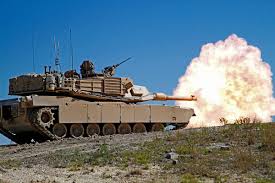
But the 17th day of August 1988 showed not a cloud in the sky.  Today, the โ€œill man with ill intentionsโ€โ€”the summation of his military commanding officer several years previousโ€”was flying down to the deserts of southern Punjab to witness a field test of General Dynamicsโ€™ Abrams M1 tank.  His American sponsors had been twisting his arm to buy a bunch of them.  The American Ambassador, Arnold Raphel, and his military attachรฉ would meet the President in the desert. Zia, as per his usual practice, would be accompanied by several of his top generals including his presumptive successor, Gen. Akhtar Abdur Rahman.

The Abram M1 no doubt missing its target

The Abram tank proved to be a dud. The Americans were embarrassed that it missed its targets and repeatedly sputtered to a halt, unable to handle the clay-laden dust of the Thar desert. Zia and his men were openly relieved. What they really wanted were AWACS.  Still, the party was surprisingly cordial given the deflating exhibit of American tech and general ill-will swirling around the figure of the President.

After a nice lunch, the President invited the Ambassador and his attachรฉ to join him in Pak-1, Ziaโ€™s Hercules C-130 transport plane with its specially fitted airconditioned VIP capsule for the hour-long flight back to Rawalpindi. No hard feelings, Mr. Ambassador. Now about those AWACS.  

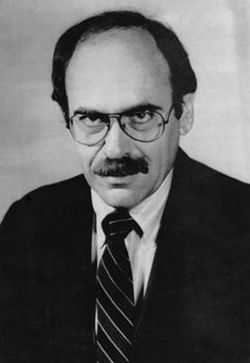
Ambassador Arnie Raphel

As everyone settled into their seats a couple crates of local mangoes of the best variety were stuffed on board.ย  At 3:40 pm the giant aircraft lifted off. Eleven minutes later it nose-dived into the desert killing everyone on board bringing Ziaโ€™s unpopular eleven-year reign to an emphatic conclusion.

Strange things began to happen pretty quick smart. An order was given (probably by both countries) to do no autopsies. Why not? The FBI, who had just a year or two earlier been mandated by Congress to investigate every terrorist attack in which an American was killed was denied entry to Pakistan for a year. And when they did arrive, they seemed less interested in the crash then in sightseeing. Ohkaay. The Pakistanis settled on sabotage. The Americans on mechanical failure. After the tank debacle youโ€™d think they were probably right but then again, no evidence has ever  been produced along those lines. So, the Pakistanis were probably right. Right.

But what kind of sabotage and by whom?  The latter was too hard to answer. Everyone wanted this prick out of the picture. How, was somewhat easier to answer. Eyewitnesses on the ground claimed they saw no smoke, no explosions, no missles hitting the plane. Remember it was a clear hot summer day. Just the damn plane genuflecting up and down and then smash.

Elaborate proposals involving military men and fast acting, time and altitude activated nerve gas were put forward. Ultimately, too much was at stake for the truth to be ever told and within a few months the drama and official curiosity was over.ย  Pakistan had a woman PM, Benazir Bhutto, the daughter of the man Zia had murdered. To her the crash had been โ€œan act of Godโ€. The Soviets had been routed and the Yanks were heading home.ย  Good riddance all round.

Sindhri mangoes

But what about those mangoes?  No one denied they were put on board in the desert. Some claim every single piece (around 60) were checked by security. Highly unbelievable. Others claim they were shoved on at the last minute with no scrutiny. Much more credible.

Early reports appeared that traces of chemicals were found on the skin of some of the mangoes recovered from the wreckage.  Had the nerve gas been hidden inside the fruit? The public loved this idea. And it remains the most popular explanation until today. A novel, The Case of the Exploding Mangoes got quite a bit of press in the late aughts.

Hmmm. No one can say for sure what actually led to the death of a dictator, his general staff and an American Ambassador. Leastwise, no oneโ€™s talking. But isnโ€™t ย it interesting that those crates of luscious juicy mangoes were a late inclusion on the plane?

On another August day, twenty years before, another case of Pakistani mangoes, from the same region as those hitching a ride on Ziaโ€™s plane, did a star turn that has to be remembered as one of weirdest sidebars in modern political history.

Pakistan and China have been best friends forever. But their friendship was especially strong in the 1960s when Pakistan was still young and China was caught up in the whirlwind of an endless series of self-induced crises with Cinemascope names. The Great Leap Forward. The Great Famine. The Great Proletarian Cultural Revolution.ย  China didnโ€™t have a lot of friends; the Pakistanis needed a big power to balance the friendship of India with the USSR.

In August 1968, the Pakistani Foreign Minister on an official visit to Beijing, gifted Mao Ze Dong (The Great Helmsman) a case of Sindhri mangoes, considered by many as the King of all mango varieties.  Mao didnโ€™t like the look of them. In fact, the fruit was pretty much unknown in China at the time, so the following day, as a token of his personal gratitude he re-gifted the funny fruit to a group of โ€˜workersโ€™ who earlier in the week had subdued some angry students at Qinghua University.

Things were messy in China. In fact, the place was a real shitshow. Two years previous with the slogan, โ€˜Sweep Away All Monsters and Demons!โ€™ the Peopleโ€™s Daily announced The Great Proletarian Cultural Revolution. With the stated aim of ridding society of all remaining bourgeoisie elements, the CR seemed to be more about Mao remaining the unchallenged leader of China, a position he feared was on somewhat shaky ground. 

A poster depicting what happens to monsters & demons. 1967

What ensued was a period of chaos in which students, with direct and active support from the Communist Party, formed themselves into bands of Red Guards denouncing, killing, destroying buildings and otherwise wreaking havoc against officials and political foes of Mao. The main cities across China turned into battlegrounds. Factions of Red Guards each claiming to be the true executors of the Chairmanโ€™s will, battled other factions of Red Guards. Public executions and torture sessions, wanton destruction of public property and street battles became the order of the day. Mao and the Cultural Revolution Group of senior Mao loyalists watched quietly; some in horror, others with glee.
But by the time the Pakistani Foreign Minister stopped by for a visit, even Mao realised he had unleashed a red wave of terror that even he could no longer control.  A fresh slogan, โ€˜The Working Class Must Exercise Leadership In Everythingโ€™ was promoted and Mao invited workers to oppose the wild students. 

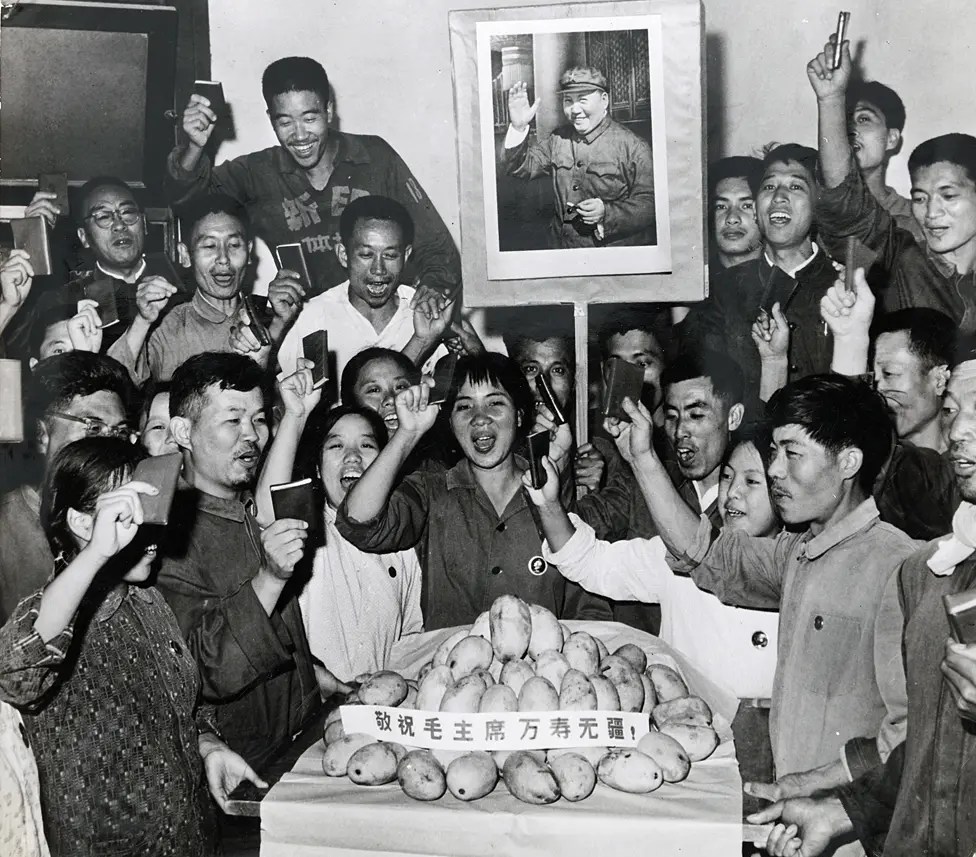
After their victory at Qinghua University, Mao sent the Pakistani mangoes to various work sites as a gift. In a way that only those who live in such mad situations can make out, this was seen as a signal that power was shifting and the Red Terror of the students was over. Things were bound to better from here on in. And this strange fruit from friendly Pakistan was to symbolise that (unwarranted, as it turned out) faith.

The worker-peasant propaganda team in Qinghua cheers the gift of mangoes – the ribbon reads: “Respectfully wishing Chairman Mao eternal life”

Not sure whether they should eat it, one factory sunk their mango into a jar of formaldehyde to preserve it for posterity.ย  In other factories people crowded around to sniff the fruit and stroke its smooth skin.ย  Some boiled the rotting pulpโ€”I mean mangoes are great but they donโ€™t last more than a day or two or threeโ€”in water which they claimed became holy.ย  If you took a sip, you were in direct touch with the Great Helmsman. A cottage industry popped up to produce wax replica mangoes encased in glass which were given pride of place in factories and workplaces. These wax mangoes became relics. Like the hair of the Prophet for Muslims or a Piece of the Cross for Catholics.ย  Mao was amused but didnโ€™t intervene. In fact, the Mango became a stand-in for the Great Man himself.

Mangoes were carried ceremoniously in parades on national holidays, flanked by portraits of the Chairman. The mangoes were toured around the country. In one case a plane was chartered to deliver a single mango to Shanghai.ย  At a time when Mao had felt his personal following to be waning, the mango re-invigorated the Chairmanโ€™s personality cult. Mango posters, tea cups and plates appeared in the shops. There were reports of workers bowing in front the wax mangoes each morning as if it were an ancestor shrine from pre-Communist days.

From โ€˜68-โ€™71, now feeling a bit more in control, Mao shifted his focus to the countryside. Millions of students and other bad characters were sent into the fields of China to learn from the peasants.  Millions died. Others were not permitted to return to the cities ever again. Life across China was yet again completely disrupted. The economy severely damaged yet again.  

The mangoes inevitably were forgotten as people struggled to survive, working the land with few tools, no wages and in inhuman conditions. ย All that remains, like the mango skins in the wreckage of Pak-1, is the story.

Lahore at the Beginning of the 20th Century

Lollywood: stories of Pakistanโ€™s unlikely film industry

This brings to a close ‘the background’ story of Lahore. The next sections will deal directly with the movies and movie-making culture of Lahore.

Bahut ghoomi ham ne Dilli aur Indore ki galiyan
Na bhooli hai na bhoolengi Lahore ki galiyan
Yeh Lahore hai Punjab ka dil/Jis zikr par aank chamak uthi hai dil dharak urdthe hain

I’ve roamed the lanes of Delhi and Indore, but Iโ€™ve never forgotten nor ever can forget the lanes of Lahore. This is Lahore. The heart of Punjab whose very mention causes the eye to sparkle and the heart to skip a beat

These opening lines of the 1949 Indian film Lahore sum up the deep affection and nostalgic sentiment millions of South Asians feel for the city of Lahore.

**

Lahore, modern Pakistanโ€™s cultural capital, is one of those cities that lives in the very soul and DNA of its residents. Like a handful of other cities across the continents it occupies a place not just on the map but in the imagination of those who know it. It is at once an indivisible part of peopleโ€™s self-image and something beyond capture. As residents of the city say, Lahore, Lahore hai (Lahore is Lahore). So profound and all encompassing is the cityโ€™s essence that the simple acknowledgement of its existence is enough to conjure an entire world.

Thereโ€™s a small but passionate genre of writing that centres on the city. Novelists, poets, journalists and emigres, displaced at the time of Partition, wax lyrical in their books and gatherings in praise a city they all remember as sophisticated, vibrant, classy, tolerant, full of tasty food, and shady boulevards. Its fabled history and stunning architecture. Itโ€™s unique urban culture. If, as they say, nostalgia is a narcotic, then Lahore is one of the subcontinentโ€™s biggest addictions.

It certainly is an ancient city and the millennia have added a depth of colour and richness that most other cities can only envy. But Lahore has also experienced long periods of cultural and physical devastation when the cityโ€™s palaces and shrines were little more than crumbling ruins. When its resplendent gardens lay overgrown and unattended. And it was this sort of Lahore that the East India Companyโ€™s redcoats grabbed away from the Sikhs who had ruled Punjab for much of the 18th and early 19th centuries.

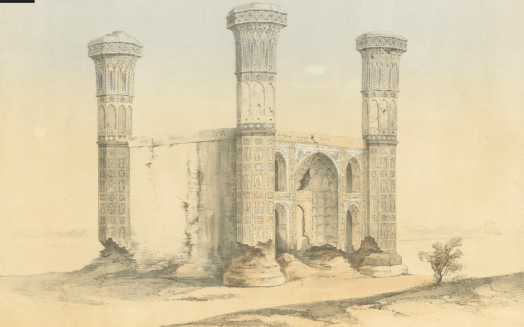
Chauburji. Gateway to a large Mughal garden completed in 1646. This depiction is by an unnamed English woman whose husband served with the EIC in Lahore. This is from 1852, three years after the British annexation of Punjab and indicates how run-down this great city was at that time.

After โ€˜annexingโ€™ Punjab, the British set about rebuilding Lahore. Though the Sikhs, under Maharaja Ranjit Singh, had added some new buildings and gardens to the old city, in general the once glorious imperial city, famous throughout the world for a thousand years, was in an awful state.  Amritsar, 80 kms to the east was the Sikhโ€™s spiritual home and a booming commercial hub; Lahore, their world-weary political capital.  Important more for what it had once representedโ€”the imperial grandeur and awesome power of the mightiest Empire of the medieval world– than what is now was: a cramped, unhygienic, walled city down on its luck.

The storied tomb of Anarkali, 1852. As drawn by an unknown English woman.

At the time the British narcotic-peddling businessmen defeated the Sikhs in February 1849 the suburbs surrounding the old city were little more than ruins.  โ€œThere is a vast uneven expanse interspersed with the crumbling remains of mosques, tombs and gateways and huge shapeless mounds of rubbish from old brick kilns,โ€ wrote an Englishman who visited the city around this time.  Though the Sikh sardars had not gone out of their way to destroy existing Mughal-era buildings they displayed no hesitation in stripping the creamy, jewel-encrusted Makrana marble off the walls of the tombs and palaces to adorn their own havelis.

More than with other cities, the British sensed that in Lahore they had indeed captured a jewel. Miltonโ€™s reference to the city in Paradise Lost had been rather cursory. More elaborate and accessible was Thomas Mooreโ€™s Orientalist fantasy Lalla Rookh which in the early 19th century had become hugely popular across Europe. Based vaguely around an imagined romance of a Mughal princess in the time of Emperor Aurangzeb (1658-1707), the poem introduced the name and idea of Shalimar into Western consciousness.

They had now arrived at the splendid city of Lahore whose mausoleums and shrines, magnificent and numberless, where Death appeared to share equal honours with Heaven would have powerfully affected the heart and imagination of Lalla Rookh, if feeling more of this earth had not taken entire possession of her already. She was here met by messengers dispatched from Cashmere who informed her that the King had arrived in the Valley and was himself superintending the sumptuous preparations that were then making in the Saloons of the Shalimar for her reception.

The development of Lahore into one of British Indiaโ€™s premier citiesโ€”and a place where a sophisticated industry like movie making could thrive– has to be understood as part of the development of British rule in India.  The great riverine plains of Punjab–a stretch of geography that historically included Delhi at the eastern edge and touched the Afghan border in the west–were the last big chunk of agricultural land available in northern India. They marked the final frontier of British India. The Empireโ€™s very existence not to mention the Companyโ€™s business model depended on a perpetually growing revenue base collected primarily from raw agricultural products and oppressive taxes on those who worked the land.  By the time they reached the Punjab, the Company was the unassailable political and military force in politically fluid landscape. But at the same time, their purely extractive approach to governing had reached its limits too.  Beyond Peshawar, a largely Afghan city but in the early 19th century  an important Sikh holding, towered the rugged mountains of the Hindu Kush, the historic barrier dividing South from Central Asia. These were a useful security asset but absolutely bereft of economic value.

Soon after wresting control of Punjab the English were confronted with the first substantial resistance to their rule. In 1857 soldiers in the employ of the British East India Company โ€˜mutiniedโ€™ and for over a year engaged their European masters in an armed conflict that engulfed much of north India, saw the destruction of Delhi and the final collapse of the (by this time, entirely symbolic) Mughal Empire. A shocking numberโ€“800,000–Indians lost their lives either directly or indirectly as a consequence of the uprising. The European community estimated at around 40,000 in all of India at the time, lost about 6000 people. Though a much smaller number, proportionally it meant that about 1 in every 7 Europeans perished.  If it did nothing else, the war exposed the underlying vulnerability and inherent instability of European rule in India. And though they would rule for nearly another century, everything that happened in India after 1857 in some way can be seen as a reaction or delayed response to the conflict.

Though the uprising was ultimately quelled the British were shaken to their core. The East India Company, which over the previous 150 years had demonstrated itself to be little more than a rapacious business enterprise intent on asset stripping the richest country in the world was disbanded by an act of Parliament.  India was reconfigured as a Crown Colony under the direct purview of Her Majesty Queen Victoria.  The British realised that things had changed. And if they were to continue to benefit from their Indian Empire they would need to experiment with different management techniques including setting up a system that at least appeared to take some interest in good governance rather than simply syphoning off Indiaโ€™s great wealth. One of the immediate, visible signs of the new era was the rise and promotion of the Punjab as a โ€˜modelโ€™ province. A place where the noble intent and attributes of a Pax Britannica could be readily demonstrated and accessible.

Punjab was a vast piece of land but it was by no means uniform. The eastern and to some extent, central districts of Punjab were rich, well-watered agricultural lands with relatively dense populations. The much larger western part of the province spreading out towards the northwest and southwest of Lahore were arid, sparsely populated and agriculturally unproductive lands. In terms of the colonial economy, eastern Punjab was valuable; the west, not so much.

It didnโ€™t take long for the administrators of Punjab to understand that this was unsustainable. It wouldnโ€™t be long before the eastern/central portions of the province would be overpopulated and the land overused.  Productivity and more importantly, revenue for the British Exchequer would fall. Also, never far from British minds was the prospect of rising social tensions that an unmet demand for land represented.  No one wanted to risk another 1857. Especially not in the land of the fabled Sikhs, who had been consistently lionised by the British as a great โ€œwarrior raceโ€ and upon whom they were banking to be the backbone of their own security and military apparatus.  To use contemporary language they needed to keep the Sikhs sweet.

And so, beginning in the 1880s, with the intention of keeping the Sikhs happy and the Punjab prosperous, the government tilted imperial policy in Punjab toward investment rather than mere extraction.  The vast, underutilised and dry western tracts of the province became the focus of a massive economic and social experiment. Construction began on a network of massive canals that diverted water from the Jhelum and Chenab rivers, that by 1920 had turned 10 million acres of โ€˜formerly desert lands, most of which had been the hitherto uninhabited and worthless property of the Rajโ€™  into some of the richest agricultural land in India. Six districts including the rural areas around Lahore experienced a demographic and economic revolution as hundreds of thousands of people, mostly Hindu and Sikh farmers, were encouraged to move from the eastern parts of Punjab to the west.  They settled in new purpose-built towns along the canals to produce wheat and cotton on a scale India had never seen before. And as the biggest city in Punjab (and the largest between Istanbul and Delhi) Lahore itself, the urban hub from which the new Canal Colonies were managed and supported, entered a fresh era of prosperity. 

Reimagining Lahore

From the moment the Sikhs were defeated, the British set about rebuilding the crumbling historic city they had inherited. The new administrators were bewildered and not a little intimidated by the old walled city, which they left largely to its own devices. Instead, the English concentrated on the ruins that lay outside the walls.  With a fearsome industriousness they cleared the plain to the southeast and laid out a European style suburbia. Christened Donald Town after Donald McLeod, an early Lt. Governor of Punjab, the main thoroughfare in this new part of town was christened McLeod Rd.  On either side, a residential and business area for Europeans sprang up including an important and large military base or cantonment, further south in Mian Mir. By the 1930s, the place where McLeod Road crossed Abbott Rd, a junction called Laxmi Chowk, would become (and remains to this day) the central locus of the cityโ€™s film industry.

Between 1860 and the early 1900s Lahore found new life as a hugely important regional centre for education, communications, publishing and culture.  Delhi, the age-old capital of northern India had been savagely destroyed during the fighting of 1857.  The city’s famous tribe of musicians, writers, poets, artists and thinkers fled the capitol in search of more secure places; some headed south to Hyderabad and others east to Lucknow.  And with its newly acquired territory in the northwest the British government deliberately identified Lahore as an alternative cultural hub to which they encouraged รฉmigrรฉ artists and intellectuals to settle.

Several prominent Urdu language writers and poets did move west to settle in the city where educational institutions were springing up under official sponsorship but also with the investment of wealthy Punjabi landowners and businessmen. Though the city had no real affinity with or history of speaking the Urdu language, a combination of official policy and organic economic development saw Lahore become one of Indiaโ€™s most important Urdu centres.  Though the cityโ€™s residents continued to speak their beloved Punjabi, using Urdu only for official work or to get a job, Lahore was transformed rather quickly into a bi-lingual town.  Their easy facility with both languages and often with English as well, in time would give Punjabis a huge advantage in the nascent Indian film industry.

Lahoreโ€™s publishing and printing industry produced newspapers, books, religious texts and magazines in multiple languages including Urdu, English, Persian, Punjabi but also Arabic and Sindhi. The city, already famous for its literary culture, refreshed its traditions with poetry recitations called mushaira which drew poets from across north India as well as significant audiences from the cityโ€™s many colleges.  By the turn of the century a hundred or more newspapers were available across the Punjab most of which were in Urdu including many published in Lahore, such as Kohinoor, Mitra Vilas and Punjab Samachar. In addition, though catering to a much smaller audience, but widely read and highly regarded were two English dailies, The Tribune and the Civil and Military Gazette, most famous today for itโ€™s most famous resident journalist, Rudyard Kipling.

Rudyard Kipling

The number of prominent Urdu writers who were born, educated or settled in Lahore is too vast to mention: Agha Hashr Kashmiri, Taj Imtiaz Taj, Faiz Ahmed Faiz, Hali, Rajinder Singh Bedi, Krishen Chander and of course, in the last years of his life, Saโ€™adat Hasan Manto many of whom developed a connection with both the local and national film industries.

Northwest Indiaโ€™s educational Mecca

In the late 1830s and 1840s the British laid out the basic parameters of an education policy for India. The ultimate purpose of the policy was very much in keeping with the political agenda of the EIC which was all about control, avoidance of undue investment and efficiency of administration. As such, to the extent that official British efforts were to be focused on educating Indians, it was as a means to advance the Companyโ€™s and then Britainโ€™s, commercial and political ends: to create a loyal group of Indian elites who would be conversant in the English language, imbibe European values and culture and be dependent upon Official patronage.  In the famous words of William Macaulay a senior and prominent 18th century administrator of the Company, โ€œwe must at present do our best to form a class who may be interpreters between us and the millions whom we govern.โ€

And to that end government efforts were to be focused on developing and supporting a system that preferenced higher education as opposed to mass primary education and which was to be delivered entirely in English through institutions modelled on those in Britain, especially the great universities in Oxford and Cambridge.

By the time the final piece of the India puzzle, Punjab, was tapped into place these ideas were fresh in the minds of the English.  And so, in keeping with their intent to make the province an exemplar of the colonial project, Lahore was developed into the premier educational city of northwest India.  Beginning in the 1860s and continuing up through the first decades of the 20th century, the British supported or sponsored the establishment and development of a number of colleges that became famous as some of the best in India and whose alumni included several generations of elite leaders including multiple Prime Ministers of both Pakistan and India.

Schools like Forman Christian College, founded by an American missionary in 1865, and Government College a year earlier, provided English/Western education to the first generation of Punjabis to live under British rule.  These schools were complemented by pioneering medical training colleges (King Edward Medical College) or absorbed into more prominent larger institutions like the University of Punjab in the 1880s.  Secondary colleges, especially the world-famous Aitchison College (1864) prepared the young sons of the princes and the landed aristocracy of the Punjab to enter the elite colleges and ultimately, service in the bureaucracy.   Being educated in Lahore became almost compulsory if you wanted to pursue a career in business, science, government or the arts. Students came to the city from all across the northwest and in the 1930s Lahore was said to have a student population of nearly 100,000 students enrolled in 270 colleges and schools.

Actor and Hindi movie superstar Dev Anand and his equally talented brothers came to Lahore from Gurdaspur in the east to be educated at Government College, part of the University of Punjab. At the same time, from Rawalpindi further to the northwest, came Balraj Sahni, who established himself as one of Indiaโ€™s finest cinema artists after the Partition.  We could fill several pages with the lists of prominent politicians, sportsmen and academics, not to mention military leaders who graduated from Lahoreโ€™s elite schools but just a few provide a flavour of the quality of education the city provided. Imran Khan (former Prime Minister of Pakistan and international cricket star), Abdus Salam (1979 Nobel Laureate in Physics), Inder Kumar Gujral (Prime Minister of India), Pervez Musharraf (President and Chief of Army Staff of Pakistan), Allama Mohammad Iqbal (writer and philosopher), Kuldip Nayyar (prominent Indian journalist), Krishen Chander (pioneering Urdu writer), Har Gobind Khorana (1968 Nobel Laureate in Medicine) and Faiz Ahmed Faiz (modern Urduโ€™s greatest poet).

While Dev Anand and Balraj Sahni were able to attend the elite colleges most of Lahoreโ€™s film industry personalities were either educated on the job in the studios and sets or attended a set of schools established to cater to the middle class Hindu and Sikh communities who controlled Lahoreโ€™s economy.  Schools like DAV College founded by the reformist Arya Samaj educated tens of thousands Hindu and Sikhs. Islamia College, long associated with Allahabad University, offered higher education to Muslims who were a little more sceptical of attending the heavily westernised University of Punjab or Forman Christian College. 

The learning environment of Lahore extended to female education as well and the city had a reputation for its relatively progressive attitude towards women participating in public life. Kinnaird College, established by missionaries in 1913 as a counterpart to Forman Christian College, educated the daughters of Punjabโ€™s best and brightest families. Writers Bapsi Sidhwa and Sara Suleri, academics of all disciplines, the human rights lawyer and campaigner, Asma Jehangir and Hindi film actress Kamini Kaushal all graduated from Kinnaird.

Migrants, not only from eastern Punjab but the rest of India came to Lahore to get in on its vibrant economy and cultured society. By the 1920s the city was known not only as a premier destination for higher education but a city of ideas. Hindu reformist movements such as the Arya Samaj and Brahmo Samaj, from Bombay and Calcutta respectively, found fertile ground in Lahore and in the case of the Arya Samaj enjoyed significant growth and popularly in the city. 

Political flashpoint

The many educational institutions created an environment in which ideas of all sorts were traded, debated and contested;  Lahore slowly gained  a reputation as a political hotspot. The British policy of building up a class of loyal Indians ready to fight for the Raj may have been the stated outcome of education in British India but too often things donโ€™t go exactly to plan.  With so many students enrolled in hundreds of schools things were bound to get out of control. 

In response to the missionariesโ€™ evangelising, each of Punjabโ€™s three major religious groups took upon themselves to reform their own faiths turning Lahore into a site of new self-styled progressive religious teaching.  Though founded in Gujarat to the south, Lahore became the main centre of the Arya Samaj, a Hindu reformist group which championed education, womenโ€™s participation in public life, a return to Vedic Hinduism as well as an aggressive anti-Muslim, anti-Christian stance.  Many of the Hindu middle classes of the city were attracted to its teachings and sent their children to the Samajโ€™s schools and the influential D.A.V College.

Initially, middle class Sikhs were welcomed and participated in Arya Samaj activities but eventually split from the movment over, among other things, the Samajโ€™s aggressive campaign of mass reconversion of rural Sikhs to Hinduism.  In response, the Sikh community sought to distinguish themselves from the Arya Samaj and began preaching a more exclusive and purist form of Sikhism which focused on the reformation of the government-sponsored โ€˜clergyโ€™ that controlled Sikh places of worship. The Akali Dal, a group that arose out of activist Sikhs, many from the new Canal colonies, quickly took on an anti-British political agenda which the British promptly labeled as a greater threat to the stability of Punjab and India then Gandhi and the Congress Party. The Sikh Sabha and Akali movement was active across Punjab but especially in Amritsar and Lahore,  whose branch was seen as the more radical and political.

Several Muslim communities found themselves developing new identities and leaders too. in the 1930s and 40s, the rural agricultural Muslim communities bounded together with similar rural groups to form a loyal pro-British political coalition.  But other groups, such as the Ahrars, established in 1929, articulated a strong anti-British, nationalist and anti-feudal agenda. At the same time, it spearheaded a religious reform agenda that among other things was the first to demand that the small but successful Ahmadiya community be declared non-Muslim.

Though reform and purification of faith were the starting point of all these movements, by the 1920s they had blurred the line between religion and politics.  The British kept close tabs on them and openly interfered in their colleges (Khalsa, DAV, Islamia) in an attempt to try to weed out nationalist thought. But it was not to be.  The massive economic success of the canal/irrigation projects not only transformed and enriched certain groups but at the same disenfranchised many others, especially the urban middle class Sikhs and Hindus, who were the backbone of Lahoreโ€™s economy.

The British state was strong and able to quash most rebellious ideas before they became widespread but in 1907 as a result of a number of pieces of legislation that further pressured and alienated the very population of rural Punjabis that the security of India depended on, violent protests broke out in the Canal Colonies. The cause was championed and given an anti-Raj colour by leaders like Lala Lajpat Rai in Lahore. The British were caught flat footed, and unprepared. Repression and suppression followed quick smart which for a few years seemed to work.

But after WWI Lahore continued to gain a reputation not only for high quality education and culture but as a political hot bed.  So much so that its reputation spread far and wide. In 1922 newspaper a rural newspaper in faraway Australia reported โ€œThe visit of the Prince of Wales to Lahore, which has been looked forward to with deep anxiety by those responsible for his safety, will, it is believed not be marred by disturbance of any kind. The tension has relaxed in the native city in the past week and it is too much to expect a general attendance of Indians to join the official welcome on Saturday afternoon for Lahore is the notorious centre of political unrest in Northern India but the Prince will not touch even the fringe of the bazars during his four days stay.โ€ (Tweed Daily, Muwrillumbah 25 Feb 1922)

T.E. Lawrence during his time in NW India (1920s)

Around that very time T.E. Lawrence (of Arabian fame) was reported to be in Lahore and causing trouble in Afghanistan. Indeed, possibly in the very  weeks leading up to Lawrenceโ€™s stealthy escape back to England, a young Sikh revolutionary who had been educated in Lahore, Bhagat Singh, assassinated a senior British police official in a case of mistaken identity.  Though he escaped and a few months later exploded several smoke bombs while the Central Legislative Assembly in Delhi was in session, he allowed himself to be arrested and imprisoned by the Indian government.  Using his imprisonment and trial to denounce the Raj, Bhagat Singh became a national cause celebre.  Anti-British protests broke out all across India and the chant โ€œBhagat Singh ke khoon ka asar dekh lena Mitadenga zaalim ka ghar dekh lenaโ€ (Wait and see, the effect of Bhagat Singhโ€™s execution: The tyrantโ€™s home will be destroyed, wait and see) became a popular public cry.  Though he was hanged in 1931 for his crime, Bhagat Singhโ€™s trial and resistance to colonial oppression made him an exhilarating figure around which the nationalist and Independence movement rallied.  Even today he is hailed as a beloved historic martyr across the political spectrum.

Bhagat Singh (back row 4th from right) during his college years in Lahore
Bhagat Singh and ‘co-conspirator’ jailed for their involvement in the Delhi Assembly bombing case (1929)

Culture and Arts in Colonial Lahore

Intrinsic to Lahoreโ€™s self-image is the world of art and culture. It has always been the cultural capital not just of Pakistan but at various times throughout the past, especially during the Mughal period, one of the major cultural centres in all of South Asia.

With the advent of the British, art and art education, like everything else in Indian life, became a project to be moulded into something that served Imperial outcomes. Most British administrators and educationists dismissed Indian art as primitive or bizarre. In the words of John Ruskin, British artist and critic, the only art Indians were capable of was drawing โ€˜an amalgamation of monstrous objectsโ€™.   As such, British administrators saw yet another deficit gaping to be filled. In 1875 the Mayo School of Arts, the first such institution outside of Bombay, Calcutta and Madras, was established in Lahore. As in education more generally, the purpose of the school was โ€œto initiate the native into new ways of acting and thinkingโ€ and of course provide skills that could be put to economic purpose.

John Lockwood Kipling, father of Rudyard, was appointed as the Collegeโ€™s first principal with a mission to introduce Western drafting and realistic drawing skills to traditional artisans and craftsmen.  Kipling himself saw much to admire in Indian art and did what he could to promote it among his colleagues and students, all the while delivering a skills-based, industry-facing curriculum which eventually included the new-fangled medium of photography. 

Interestingly, Bhagat Singh, the young political radical had cottoned on to the great potential of photographic images to educate and mobilise the masses against the British.  Prior to his arrest and trial, as leader of the radical Hindustan Socialist Republican Association, Singh had used a magic lantern, an early proto-slide projector, in his lectures and political activities.  Itโ€™s intriguing to consider that perhaps it was a piece of equipment that the Mayo College of Arts had introduced to its students and wider public in Lahore.

Soon to be superstar Mohammad Rafi sings on Lahore All India Radio in May 1941.

Lahore was a part of the classical music circuit of music conferences which brought a range of classical artists together to perform and compete. The local All India Radio station broadcast live sessions of local residents such as the eminent female singer Roshan Ara Begum and sitarist Ghulam Hussain Khan.  And not just classical music. Three years before he broke onto a film scene he was to dominate for the next three and a half decades, in May 1941, a young Mohammad Rafi had a gig singing live on Lahoreโ€™s All India Radio station at 9:15 am and again at 6:10 pm.

But it was not just formal art education.  Lahore was a city famous for its writers and poets. Its  poetry reciting contests, were famous across north India and drew poets, as well as audiences, from far and wide.  Music, especially classical music, had a long history of patronage in Lahore. The Bhatti Gate area in the old city, from where some of the earliest film personalities emerged in the early 20th century was renowned for its venerable tradition of classical music.  Such luminaries as Ustad Bade Ghulam Ali Khan, considered one of the finest voices of modern times, Pandit Amar Nath, and later the brothers Amanat Ali and Fateh Ali Khan of the Patiala gharana, entertained listeners often in their own homes. 

Indeed, the city was in love with music. So important a musical centre was Lahore that by the 1930s and 40s several international record companies including Columbia, RCA and HMV had offices in Lahore. The city had been on the talent recording circuit for European companies as early as 1904-5 when two Europeans, William Sinkler Darby and Max Hampe, representatives of  Gramophone Records, popped up in Lahore. They made a large number of recordings of women singers, apparently tawaifs (courtesans) who had entertained men for centuries in Lahoreโ€™s fabled red light district, Hira Mandi (Diamond Market). In 1906 an ad in a London newspaper read as follows:

Shunker Dass &Co. Nila Gumbaz, Lahore, are prepared to invest a considerable sun, in conjunction with a thoroughly practical firm of makers or factors, to open a Manufactory in India, in order to supply the ever increasing demand for talking machines.

It seems Mr Shunker Dass was unable to generate the capital to set up his talking machine business, as records were known in those early days. But such an ad is evidence of Lahore being on the cultural radar that not only did Mr Dass feel confident to advertise in England but that he had the vision to see an opportunity that was just beginning to emerge when he ad was placed.

With a sizeable but not overly large population of European and American residents, Lahore attracted performers from around the world and catered to the needs of its non-Indian community.  According to the Melbourne Age in January 1947 one of that cityโ€™s citizens, a dance instructor by the name of Frank Webber, was on his way to Lahore for a season of dancing at one of the cityโ€™s prominent hotels, Falettis. The city regularly hosted travelling dramatic troupes from Europe and America in its theatres not to mention the British communityโ€™s love to amateur theatrics which added to the cityโ€™s cultural lustre.

Much of the music and poetry and dance took place in and around Hira Mandi, the cityโ€™s famous red light district and from whose residents the film industry drew many of its musicians, singers and actresses.  During the early days of cinema, actresses who had originally come out of the world of traditional dance, gave recitals to great acclaim and massive audiences before and after their movies.

One local dance troupe the Opera Dancers founded by a Siraj Din from โ€˜a poor familyโ€ฆpassed his matriculation from Punjab University in 1932 and started a troupe to entertain the public with Sarla (a famous danseuse) as his chief artistโ€™. Pran Neville in his book tells of how Miss Sarla drove audiences wild in between shows at local cinema houses

Responding to the loud applause of โ€˜Mukararโ€™ (Say it again) from the audience, Sarla advanced gracefully towards the front of the stage. With the burst of a song she turned around with such vigour that the loose folds of her gown expanded and the heavy embroidered border with which it was trimmed fanned out from her waist, showing for an instant the alluring outline of her lower form. She displayed remarkable muscle control and coordination as she worked herself up to reach the climax of her dance. The music went on in waves of tumultuous sound, with the musicians falling more and more under the hypnotic influence of their instruments, crying out โ€˜Wah Wah-Shabashโ€™ to encourage the dancer. The audience burst out in applause, which manifested itself not only by loud clapping but by the showering of coins onto the stage. The tinkling sound of the coins drove the musicians to a new pitch of enthusiasm just as Miss Sarla made her exit.

Siraj Din and Ms Sarla and the Opera Dancers featured regular shows in Lahore but also entertained Indian and foreign troops during wartime through a special vehicle he called Fauji Dilkhush Sabha (Soldiers Happyheart Association).

V.D. Paluskar and The Gandharva Mahavidyalaya

The story of V.D. Paluskar, one of the most significant figures in modern south Asian cultural history probably illustrates better than any other the sort of city Lahore was in the early part of the 20th century and how many of the necessary elements for a film industry came together in the city.  Paluskar himself had only a tenuous relationship with the film world but as an influential cultural figure his ten year sojourn in Lahore is a wonderful window into how the city provided the perfect environment for new cultural ideas.

Vishnu Digambar Paluskar

Vishnu Digambar Paluskar was born into a traditional musical family in Maharashtra, western India in 1872.  Fired with a deep spiritual need to blend traditional classical music, Hindu devotional practice and education Paluskar was in essence a missionary of sorts. After spending the first 24 or so years of his life as a paid musician in the courts in several small princely states in southern Maharashtra he set out on his own to find a different sort of patron then the small minded autocratic and often musically limited petty royalty his family had been used to serving.

On his travels through western India, Paluskar encountered, at a hilltop shrine, a Hindu ascetic who among other things advised him to head  north and to the Punjab in particular. The ascetic instructed him to set up a school in order to live out his destiny. And so the young singer headed north stopping to perform and build his reputation in Gwalior, Delhi, Amritsar and the market center, Okara. In 1898 he made one final move, 130 kilometers NE to Lahore where he began immediately, despite knowing no one or speaking any of the cityโ€™s three main languages (Punjabi, Urdu and English), to put together plans for the establishment of a music school.

His choice of Punjabโ€™s capitalโ€”now in the midst of rapid development and growth under the Britishโ€”was unlikely to have been random. Even though he had no connections, the city was well networked and open to exactly the sort of innovative, even revolutionary ideas, Paluskar had banging around in his mind.

To get his idea of a school off the ground he had to raise money and so turned to the middle class Hindu community who were embracing Hindu reform movements like the Arya Samaj which, though founded in Gujarat in Western India, found Lahore to be one of its most important, if not most important site in north India. Arya Samajis were urban and salaried and had both the education and the money as well as the motivation to support causes like Paluskarโ€™s musical-devotionalism.  Lahoreโ€™s fast developing reputation as a city of education, politics and economic opportunity meant that the the elite and rulers of the many princely states from Baluchistan, Kashmir, and Punjab maintained ties and often residences in the city. Many, especially the maharaja of Kashmir offered Paluskar and his academy, the heavily Sanskritised named Gandharva Mahavidyalaya, critical financial support and patronage.

And though he may not have been conversant in Punjabi or Urdu, Lahore was attracting migrants from all over India. Its economic and strategic rise in importance meant that national vernacular newspapers often had correspondents reporting on events in the city.  One such Marathi newspaper, Kesari, began publishing stories about Paluskarโ€™s activities. And though most of his students were local , many were immigrants like himself from Maharashtra including a large number of Parsis who though small in number were prominent as retailers of European goods and services, including owners of Lahore movie halls.

That Lahore and western parts of Punjab were heavily Muslim also had an appeal to the Hindu activist. Paluskar’s entire understanding of north Indian music was that it only could be truly understood and appreciated when performed within the context of a personal Hindu faith. Furthermore, Hindustani classical music, not to mention most of Indian culture, had been debased by Muslims . He believed Muslims performed music only for entertainment and often risque, morally suspect entertainment like courtesan dance recitals, at that.

Paluskarโ€™s vision of a purely Hindu musical world was influential. In nearby Jalandhar where Indiaโ€™s first annual musical festival the Harballabh festival had since 1875 been a place where Punjabi musicians of all creeds and persuasions, but especially Muslim dhrupad artists, performed, Paluskarโ€™s sectarian and vigorously anti-Islamic/anti-Punjabi stanct, made the festival unwelcoming for some of the greatest Muslim classical musicians of the era.

Though Paluskarโ€™s vision and mission could be interpreted as being conservative and traditionalist in that it sought to reclaim the north Indian music system from Muslims and restore it to its rightful place as part of true Hindu faith and practice, (however, contentious that position was/is) there were several elements that should be seen as radical. The most important being his musical notation system.  North Indian classical music has traditionally been an oral tradition; Paluskar himself never received formal training and his own teacher never even shared with him the names of the ragas he was learning. It was a secretive and territorial business with performers and gharanas fiercely committed to protecting their styles, innovations and knowledge. This was done through a guru to whom a student devoted his life and fulfilled the role of servant until he was accomplished enough โ€”after many yearsโ€”to take on his own students.  Unlike in Western music, no music notations had ever been committed to writing. 

A sample of Paluskar’s notation system published in 1928

Paluskarโ€™s musical notation system, which he had begun to put down on paper while living for some months in Okara,  became of his first projects upon arriving in Lahore. With the support of Hindu supporters, Paluskar was to publish the system which formed a fundamental part of the curriculum of his school.

The Gandharava Mahavidhalaya became another of Lahoreโ€™s many and varied educational institutions. It offered a rigorous traditional 9 year (!) course of intense training but also shorter teacher training courses called updeshak, for poor students. The school also actively recruited middle class women, revolutionary step for the time. Paluskar not only used the press to promote his work but tapped into the booming printing industry of Lahore to publish short instructional texts in pamphlet form on various instruments and music themes.

His student body grew and included a relatively large number of women and especially Parsi women but also Maharashtrians who had migrated to the city.  Within several years his school was well established and financially sound but Paluskar still felt he needed a higher national profile if he was to really have an impact. Once again, Lahore, his adopted city, was able to provide the opportunity. 

In 1906 a โ€˜durbarโ€™โ€”a public ceremony to honour the visit of royaltyโ€”was organised to mark the birth of King George V’s son.  Paluskar recognised that if he could get on the program as part of the entertainment the eyes and ears of the entire country would be upon him.  Through his own Lahori and royal connections he was able to secure a 15 minute slot which he used to promote his vision and school even further.  By 1907/8 his school was not only well established but the Paluskar name as a educationist, a Hindu cultural reformer, an innovator and as an accomplished singer in his own right was secure. Though he left Lahore to return to Bombay in 1908 where he set up another branch of the GMV, Lahore was the city in which, as the sadhu had predicted, he would meet his destiny. The GMV in Lahore continued to operate until 1947 and the Partition when itโ€™s heavily Hinduised curricullum and patronage became unviable.

Several of Lahoreโ€™s greatest musical names such as Pandit Amar Nath had associations with the GMV either as students or instructors and throughout the 1940s contributed musical scores for Lahoreโ€™s film industry.  Paluskar himself probably felt films were exactly the sort of entertainment classical music should NOT be associated with but before his death in 1955, his son, D.V., performed in two films, the most famous of which, Baiju Bawra, he surprisingly performed a duet with the Muslim vocal maestro Amir Khan!

Real Politics beats Anger-tainment

Anthony ‘Albo’ Albanese

Last night Australians demonstrated their good sense, groundedness and well-honed pique in a big way. They voted for an imminently moderate, Elmer Fudd-like, Labor party lifer, someone who I (like almost all Aussies, except Labor party lifers) thought would probably lose the election or be so constrained by the political forces around him and his party that he/we would limp through another 3 years of soothing talk but precious little action on things we all care about: climate action, costs of life and health care.

His opposite number, the bald pated ex-Queensland cop (for non Australians, that is like being an ex-LAPD cop) not only the lost the election but also was given a tight kick in the pants by his own constituents. His career was yanked out from under him and there will be few tears shed.

Peter ‘Spud’ Dutton/Trumpf

I watched Albo’s acceptance speech. This guy has turned from Elmer Fudd into Conan the Barbarian! He spoke like he has rarely done. Confident, strong-voiced (yes he still has a high, slightly silly voice) and full of grace, goodwill and kindness. He didn’t bag the Liberals or his counterpart. He spoke of doing things the ‘Australian way’, with decency and kindness and caring for those doing it tough.

It’s easy to get cynical about politics and I’m a deep cynic. But I felt my chest swelling (for once outdoing my belly) as he spoke. I especially felt glad and proud to be Australian for one of the first times since I became a citizen. I am so grateful to be living in a country that despite being full of larrikins, (Crocodile) Dundees and (Breaker) Morants and which can be pretty crude from time to time, is indeed a country in which decency is deeply felt and practiced across all layers of society.

Pundits predicted a minority government for Labor. Once again, they got it wrong. Not only did Labor win a thumping majority, on track to have more than twice the number of seats of the Libs, but have won the largest number of primary votes (sort of like the popular vote in the USA) ever by a Labor government since WWII. And that includes those of Gough Whitlam, Bob Hawke and Kevin Rudd!

The Liberals have experienced a plane crash in which most of their leaders (a pretty low standard I admit) are gone and their brightest rising stars have all been killed. They have almost no (zero, zip) representation in the major urban centres of the country where most Aussies live. They’ve lost young people, women and the sane.

The Liberal/National Party are now even more adrift than the American Republicans. At least the spineless yesmen of the GOP are united in blindly marching over the cliff. Where they stand is clear…behind Trump with their noses and tongues on his arse. Their Australian wanna-be’s have no idea of what they want, should want and most of all have spent nearly two decades stubbornly ignoring what their own constituents want. Good luck to the grubs.

The Australian Labor Party has delivered every major social and economic reform that makes us a modern serious country. It began with Whitlam 50 years ago and continued through Julia Gillard. The Liberal grubs have done nothing but undermine, block and seek to take a torch to all of these reforms all the while espousing pioneering ideas on how to mistreat asylum seekers (El Salvador and Trump have lifted the overseas gulag idea from the Liberals), demonstrated their luddite attitude toward technology while all the time bashing the oldest human culture, Australia’s Aboriginal and Torres Strait Island peoples, at every turn.

Like the Republicans in Washington they’ve become more extreme and stupid with every election. They can be formidable in opposition but perfectly inept and corrupt when every they get near the cookie jar. Their analysis of their own coalition and approach was summarised by a senior Liberal senator last night as a ‘knife fight’.

Corruption, fear mongering. A party of drunks and women haters the LNP is out of touch with Australians on every single issue. So confused were they this time they actually took a policy of ‘tax increases’ to the election.

We did the needful, Australia. We wiped them off the mat, save for a few skid marks.

Suddenly, we are in a new era of gradual change but decency in public life. That sounds like a winner to me.

Trump was a definite factor in the final tally. Dutton praised Trump’s ‘big thinking’ and announced a cut of 40,000 bureaucrats which went down like a loud fart in church. One of the Party’s attack dogs, a young Aboriginal woman, who goes about with 3 or four bouncer types pinned in close, swore to Make Australia Great Again and proudly sported the ubiquitous red cap.

In the words of a former Liberal Prime Minister, a man who was politically assassinated by Peter Dutton in one of their Party’s famous ‘knife fights’, Trump was the mood music in the background to the election. Very clearly Australians don’t dig that sort of music. Another reason to be proud today. Trump was not THE factor as in Canada. The LNP just got whupped everywhere on every issue. Refer to my comments on ineptitude above.

So, today is a bright sunny day. Literally and politically. This has been a victory for consistent trimming of the “system” in favour of the non-millionaire class, calm and considered responses to the devils Trumpism has released. Australians chose not to go with radical ambition or goofy ideas but rather voted for the dull, the gradual and the diligence of the Labor Party lifers.

Huzzah!

Punch Houses to Parsi Theatre

Lollywood: stories of the Pakistani film industry

From Punch houses to Parsi Theatre

Though the early years of the East India Company are remembered in history as a time when hundreds of British men came to India and rapidly became very wealthy, life in a small up-country district was tough. Though the British public, to the extent they had time to care, resented the new โ€˜nabobsโ€™ who returned home to England full of ill-gotten wealth and social swagger, relatively few servants of the company actually made fortunes. Many stayed on in India after their tours setting themselves up as indigo planters or scrounging for work in the big cities. For those not part of the elite โ€˜Covenanted Officerโ€™ class which included most non-Indians, the Englishmanโ€™s daily round involved three essential things: work, avoiding illness and drink, with the last usually combined with the first two. Alcohol consumption was both a way to stay aliveโ€“especially since local water supplies were contaminatedโ€”and a way to pass the time.  The highest rungs of British society had access to a variety of European wines, porters and spirits.  The sailors, soldiers and planters, on the other hand, could mostly only afford locally brewed (and occasionally, deadly) concoctions that mixed ingredients like coconut spirits, chillis and opium.  

Though the origin of its name is contended (does it refer to the 500 litre wooden barrel that held it, known as a โ€˜puncheonโ€™ or to the Hindustani word, panch, for the number 5, the number of ingredients) punch was an alcoholic innovation invented in India by early European residents who wanted a lighter, sweeter drink than the local spirits or fiery rum. ย Experimentation found that by mixing rum or arrack,ย sugar,ย lemon/citrus juice, rosewater andย spices in water a very tasty and potent beverage emerged. As early as the 1630s, Englishmen were writing home about this new drink they called โ€˜punchโ€™. ย When the Companyโ€™s ships returned from India loaded with exotic luxuries, the shipsโ€™ crew and locals enjoyed evenings together drinking Punch on the docks. Though the many of the individual ingredients (lemons, nutmeg) were expensive in Britain, punch became โ€˜the tipple of choice for English aristocratsโ€™ for the next hundred years and since then has become a regular offering at parties, weddings and even church potlucks across the English-speaking world.

In India, however, the grimy taverns where such alcoholic drinks were sold became known as punch houses.  Not dissimilar to the famous jook joints in the southern United States, famous for their cheap booze and violence, punch houses were perfect venues for drinking binges, rowdy roughhousing, fisticuffs and whoring by bored sailors, down on their luck Europeans and soldiers. Indeed, one Englishman summarised the entertainment available for the British lower classes in India as amounting to โ€œdrinking hells, gambling hells or other hells.โ€  For the upper-class elite, punch houses were a definite โ€˜no goโ€™.

By the early decades of the 19th century this public drunkenness and violence was so pervasive in the three colonial cities as well as smaller outposts across the country that the authorities grew increasingly alarmed at the damage such behaviour was doing to the image of European and Christian superiority. Serial campaigns were launched. Multiple strategies tested. Workhouses were built, as were insane asylums. Forced religious conversion was tried out, so too was jail time.  None was very successful and the problem of European drunkenness remained forever an embarrassing black spot on the rulers publicly promoted sense of moral superiority.

Though alcohol abuse remained a problem among the British, over time the raw violence of the punch house gave way to other forms of entertainment. Musical evenings, card games and regularly scheduled visits to other European homes were popular among the โ€˜betterโ€™ classes.  The rowdier types (i.e. drunken sailors high on Punch) were drawn to disrupting dramas and causing havoc at dramatic performance at a number of theatres that began to pop up across Bombay.   

Bombayโ€™s first theatre opened in 1776, situated on a space known as โ€˜The Greenโ€™ surrounded by other official buildings. The Bombay Theatre, as it was christened, catered to officials and their families and staged performances by amateur drama enthusiasts from among the European community. It experienced a difficult life through the early years of its existence and ultimately stood shuttered and unused for many. It was eventually bought by the cityโ€™s post prominent businessman, Jamsetjee Jeejeebhoy, a Parsi opium and shipping magnate, who never bothered to reopen it.

By the mid 1840s, the city was wealthy and large enough (thanks in large part to the illegal trade of opium smuggling) to demand better entertainment. Wealthy Indians, again mostly Parsis, championed theatre building as an important part of their civic duty which grew to include funding public charities, colleges and museums. The Grant Road Theatre opened on the northern edge of the city in 1846, at the time, quite a distance from the Fort area inhabited by the elites of the Company. Though opened with an eye on that market few English found the prospect of travelling into underdeveloped outer suburbs, where hygiene and other surprises lay in wait, attractive. Very quickly the financiers opened the halls to local artists who staged plays in Bombayโ€™s most widely spoken languages, Gujarati, Urdu and Hindi.

Somnath Gupt, who wrote a history of Parsi theatre summed up the transition this way. โ€œAs long as it was patronized by the governor and high-level officials, the theatre was frequented by people of good family. Because of the location on Grant Road, however, their attendance decreased. Some Christian preachers also opposed the theatre as depraved and immoral. The Oriental Christian Spectator was chief among those newspapers that wrote in opposition to Hindu drama. In consequence, the theatre was attended by sailors from trading ships, soldiers and traders. A low class public came and made the theatre foul-smelling with their smoking. The performances began to start late, and etiquette deteriorated.  Drunken sailors and soldiers behaved rudely with the women. It began to be necessary to bring in the police to keep order. This audience wasโ€ฆinherited by the Parsi theatre.โ€[1]

Grant Road Theatre, Bombay ca 1860

The Grant Road Theatre hosted international troupes enroute to and from Australia when they showed up but the 1850s saw Parsi-owned theatrical troupes mushroom to fill the supply of plays, actors and audiences. Based on the European proscenium-style theatre that featured a huge arch over the stage as a frame for the action, the Parsis saw the theatre as a way to both entertain and educate Bombayโ€™s growing middle class.

What quickly became known as Parsi theatre was an instant hit.  The plays set the imagination of Bombay-ites on fire.  Many of the plays were wildly popular, running to packed houses night after night for years on end. A whole new class of Parsi actors, playwrights, directors, composers and producers grew up, many of whom moved seamlessly into the film world in the early 20th century. Many companies toured the countryside, not just around Bombay but to far flung parts of the interior and even to places as far away as Sumatra, Malaya, Burma and Ceylon. Drawing on local talent and tales from Hindu, Islamic and Persian epics, Parsi theatre became a uniquely Indian and lively form of entertainment many aspects of whichโ€”song, dance, bawdy humor, melodramaโ€”were directly absorbed by the subcontinentโ€™s early film makers.

Along with the companies and cohort of professional players, more theatres were built with names like the Elphinstone, Gaiety, Novelty and Tivoli. The staging of dramas was by the 1870s and 80s a huge part of Bombayโ€™s entertainment scene. Jamshedji Framji Madan โ€œ๏ปฟthe Parsi actor-turned-wine merchant-turned owner of the largest chain of theatres and cinemas in India in the first three decades of the 20th centuryโ€[2] exemplifies the central role the Parsi community played not just in whetting the Indian appetite for staged comedic and dramatic entertainment in purpose built buildings, but of leading the transition from Parsi Theatre to what would become one of the most consequential film industries the world has ever seen.

J.F. Madan

Madan started his career in the theatre first as an actor but he made a considerable fortune in y securing large contracts to provision British troops with the wine that the governing classes so condemned for corrupting Her Majestyโ€™s troops.  Sensing greater opportunities in the capital of British India, Calcutta, and loaded with money from his wine-provisioning business, Madan in 1902 set up a diversified business group, J.F Madan & Co., with interests in everything from insurance to film equipment and real estate.  He also began buying up Calcutta theatres (the Alfred and the Corinthian) where playwrights including Agha Hashr Kashmiri, aka Indiaโ€™s Shakespeare, plied their trade. Kashmiri, though from Banaras, moved to Lahore in his later years where he also wrote for films, an early example of the cross fertilisation of cinematic talent between India and what would soon become Pakistan.

Immediately after arriving in Calcutta, he set up the โ€œ๏ปฟElphinstone Bioscope Company and began showing films in tents on the Maidan before opening the first dedicated movie house in Calcutta, the Elphinstone Picture Palace.โ€[3] The venue not only was Calcuttaโ€™s and Indiaโ€™s first dedicated movie hall but marked the beginning of Indiaโ€™s first cinema hall chain.  In 1917 his company, Far Eastern Films, partnered with Maurice Bandman, an American entertainment magnate based in Calcutta to distribute foreign films in India. ๏ปฟ ๏ปฟโ€œIn 1917 his company Madanโ€™s Far Eastern Films joined forces with Bandmann to form the Excelsior Cinematograph Syndicate dedicated to distributing films as well as owning and managing a chain of cinemas. In 1919 Madan, like Bandmann, floated a public company, Madan Theatres Ltd, which incorporated the other companies. It was this company that formed the basis of the remarkable growth of the Madan empire.โ€ Madanโ€™s multiple interests in theatre and commerce led him to producing his own films, including the first commercial length feature in Bengali, Bilwamangal (1918).

Title page of a programme of the Empire Theatre Calcutta, the headquarters of Maurice Bandman’s theatrical company and his touring circuit. It was modelled on the Gaiety Theatre in London.

Madanโ€™s strong commercial eye recognized that the medium would need its own venues and screening halls, rather than relying on established theatres.  By 1919 the Madan Theatres Limited was in business and set to become India’s largest integrated film production-distribution-exhibition company with assets located not just across India but in Ceylon and Burma as well.  Madan issued shares that generated Rs. 10 million and through effective management practices was able to procure a huge number of theatres across South and SE Asia. Though film making was picking up steam in India, the vast majority of films shown were foreign.  In 1926 only 15% of films were Indian. 85% were foreign, mostly American, movies. By partnering with the French company ๏ปฟPathรฉ Madanโ€™s theatres were to a significant degree responsible for creating an audience for American and European films in India by importing and screening Hollywood films, such as the Perils of Pauline, The Mark of Zorro and Quo Vadis.

By the mid-1920s Madan controlled half of all revenues from the Indian box office and owned 127 movie houses.  His hiring of foreign directors such as the Italian, Eugenio De Liguoro who directed 6 films for Madan Theatres, gave many of his films a sheen of expertise and craft that was not yet visible within local ranks.  In essence, Madan had monopolised Indiaโ€™s nascent film industry.

**

The Lumiere brothers may not have understood the commercial viability of their inventions but it seemed that many Indians did. The great colonial cities of Bombay and Calcutta both quadrupled in size between 1850 and 1900 to be home for nearly 1 million people. Bombay and Calcutta were now world cities.  It was not surprising that this most modern and hypnotic of new technologies would catch on in places like this.  But Bombay, Calcutta and Madras were not alone.  Far to the West, on the far frontier of British India another city was starting to make waves in the movie world too. 


[1] Hansen, Kathryn. (Translator) 2001, โ€œThe Parsi Theatre: Its Origins and Development (Pt 2).Pdf.โ€

[2] Balme, Christopher. 2015. โ€œManaging Theatre and Cinema in Colonial India: Maurice E. Bandmann, J.F. Madan and the War Filmsโ€™ Controversy.โ€ Popular Entertainment Studies 6: 6โ€“21.

[3] Ibid.

Chapter Two: Of Tea and Opium

Lollywood: stories of Pakistanโ€™s unlikely film industry


Of Tea and Opium

That movies were instantaneously embraced in the new, purpose-built metropolises of British India is no surprise. Bombay, Calcutta and Madras were the throbbing hubs of an expansive world power at the peak of its self-belief. These great new empire cities were magnets for people of all persuasions, creeds, backgrounds and regions. The only requirement to be a success in this brave new world was to be open to new ideas.  And quick on your feet. Being coastal cities, the three great colonial cities served as entrepรดt  to the Jewel in Queen Vicโ€™s crown, guarding and servicing the shipping lanes which were the new global trade routes that connected an expanding Europe with the wealth of Africa and Asia.

And not just Indians, but people from all over the world sought their chances in Indiaโ€™s boom and bust emerging economy.  Armenian merchants, American missionaries, German scholars as well as businessmen, administrators and artists of all types and nations including some of America and Europeโ€™s finest jazz men and women, all sensed that Bombay and Calcutta were the place to make their names and fortunes.  The cities were linked not only to Paris, London and New York but other colonial metropolises like Shanghai, Johannesburg and Singapore. The cities were part of a new international order tied together by a globalizing modern culture in which film was the shiniest element.

Built on marginal landsโ€”often, malarial swampsโ€”and leased by the British East India Company from local rulers, Madras, Calcutta and Bombay were in conception and culture European cities. They just happened to be located in Asia.  Their European quarters and administrative districts were laid out like European cities and they looked outward, to the future for inspiration.  What happened in the mofussil (interior, countryside) across the vast plains of India was of interest only to administrators and scholars. In 1857, after a brutally fought war launched from within the East India Companyโ€™s own Indian troops, the British crown took direct control of India from the East India Company and ushered in a century of high imperialist rule.  To the British administrators in Calcutta and London 1857 marked the end of Indian history.  Henceforth, under their enlightened stewardship, India would exemplify the very best of Britainโ€™s civilizing Will. The great Indian past would now be an object of wonder best gawked at in museums. And the great cities of Bombay, Madras and Calcutta were the ultimate symbols of Lightโ€™s victory over Darkness.

Though the absolute number of Europeans and non-Indians living in India was was its peak in 1911, it never exceeded between 150,000-200,000 depending on how you identified the various groups. The population of India in 1911 was about 300 million souls. Even though Europeans counted for less than 1% of the population their presence had a massive impact on the culture of the cities. Christian missionaries influenced the way Hindus and Muslims understood and organised themselves.ย  Religious groups like the Arya Samaj and Brahmo Samaj, adopted reformist, educational and progressive social agendas that were in form if not doctrine heavily influenced by similar movements in Europe and North America.

Educational systems and curricula that emphasised Western sciences and philosophy and cultural institutions that pumped new, so called modern ideas and technologies into the daily lives of Indians sprang up.ย  The new trade of journalism was quickly embraced by writers, marking the beginnings of modern Indiaโ€™s lively, vibrant press. The publication of the Urdu novel Umrao Jan Ada in 1899 was the first in what would be a glorious and still current run of South Asian prose writing.ย  After some initial resistance, musicians realised they could reach a much bigger audience by recording their music on phonographs and radio.ย  In a relatively short space of time economically empowered Indians in the major coastal cities became both the consumers of new technologies and creative adapters of tradition.ย 

**

 The Parsis, Zoroastrian refugees from Persia, had been settled in Gujarat for centuries by the time the British took possession of a swampy, malarial set of islands from their imperial rivals, the Portuguese. The seven islands were known collectively as Bombay and with the establishment of a British fort, the settlement began to draw migrants from the hinterland. Dorabji Nanabhoy, the first Parsi to make Bombay his home arrived in 1640 but he was joined by a steady stream of thousands of others, mainly weavers and artisans from upcountry Gujarat, who began transforming themselves into one of Indiaโ€™s elite and most influential business groups.

An entrepreneurial community with a sense of adventure, the Parsis had been engaged with Europeans before the British became the dominant Western power in India. Joining Dutch and Portuguese traders operating out of Gujarati ports like Surat and Khambay in the 17th century, they showed themselves to be expert traders and developed a refined taste for European luxury goods.ย  The East India Companyโ€™s trade with China began in the early 18th century and immediately a number of Indian traders, including two Parsi brothers, Hirji and Mancherji Readymoney, established themselves in Canton.ย  Of all the groups it was the Parsis who were the most successful. By the early 19th century they dominated the China trade; nearly half of all the Indian trading companies in China were Parsi owned.

The only product that really mattered in the China trade was tea. Initially the British offered English wool and Indian cotton for the little black leaves which had taken Blighty completely by storm from the day it was first introduced in the late 1650s–just about the same time the East India Company was setting itself up in Bombay.ย  Sensationally, tea became the single biggest import into Britain during the late 17th century. Though at first it was the exclusive drink of the aristocracy and royal family by the mid-1700s it was the undisputed national drink, displacing the traditional gin and beer whose declining sales alarmed the King who personally and financially depended on the taxes from these drinks. More than 2000 tea shops sprang up in London alone.ย 

But wool–heavy and hot–did not exactly suit the Chinese climate and was rejected by the Chinese who, upon the Emperorโ€™s orders, demanded silver in exchange for their liquid gold.ย  The Company had no option but to oblige and approached the government for access to the countryโ€™s silver stocks.ย  So insatiable were the appetites of both English tea drinkers and the Chinese merchants, that the tea trade came dangerously close to draining the English treasury of its bullion reserves and seriously jeopardising the English economy. Despite the best efforts of Parliament to legislate away the negative impacts of the tea crazeโ€”including slapping a 119% tax on tea which only opened the way for smugglers to set up elaborate networks up and down the countryโ€™s bounteous coastline– by the early 1700s it was obvious that the East India Company would need to find something far more sexy and attractive than tweed and wool toย  offer the Chinese hongs (licensed traders).ย ย 

The Dutch had been peddling Indian opium across SE Asia and China where it had been valued as both a medicine and recreational narcotic since the mid 1600s.  The Dutch had invented the long opium pipe which made the smoking experience far more potent and addictive than eating opium which was how Indians preferred to consume the drug. It was the long pipe that proved so deadly to the Chinese population and that caused so much havoc over the next centuries. 

By the mid-18th century with the opium fields of Bihar and Bengal firmly within their control, the East India Company (EIC) took its first steps into the opium trade and was rewarded with instant success.ย  The company quickly established a monopoly on Indian opiumโ€”claiming a right that the Mughal Emperor Akbar had initially established–and watched their main city Calcutta and British power surge beyond imagination as the product was introduced as a new currency in the tea trade.

The importation of opium had been banned by the Chinese Emperor for a hundred years by the time the British entered the racket. And as the EIC had multiple interests in China it arranged for the opium to be sold to licensed third partiesโ€”many of them Parsisโ€”who stored the narcotic in British-controlled warehouses along the SE coast near modern Guangzhou. Corrupt hongs completed the transaction by smuggling the narcotic into the countryside beyond the British zone. As one writer summed up the neat arrangement, โ€œthe British East India Company was thus able to deny responsibility for importing opium and retain its other trading rights with China.โ€ย  But still reap incredible profits from the trade.ย  By the early decades of the 1800s, China was home to millions of addictsโ€”some estimate as many as 10-12 millionโ€”and the once shaky, threadbare English Exchequer was bursting with opium derived revenue. Ten percent of all British tax revenue came from the trade and as for the EIC, with 16% of its entire revenue coming from this single source, the further conquest and development of the Raj in India was secured.

But on the western coast of the subcontinent, Bombay, a lonely, underdeveloped and rather neglected British settlement struggled to justify its existence.ย  While Bombay enjoyed one of the great natural harbours in Asia the political realities of strong regionalโ€”mainly Marathaโ€”Mughal successor states in western and central India meant that the EIC was unable to find a political or economic footing.ย  The EIC chiefs in Calcutta and London had grown weary of Bombayโ€™s drain on Company subsidies. As Gov. General Cornwallisโ€™ (the very same who had surrendered to George Washington a few years prior) complaint to Prime Minister William Pitt shows, were the Company was even ready to abandon Bombay as a city.

 โ€œI have reflected most seriously and have conversed with the most sensible men in this country, on the utility of the civil establishment at Bombay and I am perfectly convinced that the Company derive no benefit from it.โ€

Something had to be done. If Bombay was to survive, a source of revenue had to be secured. And quick. At last, in the late 18th century, Dame Fortune smiled and caused the political winds to blow in such a way that the Company was able to exercise indirect control of large parts of the hinterlands to the north of Bombay, including the central Indian opium producing area of Malwa.ย  Though the Company still held a monopoly on the cultivation and production of opium in the east region of India, in Bombay, unlike in Calcutta, the Company made the decision to not take a direct role in the actual transport and sale of opium to China. This it left to local enterpreneurs, among which a number of Parsis immediately came to prominence, including the first Indian to be knighted, Sir Jamsetji Jejeebhoy.ย 

The Chinese Emperor, alarmed at the havoc opium continued to wreak upon his people, despite repeated bans on its import, began in the 1830s to make moves to crack down on the trade. Traders were forbidden from repatriating their profits to India.ย  Tensions were rising between the Emperor and western nations, that now included American trader/smugglers (including the forebears of a certain Franklin Roosevelt).

In March 1839, the governor of Canton forcibly confiscated and destroyed 1.2 million kgs of Indian opium held in the tradersโ€™ warehouses.ย ย  Jejeebhoy, Readymoney and the other Parsi and Indian traders could do nothing as they watched 500 Chinese laborers work for 23 days straight mixing their precious opium with lime and salt and tossing it into the sea. In all, not one rupee of compensation was paid. Incensed that an Asian despot would dare threaten their smuggling operation so dramatically the British navy immediately launched an attack in what has become known as the First Opium war.ย  The war ended in the defeat of the Chinese three years later. The British received Hong Kong as part of the settlement,ย  from where the smuggling operations continued for years to come.

The disruptions of the Opium Wars caused many Parsi families to diversify their interests. Given their background as producers of fine textiles many Parsi opium lords switched to cotton production thereby establishing the mills of Bombay as major world players.ย  In the 1860s, when Civil War in the United States temporarily interrupted the global supply of cotton, the Parsi Sethias happily filled the gap and reaped yet another windfall.ย  By this time the Parsis were the wealthiest and most influential group in Bombay. They used their fortunes made in China and cotton to go into banking and insurance and played a critical role in establishing Bombay as Indiaโ€™s financial capital. The Sethias (a professional name often used for powerful businessmen) in fact, laid many other foundations of modern Bombay: its culture of philanthropy, its museums, educational and social institutions, its wealth and its world of entertainment.

Jamsetjee Bomanjee Wadia (1756-1821) painted by J. Dorman. The Wadias were for many years one of the most influential and powerful Parsi families in Bombay and played a significant role in the development of the South Asian film industry.

Deer in the Headlights

I’m getting tired of this attitude from Democrats:

Democratic Brain Trust moaning about no-power to push back against Herr Trumpf and Elon Speer.

Given where we are at, the floor of a corrupted Congress is not the place to look for resistance to Doge-bags and the Fuerher.

Remember when Yeltsin jumped on a tank? Remember when that guy stood in front of the tank in Tiananmen Square? Remember when Gandhi marched to the ocean to make salt?

Will someone in the United States please get out there in the streets, forget about passing a goddamn “bill” which is going to be ultimately rejected by the corrupted Supreme Court and inspire Americans who don’t want this shit?

My Missionary Family Pt 3 : Ocean Liners and St. Thomas

My folks and two older brothers landed in Bombay on 2 February 1952. A second application for a visa had been successful and 28 days after leaving New York they squinted at the skyline of Indiaโ€™s largest city โ€˜with its many high-rises [that] looked pale yellow in the hazy afternoon sun, more modern looking that we had expected. 

The country where they would live and work for nearly 40 years was still young then.  Four and half years earlier the British had left in a rush leaving behind two new countries. Pakistan and India, to sort out the affairs of state amidst deep political divisions over the Partition of the subcontinent, heightened communal identify and sensitivity, a bankrupt treasury and a level of poverty that had been severely exacerbated by several massive famines in Bengal, Punjab and Sindh. 

Politically, Pakistan was in turmoil. Their first Prime Minister, Liaqat Ali Khan had been assassinated in October 1951, which saw the first direct intervention of the military in the countryโ€™s governance, a legacy the people of Pakistan continue to fight against.  The UN had declared a ceasefire in January 1951 and sent peacekeepers to Kashmir to manage the fallout of the first of four wars fought over that territory.   

India had the good fortune of being led by a charismatic visionary Prime Minister, Jawaharlal Nehru, who enjoyed stature across the globe. ย When the SS Stratheden, a British ocean liner that carried troops (during the war) and mail (after) between the UK and Australia, and which George Orwell had sailed to Morocco on in 1938, dropped anchor at Ballard Pier in Bombay, Indiaโ€™s first parliamentary elections sinceย gaining independence were almost complete. ย Nehruโ€™s Congress party would win easily and remain in power for the next 25 years. ย 

In Madras, the original Indian colonial city, 1300 kms southeast of Bombay, a cricket match between England and India got underway on the 6th of February.  King George VI died that same day, placing young Elizabeth on the throne where she would remain for many years after mom and dad both passed away.  India went on to gain its first Cricket Test victory in that match which marks the rise of the mighty Indian team of our times.  

Our family, and few missionaries that we knew,1 cared little for cricket. ย It was a quaint British game played over 5 (!) days by princes and engineers. ย Like polo, it was an elite sport. Nothing like the massively wealthy and dominant public phenomenon it is today. Field hockey was the more popular and accomplished sport1 in those years.ย 

We werenโ€™t Brits so the change of monarchs in the UK would have been little more than headline news. There was, however, one anniversary or milestone that Dad would have liked (and probably knew). That his own missionary career was beginning exactly 1900 years after one of Christโ€™s own apostles had first arrived in India. ย The tradition (which is generally accepted) tells of St. Thomas, one of the original Twelve, landing along the south east coast of India in the vicinity of the modernย city of Chennai (Madras)in 52 CE. He preached to the locals and had some success but other locals, usually identified as stuffy Brahmins, murdered him around 72 CE.ย  But he left behind Indiaโ€™s first indigenous Christian community and church, the Mar Thoma, which can, with strong historical evidence, claim to be one of the oldest, if not the oldest Christian community outside of Palestine. ย 

Syro-Malabar icon of Throne of St. Thomas the Apostle

If Iโ€™m to understand my parentsโ€™ life as missionaries in India I have to spend some time exploring a much broader history, that of Christian India, which pre-dates any formal European missionary by nearly 2 millennia.  In the next few instalments, Iโ€™m going to highlight some of the highpoints in that fascinating but underreported history. 

  1. India holds the record for most consecutive Olympic Golds (6) and most total Olympic Golds (8) in the sport. โ†ฉ๏ธŽ