I’ve been trying to write about India all my life.
And failing.
Over the weekend I began to organise my old drafts and re-drafts of things I’ve written since 1980. It appears that I’m a frustrated memoirist. Certainly, a bit of a narcissist too. There were several drafts of a piece I wrote about Varanasi which I think I ultimately did (unsuccessfully) submit for publication. I remember struggling with that, trying to understand what I actually wanted to say about the city. What to include, what to leave out. Most versions were a mix of the travel section of your weekend paper, heart-felt expressions of my love for the city and passages which sounded as if they had been written by an AI bot decades before the stuff was even thought of. All in all, it is awful.
Of course, Varanasi is the kind of place that even the most sensitive or knowledgeable of writers struggle to write about. It is one of those subjects that exists in history, in imagination, in the spiritual realm, on the map, in art and in philosophy. It is as big a subject as any in this world. So, I take my failure to capture it as inevitable.
There were lots of other much shorter pieces too. One, on an obscure south Indian puja. Several recollected conversations with people along the way. A bunch of false starts and dead ends on my two hometowns of Mussoorie and Allahabad.
What tied them all together was my inability to find the right voice to express what I wanted to say about India. Sure, I was learning a craft and had little command over my thoughts, let alone the words to describe those ideas. But there were other things in the way. Inarticulate passion & emotion which derailed things almost immediately. But more than anything the subject itself—India–seemed to block my path.
India is a country and a state of mind that people tend to love or hate. Even if you haven’t been, you’ve probably got an opinion about it. It is the ultimate in exotic. It is the place where ‘everyone everyday is steeped in spirituality,’ and where everyone wears ‘colouful, garish, brightly hued clothing’ where the bazars are jammed with ‘teeming humanity and mountains of red, yellow and black spices that amaze the casual visitor’. Where the ‘extremes of human experience’ reveal themselves against a background of ‘fabled monuments and ancient temples built by long dead dynasties’.
Heat and dust.
It’s creative writing 101 crossed with National Geographic.
India ‘overwhelms the senses’, ‘drowns one in ‘sensory overload’. India is romantic. An enigma. A land of gurus and maharajas and the world’s best cricket players. It is pastiche and projection.
It is cliche.
Speaking of National Geographic, that fine publication’s contribution to this way of looking at the world is immense. As a budding photographer my favorite subject was India (and within India it was Varanasi). For years the National Geographic approach to visualising India, epitomized by Steve McCurry, was what I emulated. I wanted to capture the best close-up portraits of Indian faces. I wanted to capture the Himalayas, grand and snowcapped and the temples silhouetted at dusk. I did get lucky from time to time but never came within a mile of McCurry or Raghubir Singh who seemed to have such a knack for uncovering those shots.
Raghubir Singh himself grew so fed up with this approach that he devoted an entire book to looking at his country with a new eye. It’s called A Way Into India. I highly recommend you go to the library or your bookstore and check it out. In essence he used the iconic Indian car, the Hindustan Ambassador, as a lens to see his country with fresh eyes. And in the process, all those noble portraits, disappeared. What he revealed were glimpses of things every other photographer dismissed as irrelevant or ugly. Details or scenes that are often hard to decipher. It gave his photography new life and has cemented his place in the pantheon of great modern photographers.
All this is to say I’m still struggling with how to write about and visualise India. It bugs he hell out of me and frustrates me. I should be able to do this, I say to myself. Why can’t I get beyond the ‘garish saris’ and ‘wizened old sadhus’? The closest I’ve come is by letting Indians I meet along the way, speak to me in their own words. In this blog you’ll find several such conversations. I try not to embellish them or add my judgements to them. Just let them speak about their Indian experience.
But that is still not what I’m searching for. I want to tell my story. I’m searching for a way into India that is true to both my experience and to the subject, Mother India.
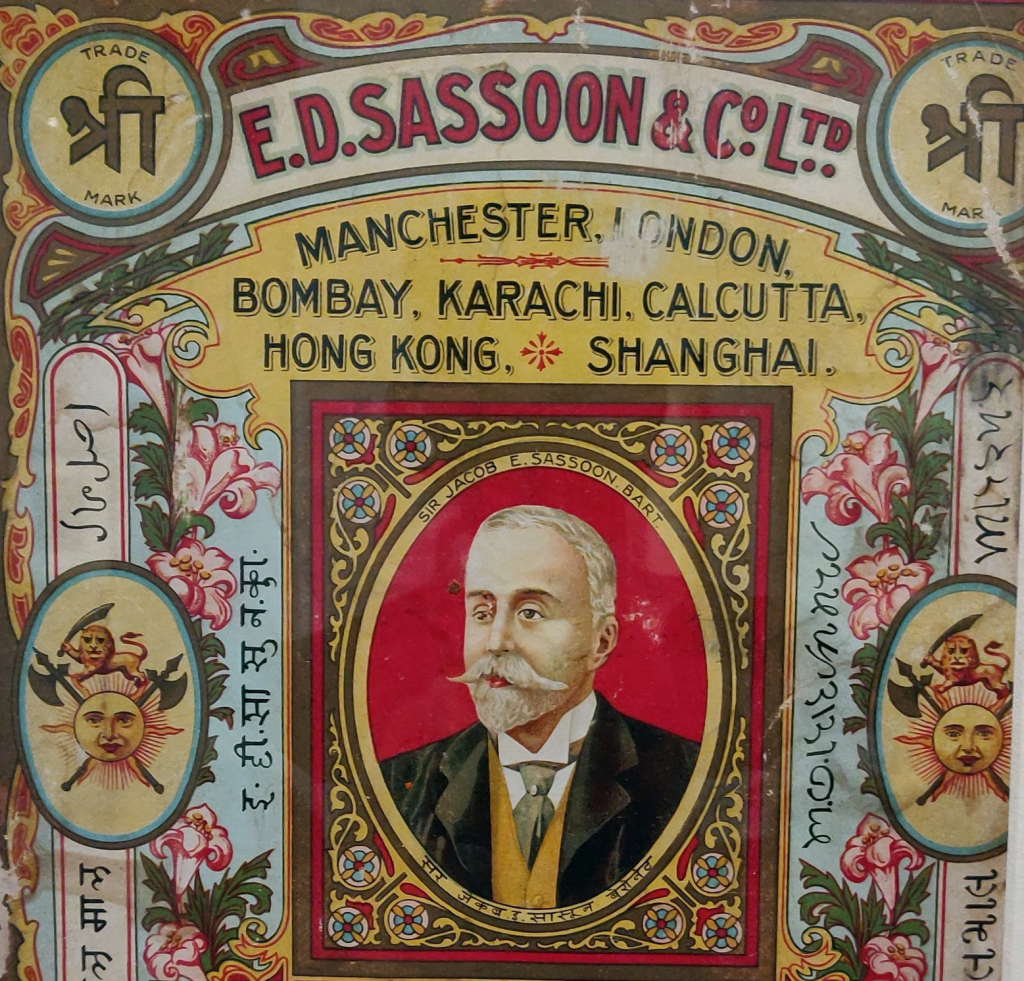
A note on the image at the top of this post. An advertisement (could have been from a calendar or a biscuit tin) for the Sassoon commercial house. The Sassoons were Baghdadi Jews who landed in India in 1830 and went on to become a leading pillar of that city’s economic and cultural heritage. The image is a cultural melange of scripts and symbols, recognisable to Indians and foreigners. The scripts mostly transcribe the family name. Sir Jacob Sassoon was the third or fourth generation to run the business. As the image depicts, he expanded operations to Karachi (now Pakistan) and Shanghai. The family, like so many of Bombay’s elite families was involved in the opium, tea, silver racket that financed the rise of the English empire. More on that in the future.
 Missionaries, Mercenaries and Misfits