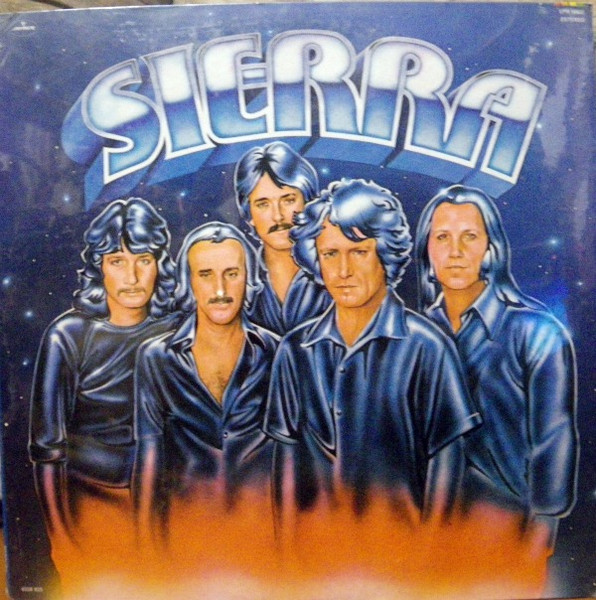
Sierra by Sierra


One of those albums that sunk like a stone. Released and then gone. Mores the pity, because this collection of 11 songs by Sierra is more than just alright. 
Sierra was a single-album band of refugees from a bunch of country-rock and rock bands of the late 60s. By 1977, when their only and self-titled record was unleashed upon the buying public by Mercury, the individual players were in the sort of professional limbo that comes about regularly but is usually swept under the carpet in the biography. Which is too bad and a bit unfair, because Sierra was made up of some formidable names with very respectable curricula vitae.

Gib Guilbeau, on rhythm guitar, had played in a whole series of country-rock and proto-Americana bands like The Flying Burrito Brothers, Swampwater and the legendary Nashville West. On drums, Mickey McGee had credits as the drummer for Jackson Browne (Take it Easy), JD Souther, Linda Ronstadt, Chris Darrow, and Lee Clayton (Ladies Love Outlaws), not to mention an early country-rock outfit Goosecreek Symphony. Oh, and late Flying Burrito Brothers! Eddie’s nephew Bobby Cochran contributes blistering lead guitar and lead vocals. ‘Sneaky’ Pete Kleinow’s steel has graced hundreds of rock and country rock albums and was first brought to wide attention as a founding member of The Burrito Bros and New Riders of the Purple Sage. On bass, Thad Maxwell, another vet of the 68-75 scene, and band fellow of Gib in Swampwater. Felix Pappalardo Jr. produced and contributed piano parts. A storied figure, throughout out his life Pappalardi supported or produced everyone from Tom Paxton to Cream, not to mention his own weighty Mountain.

So, no slouches these guys. They were not suburban lads looking for a break. Their combined talent and credits were formidable. In the parlance of job advertisements they had a “proven track record” of making excellent music. 

But alas, here the sum of the parts didn’t add up. Which is not to say this a shit album. Far from it. Sierra is a very good record of late 70s American pop and deserves to be hauled up from the bottom of the deep lake of forgotten country-rockers. 

The art work is a put-off and no doubt played a big part in the record’s stillbirth. A perfect example of a cover designed by some free lance artist with no idea about the sort of band Sierra was. Many styles did they play, but spacey country-disco was not one of them. You could be forgiven however for thinking this was in fact, their speciality, if you had access only to the dumb, lifeless cover art.

On the black wax we are treated to high quality examples of soft rock (Gina; If I Could Only Get to You), So Cal country-rock (Farmer’s Daughter; She’s the Tall One), British blues (I Found Love), top 40 slick pop (Honey Dew), boogie, rock ‘n’ roll (Strange Here in the Night; I’d Rather be With You) all sauted in the spicey warmth of the Tower of Power horns. (In this era if you were good enough to entice the ToP to record with you, you were ensured at least one extra star from the reviewer.)

But it didn’t work. The album suffered not from a dearth of talent or poor production. It sank because it had no focus. Spaghetti was all over the wall, perfectly al -dente no doubt, but spread across too wide a plane.  For country-rockers in search of Gilded Palace of Sin or even One of These Nights, this was bland stuff. Waaay too poppy, man!

But for this old guy living 50 years in the future, and slightly anxious about the coming extinction of human made music, Sierra deserves 7 stars out of ten, for capturing several trends of America popular music current in 1977.  Especially the eternal wrestle between Country and Rawk.

There are some blatant and pointless rip-offs like You Give Me Lovin, which is essentially a copy of the Eagles, Already Gone, but what did more than the front cover to kill this album, is its refusal to rise above the very good level. The album should really have been titled, Bob Cochran and Sierra, as he is the real star. It is Bob (the only non ex-Burrito), who shows the most excitement here. His guitar is sharp and always stands out. His high-tenor voice fits perfectly in both soft rock and pop—audiences the record label was clearly trying to attract.  Sadly, the band of sages behind him seem content to play perfectly, expertly, confidently but, alas, with very little real energy or pizzaz.

Ratings:

Musicianship-8/10

Listenability-8/10

Energy: 6/10

Songwriting: 5/10

Cover: 3/10

Historic Value*: 7.5/10

*a subjective ranking of combined significance & interest to the history of North American (mainly) popular music of the 1970s. Judged by myself on a particular day. Significance could include the musicians, the cover art, the producer, production quality, songwriting, influence, innovation, listen ability etc.
HERE

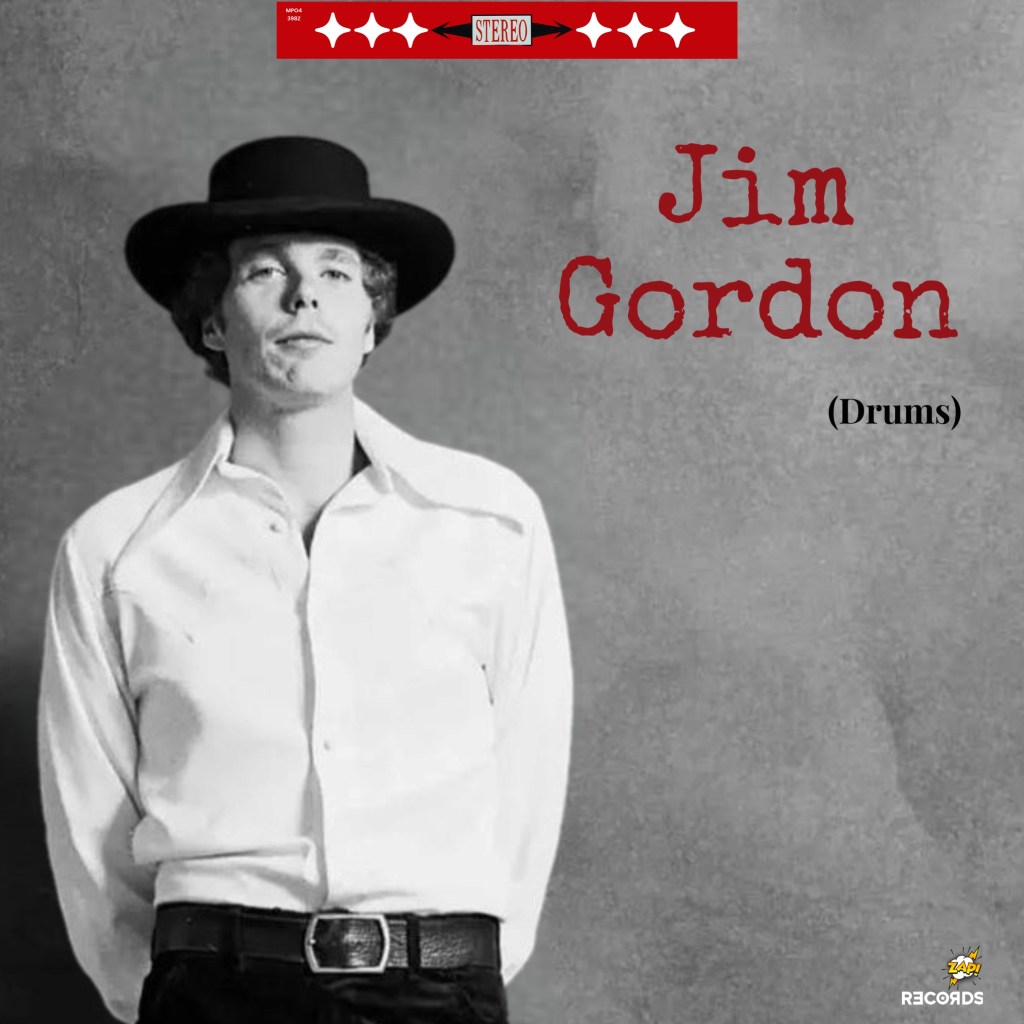
Jim Gordon (drums)

JG(D)

Remember listening to music back in the day? Settle down in a bean bag or stretch out on the couch and read the back of the album cover. You do this enough and over time you’ve developed a mental map of world of rock ‘n’ roll.  The studios. The producers. Even the fricking engineers’ names became familiar. Even if there were no lyrics to read this minutiae seemed to be as revelatory as the Dead Sea scrolls. I devoured it as part of the ‘experience’ of music and over time these names lodged in my brain.

One such name that seemed to pop up all the time was Jim Gordon (drums). My initial rock ‘n’ roll dream was to be a drummer. So, I paid attention to these guys. Steve Gadd. Jim Keltner. Jim Gordon. Levon. Keith ‘Fucking’ Moon, man!

Jim Gordon’s name came up most often so I figured he must be good (duh!). But I knew nothing about him. He didn’t have the lifestyle of Keith ‘Fucking’ Moon nor feature in Rolling Stone in any way that would make his name register for anything other than his prolific credits.

A couple months ago I read Drugs and Demons: The Tragic Journey of Jim Gordon by Joel Selvin. (Highly recommended if you’re into this sort of stuff.) Many of you will know the story and I’m not going to retell it here. I was not only stupefied to learn just how prolific, adored (by his peers and fans) and influential (‘he invented rock ‘n’ roll drumming’) he was but I was shocked to learn he murdered his mother with a kitchen knife. And that he spent the rest of his years in prison where he died just two years ago in 2023.

Surfing through the internet after that I learned that I’m a late comer to this story. There are dozens of interviews with fellow drummers on YT and other places which both praise the drummer and condemn the man.  And it’s that latter attitude that has left me unsettled.  I’m not an apologist for murder. He got what the law says was coming to him.  But to simply condemn one of the great geniuses of popular music, a man who dominated the session culture of the 60’s and 70’s, who could always be relied on to deliver exactly the sound and beat the producer or the artist needed, even when they didn’t know it, who was by all accounts a quiet, gentle giant—though these qualities worn off when the drugs really kicked in—but a man who was tortured for years by disembodied voices in his head that drove him to murder, seems unfair.

I personally don’t know what that’s like. But I know people who do. I do have experience with torturous mental health and know of the despair and the desperation this brings.  To summarize Jim Gordon’s life as that of a drug-addled murderer is a complete misreading of the man’s life.   It seems he was relieved to be put away, where he was unable to harm anyone else.  I get that; and I’m glad he found some safety and peace before he died.  RIP Jim. You deserve it.

Here is a just the thinnest of thin scraping of Jim Gordon’s work. He started out drumming for the Everly Brothers in the early 60s and then went on to be nearly every group’s and producer’s go-to sticks man for twenty years. He mostly worked alone, as a session drummer but did join Delaney and Bonnie and Derek & the Dominos for a while in the early 70s. And you know that beautiful elegiac piano outro on Layla? Well, that was Jim’s idea. And him playing.

Hope you enjoy.

One More Label Before I Go

Bob Dylan: King of Country Music

Taking the voice of both subject and object, in 1964, Bob Dylan put out one of his defining public statements in the song, All I Really Want to Do

He assures his lover that he has no interest in classifying, categorising, advertising, finalising, defining or confining her. The same lyrics can be read as well, as a plea to his fans for a reciprocal respect.  

And yet, here I go.  

Alongside the many ‘Hello! My name is…’ stickers we’ve slapped on his lapel—voice of a generation, Nobel Laureate, fundamentalist whack job, protest singer—I would like to suggest the following: Bob Dylan, King of Country Music.  

I’ve sensed this forever, but as I listened to a mixtape I posted recently, it has become clear as day.   

Dylan was not just inspired by Hank Williams, Cash and Woody Guthrie, he has throughout his career, drawn deeper on the well water of country music than any other so-called genre. It wouldn’t be too hard to argue that very few albums in his vast catalogue are NOT country or country-rock albums.  Bringing it All Home; Highway 61 Revisited; Street Legal jump to mind immediately. Of course there are some others too, but generally the sonic atmosphere of country music and his approach to his art is heavy and sticky with Mississippi mud.  

I will go further. 

Dylan is a better country singer than a rock ‘n’ roll singer.  His voice tends to divide the public. A lot of people can’t stand it. Croaky, wheezy, shallow, awful, they saw.   I am obviously not in that camp though it’s hard to deny that of late it is pretty tuneless and frail. I prefer the adjective, quirky. Country music loves quirky; Bob’s nasally and rough delivery fits perfectly alongside that of others like Kris Kristofferson, Jimmie Dale Gilmore or even Willie Nelson.   So too his quirky pronunciation and phrasing. Very country. 

It works another way too. Some of his quirkiest songs, like Dogs Run Free, a wired and weird folk-jazz oddity on New Morning (1970), is transformed into a perfect country ballad on Another Self Portrait (1969–1971): The Bootleg Series, Vol. 10. Nothing weird or wired. A curly song like this works much better as straight-ahead country. As I’ve mentioned before Dylan’s Bootleg Series are chocker block with alt.country versions of almost every song he’s ever sung.  And often these studio scraps are better than his more famous rock and folk stuff.  Honestly.  

My I admit as evidence, One of Us Must Know (Sooner or Later) a sparkling, sneering gem from Blonde on Blonde (1966 and recorded in Nashville with country session players).  An all time personal favorite. But he also released an instrumental version on The Bootleg Series, Vol. 12: 1965–1966, The Cutting Edge. The song works in both idioms and as a western canter, outshines, for its short duration of 4 minutes 57 seconds, any Chet Atkins instrumental. 

At the height of his artistic powers he could release two outstanding albums in the same year, 1975. Blood on the Tracks, his mid-period masterpiece and The Basement Tapes, a double LP of random musical experiments and frolics that qualifies as the first perfectly formed album of ‘Americana’ music.  Both albums are perennial near-the-top finalists in every ‘Best Albums of Dylan’ list ever published.  

What followed in TBT’s wake (recorded 1967-68 but released in 1975) were John Wesley Harding (1967) a proto-Outlaw country album, and Nashville Skyline (1969) pure country pop in which Dylan channels Jim Reeves.   

Even during his ‘lost 80’s’ period, some of his most memorable songs were his country ones: You Wanna Ramble & Brownsville Girl (Knocked Down Loaded/1986); Silvio & Shenandoah (Down in the Groove/1988); The Ballad of Judas Priest (Dylan & The Dead/1989). The last is really a Grateful Dead track.  Dylan’s singing is pushed along by the band’s amazing rhythm section and Jerry Garcia’s delicious guitar, but it demonstrates that other masters recognised the country potential of his words and tunes. 

Let me wrap this up by asking you to listen to this version of I Shall Be Released, recorded live with Joan Baez on the Rolling Thunder tour.  Dylan’s voice is absolutely beautiful here. And Joan’s subtle but essential supporting vocals makes a fucking good song, a fucking masterpiece. It is such a spiritual, earthy rendition, with no artifice whatsoever.  

Bob never is so relaxed as when he sings his country stuff. His unique timbre and phrasing don’t grate or stand out as weird.  Sure, he was only 34 when he recorded this, but his voice is not just physically strong, his performance is one of complete commitment.  Whereas his mid 60s stuff sometimes comes off as angry and performative, in this and most of his other country-flavored repertoire, he is nothing but authentic and true.