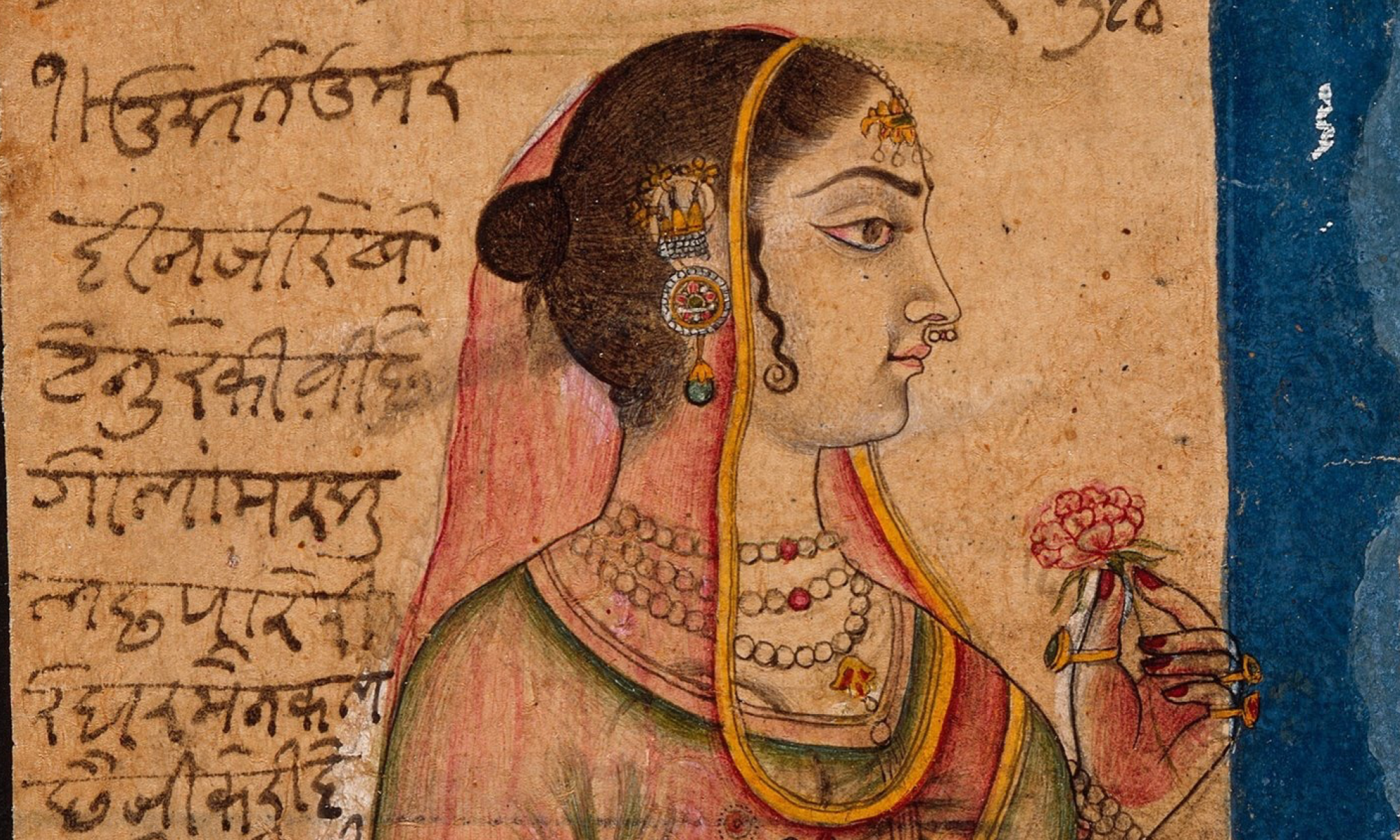
Rivers, Spies and a Treasure Trove of Stories (Pt.2)

Lollywood: stories of Pakistanโ€™s unlikely film industry

Mughal Stories

From day to day, experts present books to the emperor who hears every book from beginning to end. Every day he marks the spot where they have reached with his pearl-strewing pen. He does not tire of hearing a book again and again, but listens with great interest.  The Akhlaq-i-Nasiri by Tusi, the Kimiya-yi-saโ€™adat by Ghazzali, the Gulistan by Saโ€™di, the Masnavi-i-maโ€™navi by Rumi, the Shahnama by Firdausi, the khamsa of Shaikh Nizami, the kulliyats of Amir Khusrau and Maula Jami, the divans of Khaqani, Anvari and other history books are read out to him.  He rewards the readers with gold and silver according to the number of pages read.
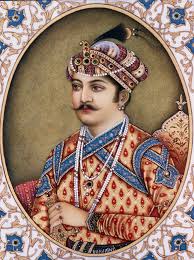
Jalal-ud-din Muhammad Akbar. Grandson of Babur, (founder of Mughal Empire), and ‘greatest’ Emperor of Mughal India. (1542-1605)

It was between the 9th and 19th centuries when north India was ruled by a series of Muslim sultans that Lahore reached its cultural apogee. And especially under the Mughals who built India into the medieval worldโ€™s grandest empire.  Akbar, the greatest of all the Mughal emperors of India loved books and stories. The snippet above, from his biographer Abul Fazl, is a fascinating glimpse into the cultured atmosphere that permeated the courts of the ruling elite of northern India.  The royal library, Abul Fazl proudly noted, included books written in Hindavi (early Hindustani), Greek, Persian, Arabic and Kashmiri.  Akbarโ€™s sons and grandsons and many of his senior nobles continued to add to the library, composing their own works but also drawing to the great darbar (court) of Lahore the greatest talents from all across India, Afghanistan, Central Asia, and even as far away as Iraq.

The Mughals looked to Persia for their notions of culture and gave pride of place not just to the Persian language but to the great poets and thinkers of Iran.  And it was from Persia that many of the grand stories they loved so much and which they adopted and were absorbed into Indian culture first came.  The elites of northern Indian during this period adopted a number of Persian poetic and literary forms in which they preserved their histories, but also stories, poems and philosophies.

Several of these forms, especially the qasida, which was a poem in praise of the monarch, remained a novelty of the darbar and did not influence broader society, but several others did.   Chief among these was the qissa, an extended poem that combined elements of moral and linguistic instruction as well as entertainment.  The subject matter were stories of military valour, spiritual attainment, love and romance.  The Mughals, especially Akbar and his son Jahangir enjoyed the qissa Dastan-i-Amir Hamza which relates at great length and with vivid imagination the fantastic adventures of the Prophet Mohammadโ€™s uncle Hamza.  So much did Akbar appreciate this work that he commissioned a massive project to illustrate the entire epic.  Completed over a period of 14 years (1562-77) the final product included 1400 full page miniature paintings and was housed in 14 volumes. 

Qissas were not just stories but in the control of a good narrator, complete one-man performances/ shows. Some of the royal qissa-khawans (story tellers) are recorded as demonstrating all manner of expressions, body movements and vocal tones in their telling, sometimes even transforming themselves, in the words of one critic of Lucknow, into tasvirs (pictures). Thus, introducing for the first time into Lahore the concept of moving pictures!  Akbar so loved the story that several times he is described as telling and acting out the qissa himself in front of courtiers and guests.  When Delhi was sacked by the Afghan Nadir Shah in 1739 the reigning emperor Muhammad Shah pleaded that after the peacock throne what he most desired to be returned to him was Akbarโ€™s Hamzanama which had illustrations โ€˜beyond imaginationโ€™.

Folio from a Hamzanama ca. 1570 depicting the story of the spy Zanbur bringing Mahiyya to the city of Tawariq,

The critics of the day stressed both telling and listening to stories were beneficial to the soul with some claiming that in the cosmic order of beings, poets and storytellers were ranked second, right behind Prophets and before Emperors!  Though this is undoubtedly a minority view, the best qissa-khawans were indeed highly esteemed.

In 1617, Emperor Jahangir, son of Akbar the Great, recorded the following event:

Mulla Asad the storyteller, one of the servants of Mirza Ghazi, came in those same days from Thatta and waited on me. Since he was skilled in transmitted accounts and sweet tales, and was good in his expression, I was struck with his company, and made him happy with the title of Mahzuz Khan. I gave him 1000 rupees, a robe of honor, a horse, an elephant in chains, and a palanquin. After a few days I gave the order for him to be weighed against rupees, and his weight came up to 4,400 rupees. He was honored with a mansab of 200 persons, and 20 horse. I ordered that he should always be present at the gatherings for a chat [gap].

It was under the reign, and patronage of Jahangir that Lahore became the favoured city of the Mughals. The emperor is remembered for ruling over a stable and prosperous Empire and for patronizing painting, poetry and architecture.  A man of artistic inclinations it was during this time that story forms like masnavi which told of current events and wonderful victories and ghazal a short romantic-mystical form of poetry superseded other forms of literature.  The ghazal in particular was championed by Jahangir and his son and successor, Shahjahan. 

The ghazal both facilitated a large appreciation of poetry outside the circles of the aristocracy, among people of all walks of life, and began to be composed and recited in all sorts of settings including by women, in private homes, in public houses and in competitions.  The masnavi quickly declined because compared to the ghazal it was a bit lengthy and rather tedious. The ghazal on the other hand, was snappy, called for clever word play and rarely ran more than a few verses.  Mushaira, poetry recitations that centred around the ghazal, became one of the most popular forms of entertainment in Lahore during this period.

Many tales are told of courtly mushaira presided over by the Emperor who believed that when expertly delivered, a ghazal was full of magical power. 

One night a singer by the name of Sayyid Shah was performing for the Emperor and impersonated an ecstatic state (sama).  Jahangir questioned the meaning of one line from the ghazal

Every community has its right way, creed and prayer

I turn to pray towards him with his cap awry

From the audience the royal seal engraver, one Mulla Ali gave an explanation of the line which was written by Amir Khusrau and which his father had taught him.  As soon as he finished telling the story, Mulla Ali collapsed and despite the best efforts of the royal physicians to revive him, passed away.

Of course, this literary world of elaborate illustrated tomes, royal qisse and the like was not uniquely Punjabi. Rather it was the literary province of the elite and as such, familiar to most urban literate North Indians.  But the mass of people was not literate and had no access to the libraries, the texts, treatises and poets of the nobility.  And yet beyond the forts and palaces and even beyond the urban areas of Mughal India there pulsated a great tradition of storytelling that influenced the emergence of films in the early 20th century.

To name all of the genres of Punjabi storytelling would be nearly impossible. In addition to qissa and ghazal there were afsane (stories), dastan (heroic tales), latifa (jokes), katha (Puranic stories), naat (poetry in praise of the Prophet), kafi (sufi poems), boliyan (musical couplets sung by women), dhadhi, kirtan, bhajan, swang, sangit, nautanki , marsiya, moโ€™jizat kahanis (miracle stories of Shiโ€™a Muslims), mahavara (proverbs) and so on.  

These forms of storytelling were a part of everyday life for the people of Lahore and the Punjab. Though they may never have seen the beautiful courtly books produced by the Emperors, the characters, plotlines and themes were deeply embedded in the consciousness and culture of common folk.

One story in particular, Heer Ranjha, based on the Arabic classic Laila Majnun, was especially beloved by Punjabis.  Compiled originally in the time of Akbar by a storyteller named Damodar Gulati, Heer Ranjha tells the story of a beautiful girl, Heer, who is wooed by a flute-playing handsome young man Ranjha.  Rejected by Heerโ€™s family because he belongs to a rival Punjabi clan, Ranjha turns toward a spiritual path. He spends time in Tilla Jogian, the premier centre of Hindu ascetism in the medieval period, and becomes a powerful kanpatha (pierced ear) jogi. His identity is uncovered by Heerโ€™s friends who convince her to run away with him which ends badly with the death of both lovers. 

The tale is the greatest of the many similar legends known as tragic love stories, the speciality of Punjab.  Sohni Mahiwal, Sassi Pannu and Dhola Bhatti are taken from the same tradition and have been told, acted and sung to rapt audiences for centuries.  Stories such as these and others, like Anarkali, whether recorded in royal tomes or told under a tree by a wondering minstrel formed the foundational inspiration for Lahoreโ€™s movie makers.  By 1932, just four years after the Lahore produced its first film, Heer Ranjha had already been made into a movie four times!  

Performing Arts

Though the earliest Punjabi stories were written down during the Indus Valley civilization, once Harappa and the other cities were abandoned, India would not use writing again until the rule of the emperor Asoka, more than 1500 years later.

The Vedas were memorised and passed on word for word from generation to generation through a caste of priests, the Brahmins.  And though many of the later Buddhist tales and eventually, even the Mahabharata and Ramayana were put into written form, writing, reading and access to these skills were confined to the very thinnest layer of elite society.   The stories of Punjab survived because they were remembered, retold, performed on stages, recited in poems, acted out in the streets and reimagined with each generation.  This oral and physical transmission, this retelling and telling again, kept the stories fresh and alive, changing, not only depending on who was doing the dancing or singing but whether the context was spiritual, secular, public or private.

Mirasi hereditary musicians ca. 19th century.

As with its oral and written literature, Punjab is likewise blessed with a huge variety of musical styles and musician groups.   Broadly referred to by the public as mirasi, the society of hereditary Punjabi musicians is complex, and highly differentiated.  Though musicians, singers and dancers were uniformly relegated to the outer limits of the caste and class system they played an important, even essential role in Punjabi society. They were the repositories of significant parts of family, folk, clan culture and history. When the movies arrived, the mirasi provided many of the musicians, dancers, singers and composers of what more than any other single trait exemplifies Pakistani/Indian popular movies, the song.

Certain groups of singers have had a direct and enduring connection with the film industry.  The dhadhis, wandering minstrels and balladeers who trace their lineage back to the times of Akbar the Great, were particularly active in Punjab. Accompanying themselves on an hourglass-shaped hand drum (dhadh) and a variety of bowed instruments, dhadis specialised in singing heroic tales (var) of local chieftains, especially Sikh rajas ,as well as the tragic love tales such as Heer Ranjha and Sohni Mahiwal.  Qawwals, who are sometimes considered part of the dhadhi tradition, were associated with the Sufi shrines and sing an intense trance (sama) inducing music that is so identified with South Asian Islamic practice.  Qawwali was a form that was quickly picked up by film makers who inserted it into scenes as light relief or as a sonic representation of an Islamic character or theme.

Also associated with spiritual singing were a class of Muslim singers known as rubabis (after the Afghan stringed lute, rubab).  The Sikh gurus employed rubabis to sing kirtans and shabad, essentially the sayings of the various Sikh gurus sung in their temples (gurdwara) as part of Sikh worship. These musicians had respected musical pedigrees and were expert on the rubab, harmonium, drums and other instruments. Being largely a Muslim group, most moved to Pakistan after 1947 and several played critical, pioneering roles as musical directors in the film world that grew up in Lahore.

The brass wedding bands that became an urban phenomenon in north India in the 19th century drew their members from yet another group of hereditary musicians known variously as Mazhabi (if they were Sikh), Musalli (if they were Muslim) and Valmiki (if they were Hindu). These musicians provided services including acting as town criers and news readers. They would make community announcements while beating their drums and playing their horns and clarinets. During festivals and celebrations they entertained people from their vast repertoire of religious and secular songs.  As the forms of entertainment changed in the 20th century and especially when sound and music were incorporated into movies in the 1930s, these skilled players formed the backbone of the studio orchestras that produced the amazing soundtracks of the films.

In addition to singers and musicians a universe of street performers, actors and magicians made up part of the Punjabi landscape as well. There were bazigaars (acrobats and contortionists who also sang and acted), bhands (comics) who interrupted weddings and other events to make fun of prominent members of the family and their guests with quick jokes and bawdy repartee for small sums, madaars (jugglers and magicians) who with their magical powders and wands would make birds, eggs and even people disappear and reappear at will.

These groups performed publicly on the streets, in city squares or open fields and bazaars. At any fair (mela) or โ€˜ursโ€™ (sufi celebration at a shrine) all of these and more would be part of the entertainment.  Indian diplomat, Pran Neville, writes in his memoir of Lahore, ๏ปฟโ€œwe had but to walk into the streets to be entertained by one or the other professional jugglers, madaris (magicians), baazigars (acrobats), bhands (jesters), animal and bird tamers, snake charmers, singers, not to mention the Chinese performers of gymnastic feats who would be out on their daily rounds.โ€[1] Like the mirasi, many of these castes of public entertainers found that the new film studios popping up in Lahore could be an unexpected source of livelihood.

An acrobat (baazigar) climbing a pole held by another man while a musician drums out a beat. Gouache painting by an Indian painter. 19th century.

If Parsi Theatre inspired the early film makers of Bombay, in Punjab other forms of theatre were just as important: swang, naqqali and nautanki.  Each of these theatrical codes were common across the Punjabi countryside where performing troupes travelled and performed a rich variety of dramas.

The most important of the traditional theatres in Punjab was a form of nautanki known locally as swang.  In essence swang which takes its name from the Sanskrit word for music (sangit) is informal folk opera. The production incorporates liberal portions of singing and dance and often all the parts are sung rather than spoken.

A performance would generally take place in an open part of a village where a local dignitary had invited the troupe to play.  After a day of preparation during which the excitement built as stages were erected and children ran amok amidst the activity. The performers prepared by singing for hours with the heads facing downwards into the villageโ€™s wells, a practice that allowed them to improve their range and enhance their projection.  The actual performance would finally begin late in the evening and continue till the early hours of the morning.  If the plot was a long one this would continue over a number of evenings.    

Audience participation–hissing, shouting, calling out requests for songs or jokes to be repeated–was expected and happily accommodated.  The performers were masterful singers who had to project their voices over the audience noise and often compete against a rival troupe performing in another part of the village.  It was said that some of the best singers could be heard more than a mile away.  One only needs to listen to the resounding voice of Noor Jehan, Pakistanโ€™s Queen of Melody, and one of the greatest film singers of the subcontinent, to get a sense of the amazing power of these traditional singers.

Long before Nargis played Radha in Mother India (1957) or Prithviraj Kapoor played Akbar in Mughal-e-Azam (1960) these open-air travelling opera companies were laying the essential template  of and sketching out the iconic roles for South Asian popular cinema.

The City as a Story

Lahore, the cultural capital of the greater Punjab region was itself was a city of a million tales. In many ways Lahore, a city so fabled for so long, was the most famous of Punjabโ€™s myriad stories.

Sita in the forest with her two sons. Lav is credited with founding the city of Lahore.

The origins of Lahore stretch back to one of the two foundational epics of Hinduism, the Ramayana.  In a storyline familiar to all movie lovers in South Asia, we are told that Sita, Ramaโ€™s wife and a goddess in her own right, becomes pregnant making her jealous husband, Rama, question her fidelity. Falsely accusing her of adultery, Rama turns Sita out of the house. Deep in a forest Sita gives birth to twin boys, Lav and Kush, whom she raises with great love and devotion.  In a dramatic twist of Fate, years later, the boys are reunited with their father whom they have never met. They take him into the forest to meet their mother. Ram is stunned and realises his mistake but despite Ramaโ€™s protestations and desperate apologies, Sita is swallowed up by the earth and returned to the Heavens.  Rama goes on to rule his kingdom with his two sons by his side in a Golden Era of peace and stability. When the time comes, he sets Lav and Kush up in the far West of his country where they establish themselves in two cities. Kush in Kasur, 52 km southeast of Lahore on the Indian border, and Lav in Lavapuri, modern Lahore, where even today, inside the fort of Lahore, there is still a small temple dedicated to this son of Lord Rama.

Despite its hoary Hindu roots, and being described as early as 300 BCE by the Greek historian Megasthenes as a place โ€˜of great culture and charmโ€™, Lahoreโ€™s greatest glory was experienced when it was the capital of various Muslim sultanates and states. Throughout the medieval period when northern India was ruled by a succession of ethnic Turkish rulers who promoted a heavily Persianised culture, Lahore was a city of prime strategic, commercial and cultural significance. And despite its oppressive summer heat a reputation of luxury, elegance and sophistication attached to the city. Its guilds and craftsmen were heralded throughout the region and beyond; its poets, some of the most beloved, even in Persia.  Like a handful of other cities around the worldโ€”modern Paris and New York for exampleโ€”Lahore has developed a special atmosphere which has caused both natives and visitors to fall in love with it.  Way back in the 12th century, Masud ibn Said al Salman one of the cityโ€™s most popular poets found himself imprisoned far from his home city for pissing off one of the cityโ€™s rulers.  Pining away in his cell he wrote a lamentation.

Lahore my loveโ€ฆ                     How are you?

Without your radiant sun, oh    How are you?

Your darling child was torn away from you

With sighs, laments and cries, woe!  How are you?

Each of the four great Mughals (Akbar, Jahangir, Shahjahan and Aurangzeb) did their bit to build, extend and refurbish the city.  Along with Agra and Delhi and for a while Fatehpur Sikri, Lahore served for years at a time as the Imperial capital and was heavily fortified as a military hub. As it enjoyed the presence of the Emperor himself, artists, administrators, philosophers and emissaries hailing from all across the world came to Lahore to live, seek patronage and practice their speciality.

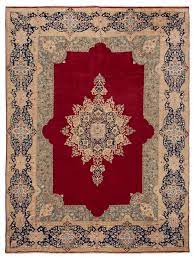
Poets such as โ€˜Urfiโ€™ of Iran made Lahore their home finding the relatively tolerant and inclusive atmosphere a delicious change from the claustrophobic Shiโ€™a Islam of his home country.  He and other poets employed by the durbar [court] produced sublime poems which were sometimes reproduced on paper reputed to be as delicate and as thin as butterfly wings. Artisans brought their skills and looms to the royal city which by the 16th century had an international reputation for producing exquisite silken carpets which, in the words of one historian, made โ€œthe carpets made at Kirman in the manufactory of the kings of Iran, look like coarseโ€ rugs.

Kirmani carpet

The painters who made Lahore their homeโ€”both immigrants from Iran and the hills of Punjab and Kashmir, as well as nativesโ€”brought glory and awe to the city and its rulers. Ibrahim Lahori and Kalu Lahori, two painters in the court of Akbar illustrated a book called Darabnama (The Story of Darab) which set out the exploits of the young Akbar, sometimes in fantastic detail, just after he had decided to leave his new purpose-built capital, Fatehpur Sikri, to take up residence in Lahore.  Their miniatures brought to life the Persian text which told wild tales of dragons swallowing both horses and their riders in one awesome gulp, as well as radical illustrations of naked humans which according to art historians were never before so accurately depicted by Indian artists.  The Darabnama which is recorded as being one of the emperorโ€™s favourite story books also depicts scenes from courtly life such as Akbar being praised and honoured by rulers from other parts of the world and India.  Ibrahim Lahori along with miniaturists like Madhu Khurd are credited with bringing a fresh and naturalistic realism to portraiture. It was in Lahore-produced books like the Darabnama that for the first time individuals with all their physical quirksโ€”bulging pot bellies, monobrows, turban stylesโ€”could be identified as real historical individuals. 

The cityโ€™s countless mosques and Sufi dargah (tombs) honouring Lahoreโ€™s many saints and pirs are not just revered places of devotion but subjects of and characters in stories filled with miracles and magic that are still told today.  The cityโ€™s storied inner walled city dominated by the domes of the Jamโ€™a masjid but filled with hundreds of other havelis (mansions), shrines, tombs, pleasure palaces and gardens are themselves characters in the various storylines.  How many poems, songs, operas and movies, including made in Hollywood, include the name Shalimarโ€”those famous Mughal-era gardens of Lahore?

Poster for 1958 Pakistani film, Anarkali, which is only one of many South Asian films to picturise the famous Lahore-based story of Prince Salim and the beautiful Anarkali.

Probably the most famous of Lahoreโ€™s many stories and one that has been retold in film in both Pakistan and India many times, is that of Anarkali. Like all tales that have been passed down through generations this one has several different tellings but the most famous and popular one is the tragic one.  

One day a Persian trader came to Lahore for business and brought with him members of his family.  In his caravan was his beautiful pink complexioned daughter Nadira also known as Sharf un-Nissa.  Her beauty stunned the bazaars of Lahore and word quickly reached the Emperor himself that there was a woman as splendidly gorgeous as a pomegranate seed in his city.  He summoned the merchant to his court and upon seeing the young woman fell immediately in love with her graceful charm.  The young womanโ€™s father was only too pleased to accede to the great Mughalโ€™s request for Nadira to be allowed to join the royal harem.

Much to the chagrin of his wives and other concubines Akbar seemed completely fixated upon the beautiful Iranian girl who was rechristened Anarkali (pomegranate seed) by the King himself.   The only time she was not by his side was when he was away from Lahore, conquering yet more lands and expanding the glory of his family and empire.  And so it happened when Akbar was leading his armies in a campaign in central India, Anarkali and the crown prince, Salim, later to rule as Jahangir, developed an intimate relationship. The gossip hit the bazaars and everyone spoke of how much the two loved each other. Salim it was said was ready even to renounce his right to the throne of India for a life with Anarkali.

When Akbar returned to Lahore he called for Anarkali but immediately sensed something different in the way she approached him. โ€˜What is the matter,โ€™ he cooed but she resisted his embrace and made an excuse to retire to her chambers as swiftly as possible.  Akbar was upset and soon livid when his spies and courtiers informed him of the fool Anarkali had made of him during his absence. โ€˜The bazaar is echoing with jokes that say Your Highness is too old to water such a lovely tree as Anakaliโ€™.

The next day Anarkali was summoned to the Emperorโ€™s chambers. โ€˜Is what I am told true? That you love Salim more than me?โ€™

Anarkali tried to demur but the wizened old ruler knew a lie when it was uttered no matter how lovely the lips that spoke it.

He sent his favourite concubine back to the harem and then called his chief wazir and instructed him to arrest Anarkali before the night was through.  โ€˜You should bury the witch alive and leave no marking of her cursed tombโ€™.

In the years that followed Lahore was abuzz with rumours and theories of what happened to Anarkali. Salim was depressed as she was nowhere to be seen. Had she been banished back to Iran?

Eventually the old Mughal died and Salim ascended the jewel encrusted throne of Lahore. One of his first acts was to build a simple tomb on the spot where Anarkali had been so heartlessly murdered.  Inscribed upon the tomb is a couplet from the love-lorn Jahangir himself, If I could behold my beloved only once, I would remain thankful to Allah till doomsday


[1] Pran Neville. Lahore: A Sentimental Journey. (New Delhi: HarperCollins, 1997), 60.
Deep Dive: The Wadia Brothers and the Masked Woman

Lollywood: stories of Pakistanโ€™s unlikely film industry

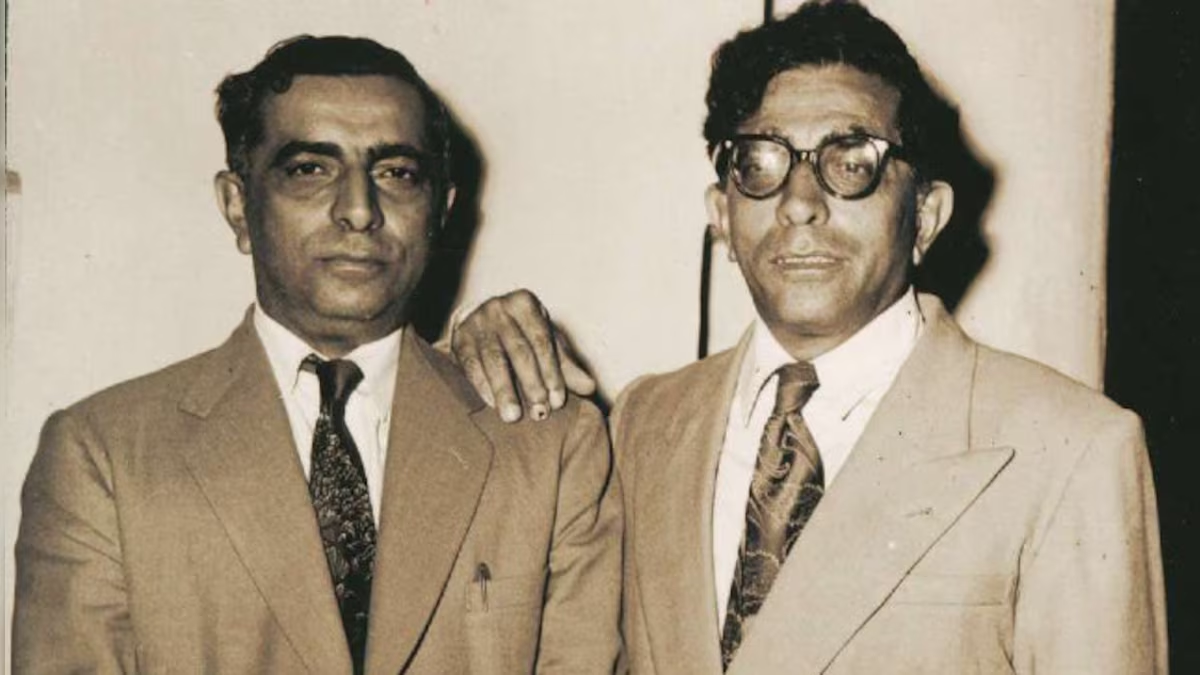
Homi & JBH Wadia

Of the many Parsi clans who leveraged their interaction with the British in Bombay to establish themselves as economic powerhouses, even to this day, the shipbuilding Wadia family is worth a closer look.

Even before the community fled Persia to seek refuge along Indiaโ€™s western coast, the Zoroastrians were renowned ship builders and sailors. During the reign of King Darius (522-486 BCE) the Persians had learned well from the Phoenicians (1200-800 BCE) and become the acknowledged shipbuilding and maritime empire of the epoch.  Though their numbers were tiny in their new home in India, (never more than 100,000) the community kept these ancient skills alive.

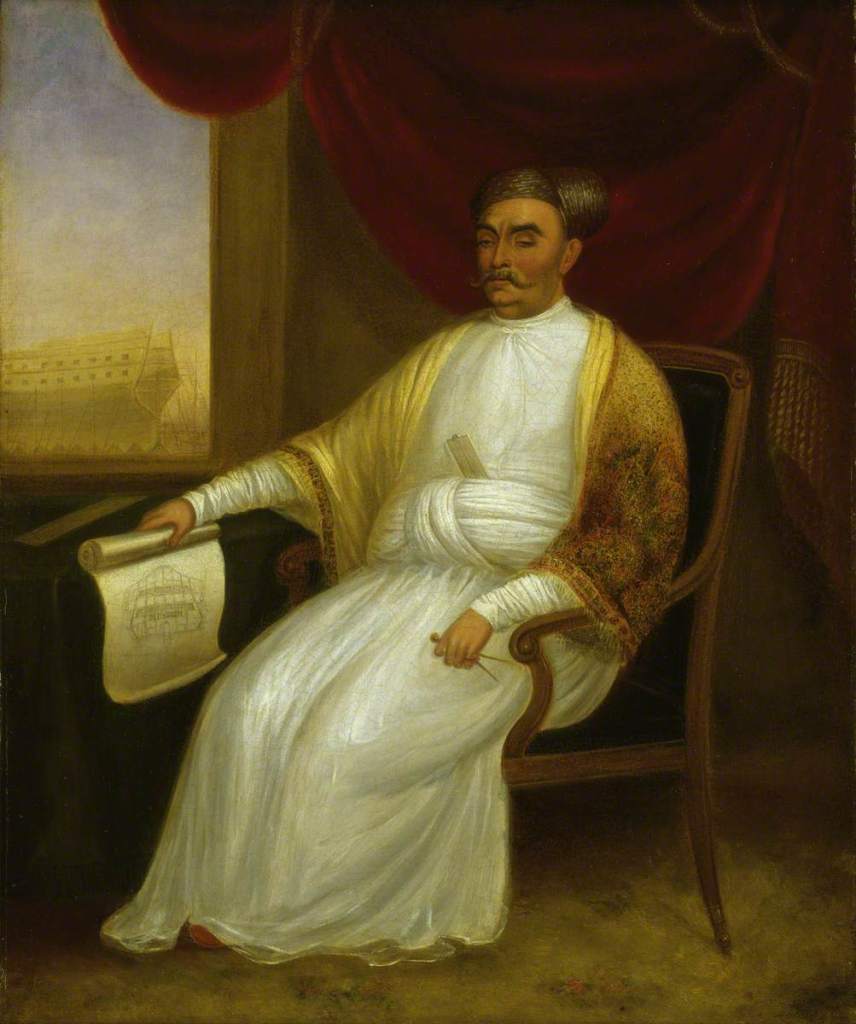
Settled and working out of Surat, the Wadia (Gujarati for โ€˜ship builderโ€™) clan, interacted with the various European trading nationsโ€”Portugal, Netherlands, Franceโ€”that sought trade with the Mughal empire and its wealthy business communities of Gujarat. When the rather slow-starting English received the islands of Bombay from the Portuguese, Parsis began to migrate from the hinterland south. One of Suratโ€™s most prominent shipbuilders, a Parsi named Lovji Nusserwanji Wadia who had built ships for a number of European trading firms in Surat, was invited by the English to establish a branch of the family business in Bombay.  And so, beginning in 1736, Lovji along with his brother Sorabji set to work building Asiaโ€™s first dry docking facility where EIC ships could be drawn entirely out of the water to be repaired and refurbished.  This single bit of infrastructure increased the economic and strategic value of Bombay immensely. It brought to the foreground Bombayโ€™s exceptional qualities as one of the best deep water harbours (the city’s name derives from the Portuguese words Bom (good) and Bahia (harbour)) from which the British, with their new infrastructure and world-class Parsi shipbuilders, were able to not only vanquish the Portuguese, Dutch and regional Indian naval powers but also clear the Arabian Sea of pirates which led to a steady increase in traffic and trade.  By the mid-19th century Bombay had become a major international commercial and naval port and the most important city in British India.

By 1759 the dry dock was operational. At the same time the brothers Wadia were providing many of the ships that carried cotton and spices and eventually that fateful black gold, opium, from India to China and other Asian ports.  Given the EICโ€™s monopoly on the Indian trade and the massive growth in the economy opium facilitated, particularly in the first part of the 19th century, the Wadiaโ€™s became immensely wealthy. Theirs was a full-service enterprise, building single-sailed sloops, water boats that managed trade up and down the west coast, beautifully sleek, fast-moving clippers, well armed frigates and man-o-wars for the military as well as cutters, schooners, and eventually steamships for the Asian/Chinese trade. Using teak, rather than English oak for the hulls, the Wadiaโ€™s ships were lighter and more resilient than ships made in Britain. Over the years, the family built over 400 ships for the EICโ€™s Maritime Service and others including their fellow Parsi sethias.

Lovjiโ€™s grandson, Nusserwanji Maneckji continued the family business and in addition to servicing the British became a much sought after local agent for early American traders building up the trade between India and New England. Maneckji Wadia was so well regarded by the Americans that he and his relatives enjoyed a virtual monopoly on the Yankee business with many American traders exchanging effusive letters with him in which his โ€™impeccable characterโ€™ is praised and his family compared to โ€˜satrapsโ€™.  Both sides profited handsomely. In the words of one Yankee businessman, they profited โ€˜monstrouslyโ€™, recovering up to 300% on the Indian textiles and other goods sourced by the Wadias.

HMS Minden in the heat of the Battle of Algiers

One of Nusserwanjiโ€™s sons, Jamshetji Bombanji, was appointed Bombayโ€™s Master Builder[1], a role usually held by an Englishman, but which the Wadia family was to hold for 150 years running.  Several of Bomanjiโ€™s ships found their way into the larger events of the time, including the first man-o-war built in Indiaโ€”a huge warship with three masts and loaded with 74 large cannonsโ€”the HMS Minden.  When it set sail in 1810 a Bombay newspaper, the Chronicle, praised โ€œthe skill of its architectsโ€ and went on to note that with โ€œthe superiority of its timber, and for the excellence of its docks, Bombay may now claim a distinguished place among naval arsenalsโ€.  Several years later, on the night of 13 September 1814, the HMS Minden was tied to a British ship in Chesapeake Bay, along the east coast of the United States, after a local lawyer, Francis Scott Key, had helped to secure the release of an American prisoner-of-war held by the British. Fighting between the Americans and British was intense with the night sky flashing red and yellow.  The frightening spectacle inspired Key to write a poem, The Star Spangled Banner, which was eventually adopted as Americaโ€™s national anthem.

Steel eventually replaced teak in the building of ships and steam took over from wind. The Wadias, like many Parsis diversified initially into textile production where steam-derived technologies helped to propel the Wadiaโ€™s Bombay Dyeing mill into one of the most successful and iconic of Indiaโ€™s modern businesses.  And when the movies came to India, two great-great grandsons of Lovji Nusserwanji took the daring decision to turn their back on textiles and ships altogether and embrace the world of moving pictures. 

Jamshed Boman Homi Wadia, known as JBH, was only 12 when Dadasaheb Phalke exhibited Raja Harishchandra, but spent his youth captivated by the Hollywood films that were becoming an increasingly common form of entertainment in Bombay.   Though well-educated as a lawyer JBH horrified his family with his announcement that he intended to make films for a living.  He quickly found work with the then prominent Kohinoor Studios producing a dozen films for the studio, some of which saw moderate success. But being an entrepreneur JBH didnโ€™t want to work for anyone else, so, joined by his younger brother Homi, launched his own studio, Wadia Movietone in 1933, retaining the family’s shipbuilding past as part of the studio’s logo.

The brothers became icons of the early Indian film history and throughout the 30s and 40s Wadia Movietone was the most profitable of all Indian filmmaking enterprises.

Wadia Movietone studios was financially backed by several other Bombay Parsi families-including the famous Tatas-and grew into one of the most successful and consistently profitable studios of the 1930s. The brothers were basically in love with stunts and action.  They especially adored derring-do characters like Zorro and Robin Hood played by Douglas Fairbanks Jr, and blatantly copied many of Fairbanksโ€™ movies for Wadia Movietone.  When Fairbanks visited Bombay, JBH made sure the actor visited his own studio; so impressed was his American idol that Fairbanks agreed to sell the Indian rights of his mega hit Mark of Zorro to Wadia Movietone.

The brothers proudly low-brow fare of fistfights, speeding trains and masked heroines dominated Indiaโ€™s box offices throughout the 30s and became the most popular genre in India at the time. Sadly, as film historian Rosie Thomas states, Indian โ€œfilm history was rewrittenโ€, by starchy Hindu nationalists who objected that stunt films did not inspire sufficient pride in Indiaโ€™s Hindu classical past.   The whole stunt movie genre was effectively eliminated from most histories of Indian film giving virtually all attention on the more staid and far less fun, middle-class targeted โ€˜socialโ€™ melodramas focusing on family and relationships.  

At their height, however, the Wadia brothersโ€™ studio was the rage of the box office. Their greatest success was without a doubt a series of action films which in todayโ€™s parlance might be called a franchise, starring a stunning white woman they billed as Fearless Nadia.

Mary Evans, a West Australian girl of Scottish-Greek extraction, moved in 1911, at the age of three, to India where her father served with the British army.  Settled and schooled for several of her early years in Bombay, Evans father was killed in 1915 while fighting in France and eventually moved to Peshawar to live with an โ€˜uncleโ€™ who in fact was a friend of her deceased father.  It was the wilds of the NW frontier of India that stimulated Maryโ€™s tomboy personality to blossom.  She discovered a love for the outdoors, sports and horse riding and with a mother who had once been a belly dancer, found herself singing (often bawdy songs) and dancing on stages across the NW and Punjab.  Between 1927 and 1934, Mary performed as a dancer and singer in various troupes and circuses as well as a solo performer, travelling across the Indian subcontinent performing for wealthy maharajas as well as illiterate labourers.  It was a risky job for a slightly big boned, well-built blonde-haired woman, travelling (often) alone across India, speaking only English and Greek, working at night in (often) seedy venues but it was one that seemed to suit her. When an Armenian fortune teller predicted a bright career for Mary, they used tarot cards to select a stage name, eventually settling on Nadia.

Mary Evans aka Fearless Nadia

Sometime in the early 1930s, a Mr. Langa, the owner of Lahoreโ€™s Regent Cinema, saw one of Maryโ€™s stage shows. Given that cinemas in those days regularly booked dance troupes to complement the movie, it is possible Langa hosted Mary at the Regent itself.  Whatever the circumstances, Langa was taken by her presence and striking looks. He offered to introduce Evans to a friend of his, someone named JBH Wadia, who ran a movie studio in Bombay. Was she interested?  With sparkling blue eyes and blonde hair, Nadia hardly fit the bill as the ideal Indian woman but she was not alone. Throughout the silent era and even into the age of Talkies, many of Indiaโ€™s initial generation of female starlets were in fact Anglo-Indian (mixed European and Indian heritage), European and Jewish women. At a time when acting was considered a dishonourable career by most Indians, non-Indian women felt less inhibited socially to take to the stage. Most adopted Indian stage names and worked hard to improve their unmistakably foreign accents.  Still, the basic assumption was that actress was a synonym for prostitute.  German film historian, Dorothee Wenner, whose biography of Evans, Fearless Nadia, sums up the situation as follows:

The connections between theatre, dance, music and prostitution remained so closely entwined well into the twentieth century that any official attempt to limit prostitution simultaneously represented a threat to the dramatic arts. The consequences for cinema were first felt by the father of Indian cinema, D.G. Phalke. He knew that filming made different demands on the realism of scenes than the stage did and therefore he wanted a woman to play the female lead in his first film Raja Harischandra. It was 1912 when he went looking around the red-light district of Bombay for a suitable performer. Although the impoverished director offered the few interested parties more money than they would normally earn, all the prostitutes turned the film work downโ€ฆit was below their dignity!โ€[2]

When they met, Wadia immediately understood Evansโ€™ appeal and potential. He suggested that the Australian change her name to Nanda Devi and wear a plaited dark wig. But Mary refused.  โ€œLook here Mr Wadia,โ€ she said, undeterred of her future employerโ€™s power or status, โ€œIโ€™m a white woman and Iโ€™ll look foolish with long black hair.โ€ As for the name change, she scoffed. โ€œThatโ€™s not in my contract and Iโ€™m no Devi! (goddess)โ€ She pointed out that her chosen stage name, Nadia, resonated with both Indian and European audiences, and also just happened to rhyme with his own name, Wadia. JBH, not used to be spoken to so boldly by an employee, let alone a woman, figured she just might have what it takes to make it in the movies. He hired her on the spot.

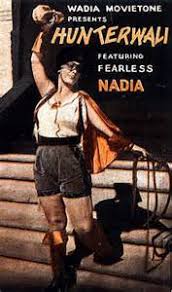
An agreement was reached and in 1935 the brothers tested her in a couple of small roles in two films. Her charisma, not to mention her stunning and exotic looks, were obvious. She stood out like a ghost at midnight. Immediately, she was offered the lead in a Zorro-like picture called Hunterwali (Lady Hunter) which became a smash hit and is now considered one of the most significant milestones in South Asian film.   The Wadia brothers had been unable to find a distributor for their extravagant production. Most considered it too radical and unsuitable for local tastes. A white masked woman, cracking a whip, smashing up villainous men, riding a horse and sporting hot pants that revealed her very white fleshy thighs? Absolutely not!

Unbowed, the brothers pooled their resources and sponsored the filmโ€™s premier at the Super Cinema on Grant Road, on a wet June evening in 1935. This was make or break.  The Wadias believed in Nadia even though everyone else did not.  Not without a little trepidation rippling through the cinema the lights dimmed and the show began. Fifteen minutes in, as Nadia pronounced that โ€˜From now on, I will be known as Hunterwali!โ€™, the working class male audience stood up, cheered and clapped and in their own way pronounced the coronation of the Queen of the Box Office, a title she would hold for more than a decade.

The Wadiaโ€™s, as indeed most of their countrymen and women, were politically active (supporting Independence from Britain) and socially progressive. They championed womenโ€™s rights, Hindu-Muslim solidarity and anti-casteism.  Though official censorship prohibited open discussion of these themes the Wadias made sure their superstar made casual references to them. As Nadia herself said, โ€œIn all the pictures there was a propaganda message, something to fight for.โ€[3]

The girl from Perth via Peshawar and Lahore, was now a superstar of action and stunt film with millions of fans.  Known and billed as Fearless Nadia she insisted on doing all her own stunts be it fistfights on the top of a fast-moving train, throwing men from roofs or being cuddled by lions.  She starred in nearly 40 pictures most made by the Wadia brothers (she married Homi in 1961) with such fantastical titles as Lady Robinhood, Miss Punjab Mail, Tigress, Jungle Princess and Stunt Queen.

In 1988 a version of Hunterwali, perhaps the most famous of all of Nadiaโ€™s films was released in Pakistan, starring Punjabi movie icons, Sultan Rahi and Anjuman.


[1] A highly critical and strategic role that oversaw ship design and construction but innovation, compliance with international shipping regulations and development of the shipbuilding industry.

[2] Wenner, Dorothee. 2005. Fearless Nadia: The True Story of Bollywoodโ€™s Original Stunt Queen. Penguin. Pg. 79.

[3] Thomas, Rosie, โ€œNot Quite (Pearl) White: Fearless Nadia, Queen of the Stuntsโ€, in Bollyword: Popular Indian Cinema through a Transnational Lens, ed. Raminder Kaur & Ajay J Sinha (New Delhi: Sage Publications India Pvt Ltd, 2005) 35-69.

Chapter Two: Of Tea and Opium

Lollywood: stories of Pakistanโ€™s unlikely film industry


Of Tea and Opium

That movies were instantaneously embraced in the new, purpose-built metropolises of British India is no surprise. Bombay, Calcutta and Madras were the throbbing hubs of an expansive world power at the peak of its self-belief. These great new empire cities were magnets for people of all persuasions, creeds, backgrounds and regions. The only requirement to be a success in this brave new world was to be open to new ideas.  And quick on your feet. Being coastal cities, the three great colonial cities served as entrepรดt  to the Jewel in Queen Vicโ€™s crown, guarding and servicing the shipping lanes which were the new global trade routes that connected an expanding Europe with the wealth of Africa and Asia.

And not just Indians, but people from all over the world sought their chances in Indiaโ€™s boom and bust emerging economy.  Armenian merchants, American missionaries, German scholars as well as businessmen, administrators and artists of all types and nations including some of America and Europeโ€™s finest jazz men and women, all sensed that Bombay and Calcutta were the place to make their names and fortunes.  The cities were linked not only to Paris, London and New York but other colonial metropolises like Shanghai, Johannesburg and Singapore. The cities were part of a new international order tied together by a globalizing modern culture in which film was the shiniest element.

Built on marginal landsโ€”often, malarial swampsโ€”and leased by the British East India Company from local rulers, Madras, Calcutta and Bombay were in conception and culture European cities. They just happened to be located in Asia.  Their European quarters and administrative districts were laid out like European cities and they looked outward, to the future for inspiration.  What happened in the mofussil (interior, countryside) across the vast plains of India was of interest only to administrators and scholars. In 1857, after a brutally fought war launched from within the East India Companyโ€™s own Indian troops, the British crown took direct control of India from the East India Company and ushered in a century of high imperialist rule.  To the British administrators in Calcutta and London 1857 marked the end of Indian history.  Henceforth, under their enlightened stewardship, India would exemplify the very best of Britainโ€™s civilizing Will. The great Indian past would now be an object of wonder best gawked at in museums. And the great cities of Bombay, Madras and Calcutta were the ultimate symbols of Lightโ€™s victory over Darkness.

Though the absolute number of Europeans and non-Indians living in India was was its peak in 1911, it never exceeded between 150,000-200,000 depending on how you identified the various groups. The population of India in 1911 was about 300 million souls. Even though Europeans counted for less than 1% of the population their presence had a massive impact on the culture of the cities. Christian missionaries influenced the way Hindus and Muslims understood and organised themselves.ย  Religious groups like the Arya Samaj and Brahmo Samaj, adopted reformist, educational and progressive social agendas that were in form if not doctrine heavily influenced by similar movements in Europe and North America.

Educational systems and curricula that emphasised Western sciences and philosophy and cultural institutions that pumped new, so called modern ideas and technologies into the daily lives of Indians sprang up.ย  The new trade of journalism was quickly embraced by writers, marking the beginnings of modern Indiaโ€™s lively, vibrant press. The publication of the Urdu novel Umrao Jan Ada in 1899 was the first in what would be a glorious and still current run of South Asian prose writing.ย  After some initial resistance, musicians realised they could reach a much bigger audience by recording their music on phonographs and radio.ย  In a relatively short space of time economically empowered Indians in the major coastal cities became both the consumers of new technologies and creative adapters of tradition.ย 

**

 The Parsis, Zoroastrian refugees from Persia, had been settled in Gujarat for centuries by the time the British took possession of a swampy, malarial set of islands from their imperial rivals, the Portuguese. The seven islands were known collectively as Bombay and with the establishment of a British fort, the settlement began to draw migrants from the hinterland. Dorabji Nanabhoy, the first Parsi to make Bombay his home arrived in 1640 but he was joined by a steady stream of thousands of others, mainly weavers and artisans from upcountry Gujarat, who began transforming themselves into one of Indiaโ€™s elite and most influential business groups.

An entrepreneurial community with a sense of adventure, the Parsis had been engaged with Europeans before the British became the dominant Western power in India. Joining Dutch and Portuguese traders operating out of Gujarati ports like Surat and Khambay in the 17th century, they showed themselves to be expert traders and developed a refined taste for European luxury goods.ย  The East India Companyโ€™s trade with China began in the early 18th century and immediately a number of Indian traders, including two Parsi brothers, Hirji and Mancherji Readymoney, established themselves in Canton.ย  Of all the groups it was the Parsis who were the most successful. By the early 19th century they dominated the China trade; nearly half of all the Indian trading companies in China were Parsi owned.

The only product that really mattered in the China trade was tea. Initially the British offered English wool and Indian cotton for the little black leaves which had taken Blighty completely by storm from the day it was first introduced in the late 1650s–just about the same time the East India Company was setting itself up in Bombay.ย  Sensationally, tea became the single biggest import into Britain during the late 17th century. Though at first it was the exclusive drink of the aristocracy and royal family by the mid-1700s it was the undisputed national drink, displacing the traditional gin and beer whose declining sales alarmed the King who personally and financially depended on the taxes from these drinks. More than 2000 tea shops sprang up in London alone.ย 

But wool–heavy and hot–did not exactly suit the Chinese climate and was rejected by the Chinese who, upon the Emperorโ€™s orders, demanded silver in exchange for their liquid gold.ย  The Company had no option but to oblige and approached the government for access to the countryโ€™s silver stocks.ย  So insatiable were the appetites of both English tea drinkers and the Chinese merchants, that the tea trade came dangerously close to draining the English treasury of its bullion reserves and seriously jeopardising the English economy. Despite the best efforts of Parliament to legislate away the negative impacts of the tea crazeโ€”including slapping a 119% tax on tea which only opened the way for smugglers to set up elaborate networks up and down the countryโ€™s bounteous coastline– by the early 1700s it was obvious that the East India Company would need to find something far more sexy and attractive than tweed and wool toย  offer the Chinese hongs (licensed traders).ย ย 

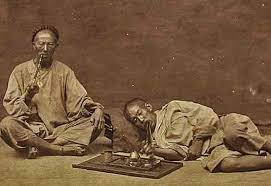
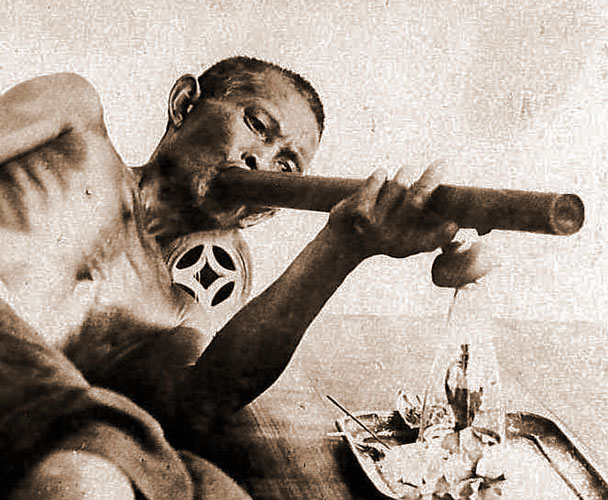
The Dutch had been peddling Indian opium across SE Asia and China where it had been valued as both a medicine and recreational narcotic since the mid 1600s.  The Dutch had invented the long opium pipe which made the smoking experience far more potent and addictive than eating opium which was how Indians preferred to consume the drug. It was the long pipe that proved so deadly to the Chinese population and that caused so much havoc over the next centuries. 

By the mid-18th century with the opium fields of Bihar and Bengal firmly within their control, the East India Company (EIC) took its first steps into the opium trade and was rewarded with instant success.ย  The company quickly established a monopoly on Indian opiumโ€”claiming a right that the Mughal Emperor Akbar had initially established–and watched their main city Calcutta and British power surge beyond imagination as the product was introduced as a new currency in the tea trade.

The importation of opium had been banned by the Chinese Emperor for a hundred years by the time the British entered the racket. And as the EIC had multiple interests in China it arranged for the opium to be sold to licensed third partiesโ€”many of them Parsisโ€”who stored the narcotic in British-controlled warehouses along the SE coast near modern Guangzhou. Corrupt hongs completed the transaction by smuggling the narcotic into the countryside beyond the British zone. As one writer summed up the neat arrangement, โ€œthe British East India Company was thus able to deny responsibility for importing opium and retain its other trading rights with China.โ€ย  But still reap incredible profits from the trade.ย  By the early decades of the 1800s, China was home to millions of addictsโ€”some estimate as many as 10-12 millionโ€”and the once shaky, threadbare English Exchequer was bursting with opium derived revenue. Ten percent of all British tax revenue came from the trade and as for the EIC, with 16% of its entire revenue coming from this single source, the further conquest and development of the Raj in India was secured.

But on the western coast of the subcontinent, Bombay, a lonely, underdeveloped and rather neglected British settlement struggled to justify its existence.ย  While Bombay enjoyed one of the great natural harbours in Asia the political realities of strong regionalโ€”mainly Marathaโ€”Mughal successor states in western and central India meant that the EIC was unable to find a political or economic footing.ย  The EIC chiefs in Calcutta and London had grown weary of Bombayโ€™s drain on Company subsidies. As Gov. General Cornwallisโ€™ (the very same who had surrendered to George Washington a few years prior) complaint to Prime Minister William Pitt shows, were the Company was even ready to abandon Bombay as a city.

 โ€œI have reflected most seriously and have conversed with the most sensible men in this country, on the utility of the civil establishment at Bombay and I am perfectly convinced that the Company derive no benefit from it.โ€

Something had to be done. If Bombay was to survive, a source of revenue had to be secured. And quick. At last, in the late 18th century, Dame Fortune smiled and caused the political winds to blow in such a way that the Company was able to exercise indirect control of large parts of the hinterlands to the north of Bombay, including the central Indian opium producing area of Malwa.ย  Though the Company still held a monopoly on the cultivation and production of opium in the east region of India, in Bombay, unlike in Calcutta, the Company made the decision to not take a direct role in the actual transport and sale of opium to China. This it left to local enterpreneurs, among which a number of Parsis immediately came to prominence, including the first Indian to be knighted, Sir Jamsetji Jejeebhoy.ย 

The Chinese Emperor, alarmed at the havoc opium continued to wreak upon his people, despite repeated bans on its import, began in the 1830s to make moves to crack down on the trade. Traders were forbidden from repatriating their profits to India.ย  Tensions were rising between the Emperor and western nations, that now included American trader/smugglers (including the forebears of a certain Franklin Roosevelt).

In March 1839, the governor of Canton forcibly confiscated and destroyed 1.2 million kgs of Indian opium held in the tradersโ€™ warehouses.ย ย  Jejeebhoy, Readymoney and the other Parsi and Indian traders could do nothing as they watched 500 Chinese laborers work for 23 days straight mixing their precious opium with lime and salt and tossing it into the sea. In all, not one rupee of compensation was paid. Incensed that an Asian despot would dare threaten their smuggling operation so dramatically the British navy immediately launched an attack in what has become known as the First Opium war.ย  The war ended in the defeat of the Chinese three years later. The British received Hong Kong as part of the settlement,ย  from where the smuggling operations continued for years to come.

The disruptions of the Opium Wars caused many Parsi families to diversify their interests. Given their background as producers of fine textiles many Parsi opium lords switched to cotton production thereby establishing the mills of Bombay as major world players.ย  In the 1860s, when Civil War in the United States temporarily interrupted the global supply of cotton, the Parsi Sethias happily filled the gap and reaped yet another windfall.ย  By this time the Parsis were the wealthiest and most influential group in Bombay. They used their fortunes made in China and cotton to go into banking and insurance and played a critical role in establishing Bombay as Indiaโ€™s financial capital. The Sethias (a professional name often used for powerful businessmen) in fact, laid many other foundations of modern Bombay: its culture of philanthropy, its museums, educational and social institutions, its wealth and its world of entertainment.

Jamsetjee Bomanjee Wadia (1756-1821) painted by J. Dorman. The Wadias were for many years one of the most influential and powerful Parsi families in Bombay and played a significant role in the development of the South Asian film industry.

Lollywood: stories of Pakistan’s unlikely film industry

Chapter One: An Invention With No Future

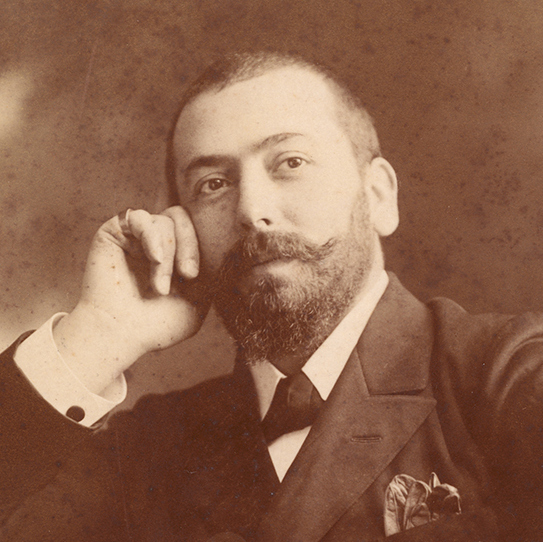
Marius Sestier

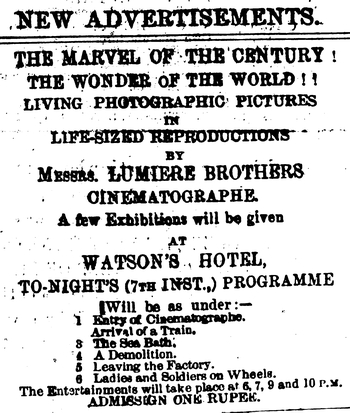
Fifty one years to the day before India won its Independence, on 15th August 1896, the well heeled citizens of Bombay enjoyed a final evening of the most โ€˜marvellousโ€™ spectacle the city had ever experienced.  For several weeks, first at Watsonโ€™s Hotel in Kalaghoda and then at the Novelty Theatre on Grant Road, a Frenchman en route to Australia, had been delighting audiences with the latest hi-tech entertainment.  Called the โ€˜cinematographeโ€™ his contraption, which looked like an ordinary wooden box with a hand crank on one side and a small brass-encased lens on the other, was the closest thing to magic audiences could imagine. As the Frenchman rotated the crank a spool of thin grey film through which light flowed from a second box attached to the top, the most unbelievable photographic images danced against a white screen.  In the darkened hall the rapt viewers wondered if they had not been transported to a new dimension.

The projection of moving pictures was the most exciting development yet in the short life of the revolutionary new science of photography. Two French brothers Auguste and Louis Lumiere had been experimenting with colour photography for a number of years and as a sort of intellectual side-project had attacked the problem of combining animation with projection of light. Just nine months earlier, in December 1895, at Parisโ€™ Grand Cafe, the brothers had stunned audiences with the first commercial showing of a film, which over a span of 49 seconds, depicted a train pulling into a station and passengers jumping on and off. 

The Lumiere brothersโ€™ version of the movie camera-cum-projector was small and light enough to be carried about outdoors. At first, the inventor brothers didnโ€™t know what to make of their apparatus. In fact, they saw it not so much as an idea whose time had come but, as Louis Lumiere said, as โ€˜an invention without a future.โ€™ His brother put it even more emphatically: โ€˜our inventionโ€ฆhas no commercial future whatsoever.โ€™

But in direct contradiction of their conviction, the siblings launched a campaign to take the Cinematographe experience to audiences around the world. To assist them they contracted a fellow Frenchman, a pharmacist by trade, named Marius Sestier to be this new technologyโ€™s evangelist in the furthest end of the world, Australia. So dubious of their inventionโ€™s prospects were the brothers that a year or two later they put together a travelling road show complete with 40 magicians to tour Asia, the Far East and the Fiji Islands.  If the moving pictures didnโ€™t draw the crowds perhaps the wonder workers would be a profitable Plan B.

Sestier, who sported a trim beard and moustache with ends that curled confidently upwards in the style of an upperclass gentleman, set sail, with this wife, from Marseilles on 11 June 1896 with a passage to India.  They docked in Bombay nineteen days later and though it seems Sestier knew little English, he immediately set out making arrangements for the showing of several films. Over a period of four nights people crammed into a small room in Watsons Hotel to watch six short films[1], including the much bally-hooed Arrival of a Train, all produced by the Lumiere brothers.  The local papers proclaimed this new thing, โ€˜The Wonder of the World!โ€™

The impact was tremendous and immediate.  More showings were added (though one was cancelled due to an early case of load shedding) and additional, larger venues were secured. The local press gushed enthusiastically about this amazing Marvel of the Century but found Mr Watsonโ€™s hotel to be somewhat unsuitable. The Bombay Gazetteโ€™s reporter complained that because of โ€œthe smallness of the room, the operator is unable to have the instrument sufficiently removed from the canvas to make the figures life-size, and this has the further disadvantage that it makes the actors in each of the scenes move about rather too quickly.โ€

Sestier responded to the criticism by securing the premises of the Novelty Theatre as a corrective measure.  Built in 1878, the Novelty was one of Bombayโ€™s glittering new theatres along Grant Road, the cityโ€™s answer to Broadway. It boasted a large 90 x 65 ft. stage and accommodated 1400 people. The Lumieres were in business! At Rs. 1 a seat, Sestier grossed close to Rs. 100,000 (close to one million in contemporary terms) over more than 60 sold-out shows, which proved beyond any argument, that inventors should not be relied upon for their business acumen.

By the time Sestier boarded the French steamship Caledonien for Colombo and Sydney on 26th August, he had changed India forever. The movie bug had found a new host. Many Indians had attended the shows at the Novelty Theatre and one in particular, a photographer, Harishchandra Sakharam Bhatwadekar (aka ‘Save Dada’) was so enraptured he immediately placed an order for a Lumiere Cinematographe with the London firm Riley Brothers. The investment set him back a pretty penny but within three years Bhatwadekar had made and shown Indiaโ€™s first documentary film, The Wrestlers, which depicted a match at Bombay’s Hanging Gardens between a couple of popular local wrestlers, Pundalik Dada and Krishna Navi.  Over the next several years Save Dada made a number of other films, all of mundane everyday subjects and reached his cinematic zenith by documenting the grand Delhi Durbar, a celebration of King Edward VIIโ€™s accession to the Imperial throne in 1903.

Save Dada was not alone.  In Calcutta and Madras, other men (yes, they were all men) were just as excited about this stunning new invention.  With a buzz that can only compare to the one we experienced when we received our first email or spent our first hours surfing the web, dreamers and entrepreneurs in every corner of British India sensed the magic of films and moved quickly to grab hold of it.

In Bengal, a rakishly thin lawyer, Hiralal Sen, scion of one of Bengalโ€™s prominent Bhadralok families moved to Calcutta from Dhaka in 1887 to indulge his fascination with photography and cameras.  Some years after his arrival in Calcutta, the legendary studio of Bourne and Shepherd sponsored a photographic competition which Sen, eager, like all budding photographers for some recognition, entered.  When he won a prize, the young lawyer was so encouraged he abandoned the Bar and rather rashly established his own photo business.

Though photography had been around for nearly half a century by this time, it was still so new.  Its possibilities intrigued practitioners who experimented with all manner of materials and processes. Everything had to be tested and tried. In between taking portraits of Calcuttaโ€™s citizenry Sen began experimenting with light by projecting shadowy images against the wall using a lantern and black cloth. But as far as we know, by 1896 Sen had not yet seen a motion picture.

This happy event happened in 1898, two years after Sestierโ€™s shows on the other side of the country. A certain Mr Stevenson, one of those minor characters that wanders across the stage of  history but about whom next to nothing is known, hired a swank venue on Beadon Street, the Star Theatre, where he exhibited a โ€˜Bioscopeโ€™ film that ran on the same bill as a popular stage play, The Flower of Persia.

Charles Urban, an American book and office supplies salesman with a fetish for silk hats, fell in love with movies from the first moment he put his eye to the peephole of a Kinetoscope, the early American film projector invented by Thomas Edison.  Ever the salesman, Urban immediately cottoned to the commercial potential of moving pictures (even if Edison, like the Lumieres, did not) and arranged to be Edisonโ€™s agent for the state of Michigan. By 1896, as Sestier was wowing Bombayโ€™s citizens at the Novelty Theatre, Urban was trying to sell Edisonโ€™s updated projector, the Vitascope from his shop in Detroit. A year later, after asking an engineer friend to come up with a better projector that didnโ€™t โ€˜flickerโ€™ as each frame passed through the light, Urban was marketing his very own Bioscope, a single wooden box more tall and narrow than Lumiereโ€™s but like theirs with a hand crank. His projector had the added advantage of not requiring electricity to operate.  The Bioscope was so successful that an English firm, Warwick Trading Company, invited Urban to move to London and head up the company with his Bioscope as its flagship product.

Charles Urban

Given his familyโ€™s wealth it appears not to have been a big deal for Sen to fork out Rs. 5000 for one of Urbanโ€™s spiffy new inventions.  Upon its arrival in India though the equipment was slightly damaged. And to complicate matters it came with no instruction manual. But Sen was not easily deterred.  He sought out a European friend, a Jesuit priest named Father Lafouis, who assisted Sen in repairing the Bioscope as well as figuring out how the contraption functioned. Within a short time Sen had so mastered the Bioscope that with the financial help of his brother Motilal and two other investors, he established the Royal Bioscope Company in 1899.  Sen quickly became an importer of European films and within a year had shot his own footage. Taking a cue from the mysterious Mr Stevenson, who appears to have moved on to greener pastures, Sen cut a deal with the Classic Theatre, to exhibit his films between acts of a stage play, as a sort of bonus entertainment.  The first Sen film to gather notices was Dancing Scenes from the Flower of Persia, which was a popular stage production at the time.  Encouraged by the publicโ€™s response Sen filmed scenes from other stage productions including Ali Baba, Sitaram and Life of Buddha which were then shown at other city theatres including the Star and Minerva. As in Bombay, the shows stunned the local press. โ€œThis is a thousand times better than the live circuses performed by real persons. Moreover, it is not very costly โ€ฆ Everybody should view this strange phenomenon,โ€ gushed one local daily.

And it wasnโ€™t just the residents of Indiaโ€™s most populous city that got to partake of this strange phenomenon. Royal Bioscope took their films to the countryside, setting up impromptu open-air cinemas in small towns across Bengal and Orissa, starting a practice of travelling movies that continues up to the present.  Hiralal turned out to be an artiste of amazing inquisitiveness and is credited with making Indiaโ€™s first political film (fiery nationalist speeches denouncing the British Raj by Surendranath Bannerjee, a founder of the Indian National Congress) as well the first commercials for a certain Edwards Tonic and Jabaskum Hair Oil.  He continued to film stage shows as well as produce  short films of everyday life for a decade and a half  but sadly his entire ouvre went up in smoke. Literally. In 1917 the Royal Bioscope Company warehouse caught fire and destroyed all his work and some of South Asiaโ€™s earliest and most important films.

Senโ€™s success ignited the imaginations of others and movies began their journey from novelty toward industry.  Back in Bombay, in 1911, Dhundiraj Govind โ€˜Dadasahebโ€™ Phalke, another photographer cum magician cum printmaker was completely smitten after catching a film called Amazing Animals, a sort of early David Attenborough nature film, at the America India Picture Palace.  He returned for more, this time buying a ticket to an Easter time showing of a French film called The Life of Jesus.  โ€˜Why,โ€™ he whispered quietly to his to his sceptical wife as they sat in the dark, โ€˜couldnโ€™t I tell the story of our Hindu gods and deities on film, as well?โ€™

How his wife answered we donโ€™t know. But Phalke who had struggled up this point to find anything that could capture his interest for more than a few years at a time, and whoโ€™s several business partnerships had ended acrimoniously,  spent the better part of a year buying up equipment and  learning as much as he could about film making before  travelling to England in February 1912 to meet with moviemakers and technicians. During this time one of Phalkeโ€™s correspondents was an American magician named Carl Hertz. Hertz had spent time in India tracking down fakirs who could reveal to him the secret of the Indian Rope Trick and meeting with the painter Raja Ravi Varma. Given subsequent events, in which he tours the South Pacific as part of the Lumiere brothers troupe of  40 magicians/ projectionists it seems likely that he may have met Sestier himself at one his Bombay movie exhibitions.

Dadasabeb Phalke

In any case, both men, Phalke and Hertz, were in Bombay around the same time and shared a passion for moving pictures and magic.  In the years proceeding his cinematic career, Phalke for a time had billed himself as a magic man named Professor Kelpha, an anagram of his family name. In another intriguing twist Phalke had done business with Raja Ravi Varma through one of his other commercial ventures the Phalke Engraving and Printing Works. So it is possible that Hertz had met Phalke as well.  After leaving India, Hertz integrated moving images into his magic show as a regular feature and went on to achieve a minor notoriety as the first man to show a film on a ship and in South Africa. 

Phalkeโ€™s London sojourn was a lightening trip.ย  He was back on Indian soil three months later, and on 1 April 1912, the very day he landed in Bombay, he registered the Phalke Films Company, and began putting together this first film, Raja Harischandra, based upon a legendary ruler of ancient India described in the epic Mahabharata and other literary works.

Released in 1913, Raja Harishchandra holds the official title as Indiaโ€™s first feature film. But in fact, a year earlier, in 1912, another enterprising Maharashtrian exhibited a movie titled, Shree Pundalik, at the Coronation Cinematograph at Girgaum. Most film historians reject the idea that it was in fact, โ€˜Dadasahebโ€™ Tornay, the maker of Shree Pundalik, who deserves the accolade as Indiaโ€™s earliest feature film maker, on the rather lame grounds that the camera was operated by a European named Johnson. And that the film was sent to London for processing. Had these criteria been sufficient to disqualify a film from being judged Indian, many films including some of the most loved such as the classic Pakeezah (1972) which was shot by German Josef Wirsching would also need to be removed from the canon.

But whereas Tornay failed–Shree Pundalik was a commercial flop–Phalke went on to make more than a hundred silent films many of which included his wizardry with special effects like the Hindu god Hanuman flying through the sky.  After a falling out with his business partners Phalke, who rightly, is credited as the father of Indo-Pakistani cinema, retired to the banks of the Ganges in Varanasi, a somewhat disillusioned and lonely man. For years he resisted making more films but eventually agreed to accept an offer from the maharaja of Kholapur to produce one final film, a talkie called Gangavatran. Like many others Phalke struggled to cope with the transition from silent to sound films and was unable to repeat his early silent film success.  He passed away in 1944 a forlorn and rather forgotten figure.

In the southern city of Madras, a dealer of imported American cars, Nataraja Mudaliar, was a fan of Phalkeโ€™s films, and like Sen, Bhatwadekar and Phalke just had to try his hand at the new craze.  Mudaliar requested an Englishman by the name of Stewart Smith who was in town filming a documentary on Lord Curzon ( Viceroy of India from 1899 to 1905), to give him several lessons on the finer points of using a camera.  With a confidence that only the amateur can muster, Mudaliar, established Indiaโ€™s first film studio, the India Film Company in Puruswalkam. The year was 1917.  Within a year, he had produced a series a well-received historical pictures including South Indiaโ€™s first feature film Keechaka Vatham, an episode from the Mahabharata, exhibited at the Elphinstone Theatre. The film was a smash hit by any standards thrilling audiences and netting Mudaliar Rs. 50,000.  Excited by the money making potential of his film, Mudaliar arranged for it to be shown in cities outside of India with large Tamil populations including Rangoon, Singapore and Colombo. These venues further netted him a handsome Rs. 15,000.  So infectious was this new art form that even the Father of Independent India, Mahatma Gandhiโ€™s family was caught up. His son Devdas Gandhi, then a journalist, was hired by Mudaliar to write the script cards for Keechaka Vatham in Hindi, in order that the film could be shown in the north.


[1] During his stay in Bombay, Sestier screened between 35-40 films, all presumably shot by his sibling sponsors in France. They included such delights as Rejoicing in the Marketplace, Foggy Day in London and Babies Quarrels.

Lollywood: stories of Pakistan’s unlikely film industry

Introduction

The bloody cataclysm of 1947 which resulted in the death and displacement of multiple millions of people, the destruction of an ancient cityโ€™s sense of community, the disruption of a vibrant economy and a fundamental reassessment of a peopleโ€™s and cityโ€™s very meaning and identity seemed to signal, beyond any shadow of doubt, the end of Lahoreโ€™s emerging movie making dream.

Within a month of Roop Kishoreโ€™s escape and the razing of his sparkling new studio the guts were ripped out of the entire industry. The financers and producers, most of whom were at least โ€˜nominalโ€™ Hindusโ€™ like Shorey, many of the editors and writers of the cityโ€™s lively film press, actors, music director, playback singers, directors and countless Sikh and Hindu techniciansโ€”cameramen, editors, sound recordists and visual artistsโ€”fled.  While most probably harboured hopes that โ€˜when things calm downโ€™ they would return–โ€˜maybe a few weeks, at most a month or twoโ€™– and pick up finishing the picture they were working on, all except a small handful never set foot in Lahore again. As it happened, Roop Kishore Shorey was one of the few who did. But weโ€™ll get to that a bit later.

By the end of 1947 the writing was on the wall. The exciting glory days of making films in Lahore was over.  The cityโ€™s movie refugees reconciled themselves to re-establishing themselves in Bombay, which except for the biggest names and most established stars turned out to be a struggle. Eventually some made it and went on to become rich. Even giants. Most found work, maybe even had a hit or three, but within a decade, they quietly faded away like the pages of the film magazines that once published their pictures.

Back in Lahore the remnant of the industry had other priorities: rebuilding their city, burying their dead, feeding and schooling their children. Making films seemed frivolous under the circumstances. And already questions were being raised by the mullahs, those who had championed the very idea of Pakistan as a thing, about whether there was a place for such a ridiculous, scandalous and even anti-Islamic thing as movies in the new country.

A number of Muslim actors, directors, producers singers and writers did leave Bombay and Calcutta and move to Lahore. But their number was small, especially in the early days.ย  It is said that Mehboob Khan, one of Indiaโ€™s most revered directors, maker of Mother India, made a quick post Partition foray into Lahore to assess whether he should emigrate. โ€œI need electricity to make films,โ€ he is reported to have snorted upon his return to Bombay.

Yes, Noor Jehan, Indiaโ€™s most famous and beloved singing actress, โ€˜optedโ€™ for Pakistan as did Manto, the incendiary writer, and a few other biggish names but obstacles and hurdles were so many that the idea of putting Lahore back on the film making map seemed the stuff of madmen. Manto drank himself to death, after spending most of his time in court fighting for artistic freedom.

One can empathise with their gloom. The dream had ended not only so abruptly, but too soon.

Films had been a part of Lahoreโ€™s life since at least the 1920s though one source claims that the Aziz Theatre in Shahi Mohalla was converted to a cinema in 1908. The cityโ€™s residents, especially the large number of students who attended Lahoreโ€™s many premier universities and colleges, were instant fans and supporters of the medium. Hollywood movies starring Mary Pickford, Hedy Lamar, Charlie Chaplain, Douglas Fairbanks and especially Rudolph Valentino were hugely popular. Rowdy Punjabi audiences were recognised (and most of the time appreciated) for their unabashed preference for action and romance pictures; by the late 1920s and early 30s the Northwest region of India was the number 1 film market outside of Bombay. The big production centers of Calcutta and Bombay made pictures that would appeal to the Punjabi and Muslim audience churning out Mughal era historicals and recreations of Arabic and Persian folk stories.

In the late 1920s a Bhatti Gate resident, Abdul Rashid Kardar, turned to making his own films. Filmed in open air along the banks of the Ravi river or amidst the cityโ€™s many medieval ruins, the films were well received even if by a tiny local audience. Wealthy businessmen and civic leaders started investing in the new technology. A high court judge invested Rs45,000 in a German Indian co-production called Prem Sanyas (The Light of Asia), a story of the Buddha, that has gone on to be claimed as a classic of world cinema.ย 

When speaking and singing pictures became possible others jumped into the river. โ€˜Studiosโ€™ and production units popped up all over the place in Muslim Town, on McLeod Road, along Multan Road, and especially Laxmi Chowk. Lahoreโ€™s publishing industry sprang into action and began pumping out film magazines in English and Urdu from as early as the 1920s and 30s. Roop Kishore Shorey started making rip offs of American and Bombay action films some of which got fair notices. After a downturn in the mid-1930s by the early 1940s Lahore was fast developing into the B-movie capital of India. A source of talent and story lines (the number of Lahore or Punjab born and or educated actors, directors, producers, singers and writers who made and whose children and grandchildren continue to make Bombay the world leading industry it is, is too numerous to count) Lahore was what the Americans call a farm club. A place where talent was procured tested and then sent up to the big leagues in Calcutta and Bombay.

While the smart movies were made in Calcutta and the big productions came out of Bombay the filmmakers of Lahore in no way suffered from an inferiority complex. They prioritised quantity, action and speed. They prioritised fun. They made money, they drank, they swapped wives, they got divorced, they gambled and raced the horses. They travelled the world looking for money and even produced films for international markets. 

But then the dark clouds of politics rolled in and poofโ€”like the bomb in one of their action movies–the game was up.

Yet, it was in the bloody rubble of Lahore that the seeds of a new industry were born. Not just a minor player, but within a few decades, a booming national film industry. By 1970 Pakistan was the largest film producer in the Islamic world and the 4th largest (by volume) in the world. Without its old stars it produced several generations of superstars, actors, starlets, writers and singers, oh the singers. Not just Noor Jehan, but Mehnaz, Irene, Nahid and the Bengali bomb, Runa Laila.  A lot of them went on to sing for Bollywood and still do (Atif, Adnan Sami, Ali Zafar, Rahat).

That Lahore would be a major world film centre is on the face of it improbable. It was far removed for the colonial power centers and indeed, is the only major south Asian movie city not based in a colonial city, that has survived and thrived. How weird is that? Especially, in such a hostile environment. In a land where official, political and religious biases have constantly been more of a threat than the erstwhile films of India which are forever being outlawed.

To understand this amazing, improbable story we have to start not with Roop Kishore Shorey staring into the ashes of his modern studio but go back in time to the very beginning.

Lollywood: stories of Pakistan’s unlikely film industry

Scenes from never-made Pakistani films [Number 1]

Film: Tabahi (Annihilation)

Released: June & July 1947

Starring: al Nasir, Vinod & Roop Kishore Shorey

A man stands by the side of the road staring into the smouldering skeleton of a large double storied building. He covers his nose with a blue silk handkerchief to keep the noxious, semi-sweet smell of burning nitrate at bay.  The lenses of his round rimmed glasses reflect the flames that leap from room to room.

The camera pans back for a super wide shot and reveals behind him the apocalypse that everyone had been praying would never come playing out.  The citizens of Lahore are moving hurriedly and fearfully towards the railway station. For once no one argues with the tonga walas who are demanding Rs100 to make the short journey. Bloated groups of people–women and children in the middle; wild-eyed men armed with swords, pistols, axes and lathis on the perimeters–move deliberately towards neighbourhoods where their co-religionists might give them safety. Hindus to Nisbet and Chamberlain Roads. Muslims to Mozang and Icchra. Sikhs want to make Amritsar or Delhi.

To the north, old Lahore is an inferno. The once rich markets and havelis of Shahalmi, one of Lahoreโ€™s mighty 13 gates is no more. Gangsters and politicians had banded together two days previous to raze the historic mohalla to the ground, killing hundreds of mostly Hindus.  War chants echo in waves as lorries race by loaded with enraged men. โ€œKhoon se lenge Pakistan!โ€  โ€œHar Har Mahadev.โ€   For weeks the citizens of Punjabโ€™s greatest city have heard that goondas from Amritsar have snuck into town to mock and shame their Muslim brothers to cleanse the city of all kafir.  In response the Sikh leaders have mobilised their small armies of jathas in an all out war of revenge.  Everyone knows that even the Lahore Relief Committee set up by some prominent Hindus is just a front for RSS militants more concerned with smuggling weapons to their frightened people than offering relief any sort of relief.

The days are unbearable. The early summer heat has maded the tar on the roads gooey. With the fires and explosions all across the city the temperature has never risen so high. Perhaps when the rains come all this madness with come to an end?

The staring man goes by the name of Roop Kishore Shorey. He turns away and falls into the backseat of an American sedan that has been idling for him. Inside an anxious driver guns the car down the road and yells out โ€œWhere to sahib? Lahore is no longer safe.โ€

Shorey doesnโ€™t answer. Next to him fidgeting anxiously sits his friend, the music director Vinod, who just a few months earlier had completed his first score for the movie Khamosh Nigahein at the now destroyed Shorey Studio.  Vinod shouts for the driver to turn the car, which was headed north toward the city and railway station, to the south.  โ€˜Go to Walton Air field.โ€™

At the airport the pair find Al Nasir, the debonair hero and recently licensed pilot, readying his tiny single prop plane for takeoff.  โ€œYou know, I only have room for one of you,โ€ Al Nasir says merrily, seemingly oblivious to the carnage in the city.

โ€œTake him.โ€ Vinod pushes a nearly catatonic Shorey forward. โ€œIโ€™ve got a family to worry about.โ€

 โ€œThirty-four and still a bachelor! Who can believe it,โ€ laughs Al Nasir. Sex and women were essential parts of the actorโ€™s life. Heโ€™d just divorced the beautiful Meena and was now hot in pursuit of a number of other starlets in Lahore and Bombay.

Shorey embraces Vinod seemingly unwilling to let him go, but the music director untangles himself. โ€œIโ€™ll follow you soon. Iโ€™ll find you, donโ€™t worry. My family must think Iโ€™m dead, I have to go.โ€

Vinod runs back to the car which speeds off toward the city.

Al Nasir gets in beside Shorey and notices that the producerโ€™s normally pristine white shirt is grey with dust and ash. Sweat and tears have muddied the lenses of his expensive German spectacles.  He smiles grimly at his friend and without waiting for approval from the tower taxis down the runway.  Lifting off, the plane circles and climbs steadily through the heavy, smoky air.  Shorey stares out of the window. The city of his birth, the city he loved, the city he was so determined would one day be as famous for its movies as Bombay, is now a medieval battleground. Fires, pillars of black smoke and crumbled buildings everywhere.  Around the railway station a mini city has grown up. He can hear gun shots, There are army trucks at every chowk.

โ€˜Weโ€™ll be back,โ€™ Al Nasir, calls out. Heโ€™s still smiling. โ€œNehru and Jinnah and Gandhi will sort it out. This is Lahore after all. Let them call it Pakistan. Itโ€™s still India. In a few weeks everyone will get tired of blood and bombs and the public will want to see our movies and have fun again.โ€ 

The plane climbs higher and disappears into a dark grey cloud.