Thank you to everyone who is following this blog and especially thank you to those who have donated! So appreciated.
I am current navigating some severe weather in other parts of my life and am not posting much at all. This will pick up soon I hope but thanks for sticking around.
All religions are rife with factions. And in that way, they are a manifestation of the most primitive and base of human instincts. Group think. Tribalism. Belief regardless of a lack of evidence. Even evidence to the contrary.
I was born and nurtured within the ‘Bible is the inerrant Word of God’ tribe. The people who insist that every word, every story, every miracle found within the Christian/Jewish Bible is cent per cent pure and untainted by any contradiction or human failing. The Universe was created in six 24-hour days. Elijah ascended to ‘heaven’ in a burning chariot. The Supreme Lord of Everything addressed Abraham through a burning bush. Wine to water. 2 pieces of bread and 5 sardines fed 5000 people. You get the picture.
I should clarify. My father, our clan leader, actually felt most comfortable in a sub-faction of this larger tribe. I would call it ‘the Bible is the actual reflection of God’s mind but not 100% historically or scientifically accurate’. He argued that science and learning were needed to understand the mysteries of such a revered set of writings as the old and new testaments. He would acknowledge (later in life) that humans did not have the capacity to understand ‘God’ and so, ultimately, whether or not Jesus did turn a cistern of water into Merlot at the wedding party, it was not worth starting a war over. He liked to believe it, but he and others in the sub-faction allowed space for individual interpretation.
I have no personal faith or belief in Jesus, Yahweh, God or any other such divine creature. But I had a good childhood and my 25 years of practicing Christianity has made an indelible imprint on my mind. I cannot and do not want to excise that part of me. I find great comfort in many passages of the Bible (OT and NT). I still love and sing along to the hymns and choruses I learned from countless Bible Clubs, camps and revival services. And throughout my adult years I have enjoyed reading academic and true-believer debates about all manner of Biblical studies and archaeology.
I recently read a book titled Jesus Interrupted. I didn’t finish it because it was a bit too elementary for me. The author, is an ex-believer like myself, but a scholar of the Bible. His audience seems to be those of the ‘Bible is the inerrant Word of God’ tribe who are looking for encouragement to use their minds rather than practice blind faith. I can hear him whispering to them ‘It’s ok. Jump. You won’t be crushed by what you find.’
He spends a lot of time talking about ‘contradictions’ and ‘inconsistencies’ within the 4 Gospels and other books of the New Testament. Of which there are many. And which should be sufficient for any unbiased reader to understand that what they are reading is not History. For those who have come to believe that the God of the Bible is a distinct and discrete being, separate from the Universe, and who’s wont is to stick his hand into the petri dish called Earth and mess things up or direct action in a particular way, the notion that the story of the 3 wise men or the resurrection is not the accurate tale of an actual event, is a hard concept to embrace.
I have published two novels, the first of which is what bookstores label, ‘historical fiction’. It is set in mid-20th century Iraq and as such the narrative refers to and is framed by actual events. And people who are historical figures, the most prominent of which is Saddam Hussain. But there are many others who pop up, mostly in very minor and insignificant roles. The main characters are entirely fictional and most of the happenings that the book describes are real only to the characters. They have no basis in history.
If you used my book to prepare for a trip to Iraq you might get a EXTREMELY HIGH LEVEL glimpse of the turbulent political history of modern Iraq up to about 1985. But I hope no one would ascribe the words I put in the mouth of real historical figures as ‘accurate’ or historical. The point of my book, what got me going, was to explore and try to understand the idea of politically-motivated violence against people who think differently. Torture. What goes on in the mind of the man who willingly and knowingly inflicts physical pain upon those who have been captured and have no way to fight back?
I was not writing and didn’t set out to write a description of the Ba’ath party or Iraqi politics. It was my way of unpacking an issue I was confronted with on a daily basis when I worked with the UN refugee agency.
As I read Jesus, Interrupted it dawned on me that the best way to describe the Gospels and other Biblical stories is as “historical fiction”. They are historic in the sense that they describe a society and historical figures that really did exist. But they are like tent poles or stakes that hold the story up but which are really supportive rather than central to the action. Yes, there was a tough guy named Pontius Pilate. And there were a group of Jews known as Pharisees. Nazareth and Bethlehem can be found on a map. But anything beyond this sort of thing is historically iffy. Even the historic reality of the central hero, Jesus.
The gospels, written decades after Jesus was allegedly crucified, by unknown writers, were composed to tell a specific story to a specific audience. The story was one of spiritual and moral guidance not a biography of the Nazarene.
None of this is fresh insight. It’s as old as the hills. But it does help me understand these essential texts of my life. They are not history. But they are not fiction, either. They are historical fiction.
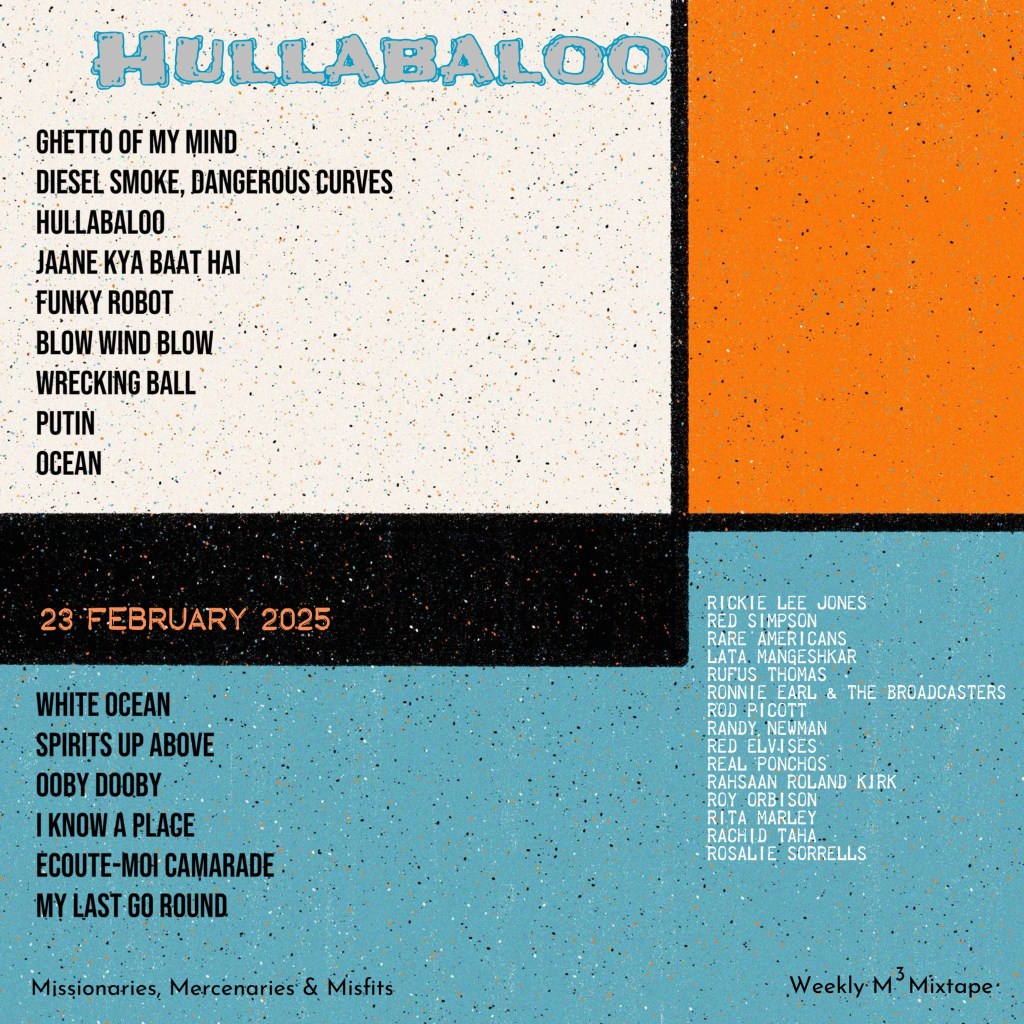
My Man [Eagles] – Gram Parsons was not really an Eagles fan. He famously blew them off as ‘bubblegum’ just before he passed away in 1973. He didn’t think they were country enough, even though they were being heralded as the ultimate country-rock players, a genre most historians agree Gram Parsons almost single-handedly invented. There was always a tug-of-war in the Eagles, country vs. Rock ‘n’ roll. Eventually, the rocker’s won. The two members of the band with the strongest country music credentials, Randy Meisner and Bernie Leadon, departed after Hotel California and One of These Nights respectively. Leadon had come to the Eagles originally after a short stint in the Flying Burrito Brothers, Parsons pioneering band, during which he played on their second album, Burrito Deluxe (1970). My Man was written and sung by Leadon as a tribute to his hero. It was included on their 1974 On the Border album, though it was issued as a single only in the UK.
Malcolm X [The Skatalites] ‘As the nation’s most visible proponent of Black Nationalism, Malcolm X’s challenge to the multiracial, nonviolent approach of Martin Luther King, Jr., helped set the tone for the ideological and tactical conflicts that took place within the black freedom struggle of the 1960s. Given Malcolm X’s abrasive criticism of King and his advocacy of racial separatism, it is not surprising that King rejected the occasional overtures from one of his fiercest critics. However, after Malcolm’s assassination in 1965, King wrote to his widow, Betty Shabazz: “While we did not always see eye to eye on methods to solve the race problem, I always had a deep affection for Malcolm and felt that he had the great ability to put his finger on the existence and root of the problem”.’ Malcolm X was gunned down in February 1965. The Skatalites released this tribute later in the year based upon Sidewinder by jazz trumpeter Lee Morgan released a year previous.
Presidential Rag [Arlo Guthrie] Nice guy Arlo digs the knife into Richard Nixon a few months before he resigned in disgrace. But with lines like, “Nobody elected your family/nobody elected your friends/no one voted your advisers/ and nobody wants the men” this could not be more topical to this current moment.
John Riley [Gráda] An Irish band singing about an Irishman stuck in the San Patricios who fought bravely in the Battle of Churobusco (1847) of the Spanish-American War. “This Mexican unit actually consisted of former American soldiers, mostly Irishmen, who had deserted in the face of anti-Irish sentiments in the old army, and wary of fighting a fellow Catholic nation. The San Patricios had made a name for themselves, fighting from Monterrey, Buena Vista, and Cerro Gordo. Knowing that defeat and capture meant almost certain death for desertion, the San Patricios kept fighting, tearing down the white flag of surrender that other Mexican troops tried to fly. Finally, they were subdued.”
Ode to Olivia [Stella Parton] Dolly’s sister stands up for Olivia Newton-John whose early forays into the American music scene were criticized for not being “real country music”. A debate that will rage till the next meteor wipes us all clean off Earth. “The Country Music Association’s founding premise in 1958 was to keep country music pure; to prevent the infiltration of rock ‘n’ roll. When Olivia won Female Vocalist of the Year in 1974, she raised eyebrows and ruffled feathers. Look at the titleists either side of her winning year: Loretta Lynn, Tammy Wynette, Dolly Parton – Nashville Royalty. Olivia remains the only non-American to win the CMA Female Vocalist of the Year. Heads of Nashville convened and formed the Association of Country Entertainers (ACE) in response, to lobby on behalf of traditional country artists. (It fell in a heap when John Denver won Entertainer of the Year the following year and Charlie Rich infamously burned the envelope with Denver’s name in it).” The song is interesting primarily because Dolly was not an Olivia fan at the time. When Stella sang it for her Dolly begged her not to share with Porter Wagoner, her singing partner at the time, apparently because he would freak out!
Vida Blue [Albert Jones] “Vida Blue burst onto the scene in major-league baseball as a fireballing left-hander for the Oakland A’s and served as one of the primary characters in the A’s streak of five division championships and three World Series championships. His career, which spanned from 1969 to 1986, would see high points, including the multiple World Series championships and outstanding pitching performances, as well as dark days, such as his suspension from the game for drug use and his involvement in one of the most publicized contract holdouts in the history of the game. In many ways, the ups and downs of Blue’s baseball career, both on and off of the field, reflected the times during which he played perhaps more than any other of his contemporaries.” Soulman Albert Jones was a Detroit boy and no doubt loved his hometown Tigers but Blue so captured the American imagination in the early 70s a song such as this is a valuable historical milestone. The song was inspired by Vida Blue’s incredible performance in 1971, when he achieved a 24-8 record with a 1.82 ERA, making him the standout player that year.
Lindy Comes to Town [Al Stewart] From Songfacts.com “Charles Lindbergh (1902-74) was an authentic American hero; he rose to fame after making the first nonstop flight from New York to Paris, but suffered personal tragedy when his baby son was kidnapped and murdered, a story that made worldwide headlines; German immigrant Bruno Hauptmann was tried, convicted and executed for the crime. Before the United States entered the Second World War, Lindbergh fought bitterly for the Isolationists, but after it was dragged in by the sneak attack on Pearl Harbor, he dusted off his pilot’s wings and joined the conflict in the Pacific. Although Stewart has written many quite detailed biographical songs, this upbeat number focuses solely on Lindbergh’s epic 1927 flight in the Spirit of St Louis, a journey that took 33 1/2 hours and earned him the adulation of millions. It is an antidote to Woody Guthrie’s factually inaccurate “Lindbergh.”
Letter to Linda [Tanya Tucker] A love letter to Linda Ronstadt from Tanya Tucker.
Piney Brown Blues [Big Joe Turner] Written about a real/mythical (?) KC bartender and released in 1955. But a blues singer named Columbus Perry assumed the name Piney Brown in the late 40s and so perhaps this song is inspired by him. Maybe Perry was a bartender too? He did spend time in KC trying to get established before moving East.
Ford Econoline [Nancy Griffith] Inspired by the inspiring Rosalie Sorrells, American folk singer of Mormon roots who is way underappreciated. See more about her on the final track of this edition. Of course, the Ford Econoline, “A Workhorse with a Legacy”, has also inspired millions of Americans to haul shit around. When I was 19, we had our eye on one to refurbish and drive down to Mexico. Por supuesto, nunca lo hicimos.
Simply Spalding Gray [Steve Forbert]Spalding Gray was an iconic New York downtown actor and writer. He is most known for the autobiographical monologues that he wrote and performed for the theatre in the 1980s and 1990s. Theatre critics John Willis and Ben Hodges described his monologue work as “trenchant, personal narratives delivered on sparse, unadorned sets with a dry, WASP, quiet mania.” Gray became famous with his monologue Swimming to Cambodia, which was adapted into a film in 1987 by filmmaker Jonathan Demme. Other one-man shows by Gray that were captured on film include Monster in a Box, directed by Nick Broomfield, and Gray’s Anatomy, directed by Steven Soderbergh. Gray died in New York City, New York, of an apparent suicide in 2004.
From Little Things Big Things Grow [Kev Carmody & Paul Kelly] This song has become one of Australia’s informal national anthems. “[P]aying tribute to the Gurindji people, and becoming symbolic of the broader movement for Indigenous equality and land rights in Australia.”
Tennessee Valley Authority [Chatham County Line] The Tennessee Valley Authority act of May 18, 1933, created the Tennessee Valley Authority to oversee the construction of dams to control flooding, improve navigation, and create cheap electric power in the Tennessee Valley basin.
Brigham Young [Rosalie Sorrells] Rosalie Sorrells was one of those American folk artists that insisted on ploughing her own path which was accomplished but largely un(der)recognised. To quote an oft-quoted quote from Elijah Wald, “She traveled around the country while raising five children. She drinks strong men under the table and is the first one up in the morning, bright and cheery and planning one of her famous dinners. And she can make the noisiest barroom crowd shut up and listen when she sings.” See track 12 for Nancy Griffith’s tip of the hat to her. Brigham Young, of course, was the charismatic elder of the Morman Church during its formative pioneering years in Utah. Rosalie was not a Morman but wrote and sang a lot of songs about the community.
If you have come to Missionaries, Mercenaries and Misfits looking for one of my older blogs (Washerman’s Dog, Harmonium Music, C90 Lounge etc.) welcome!
Those blogs are now ‘dead’ in the sense that I will no longer post there. I will be posting what I used to post on those blogs, here from now on. That means you will find music (all regions, all styles, including South Asia)and more here.
Thanks for stopping by and I hope you like what you find here. I’m still populating this site so keep checking in. There should be stuff posted almost every day.
One is Civil War. Here is a piece I thought I had shared one of my other blogs (C90 Lounge) but may have not. Apologies if you’ve read this before.
I saw Civil War yesterday. My companion, an emotionally hard-boiled Aussie of the 80s, was sceptical. He expected a ‘made for TV’ type production and groaned at the poster’s depiction of a gunner’s nest in the flame of the Statue of Liberty.
I’m invested in this, I said.
Years ago, in the era of ‘W’, my brother and I half-seriously agreed that should ever there be a revolution in America, we would return (he was living in Canada, me in Australia) and fight for the good guys. So, I’ve been seeing armed rebellion in the heartland for decades. In the intervening years I’ve worked in Iraq and the former Yugoslavia and Tajikistan. Each of those countries, in their own space and time, were places where citizens believed, ‘it will never happen here’.
Of course, it did happen there. Half a century of state building and brutal imposition of power by an ultimate stable, seemingly intractable family or party structure crumbled faster than anyone could have imagined leaving once proud capital cities and rural hamlets alike pockmarked with the imprints of thousands of shells, collapsed roofs, burned out vehicles and bands of uniformed heavily armed men with trembling trigger fingers in attack or perhaps in retreat.
The picturisation of the road trip from NYC to DC depicted in Civil War gets full marks from me. The mayhem and the menace were completely believable. The Americanisation of the scene, for an initial moment seemed unreal, but quickly the recollection of similar road trips I’ve made through Bosnia and Kosovo, Central Asia and Angola, made me appreciate the truism, local context is everything. This is exactly what civil war and the collapse of a national superstructure looks like. It just so happens that McDonalds dot the landscape instead of mosques.
The film is not edifying. I left scratching my head what it said about the media. Villian or simply the least-worst group in a land full of horrible people? The scene with the red-headed militia man with his red sunglasses was completely real and believable. Appropos to the storyline I left the theatre wondering, ‘who were the good guys?’. Maybe my brother and I would have fighting each other, not side by side. It was depressing.
Much better than I expected, said my hardboiled friend. Neither of us had much to say for a long time.
**
The second film is Shatranj ke khiladi (The Chess Players). It came out in 1977 and is a brilliant picturisation of Indian writer, Munshi Prem Chand’s, beloved short story of the same name.
Set in 1856 it recounts the final days of nawabi 1Lucknow, the most important ‘successor’ kingdom to emerge in the years following the severe collapse of Mughal political authority in north and central India, beginning in the early 18th century.
Satyajit Ray directed the all star cast which includes Sanjeev Kumar, Saeed Jaffrey, Sir Richard Attenborough, Amitabh Bachchan, Shabana Azmi, Amjad Khan, Victor Bannerji and Tom Alter, with whom I share a personal connection and whom I knew as an ‘upperclassman’ at boarding school. Each actor gives a generous and pitch perfect performance.
I love the sound of this film which is told in Urdu. Lucknow was accepted as the center of the Urdu speaking world and Urdu, with a Sanskrit grammar base but Persianised vocabulary, is among the most beautiful languages ever devised by us humans. The atmosphere (mise-en-scène?) of the film is authentic to my imagined 19th century nawabi Hindustan, 2 and captures the dust-layered pale clay and brushy landscape of that part of India perfectly.
The story is both hilarious and deeply sad. It is a tale of self delusion in a time of political chaos and confusion. A story about the passing of one era and the forceful, violent birth of a new order. A story perfect for this notorious American moment. The copy that is on You Tube is high quality with English sub titles, though significant parts of the story are told in English. Highly recommended!
Nawabi is an Urdu term meaning ‘royal’ but which over time has become shorthand for a particular culture and lifestyle of Muslim (mainly) elites, centered in Lucknow but prevalent across much of the Gangetic plains of north India. Nawabi is a way to signal decadence, hedonism and a self indulgent ruling class of land owners and pleasure seekers.↩︎
Hindustan is often used to refer to India as a whole, but historically and culturally it refers to the area of northern India the is watered by the Yamuna and Ganga (Ganges) rivers, also known as the doab (two waters.) More broadly it refers to the heartland of Muslim India that stretches from Lahore in Pakistan to Dhaka in Bangladesh.↩︎
Under President Trump’s bold leadership, his administration is ushering in a new era of financial transparency in government. I’ve long wondered where my tax dollars are going but haven’t bothered to do the five minutes of research it would take to learn that all that information is already meticulously documented and tracked in numerous publicly available reports and websites.


 Missionaries, Mercenaries and Misfits