Lollywood: stories of Pakistan’s unlikely film industry

Of Tea and Opium
That movies were instantaneously embraced in the new, purpose-built metropolises of British India is no surprise. Bombay, Calcutta and Madras were the throbbing hubs of an expansive world power at the peak of its self-belief. These great new empire cities were magnets for people of all persuasions, creeds, backgrounds and regions. The only requirement to be a success in this brave new world was to be open to new ideas. And quick on your feet. Being coastal cities, the three great colonial cities served as entrepôt to the Jewel in Queen Vic’s crown, guarding and servicing the shipping lanes which were the new global trade routes that connected an expanding Europe with the wealth of Africa and Asia.
And not just Indians, but people from all over the world sought their chances in India’s boom and bust emerging economy. Armenian merchants, American missionaries, German scholars as well as businessmen, administrators and artists of all types and nations including some of America and Europe’s finest jazz men and women, all sensed that Bombay and Calcutta were the place to make their names and fortunes. The cities were linked not only to Paris, London and New York but other colonial metropolises like Shanghai, Johannesburg and Singapore. The cities were part of a new international order tied together by a globalizing modern culture in which film was the shiniest element.
Built on marginal lands—often, malarial swamps—and leased by the British East India Company from local rulers, Madras, Calcutta and Bombay were in conception and culture European cities. They just happened to be located in Asia. Their European quarters and administrative districts were laid out like European cities and they looked outward, to the future for inspiration. What happened in the mofussil (interior, countryside) across the vast plains of India was of interest only to administrators and scholars. In 1857, after a brutally fought war launched from within the East India Company’s own Indian troops, the British crown took direct control of India from the East India Company and ushered in a century of high imperialist rule. To the British administrators in Calcutta and London 1857 marked the end of Indian history. Henceforth, under their enlightened stewardship, India would exemplify the very best of Britain’s civilizing Will. The great Indian past would now be an object of wonder best gawked at in museums. And the great cities of Bombay, Madras and Calcutta were the ultimate symbols of Light’s victory over Darkness.
Though the absolute number of Europeans and non-Indians living in India was was its peak in 1911, it never exceeded between 150,000-200,000 depending on how you identified the various groups. The population of India in 1911 was about 300 million souls. Even though Europeans counted for less than 1% of the population their presence had a massive impact on the culture of the cities. Christian missionaries influenced the way Hindus and Muslims understood and organised themselves. Religious groups like the Arya Samaj and Brahmo Samaj, adopted reformist, educational and progressive social agendas that were in form if not doctrine heavily influenced by similar movements in Europe and North America.
Educational systems and curricula that emphasised Western sciences and philosophy and cultural institutions that pumped new, so called modern ideas and technologies into the daily lives of Indians sprang up. The new trade of journalism was quickly embraced by writers, marking the beginnings of modern India’s lively, vibrant press. The publication of the Urdu novel Umrao Jan Ada in 1899 was the first in what would be a glorious and still current run of South Asian prose writing. After some initial resistance, musicians realised they could reach a much bigger audience by recording their music on phonographs and radio. In a relatively short space of time economically empowered Indians in the major coastal cities became both the consumers of new technologies and creative adapters of tradition.
**
The Parsis, Zoroastrian refugees from Persia, had been settled in Gujarat for centuries by the time the British took possession of a swampy, malarial set of islands from their imperial rivals, the Portuguese. The seven islands were known collectively as Bombay and with the establishment of a British fort, the settlement began to draw migrants from the hinterland. Dorabji Nanabhoy, the first Parsi to make Bombay his home arrived in 1640 but he was joined by a steady stream of thousands of others, mainly weavers and artisans from upcountry Gujarat, who began transforming themselves into one of India’s elite and most influential business groups.
An entrepreneurial community with a sense of adventure, the Parsis had been engaged with Europeans before the British became the dominant Western power in India. Joining Dutch and Portuguese traders operating out of Gujarati ports like Surat and Khambay in the 17th century, they showed themselves to be expert traders and developed a refined taste for European luxury goods. The East India Company’s trade with China began in the early 18th century and immediately a number of Indian traders, including two Parsi brothers, Hirji and Mancherji Readymoney, established themselves in Canton. Of all the groups it was the Parsis who were the most successful. By the early 19th century they dominated the China trade; nearly half of all the Indian trading companies in China were Parsi owned.
The only product that really mattered in the China trade was tea. Initially the British offered English wool and Indian cotton for the little black leaves which had taken Blighty completely by storm from the day it was first introduced in the late 1650s–just about the same time the East India Company was setting itself up in Bombay. Sensationally, tea became the single biggest import into Britain during the late 17th century. Though at first it was the exclusive drink of the aristocracy and royal family by the mid-1700s it was the undisputed national drink, displacing the traditional gin and beer whose declining sales alarmed the King who personally and financially depended on the taxes from these drinks. More than 2000 tea shops sprang up in London alone.
But wool–heavy and hot–did not exactly suit the Chinese climate and was rejected by the Chinese who, upon the Emperor’s orders, demanded silver in exchange for their liquid gold. The Company had no option but to oblige and approached the government for access to the country’s silver stocks. So insatiable were the appetites of both English tea drinkers and the Chinese merchants, that the tea trade came dangerously close to draining the English treasury of its bullion reserves and seriously jeopardising the English economy. Despite the best efforts of Parliament to legislate away the negative impacts of the tea craze—including slapping a 119% tax on tea which only opened the way for smugglers to set up elaborate networks up and down the country’s bounteous coastline– by the early 1700s it was obvious that the East India Company would need to find something far more sexy and attractive than tweed and wool to offer the Chinese hongs (licensed traders).
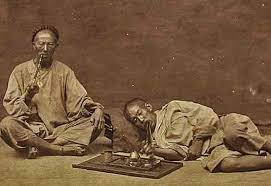
The Dutch had been peddling Indian opium across SE Asia and China where it had been valued as both a medicine and recreational narcotic since the mid 1600s. The Dutch had invented the long opium pipe which made the smoking experience far more potent and addictive than eating opium which was how Indians preferred to consume the drug. It was the long pipe that proved so deadly to the Chinese population and that caused so much havoc over the next centuries.
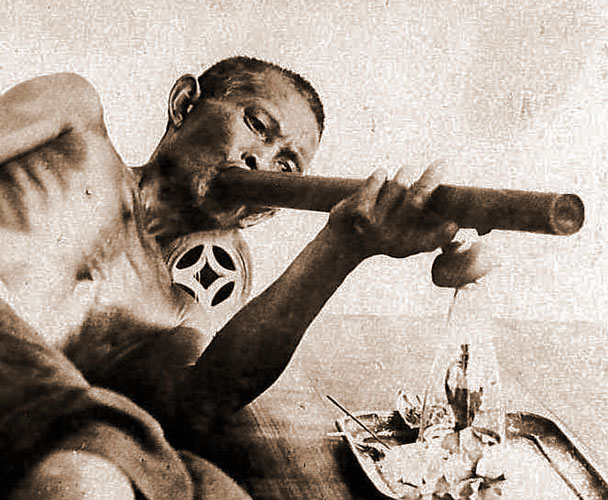
By the mid-18th century with the opium fields of Bihar and Bengal firmly within their control, the East India Company (EIC) took its first steps into the opium trade and was rewarded with instant success. The company quickly established a monopoly on Indian opium—claiming a right that the Mughal Emperor Akbar had initially established–and watched their main city Calcutta and British power surge beyond imagination as the product was introduced as a new currency in the tea trade.
The importation of opium had been banned by the Chinese Emperor for a hundred years by the time the British entered the racket. And as the EIC had multiple interests in China it arranged for the opium to be sold to licensed third parties—many of them Parsis—who stored the narcotic in British-controlled warehouses along the SE coast near modern Guangzhou. Corrupt hongs completed the transaction by smuggling the narcotic into the countryside beyond the British zone. As one writer summed up the neat arrangement, “the British East India Company was thus able to deny responsibility for importing opium and retain its other trading rights with China.” But still reap incredible profits from the trade. By the early decades of the 1800s, China was home to millions of addicts—some estimate as many as 10-12 million—and the once shaky, threadbare English Exchequer was bursting with opium derived revenue. Ten percent of all British tax revenue came from the trade and as for the EIC, with 16% of its entire revenue coming from this single source, the further conquest and development of the Raj in India was secured.
But on the western coast of the subcontinent, Bombay, a lonely, underdeveloped and rather neglected British settlement struggled to justify its existence. While Bombay enjoyed one of the great natural harbours in Asia the political realities of strong regional—mainly Maratha—Mughal successor states in western and central India meant that the EIC was unable to find a political or economic footing. The EIC chiefs in Calcutta and London had grown weary of Bombay’s drain on Company subsidies. As Gov. General Cornwallis’ (the very same who had surrendered to George Washington a few years prior) complaint to Prime Minister William Pitt shows, were the Company was even ready to abandon Bombay as a city.
“I have reflected most seriously and have conversed with the most sensible men in this country, on the utility of the civil establishment at Bombay and I am perfectly convinced that the Company derive no benefit from it.”
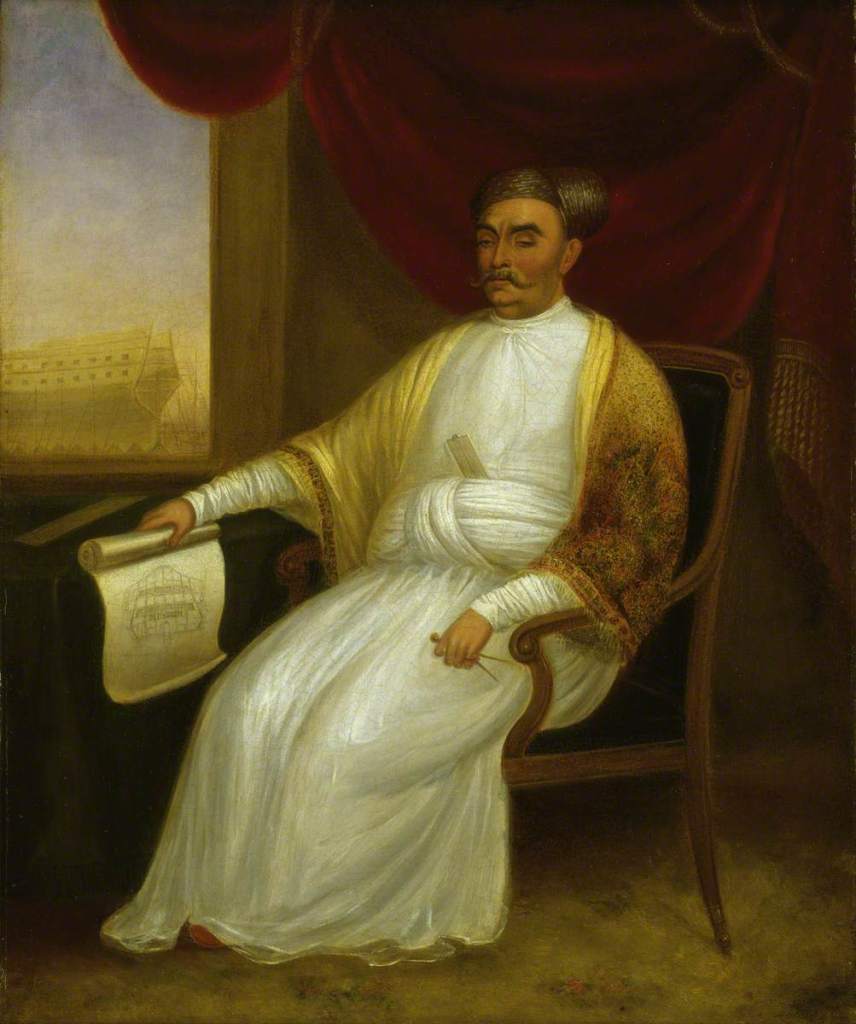
Something had to be done. If Bombay was to survive, a source of revenue had to be secured. And quick. At last, in the late 18th century, Dame Fortune smiled and caused the political winds to blow in such a way that the Company was able to exercise indirect control of large parts of the hinterlands to the north of Bombay, including the central Indian opium producing area of Malwa. Though the Company still held a monopoly on the cultivation and production of opium in the east region of India, in Bombay, unlike in Calcutta, the Company made the decision to not take a direct role in the actual transport and sale of opium to China. This it left to local enterpreneurs, among which a number of Parsis immediately came to prominence, including the first Indian to be knighted, Sir Jamsetji Jejeebhoy.
The Chinese Emperor, alarmed at the havoc opium continued to wreak upon his people, despite repeated bans on its import, began in the 1830s to make moves to crack down on the trade. Traders were forbidden from repatriating their profits to India. Tensions were rising between the Emperor and western nations, that now included American trader/smugglers (including the forebears of a certain Franklin Roosevelt).
In March 1839, the governor of Canton forcibly confiscated and destroyed 1.2 million kgs of Indian opium held in the traders’ warehouses. Jejeebhoy, Readymoney and the other Parsi and Indian traders could do nothing as they watched 500 Chinese laborers work for 23 days straight mixing their precious opium with lime and salt and tossing it into the sea. In all, not one rupee of compensation was paid. Incensed that an Asian despot would dare threaten their smuggling operation so dramatically the British navy immediately launched an attack in what has become known as the First Opium war. The war ended in the defeat of the Chinese three years later. The British received Hong Kong as part of the settlement, from where the smuggling operations continued for years to come.
The disruptions of the Opium Wars caused many Parsi families to diversify their interests. Given their background as producers of fine textiles many Parsi opium lords switched to cotton production thereby establishing the mills of Bombay as major world players. In the 1860s, when Civil War in the United States temporarily interrupted the global supply of cotton, the Parsi Sethias happily filled the gap and reaped yet another windfall. By this time the Parsis were the wealthiest and most influential group in Bombay. They used their fortunes made in China and cotton to go into banking and insurance and played a critical role in establishing Bombay as India’s financial capital. The Sethias (a professional name often used for powerful businessmen) in fact, laid many other foundations of modern Bombay: its culture of philanthropy, its museums, educational and social institutions, its wealth and its world of entertainment.
 Missionaries, Mercenaries and Misfits
Great, if effin’ depressing, work…
as a sidenote–only tangentially related–you probably know McCoy’s epic The Politics of Heroin in Southeast Asia.
Click to access politics-of-heroin-in-south.pdf
Updated (I think): https://archive.org/details/isbn_9781556521256
Audiobook: https://archive.org/details/ThePoliticsOfHeroin
LikeLike
Thanks. Different time different place but same to same as they say. Looking forward to reading it. I was aware of some of this but not the whole picture.
LikeLike